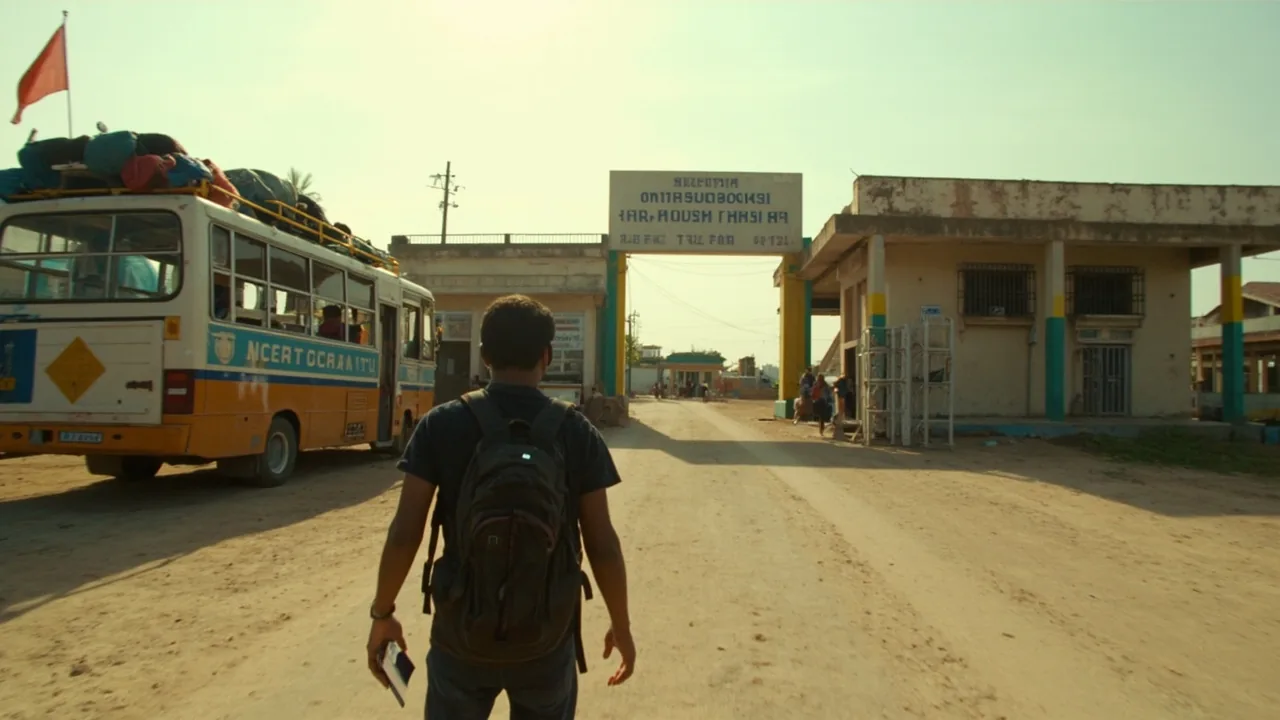
Cambodia to Vietnam by Bus: The Ultimate 2026 Bavet Border Crossing Guide for Indian Backpackers
The Cambodia to Vietnam overland bus Bavet border crossing is the route most Indian backpackers use in 2026: a minibus from Phnom Penh to Bavet, a walk across no-man’s-land, then onward to Ho Chi Minh City via Moc Bai. Here is what the border looks like, with real prices and warnings that matter.
Quick Answers
| What | Answer | Price (INR) |
|---|---|---|
| Average Phnom Penh to Ho Chi Minh City bus (direct via Bavet) | 6 to 8 hours including border | ₹2,119 (~22 USD) to ₹3,372 (~35 USD) |
| Cambodia exit fee at Bavet | ₹481 (~5 USD), paid at the window before immigration | ₹481 (~5 USD) |
| Vietnam e-visa application fee (Indian passport) | ₹2,408 (~25 USD), applied online 3+ days before travel | ₹2,408 (~25 USD) |
| Shared taxi from Phnom Penh to Bavet | Faster than the bus if you have 2 to 3 people | ₹1,445 (~15 USD) to ₹1,927 (~20 USD) per person |
| Siem Reap to Phnom Penh night boat | Slow, scenic, 5 to 6 hours on the Tonle Sap | ₹1,927 (~20 USD) to ₹3,372 (~35 USD) |
The Three Real Options for Getting to Vietnam
There are three ways Indians cross from Cambodia into Vietnam by land in 2026, and the choice you make depends on where you are starting from and how much of a hurry you are in.
Option 1: Phnom Penh to Ho Chi Minh City direct bus. This is the default option. Giant Ibis, Mekong Express, and Virak Buntham all run air-conditioned coaches with a guaranteed seat, a luggage hold underneath, and a driver who handles the border paperwork. You board in Phnom Penh around 7 to 8 AM, you arrive in Ho Chi Minh City around 2 to 3 PM, and you do not need to think hard. The price is ₹2,119 (~22 USD) to ₹3,372 (~35 USD), the seat is comfortable enough for a half-day ride, and your backpack goes underneath. This is the option 80% of Indian backpackers take. Book the bus on 12go.
Option 2: Shared taxi or minivan to Bavet, then walk across, then a Vietnamese taxi on the other side. This is cheaper if you have a small group, slightly faster, and considerably more annoying. Shared taxis from Phnom Penh to Bavet cost ₹1,445 (~15 USD) to ₹1,927 (~20 USD) per person, they leave when they are full (so you might wait an hour), and the drivers will try to overcharge you at the border for “expedited” paperwork services you did not ask for. The trade-off is that on the Vietnam side you have more flexibility: you can grab a Grab bike or car straight to your hostel in District 1 instead of being dropped at a fixed bus station.
Option 3: Siem Reap to Phnom Penh night boat, then bus the next morning. This is the slow, scenic route. The boat runs from Siem Reap down the Tonle Sap river to Phnom Penh overnight, you sleep on a mattress on the deck (bring a sarong, bring a padlock for your bag), and you wake up in the capital. The next morning you catch the direct bus to Ho Chi Minh City. Total time is around 24 hours including the wait, total cost is ₹3,853 (~40 USD) to ₹5,298 (~55 USD), and you get a genuinely different experience of Cambodia. This is the route you take if you have 5 to 7 extra days and want to skip the Phnom Penh-Phnom Penh-Phnom Penh backpacker circuit.
The Border Crossing Itself, Step by Step
This is what happens at Bavet-Moc Bai in 2026, in the order it happens. None of this is complicated, but a few steps are slow and a few steps have specific scams attached to them. If you’re planning more border crossings in the region, our Cambodia border crossings guide covers all land routes.
Step 1: Get dropped at the Cambodian exit side. The bus drops you in a parking lot 200 metres before the actual immigration hall. Expect touts immediately. People with laminated “helper” badges will offer to “process your visa” or “expedite the line” for ₹482 (~5 USD) to ₹963 (~10 USD). Smile, say “no thank you,” and walk into the building yourself. The line moves.
Step 2: Pay the Cambodia exit fee. At a small window just before the immigration counters, there is a (about ₹48 (~$0.50)) exit fee. This is real, this is official, and this is the one fee that is not a scam. You will get a small receipt. Keep it.
Step 3: Cambodian immigration out-stamp. Hand over your passport, your Cambodia visa or e-visa, and the exit receipt. The officer will stamp you out. This takes 5 to 15 minutes depending on the line.
Step 4: Walk across no-man’s-land. It is a paved road, about 800 metres, sometimes with a covered walkway, sometimes not. The Cambodian side hands you off to a few more “helpers,” who will again offer paperwork services you do not need. Ignore them. Walk.
Step 5: Vietnam immigration in-stamp. This is where your Vietnam e-visa matters. You should have applied for it at least 3 days before crossing, on the official portal at https://evisa.xuatnhapcanh.gov.vn. The fee is ₹2,408 (~25 USD), the visa is valid for 90 days, multiple entry, and you will need to present the printed approval letter, your passport, and a 4x6 cm white-background photo taken within the last 6 months. The officer will scan your fingerprints, take your photo, and stamp you in. The line here is usually 20 to 45 minutes.
Step 6: Vietnamese taxi or bus to your final destination. The bus companies have a representative waiting just outside Vietnamese immigration who will herd you onto a minivan to District 1. If you prefer to go your own way, Grab works, and you can pre-book through the app to a specific hostel. Book your onward transport on 12go.
Subodh’s Pro Tip: Print two copies of everything. Your Vietnam e-visa, your Cambodia visa, your onward bus ticket, your hotel booking for the first night in Vietnam. Immigration officers on both sides ask for “the other copy” more often than you would expect, and a missing printout is the #1 reason Indian backpackers get held in a side office for an extra 30 minutes.
Cambodia Exit Tax 2026: What It Is
The Cambodia exit fee at Bavet is about ₹48 (~$0.50). It is the only official exit fee charged on the Cambodian side, and it has been at this rate for several years. There is no longer a separate “border processing” fee charged by any official agency. If someone at the border window tells you the fee is ₹482 (~5 USD) or ₹963 (~10 USD), you are at the wrong window or you are being scammed. Ask to see the printed rate card above the counter.
What has changed recently is the unofficial market around the exit fee. Touts around the parking lot will tell you that “the exit fee went up to ₹963 (~10 USD)” or that “there is a new health inspection fee.” Neither of these is true. The actual fee is on the printed card at the window. Pay that and walk away.
If you entered Cambodia by air and got a visa-on-arrival, that visa is single-entry, so when you cross out at Bavet you are using up that single entry. If you entered on a Cambodia e-visa (which most Indians do, since 2024), your e-visa is also single-entry by default. If you want to come back into Cambodia later on the same trip, apply for a multiple-entry e-visa in advance.
Safety Alert: The biggest scam at Bavet in 2026 is the “Cambodia exit tax is now USD” claim. Travellers report being told that the fee has been replaced by a ₹482 (~5 USD) to ₹963 (~10 USD) fee. The exit tax has not changed. If anyone other than the official window tells you the fee, decline and walk to the window yourself.
Bus Options with Luggage Space for Backpackers
Not all Phnom Penh to Ho Chi Minh City buses are equal. If you have a 60-litre backpack and a daypack, you need a bus that has a real luggage hold and a tag system. The three reliable options for backpackers in 2026:
Giant Ibis is the premium option. The buses are newer, the seats recline further, there is a working USB port at every seat, and the driver does not stop for random “lunch” detours. The downside is the price: ₹2,890 (~30 USD) to ₹3,372 (~35 USD), which is ₹482 (~5 USD) to ₹963 (~10 USD) more than the cheapest options. You get what you pay for. Book the bus on 12go.
Mekong Express is the mid-range option. Comfortable enough, runs on time, ₹2,408 (~25 USD) to ₹2,890 (~30 USD). This is what most Indian backpackers end up on because it is the default that 12go and Bookaway show first. The luggage hold is fine, the air conditioning works, the driver does not try to sell you a SIM card at every stop.
Virak Buntham is the budget option, ₹1,927 (~20 USD) to ₹2,408 (~25 USD). The buses are older, the seats are firmer, and the route sometimes includes a 30-minute stop at a “snack shop” that the company owns. But the bus runs, the driver will not leave your backpack at the border, and the price is the lowest you will find. Fine for budget-conscious backpackers who are not picky.
Subodh’s Pro Tip: Book the bus at least 24 hours in advance on 12go or Bookaway, not through your hostel. Hostel bookings at this border route usually add a ₹482 (~5 USD) to ₹963 (~10 USD) commission, and the bus is the same bus regardless of who sold you the ticket. Walk-ins at the Phnom Penh bus station are also fine, but you lose the morning departures and might end up on the 1 PM bus instead of the 7:30 AM one.
The Siem Reap to Phnom Penh Night Boat
If you are coming from Siem Reap (after Angkor Wat) and want a different experience of Cambodia than another minibus, the night boat is worth knowing about. It runs from a dock in Siem Reap down the Tonle Sap river and into the Mekong at Phnom Penh. Total journey is 5 to 6 hours, you sleep on a mattress on the deck (in a private cabin for ₹963 (~10 USD) to ₹1,927 (~20 USD) extra), and you arrive in Phnom Penh around sunrise. Cost is ₹1,927 (~20 USD) to ₹3,372 (~35 USD) for a deck ticket, ₹3,372 (~35 USD) to ₹4,816 (~50 USD) for a cabin.
This is genuinely the only way to see the Cambodian countryside that does not involve sitting on a bus staring at rice paddies for 6 hours. The boat passes fishing villages, flooded forest, and small stilted houses along the riverbank. The catch is that the boat is slow, the toilets are basic, the mattresses are thin, and you will probably get bitten by mosquitoes unless you have a strong repellent.
Safety Alert: The night boat is not safe for solo female travellers in the same way a bus is. The boat deck is shared, lights are off by 10 PM, and the crew are not security. Travellers report theft from unsecured bags on deck. If you are taking this boat, bring a padlock, sleep with your bag wrapped around your body, and do not bring anything you cannot afford to lose.
The night boat is also dependent on water levels. During the dry season (roughly December to April), the boat sometimes cannot run the full Siem Reap to Phnom Penh route, and you get transferred to a bus for part of the journey. Check the current status at your Siem Reap hostel 24 hours before departure.
The Mekong Speedboat Option
There is a Mekong speedboat from Phnom Penh to Chau Doc (on the Vietnamese side, near the Cambodian border town of Kaam Samnor) that used to be popular with backpackers. In 2026, the speedboat is not running on a regular schedule, the boats are old, the safety record is poor, and the Vietnamese side at Chau Doc does not have a direct land crossing to Ho Chi Minh City anyway. Travellers report that booking a “speedboat to Vietnam” through a Phnom Penh hostel usually ends up being a bus-to-bus-to-bus transfer with a boat ride of 30 minutes somewhere in the middle. Skip it. Take the bus.
Shared Taxi from Phnom Penh to Bavet
The shared taxi is a real option if you have 2 to 3 people and want to save money. Cost is ₹1,445 (~15 USD) to ₹1,927 (~20 USD) per person, journey is 3 hours, and the driver drops you at the Cambodian exit side. You then walk across, do the immigration, and grab a Vietnamese taxi on the other side for the last 2.5 hours to Ho Chi Minh City (a Grab, which is cheaper at ₹1,472-₹2,944 (~400,000-800,000 VND or ~$15.28-$30.56)).
The catch with shared taxis is twofold. First, the drivers often wait until the car is full before leaving, which can mean a 1 to 2 hour wait at your Phnom Penh guesthouse. Second, the drivers usually have a relationship with a “border helper” who will try to process your visa for an extra ₹963 (~10 USD) to ₹1,927 (~20 USD). You do not need this helper. You have an e-visa. Just say “khum ot” (no thank you in Khmer) and walk.
The total cost of a shared taxi plus Vietnamese Grab from Phnom Penh to District 1 is ₹2,408 (~25 USD) to ₹3,372 (~35 USD) per person, which is roughly the same as the direct bus, with more moving parts. The shared taxi only makes sense if you are a group of 3 to 4 splitting a private car (which costs ₹6,743 (~70 USD) to ₹8,670 (~90 USD) for the whole car, much cheaper per person).
Vietnamese Side: What Happens After the Border
You walk out of Moc Bai immigration with your passport stamped, your backpack, and a 70 km journey ahead of you to Ho Chi Minh City. The official bus companies have representatives right outside the gate. They will hand you a sticker with a bus number and tell you to wait. The wait is usually 15 to 30 minutes while the bus fills up.
If you booked a direct bus from Phnom Penh, the same driver and the same bus will be waiting on the Vietnamese side. You do not need to do anything. Just find the bus, show your sticker, sit down.
If you crossed by shared taxi, you have two options on the Vietnamese side. The official “Moc Bai to HCMC” minibuses charge around ₹736 (~200,000 VND or ~$7.64) per person, take 3 to 4 hours, and drop you at a fixed bus station in District 1. Grab cars cost ₹4,416-₹5,520 (~1,200,000-1,500,000 VND or ~$45.84-$57.30) for the whole car, take 2.5 to 3 hours, and drop you at your specific hostel door. If you are 2 or more people, Grab is cheaper per person and faster.
A Grab bike costs ₹1,472-₹2,208 (~400,000-600,000 VND or ~$15.28-$22.92) for the same trip, takes 2 to 2.5 hours, and is genuinely the cheapest option for a solo traveller who does not have a full-size backpack. With a backpack, the bike is not legal in Vietnam anyway, so do not plan on it.
Vietnam e-Visa: What Indians Need
You cannot get a Vietnam visa on arrival in 2026. Indian passport holders must apply for an e-visa in advance through the official portal at https://evisa.xuatnhapcanh.gov.vn. The fee is ₹2,408 (~25 USD), processing is 3 working days (apply a week before to be safe), and the visa is valid for 90 days, multiple entry. You will need:
- A passport valid for 6+ months from your entry date
- A 4x6 cm white-background photo taken within the last 6 months (this is different from the 2x2 inch photo most Indians have from their US/UK visa applications)
- A scanned copy of your passport bio page
- A credit or debit card for the ₹2,408 (~25 USD) fee
The approval letter arrives by email. Print two copies, in colour if possible. The photo you upload is what shows up on the visa, and border officers do check that you look like the photo. Do not use a 5-year-old photo.
For the full e-visa walkthrough and what to do if your application gets rejected, see our Vietnam e-visa for Indian passport holders and Vietnam 90-day e-visa guide.
Safety Alert: The official portal is https://evisa.xuatnhapcanh.gov.vn. There are at least a dozen fake “Vietnam visa” websites that charge ₹4,816 (~50 USD) to ₹7,706 (~80 USD) for the same e-visa you can get for ₹2,408 (~25 USD) on the official site. The URL above is the only one you should use. If a search result or a hostel tells you to use a different URL, it is a paid referral and you are overpaying.
Costs: What the Whole Trip Costs
For a budget backpacker, here is the realistic cost of Phnom Penh to Ho Chi Minh City by bus in 2026. For managing money on the Vietnamese side, read our Vietnam money guide for Indians.
| Item | Cost (single traveller) |
|---|---|
| Direct bus Phnom Penh to Ho Chi Minh City | ₹2,119 (~22 USD) to ₹3,372 (~35 USD) |
| Vietnam e-visa | ₹2,408 (~25 USD) |
| Cambodia exit tax | |
| Vietnamese SIM card (Viettel or Mobifone, 14 days, 6 GB) | ₹478 (~130,000 VND or ~$4.97) |
| Grab from Vietnamese bus station to District 1 hostel | ₹147-₹294 (~40,000-80,000 VND or ~$1.53-$3.06) |
| Water and snacks at the border | ₹289 (~3 USD) to ₹482 (~5 USD) |
| Total (no hostel) | ₹5,780 (~60 USD) to ₹7,706 (~80 USD) |
For a shared taxi + Grab option (cheaper for 2 to 3 people):
| Item | Cost (single traveller) |
|---|---|
| Shared taxi Phnom Penh to Bavet | ₹1,445 (~15 USD) to ₹1,927 (~20 USD) |
| Vietnamese Grab from Moc Bai to District 1 | ₹1,472-₹2,944 (~400,000-800,000 VND or ~$15.28-$30.56) |
| Cambodia exit tax | |
| Vietnam e-visa | ₹2,408 (~25 USD) |
| Total (single, no hostel) | ₹4,335 (~45 USD) to ₹5,780 (~60 USD) |
FAQ
Do I need a Vietnam visa to cross at Bavet? Yes. Indian passport holders cannot get a visa on arrival in Vietnam as of 2026. Apply for an e-visa at https://evisa.xuatnhapcanh.gov.vn at least 3 days before crossing. The fee is ₹2,408 (~25 USD).
Is the Cambodia exit fee ₹48 (~$0.50)? Yes. This is the official fee, charged at the window just before immigration. Anyone telling you the fee is ₹482 (~5 USD) or ₹963 (~10 USD) is scamming you. Ask to see the printed rate card at the window.
Can I walk across the Bavet-Moc Bai border without a bus? Yes, technically. You can take a shared taxi to Bavet, walk across, and grab a Vietnamese taxi on the other side. This is the cheapest option for solo travellers, but you handle the border paperwork yourself. Most backpackers prefer the direct bus because the bus company handles the helpers for you.
Is the Siem Reap to Phnom Penh night boat safe? It is safe enough for cautious travellers. Thefts from unsecured bags on deck are reported regularly. Bring a padlock, sleep with your bag attached to your body, and do not bring anything you cannot afford to lose. The boat is also weather-dependent and sometimes replaced by a bus during the dry season.
What is the fastest option from Phnom Penh to Ho Chi Minh City? A private car for 3 to 4 people, door-to-door, takes about 5 to 6 hours including the border. Cost is ₹6,743 (~70 USD) to ₹8,670 (~90 USD) for the whole car. For a solo traveller, the direct bus is faster than the shared taxi because the bus company handles the border faster.
Do I need a Cambodia visa to cross at Bavet? Yes, you need a valid Cambodia visa to enter Cambodia in the first place. Most Indian backpackers get a Cambodia e-visa online before flying in, which is single-entry. Once you are in Cambodia, the Bavet exit is just a fee and a passport stamp. For Cambodia visa details, see Cambodia visa for Indians.
Can I get a SIM card at the border? Yes, Viettel and Mobifone both have booths on the Vietnamese side. A 14-day tourist SIM with 6 GB of data costs around ₹478 (~130,000 VND or ~$4.97). The line is fast. If you want a more flexible option, consider a Nomad eSIM, which you can activate before you even leave Cambodia.
Subodh’s Take
The Bavet-Moc Bai border is one of the most backpacker-friendly crossings in Southeast Asia in 2026. It is not glamorous, the helpers are persistent, and the buses are not luxury coaches, but the process is honest, the prices are published, and the line moves. The biggest mistake I see Indian backpackers make is booking the cheapest possible bus, then ending up at a bus station in District 1 at 11 PM with no Grab account and no Vietnamese dong. Sort the SIM, the e-visa, and the first-night hostel before you get on the bus in Phnom Penh, and the whole crossing is a half-day of easy travel instead of a stressful 10-hour ordeal.
