Changi Airport Money Guide for Indians: GST Refund on iPhone, Currency Exchange & Duty Free vs Dubai
Cross-checked against the IRAS TRS page on 12 July 2026: GST rate still 8%, minimum spend still SGD 100, eligible-goods list unchanged; Global Blue’s admin fee schedule last updated April 2026. If Singapore changes its GST tourist refund scheme again (and it has been reshaped twice since 2022), that is the date you’ll want to confirm against. For related planning, see our guide on Changi Airport Layover Guide Indian Travelers and the Southeast Asia backpacking hub for the full regional route.
Changi is one of the few airports in Asia where you arrive, spend, and leave without ever thinking about money; the signage, the cards, and the UPI QR codes quietly run everything. That ease is the trap. Convert at the wrong counter, claim the refund through the wrong kiosk, or make the wrong assumption about what’s accepted past immigration, and you’ve burnt a few thousand rupees in a single afternoon. This Changi airport GST refund currency exchange guide for Indian travelers covers the four questions every Indian shopper at Changi asks: where to exchange, what to do with leftover Singapore dollars when you fly home, how to claim GST on that iPhone you just bought at the Apple reseller, and is Changi cheaper than Dubai duty free on perfume?
Quick Answers
| What | Answer | Price (INR) |
|---|---|---|
| Best place to exchange INR to SGD at Changi | The Travelex, ICE, or ChangeFX counters in the public (landside) area, or skip the airport entirely and use an Indian forex card at any ICan or DBS ATM | ₹8-₹12 (~$0.08-$0.12) |
| GST refund rate for tourists | 8% of the purchase price, minus a small administrative fee at the refund counter | ₹0 (refund, not a cost) |
| Minimum spend for GST refund | ₹7,473 (~100 SGD or ~$77.52) at a single retailer, on the same day, same shop | ₹7,500 (~$77.74) |
| Will Indian credit/debit cards work at Changi ATMs | Yes; ATMs inside all four terminals accept Visa, Mastercard, Maestro, and UnionPay. Most also run Cirrus/Maestro debit cards from Indian banks | ₹373-₹523 (~5-7 SGD or ~$3.87-$5.42) may apply) |
| Is perfume cheaper at Changi vs Dubai | On the same SKU (Tom Ford, Chanel, Dior) the gap is around 5-12% in Dubai’s favour; Changi only wins on Singapore-exclusive line-ups | ₹0 (depends on what you buy) |
Where to Exchange Money at Changi (and Why You Probably Shouldn’t)
Changi has more currency exchange counters than almost any other airport: Travelex, ICE, ChangeFX, and a handful of bank counters. They sit in three zones: publicly accessible landside (before immigration), airside after immigration in each terminal, and arrival halls. At current rates (1 SGD = ₹74.6855), the spread they offer on INR is wider than you’d find at a city centre Mustafa or Lucky Plaza by 2-3%.
If you have an Indian forex card (HDFC, Axis, Niyo, Fi), withdraw cash from an ICan or DBS ATM at landside. You pay your bank’s ATM fee in INR, but the FX margin is the mid-market rate or close to it, no counter spread. The single-trip withdrawal fee of around ₹374-₹523 (~5-7 SGD or ~$3.88-$5.43) is usually less than the 2-3% you’d lose at the airport counter if you’re exchanging more than ₹14,946 (~200 SGD or ~$155.03).
Subodh’s Pro Tip: If you’re only here for a 3-day Singapore stopover and you’ll spend mostly on card, you can get by with very little local cash — a forex card covers most of the trip. MRT accepts foreign Visa/Mastercard directly (just tap at the gate), Grab accepts UPI QR codes in 2026, and most hawker stalls and malls now run PayNow QR or NETS. Don’t manufacture a problem by trying to solve it.
The one situation where the Changi counter makes sense: you’ve forgotten to carry any forex card, you need ₹3,736-₹7,473 (~50-100 SGD or ~$38.76-$77.52) in cash to get from Changi to your hotel in a taxi, and every other option is locked. Even then, withdraw from an ICICI/DBS ATM before you queue at Travelex. The Travelex counter is fine for USD/EUR to SGD if you’re transiting from another country; for INR it is the worst deal you’ll find.
What Currencies Does Changi Accept?
The headline rule: Changi is a global airport; major currencies (USD, JPY, INR) are always exchangeable, and every shop accepts Visa, Mastercard, and UnionPay. Most Changi food and retail outlets also accept Alipay, WeChat Pay, and increasingly UPI QR (post-migration to Singapore’s SGQR network). Cash INR, however, is rarely accepted by any retailer at the posted price. The exchange counters will buy your leftover INR notes at the wholesale rate, but only above a minimum (usually ₹1,000 (~$10.36) worth), so don’t bother saving the small change.
Leftover Singapore Dollars: Don’t Convert Them Back to INR
If you’re flying home from Changi with ₹3,736 (~50 SGD or ~$38.76) or ₹7,473 (~100 SGD or ~$77.52) left in your wallet, the airport counter will buy it back. The sell-back spread is even worse than the buy spread; on a typical transaction you’ll lose another 3-4% on top of what you lost originally. Instead, spend it. The airside duty free shops, food halls, and even the lounge accept SGD right up to boarding. If you’re stuck with coins, the machine at Terminal 2 landside will swallow them and donate the value. The answer is: drink it on a Tiger or Kopi before you board.
The GST Refund Process at Changi (Tourist Refund Scheme)
Singapore runs the Tourist Refund Scheme (TRS) for goods bought in Singapore and exported within 8 weeks. Indian tourists qualify. The official operator is Global Blue, though a handful of retailers also run their own eTRS digital refund; the end result is the same (an 8% refund minus admin). For the broader Singapore immigration process for Indians at Changi, the refund validation happens before you clear immigration.
What You Can Claim Refund On
Anything that’s been bought in a participating Singapore retailer, with a single-shop same-day minimum of ₹7,473 (~100 SGD or ~$77.52). Goods must be new, unused, and personally carried out by you (hand-carry or checked-in, but security may want to inspect them). Services (hotel, food, transport), consumables opened or used in Singapore, and digital delivery goods (e.g. App Store credit) are excluded.
The famous use case is the iPhone. Buy one at the Apple Premium Reseller in Marina Bay Sands or at a participating retailer at Changi, and at current Singapore prices (iPhone 16 Pro 256GB ~₹115,756 (~1,549 SGD or ~$1,200.75)), the refund is roughly ₹9,266 (~124 SGD or ~$96.12) minus admin. That’s the headline number that pulls Indian shoppers across the causeway.
How the Refund Mechanically Works
Step 1 (Buy). Make sure the retailer participates in the Tourist Refund Scheme. Most large electronics and luxury shops do; small heartland shops usually don’t. Ask before paying. Get a paper tax-refund invoice from the cashier, or a digital one in your email.
Step 2 (eTRS). Either scan the QR on the invoice to upload into the eTRS Customs mobile app, or hold onto the paper copy. Until you validate this at the airport, no refund is possible.
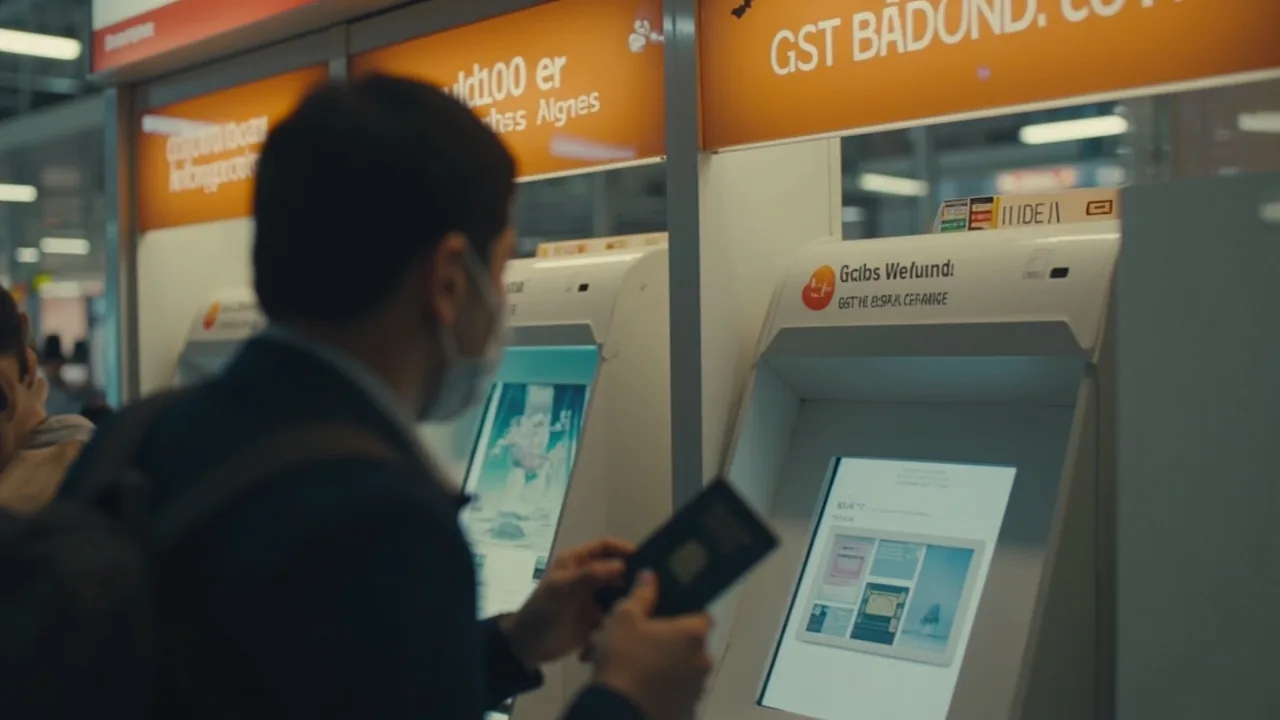
Step 3 (Validate at Changi before flying out). This is the one most Indian travellers miss, and it’s the one that loses the refund. Use the GST Refund Self-Service kiosks in the Departure Check-in Hall (Terminal 1, 2, 3, and 4). Scan your passport, scan the invoice QR, and the kiosk prints a “Validated” stamp and a refund claim. After that, head to the Global Blue / TRS refund counter for cash or card credit.
Subodh’s Pro Tip: Don’t do what the line behind you is doing. Most refund claims get the money credited to the same Visa/Mastercard used in the shop, in 5-15 days, less admin. The “instant cash refund” is available but carries a higher admin fee. If your shop purchase was on a forex card with a 1% FX margin, that’s already less than the cash-refund admin fee; take the card credit, not the cash.
The Land-Border Edge Case (Departing via Tuas or Woodlands)
This is the angle most other GST guides completely miss, and it’s the one Singapore has a separate procedure for. If you bought the goods in Singapore but you’re flying out of KL via a bus across the causeway at Tuas or Woodlands, you cannot validate at Changi. There’s no airport there.
The process for land-border departures: validate at the Tuas or Woodlands checkpoint eTRS counter before boarding the bus. The goods and the original receipt must be physically on you at validation. The refund is then issued either as a credit card refund (in 5-15 days) or, for some corridors, a PayNow transfer to a registered Singapore or Malaysian mobile number. Get the eTRS app loaded, walk to the counter with the goods, and let the Customs officer scan.
What Happens If You Don’t Validate
No validation, no refund. The kiosk prints the claim. If you skip it and only stop at the refund counter, the counter will physically bounce you back to the kiosk. If your flight boards and you’re still in line at the kiosk, the refund dies. The 8 weeks is a hard window: miss it, and the claim is gone.
Changi vs Dubai Duty Free: The Honest Perfume Comparison
The most-asked question: “I’m flying Singapore → Dubai → home, should I buy perfume at Changi or DXB?” The honest answer depends on what you’re buying, but here’s the framework most Indian shoppers miss: Changi has better pricing on liquor and chocolate; Dubai has better pricing on perfume, skincare, and gold; on the SKU overlap (Tom Ford, Dior, Chanel), Dubai is almost always 8-12% cheaper because the UAE imposes no excise on most personal-care and fragrance goods. Singapore’s GST is paid and then refunded, while Dubai’s price already has no VAT; the math tilts toward DXB.
Three specific gotchas for Indians shopping this comparison:
-
Dubai charges no GST, but there’s a 5% municipality duty on certain products (tobacco, alcohol). Perfume falls outside. So you’re comparing 8% refundable in Singapore vs 0% in Dubai, plus the retailer base-price difference. DXB wins by net 5-12%.
-
Changi has Singapore-exclusive line-ups: limited-edition SKUs, regional-only bottlings, and Asia-Pacific packaging runs. If you want Tom Ford Black Orchid in a 30ml Singapore-exclusive case, Changi is the only place. Don’t try to compare to Dubai.
-
Open the box at home, not at the airport. The sealed bag is the boarding pass for your refund claim; if you’ve opened or used a perfume tester, the customs officer will not validate. They have less patience on fragrance than on iPhones.
The real decision factor isn’t the headline discount; it’s the convenience of refund validation at Changi versus no paperwork at all in Dubai. If your Singapore trip includes a 3-night stay and you’re flying home from Changi, buying at Changi and validating before you board saves a Dubai detour. If you’re transiting through Dubai anyway, Dubai wins on both price and zero paperwork.
GST Refund on iPhone and Big Electronics: The Real Number
An iPhone 16 Pro 256GB at a participating TRS electronics retailer in the city (Apple resellers, large electronics chains) — confirm TRS participation at the cashier before paying — currently lists at ₹115,756 (~1,549 SGD or ~$1,200.75). GST is 8%, paid in the price; the refund is 8% of ₹115,756 (~1,549 SGD or ~$1,200.75) = ₹9,266 (~124 SGD or ~$96.12). Minus admin (Global Blue charges a tiered fee), the net refund lands around ₹7,847-₹8,220 (~105-110 SGD or ~$81.39-$85.27). Worth it for that ticket price. Worth less for a ₹11,135 (~149 SGD or ~$115.50) cable.
The trick is: don’t buy the iPhone at Changi airside; the airside shops sell at the same Singapore retail price plus an airside upcharge that often eats the GST refund. Buy at a participating TRS electronics retailer in the city (Apple resellers, large electronics chains) — confirm TRS participation at the cashier before paying, then validate at the Changi TRS kiosk and claim at the Global Blue counter. Travellers who skip this and buy at Changi’s Apple reseller often find themselves 1-2% worse off than buying in Singapore city and validating at Changi.
Safety Alert: Pre-validation before customs scan is the single most common reason Indian iPhone-Shoppers lose their refund. Customs does not validate after immigration has stamped your passport. Get the eTRS mark first, then immigration.
Connectivity and SIM
You’ll want a SIM for Grab, Google Maps, and the eTRS app during validation. Two clean options:
Physical SIM: Singtel and M1 both sell a 7-day tourist SIM with 50GB data for ₹1,121 (~15 SGD or ~$11.63), available at the convenience stores right after customs in every terminal. Active in 5 minutes, passthrough to any Singapore tower.
eSIM: If your phone supports eSIM and you’d rather not swap the physical tray, you can grab an eSIM before you even take off from India. Nomad eSIM and Airalo both run regional Asia packages.
Get Nomad eSIM is the cleanest one-click option; 1GB / 3GB / unlimited packages for Singapore land from ~₹434 (~4.50 USD).
Pick whichever suits your hardware and trip length. The only reason to choose the physical SIM over eSIM is if your Indian phone is eSIM-locked, which is rare on Indian-bought flagships since 2023.
How to Get to the City
From Changi to a Marina Bay or Little India hotel, you have four realistic options:
- MRT (East-West Line): Cheapest by far. Land at Changi MRT station landside, ride to Tanah Merah, then continue on the city line. About 45 minutes to Little India. Single-ride fare is around ₹75-₹187 (~1-2.50 SGD or ~$0.78-$1.94). You can tap your foreign Visa/Mastercard directly at the gate in 2026 (no separate card needed); see the Singapore MRT card for tourists guide for details.
- Public Bus (Service 36 or Service 858): Around ₹67-₹187 (~0.90-2.50 SGD or ~$0.70-$1.94), 60-80 minutes depending on traffic, lands you near most backpacker hubs.
- Grab/Tada/Gojek: Around ₹1,868-₹2,989 (~25-40 SGD or ~$19.38-$31.01) for a sedan to the city, 20-30 minutes, fastest and door-to-door.
- Airport shuttle or fixed-rate taxi: Around ₹1,868-₹3,363 (~25-45 SGD or ~$19.38-$34.88) with an airport surcharge layered on; convenience is the same as a Grab for ~10-15% more.
For Indian travellers landing late and dragging two bags, the Grab wins on time and stress. For the early-morning, light-packing traveller, the MRT is unbeatable on price. If you’re transiting only (no city), use Changi’s free Skytrain between terminals.
Where to Eat at Changi (During a Long Layover)
If you’re doing a 5-10 hour Singapore layover, two quick options for Indian food without leaving the secure side:
Vegetarian Indian spread: For a sit-down meal, the Vegetarian Indian Food Guide for Changi Terminals maps every terminal’s veg Indian options by price; you can usually find a full thali in any terminal 24 hours a day.
Sit-down Indian in the city once you clear immigration: If you’re heading into Singapore to kill time, the is-singapore-safe-for-indian-travelers-scams-safety-tips-emergency-contacts covers the three reliable Boat Quay / Little India Indian restaurants that are open late and don’t gouge on price.
Quick price rules: a vegetarian thali in a Singapore Indian restaurant runs around ₹1,345-₹2,242 (~18-30 SGD or ~$13.95-$23.26); expect ₹1,868-₹3,363 (~25-45 SGD or ~$19.38-$34.88) per person with drinks. Singapore is more expensive than Bangkok by 2-3x on the same dish.
FAQ
Do I need to validate GST refund before or after immigration?
Before. The TRS kiosks are in the public Departure Check-in Hall; once you walk past immigration, you cannot validate, and you lose the refund.
What is the minimum spend for GST refund in Singapore?
₹7,473 (~100 SGD or ~$77.52) at a single participating retailer, same day, same shop. Multiple shops on the same receipt at a department store can qualify together; multiple shops on multiple receipts don’t.
Can I get GST refund on Changi purchases?
Yes, but only on purchases at participating retailers and only if the goods are sealed in tamper-evident bags when you validate. The eTRS mobile app’s QR code gives you exact instructions per terminal. Two important exceptions: no refund on consumables opened before validation, and no refund on services.
How much cash should I keep in SGD for a Singapore trip?
If you have an Indian forex card on a Mastercard/Visa network, you can technically go zero-cash. Practically, ₹7,473-₹14,946 (~100-200 SGD or ~$77.52-$155.03) covers hawker centres, MRT top-ups, and small vendors that don’t take card. Withdraw from an ICICI or DBS ATM landside; skip the airport counters.
Can I buy an iPhone and claim GST refund at Changi?
Yes, but buy from a participating TRS electronics retailer in the city (Apple resellers, large electronics chains) — confirm TRS participation at the cashier before paying, then validate at the TRS kiosk at Changi before immigration and claim at the Global Blue counter. Net refund on an iPhone 16 Pro 256GB is around ₹7,847-₹8,220 (~105-110 SGD or ~$81.39-$85.27) after admin fees.
Will Dubai duty free beat Changi on perfume?
On the same SKU (Tom Ford, Dior, Chanel), DXB beats Changi by 5-12% on the headline price. The only Changi advantage is Singapore-exclusive SKUs and regional packaging. If your SKU is interchangeable, Dubai wins.
Do I need to keep the original receipt for GST refund?
Yes. Paper or digital (eTRS app). Don’t lose it; the refund counter won’t process without a validated invoice linked to your passport.
