Singapore Immigration Process for Indians: Documents, Time, and the Stuff Nobody Tells You
Yes - the immigration process for Singapore for Indian passport holders has two parts: the visa must be approved before you board, and the SG Arrival Card must be submitted within three days of arrival. The visa costs ~₹1,900 (~30 SGD or ~$22 USD) and takes 3 to 5 working days to process.
The visa must come before the flight (Singapore does not do visa-on-arrival for Indian passport holders), and the arrival process at Changi is faster than any other Southeast Asian hub, provided your paperwork is in order. This guide walks you through the whole pipeline: the visa application, the SG Arrival Card, the queues and biometrics, and the customs red-green channel choice that decides whether you walk out in five minutes or spend twenty minutes answering questions.
Let’s start with the single biggest source of confusion.
Quick Answers
| What | Answer | Price (INR) |
|---|---|---|
| Do Indians need a visa for Singapore? | Yes, applied online before flying (no visa-on-arrival) | ~₹1,900 (~30 SGD or ~$22 USD) |
| How long does the eVisa take? | 3 to 5 working days, sometimes faster | Included above |
| SG Arrival Card submission window | Within 3 days before arrival (free, mandatory) | Free |
| Visa fee (government, paid online) | ~₹1,900 (~30 SGD or ~$22 USD) | Included above |
| Express processing (agent-dependent) | Often available; fee set by the visa agent | Agent-dependent |
| Average immigration queue at Changi for Indians | 10 to 15 minutes off-peak, 35 to 50 minutes during Indian-school-holiday rushes | — |
| Common rejection reason | Insufficient funds shown in bank statement | — |
Subodh’s Pro Tip: The government visa fee is ~₹1,900 (~30 SGD or ~$22 USD). Any higher figure charged by agents is a service markup. Apply directly through ICA’s authorised partner if you want to save the markup.
Before You Fly: The Singapore Tourist Visa for Indians
Singapore does not offer visa-on-arrival to Indian passport holders. You must have an approved visa in your passport (eVisa printout) before you board your flight, or the airline will deny you boarding at the check-in counter in Chennai, Mumbai, Bengaluru, Delhi, Hyderabad, Kolkata, or Cochin. This is the single most important difference between Singapore and the rest of Southeast Asia for Indian travellers. For the full application walkthrough, see our Singapore visa application process for Indians.
What the visa is
Singapore issues a single-entry tourist visa valid for 30 days from the date of entry. Indian applicants apply through one of the authorised visa agents (the official list is on the ICA site) or via the official Singapore eVisa partner platform. Processing takes 3 to 5 working days in most cases, though some agents offer express 24-hour turnaround for an extra fee. The government fee is ~₹1,900 (~30 SGD or ~$22 USD), and any higher INR figure charged by agents is a service markup.
Documents ICA and agents ask for
Here is what you will need to upload for the application:
- Scanned passport bio page (must be valid for at least 6 months from your date of entry into Singapore).
- Passport-sized photograph (white background, 35mm × 45mm, taken within the last 3 months).
- Confirmed return air ticket or onward ticket to a third country.
- Hotel booking confirmation for the full duration of your stay, or a host’s invitation letter if staying with friends/family.
- Bank statement showing sufficient funds. A savings account with a healthy closing balance and consistent salary credits works best.
- For employed applicants: latest 3 months’ salary slips and a leave letter or employment letter on company letterhead.
- For self-employed/business owners: GST registration, company bank statement, or business registration proof.
- For students: student ID and a bonafide letter from the institution.
Safety Alert: The most common rejection reason Indian travellers face is “insufficient evidence of funds or ties to India.” If your bank statement shows a low closing balance or your employment letter is vague (“works at XYZ company”), expect a rejection. Build your application around proof that you have a reason to come back to India.
How to apply
You cannot apply directly to ICA. You must go through one of the authorised travel agents or visa service centres listed on the ICA website. Common choices for Indian applicants include VFS Global, Cox & Kings, and a handful of online agents. Pay the visa fee (~30 SGD, payable via the official partner at https://singaporeevisa.sg/c/bananarchy), upload your documents, and wait for the eVisa to land in your email. Print it out, because some airlines and hotel check-ins still ask for a physical copy.
3 Days Before: SG Arrival Card
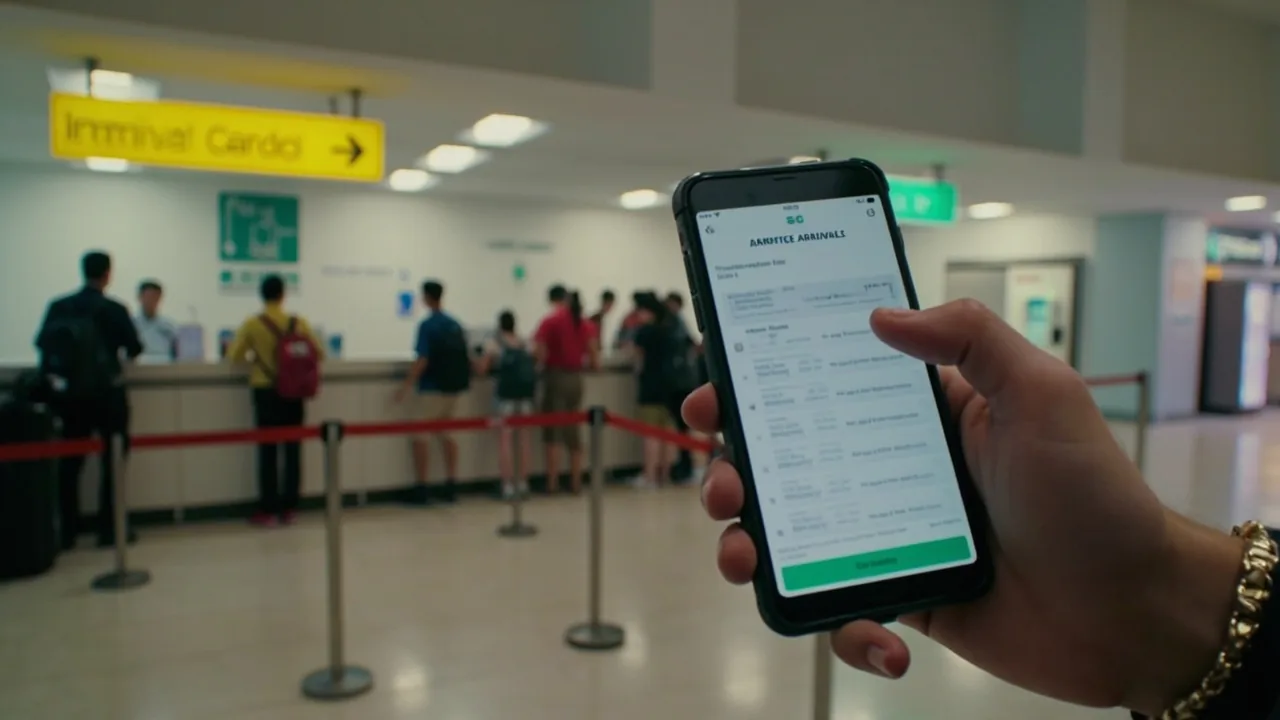
Every traveller entering Singapore, regardless of nationality, must submit the SG Arr arrival Card online within 3 days before arrival. It is free, it takes 5 minutes, and skipping it is the fastest way to get pulled aside at the immigration counter.
You submit it through the official MyICA mobile app or the ICA website. You will need:
- Passport details
- Flight number and arrival date
- Address of your accommodation in Singapore (hotel name and address, or your host’s address)
- A few health declaration questions (post-COVID, these are still asked but are mostly routine)
- Email address (the confirmation goes there)
Save the PDF or screenshot the confirmation email. You will not be asked to show it at the gate, but if the system flags your record, having it on your phone speeds up the secondary check.
At Changi: The Physical Immigration Process
Changi has four terminals, but most flights from India land at Terminal 1 or Terminal 3. Terminal 4 handles a few budget carriers, and Terminal 2 is mostly used for regional ASEAN routes. Terminal 2 is currently undergoing expansion and partial closure, so double-check your terminal before you land. For a full breakdown of which airline uses which terminal, see our Changi terminals guide for Indian-airline check-ins.
Step-by-step, gate to kerb
1. Disembark and follow the “Arrival” signs. Changi’s signage is in English, Malay, Chinese, and Tamil. The walk from the gate to immigration is usually 5 to 10 minutes.
2. SG Arrival Card check. Before you reach the immigration hall, ICA officers at a pre-check kiosk verify your SG Arrival Card submission. If your record is in the system, you get waved through. If not, you are directed to a kiosk to fill it in on the spot. This is where having your flight and hotel details ready on your phone matters.
3. Immigration counters. Indian passport holders join the “All Passports” queue, not the ASEAN or Singapore resident fast-track. Off-peak, the queue is 10 to 15 minutes. During the Indian school holiday rush (April to early June, October to November, and the December 15 to January 5 window), expect 35 to 50 minutes. For more on timing and lounges, check our best Changi lounges for Indian travellers.
4. At the counter, the officer asks for: your passport, your printed eVisa, and sometimes your hotel booking confirmation and return ticket. Have all three ready in your hand, not buried in your cabin bag. Fingerprint scan and a photo are taken at the counter, this is the biometric step. It takes 30 seconds. The officer stamps your passport, says “welcome to Singapore,” and you move on.
5. Baggage claim. Screens above the carousels show which belt your flight is assigned to. Standard baggage claim takes 10 to 20 minutes after immigration.
6. Customs: Red or Green channel. After baggage, you walk past the customs checkpoint. Green channel means “nothing to declare.” Red channel means you have goods to declare (goods exceeding the GST relief threshold of ₹37,365 (~500 SGD or ~$387.59), or restricted items like duty-free alcohol above your allowance). Most Indian tourists go green. Read the full customs rules in our Changi money guide for Indian travellers.
7. Out to the kerb. You emerge into the arrivals hall, where SIM card counters, ATMs, and the MRT (Mass Rapid Transit) entrance to the city are all within a 3-minute walk.
What Gets Indian Travellers Pulled Aside
Based on traveller reports and ICA’s published advisories, these are the most common reasons for secondary inspection:
1. Insufficient funds in the bank statement. This is the visa-stage issue, but it can follow you to arrival if ICA does a spot check. Carry a printed bank statement and a credit card with a healthy limit.
2. No return or onward ticket. If you cannot show that you are leaving Singapore within 30 days, you can be refused entry or asked to buy a ticket on the spot.
3. Mismatch between declared hotel and actual location. If your SG Arrival Card says you are staying at Hotel A and you show up with a booking at Hostel B in Little India, the officer may ask questions. This is rare, but it happens when friends book on behalf of travellers.
4. Overstaying on a previous trip. Singapore shares data with Malaysia and other ASEAN neighbours through the immigration network. If you overstayed in Thailand or Malaysia within the past 12 months, there is a chance ICA flags you.
5. Unusual cash amounts. If you are carrying more than USD 3,000 (equivalent in any currency), you must declare it at the red channel or on the customs form. Not declaring it is a criminal offence, not a fine. For Indian-specific FX rules, see our best forex cards for Singapore trips.
You have cleared immigration. Now what?
SIM card: The arrivals hall at Terminal 1 has Singtel, M1, and StarHub counters. The Singtel tourist SIM (7 days, ~50GB data) costs ~₹1,121 (~15 SGD or ~$11.63). M1 offers a similar package. You will need your passport and your eVisa printout. If you would rather sort this before you fly, get a Nomad eSIM and activate it the moment you land.
Cash: There are ATMs in the arrivals hall that accept Indian debit cards (HDFC, ICICI, SBI all work). Withdraw ~₹7,470-₹14,940 (~100-200 SGD or ~$77.52-$155.03) in cash to cover taxis, hawker centres, and small vendors who do not take cards. Airport FX counters exist but offer poor rates; skip them unless you need cash at 2 a.m.
Getting to the city: The MRT from Terminal 2 or Terminal 3 is the cheapest option, a single ride costs ~₹75-₹187 (~1-2.50 SGD or ~$0.78-$1.94). If you are arriving late (after 11 p.m.), the MRT does not run at full frequency, so a Grab (Southeast Asia’s answer to Uber) is more reliable. Short Grab rides within the city cost ~₹598-₹1,121 (~8-15 SGD or ~$6.20-$11.63). For a full breakdown, see our guide from Singapore airport to the city at night.
Eat something: If you need a real meal and not just an MRT ride, head straight to one of the Indian restaurants in the city. Sahebs on Orchard Road does solid North Indian vegetarian food, Zaffron Tandoori at Boat Quay is great for tandoori with a riverside view, and Black Pepper Multicuisine handles both North and South Indian dishes well. For more on Singapore entry rules and what to expect, see our Singapore entry rules for Indians.
Frequently Asked Questions
1. Do Indian passport holders need a visa for Singapore?
Yes, applied online before flying. There is no visa-on-arrival. The tourist visa costs ~₹1,900 (~30 SGD or ~$22 USD) and is a single-entry visa valid for 30 days from the date of entry. Apply at least 5 working days before your flight through an authorised visa agent listed on the ICA website.
2. How long does the immigration queue at Changi take for Indians?
Off-peak, 10 to 15 minutes. During Indian school holiday rushes (April-May, October-November, December 15 to January 5), expect 35 to 50 minutes. The queue is faster at Terminal 1 than Terminal 3 during peak hours.
3. Is the SG Arrival Card the same as the visa?
No. The SG Arrival Card is a free, mandatory health and travel declaration submitted within 3 days before arrival. The tourist visa is a separate document (~30 SGD / ~$22 USD fee) that you must have before you even board the flight from India.
4. Do I need to carry printed copies of my visa and hotel booking?
Yes. Print both your eVisa and your hotel booking. Some immigration officers at Changi ask for them, and Singapore hotels check your visa status during check-in. Digital copies on your phone are a backup, but a physical printout avoids any friction.
5. Can I use UPI in Singapore?
Limited UPI acceptance via India’s RuPay network exists at some merchants, but it is not reliable. Carry a forex card or a Visa/Mastercard credit card for everyday spending. For Indian-specific FX planning, see our Singapore dollar to Indian rupee rate guide.
6. Is travel insurance mandatory for Singapore immigration?
Not strictly required for visa approval, but Singapore healthcare is expensive. A single A&E visit can cost ₹14,946-₹37,365 (~200-500 SGD or ~$155.03-$387.59). If you have not already arranged cover, Get SafetyWing travel insurance, it covers Indian travellers from ~$62/month (~₹5,900) and includes trip interruption and medical evacuation.
7. What happens if my visa application gets rejected?
You can reapply immediately through the same agent with stronger documents. Common fixes: add a more recent bank statement showing higher closing balance, attach an ITR (Income Tax Return) acknowledgement, or include a more detailed employment letter. There is no official “cooling off” period.
Subodh’s Take: Singapore is the easiest Southeast Asian arrival for Indians, but only if you remember that the visa comes first. Some travellers assume “Singapore is ASEAN, must do visa-on-arrival” and get turned around at the gate. Get the eVisa sorted at least a week before your flight, fill in the SG Arrival Card 48 hours out, and the rest is the smoothest immigration process in the region. For a full overview of entry rules, see our Singapore entry rules guide.
