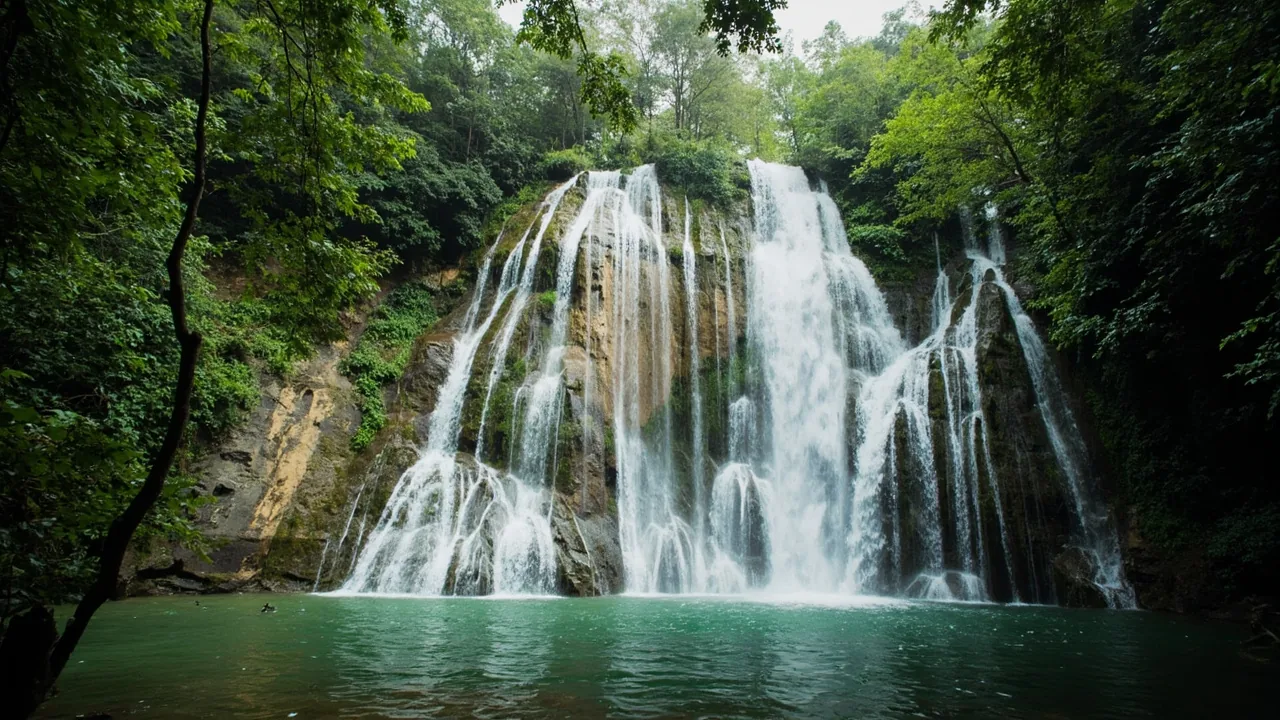
Chiang Mai’s Famous Waterfalls: A Backpacker’s Guide to Thi Lo Su and Nearby Falls (2026)
The biggest waterfall in Chiang Mai (or anywhere in Thailand, for that matter) is Thi Lo Su, a 250-metre cascade inside the Umphang Wildlife Sanctuary, about 350 km southwest of the city. You can do it as a 2-day side trip from Chiang Mai, and the best months to go are November and December, when flow is heavy and the road in is open. Verified against the Thai Department of National Parks’ official park list and current traveller reports from June 2026. Planning the wider region? Our Southeast Asia backpacking hub covers the full multi-country route.
Chiang Mai is landlocked, so if you’re searching for a “waterfall that falls into the sea,” that doesn’t exist here. It does exist in Vietnam, the Philippines, and parts of Indonesia. I’ll cover both questions in this guide: how to plan the Thi Lo Su trip, and where to go in Southeast Asia if you specifically want a falls-into-ocean experience.
What Is Thi Lo Su?
Thi Lo Su (sometimes spelled Te Lo Su or Thi Lo Su Waterfall) is a multi-tiered cascade in Tak Province, on the western edge of Thailand, near the Myanmar border. At around 250 metres of total drop across tiers, it’s the tallest waterfall in Thailand and the single biggest draw for waterfall chasers doing the Chiang Mai circuit. The water spills through dense teak forest inside the Umphang Wildlife Sanctuary, and the upper pool is deep enough to swim in during dry months.
The falls sit in a protected Karen and Hmong homeland. The Umphang area has been a wildlife sanctuary since 1989, and the communities around it run most of the homestays, boat rides, and guiding services. Going with a local Karen guide isn’t optional from a logistics angle (the route involves a long-tail boat transfer across the reservoir) and it’s also the most respectful way to do it.
Quick Answers
| What | Answer | Price (INR) |
|---|---|---|
| Biggest waterfall in Chiang Mai region | Thi Lo Su (250m, Umphang Wildlife Sanctuary) | , |
| Distance from Chiang Mai | ~350 km / 7-8 hours one way | , |
| Best months to visit | November to early February (flow strong, road open) | , |
| Park entry (foreign adult) | ₹574 (~200 THB or ~$5.96) | , |
| Long-tail boat to the falls | ₹1,723-₹2,297 (~600-800 THB or ~$17.87-$23.83) per boat (shared) | , |
| 2D1N tour from Chiang Mai (group) | ₹12,922-₹18,665 (~4,500-6,500 THB or ~$134.04-$193.61) per person | , |
| Karen village homestay + meals | ₹2,297-₹3,446 (~800-1,200 THB or ~$23.83-$35.74) per night | , |
| Nearest ATM | Umphang town, ~30 km from the falls | , |
| Mobile signal at the falls | Patchy, AIS works best | , |
| A “waterfall into the sea” from Chiang Mai? | Not possible, Chiang Mai is landlocked. Try Quy Nhon or Cat Ba in Vietnam. | , |
Exchange rate: Verified 2026-07-17 at 1 THB = ₹2.87. Park entry 200 THB ≈ ₹574.
Step-by-Step: How to Visit Thi Lo Su from Chiang Mai
Step 1: Decide your route (Chiang Mai → Umphang)
You have three real options:
- Minivan from Chiang Mai Arcade Bus Terminal to Umphang town (~8 hours, 450 THB). Two departures a day, leaving around 07:00 and 21:00. The night departure is a sleeper and saves a hotel night, but the road is winding for the last 2 hours and you arrive tired.
- Private songthaew or taxi from Chiang Mai to Umphang (~3,500-5,000 THB for the whole car, 7 hours). Worth it if you’re a group of 3-4.
- Join a 2D1N tour from Chiang Mai (₹12,922-₹18,665 (~4,500-6,500 THB or ~$134.04-$193.61) per person, including transport, guide, boat, park fee, and 1 night homestay). This is what most Indian backpackers end up doing, because Umphang is not a place where you want to wing it on arrival with no Thai and no local contacts.
If you’re booking the bus yourself, search the route on Book on 12go. Tickets open 1-2 weeks in advance. Sleeper minivans fill up in November-December.
Step 2: Sleep one night in Umphang town
Umphang town itself is a sleepy riverside stop with a handful of guesthouses, 7-Eleven, and basic restaurants. Most 2D1N tours sleep here on the way in or out. Travellers report that Tree Tara Resort and Baan Tha Luang Homestay are the two comfortable options without a big price jump. Budget ₹1,723-₹2,584 (~600-900 THB or ~$17.87-$26.81) for a private room with fan.
Subodh’s Pro Tip: Book your Umphang accommodation before you leave Chiang Mai. Umphang has maybe 30 rooms total, and the November-December window is when Thai domestic tourists come up for the falls. Walk-ins during peak flow weekends can leave you sleeping on a guesthouse floor.
Step 3: Get to the falls (long-tail boat from Umphang town)
The falls are inside the sanctuary, which is why you can’t just drive to them. From Umphang town, you drive or songthaew about 25 km to Pha Luang Bridge, then transfer to a long-tail boat that runs you across the reservoir. The boat ride is around 40 minutes and costs ₹1,723-₹2,297 (~600-800 THB or ~$17.87-$23.83) per boat, split between 4-6 passengers. The boat drops you at a Karen village, then it’s a 30-minute easy walk to the lower tier of the falls.
The upper tier requires an additional 2-3 hour round-trip hike with a Karen guide (₹4,307 (~1,500 THB or ~$44.68) for a private guide, ₹1,436-₹2,010 (~500-700 THB or ~$14.89-$20.85) per person in a small group). The upper tier is where the swimming pool sits. Travellers say the lower tier alone is worth the trip; the upper tier is worth it only if you have a full day.
Step 4: Pay the park entry
₹574 (~200 THB or ~$5.96) per foreign adult, payable at the sanctuary checkpoint. The Karen guides collect this on behalf of the Department of National Parks. There is no separate fee for photography. Drones technically require a permit from the Department of National Parks headquarters in Bangkok, and in practice, park staff ask you to land them.
Step 5: Spend the night or return to Umphang
If you’re on a 2D1N tour, the night is usually in a Karen village homestay near the falls. If you’re on a day trip, you boat back to Pha Luang Bridge and either sleep another night in Umphang or get on the night bus back to Chiang Mai.
Common Mistakes Indians Make
Mistake 1: Going in October or March “because the weather looks fine.” October is the tail end of monsoon. The road from Umphang town to Pha Luang Bridge often closes after heavy rain, and the falls themselves turn brown and muddy. March is pre-burn season, flow is weak, and the air is hazy from agricultural burning in Myanmar. The window is roughly late October to early February, with November-December being peak flow.
Mistake 2: Skipping the Karen guide to save money. The upper tier of Thi Lo Su genuinely needs a guide for safety (slippery rocks, sudden water rises) and for park compliance. Travellers who tried to hike up without one in 2024-2025 have been turned back at the village. The ₹1,436-₹2,010 (~500-700 THB or ~$14.89-$20.85) per person is worth it.
Mistake 3: Not carrying enough cash. There is one ATM in Umphang town, and it sometimes runs out of cash on weekends during high season. The sanctuary has no card payment for the park fee, the boat, or the homestay. Withdraw at least ₹8,614-₹14,358 (~3,000-5,000 THB or ~$89.36-$148.93) in Chiang Mai before you leave.
Mistake 4: Booking the bus for the same day you arrive in Chiang Mai. International flights land tired. The 8-hour minivan to Umphang on day one is a bad start. Sleep one night in Chiang Mai, leave on the morning bus, sleep in Umphang, do the falls the next day. Travellers who tried to do it all in one go have missed the boat transfer because the bus arrived too late.
Mistake 5: Wearing floaters or sports sandals to the falls. The trail is rocky, muddy, and crosses shallow streams. Closed-toe sandals with a heel strap (Tevas, Decathlon Quechua MH500) or actual hiking shoes are what the Karen guides wear. Open slippers get destroyed.
Safety Alert: The area around Thi Lo Su is near the Thailand-Myanmar border. Before booking, check the Indian MEA travel advisory (mea.gov.in) and the Royal Thai Government’s current advisory. Border regions in Tak Province have seen periodic tension, and park closures do happen on short notice.
What Most Guides Don’t Tell You
The lower tier is more impressive than the upper tier in peak flow. Most Instagram photos are from the upper tier because of the swimming pool, but the lower tier has a wider, more dramatic sheet of water in November-December. If you only have time for one, do the lower.
Bengal monitor lizards and wild elephants do appear. Travellers report monitor lizards 1-2 metres long on the trail, and a small herd of wild elephants lives in the sanctuary. Stay with your guide, don’t run, don’t feed them, and keep food sealed.
Umphang has a hot spring about 10 km from town (Pha To Hot Spring) that’s worth a stop on the way back. Entry is ₹57 (~20 THB or ~$0.60) and it’s a free, no-frills concrete pool beside a stream. Travellers who’ve been there say it’s a much better post-falls soak than trying to wash off in the falls basin.
If you want to skip Umphang, you can fly to Mae Sot and bus from there. This shaves 3-4 hours off but only makes sense in late November to February. Thai Smile flies Chiang Mai to Mae Sot once daily, and Umphang is 2 hours by minivan from Mae Sot. Outside the dry season, the Mae Sot to Umphang road is rougher than the Chiang Mai to Umphang one.
The falls are NOT in Chiang Mai province. This is a common mistake in English-language blogs. Thi Lo Su is in Tak Province, and Umphang is in Tak Province. You’re leaving Chiang Mai Province to get there.
”Waterfall That Falls Into the Sea”: Real Options Near Thailand
Chiang Mai is 700+ km from the nearest coast, so no waterfall here can fall into the sea. If you specifically want a falls-into-ocean experience, these are the closest real options from the same Southeast Asia route:
Quy Nhon, Vietnam (~2 hours by air from Bangkok or direct flight from Chiang Mai via Hanoi): Quy Nhon has a small chain of coastal waterfalls where freshwater streams drop directly onto beaches. Eo Gio and the falls near Bai Xep are the two most photogenic. Travellers describe the contrast of jungle stream hitting saltwater as the specific thing that makes these worth the detour.
Cat Ba Island, Vietnam: Cat Ba has several inland falls that drain into the bay. Trung Trang Cave area has a small fall that runs into a tidal pool, and Viet Hai village has a few on the hiking routes. Pair with the Halong Bay area.
Luang Prabang, Laos: Not coastal, but Kuang Si Falls is a multi-tier cascade whose lower pools flow into a turquoise river that’s the closest thing to a “falls into water” experience you can get in mainland Southeast Asia without a coast. 3-4 hours by slow boat from the Thai border.
Cambodia: Popokvil Waterfall in Bokor National Park runs off a cliff that faces the Gulf of Thailand. It’s not directly into the sea but the view across to the ocean is the specific draw.
For more on coastal and water-based experiences in the same region, our guides on sea kayaking in El Nido and snorkeling in Koh Tao cover the saltwater side of the same trip.
Other Waterfalls Worth Doing from Chiang Mai
If 2 days and 350 km is too much, these are the closer Chiang Mai waterfalls that are doable as half-day trips:
Mae Sa Waterfall: 25 km from the Old City, in the foot-hills of Doi Suthep. It’s a series of 8 short cascades along a paved walking path. Entry ₹287 (~100 THB or ~$2.98). Travellers say it’s best in September-October when the flow is full. Pair it with a visit to Wat Phra That Doi Suthep, which is on the same road.
Mae Klang Waterfall (Doi Inthanon): About 1.5 hours from the city, at the base of Doi Inthanon, Thailand’s highest mountain. ₹287 (~100 THB or ~$2.98) entry. A wide cascade with a shallow pool, good for a 1-hour stop on the way to the summit.
Wachirathan Waterfall (Doi Inthanon): Higher up Doi Inthanon than Mae Klang. A single, tall drop in a forest setting. Travellers say this one has the best view per minute spent of any Chiang Mai-area fall.
Bua Thong Sticky Waterfalls (Nam Phu Chet Si): 50 km from the city, near Mae On. The travertine rock is so grippy you can walk up the water. Free entry, donations welcome. A favourite for half-day trips out of the city.
Mae Ya Waterfall: 60 km from the city in Chom Thong district. ₹574 (~200 THB or ~$5.96) entry. Travellers describe it as a 30-metre wide curtain drop with a deep pool, less crowded than Mae Sa. It’s on the same road as Doi Inthanon, so a logical second stop.
What to Eat Near the Falls (and Back in Chiang Mai)
Back in Chiang Mai after the trip, refuel with Khao Soi (the Northern Thai coconut curry noodle soup that the city is famous for). Two real spots from the shortlist:
Chiang Mai (the restaurant) on the local Thai side is the spot travellers recommend for the most authentic Khao Soi. The Khao Soi there is around ₹230-₹345 (~80-120 THB or ~$2.38-$3.57) per bowl.
Riverfront Restaurant Chiang Mai for a sit-down riverside meal with the same Northern Thai dishes but more space and a view. Plan ₹718-₹1,149 (~250-400 THB or ~$7.45-$11.91) per person for a full meal.
For Indian food when you’ve had enough noodles:
Chai “N” Thai @ Nimman Indian Restaurant is the highest-rated Indian option in the Nimman area, with both North and South Indian preparations, vegan, and halal options. A full thali runs ₹574-₹861 (~200-300 THB or ~$5.96-$8.94).
Chada Vegetarian Restaurant Chiang Mai is the go-to for pure veg, including Indian-style preparations. Budget ₹287-₹517 (~100-180 THB or ~$2.98-$5.36) per meal.
Coconuts N Cocktails Indian Restaurant near the Night Bazaar, useful if you’re back from a day trip and don’t want to leave the bazaar area.
For practical budgeting, our guide on average spend in Thailand per day covers meal-by-meal costs.
Getting Connected in Umphang
Mobile signal in Umphang town is fine on AIS and TrueMove. At the falls themselves, AIS gets 1-2 bars of 4G near the lower tier and drops to nothing at the upper tier. If you want a more reliable connection for the homestay night, a Nomad eSIM works on AIS’s network and is the most reliable roaming option for the area. Get Nomad eSIM before you leave Chiang Mai so you can install it on the bus.
If you’d rather have a physical SIM, buy an AIS tourist SIM at Chiang Mai Airport (₹859 (~299 THB or ~$8.91) for 8 days, 15 GB) and it’ll work in Umphang.
Safety and Common Scams
The Umphang area is genuinely low-scam compared to Bangkok or Phuket. Two things to be aware of:
Boat pricing at Pha Luang Bridge. Independent travellers sometimes get quoted ₹3,446-₹4,307 (~1,200-1,500 THB or ~$35.74-$44.68) per boat by drivers who intercept them at the bridge. The standard rate is ₹1,723-₹2,297 (~600-800 THB or ~$17.87-$23.83) per boat, which is what the registered operators charge. Book your boat through your Umphang guesthouse the night before, or through a 2D1N tour.
“Guide required” upcharges. The lower tier doesn’t need a guide. The upper tier does. If someone at the lower tier offers to “guide” you for ₹1,436 (~500 THB or ~$14.89), you’re paying for a hike you can already do yourself. For the upper tier, the ₹1,436-₹2,010 (~500-700 THB or ~$14.89-$20.85) per person rate is the fair price.
Border area caution: as noted above, check the official advisories before you go. For general Thailand safety, our tuk-tuk scam guide and solo female travel in Southeast Asia have broader context.
Sample 3-Day Chiang Mai + Thi Lo Su Itinerary
Day 1: Chiang Mai → Umphang 07:00 - Minivan from Chiang Mai Arcade Bus Terminal to Umphang (~8 hours, 450 THB) 15:00 - Check in to a guesthouse in Umphang, walk the riverside 18:00 - Dinner at the local night market, Khao Soi or grilled river fish (₹230-₹431 (~80-150 THB or ~$2.38-$4.47)) Sleep: Umphang guesthouse (₹1,723-₹2,584 (~600-900 THB or ~$17.87-$26.81))
Day 2: Thi Lo Su 08:00 - Songthaew from Umphang to Pha Luang Bridge (₹144 (~50 THB or ~$1.49) per person, shared) 08:45 - Long-tail boat to the Karen village (₹1,723-₹2,297 (~600-800 THB or ~$17.87-$23.83) per boat, split 4-6 ways) 09:30 - Hike to the lower tier, swim, photos 12:00 - Lunch at the Karen village (included in most homestays) 13:30 - Hike to the upper tier with a Karen guide (₹1,436-₹2,010 (~500-700 THB or ~$14.89-$20.85) per person) OR stay at the lower tier 17:00 - Boat back to Pha Luang Bridge, songthaew to Umphang 18:30 - Dinner in Umphang, early sleep Sleep: Karen homestay OR another night in Umphang
Day 3: Umphang → Chiang Mai 07:00 - Optional stop at Pha To Hot Spring on the way back (₹57 (~20 THB or ~$0.60) entry) 08:00 - Minivan back to Chiang Mai from Umphang (8 hours, ₹1,292 (~450 THB or ~$13.40)) 16:00 - Arrive Chiang Mai, rest and dinner Evening: Book a Chiang Mai Old City tuk-tuk tour to see the city at night (₹1,292-₹1,723 (~450-600 THB or ~$13.40-$17.87) per person)
Total cost for 3 days: ~₹21,536-₹28,715 (~7,500-10,000 THB or ~$223.40-$297.86) per person including transport, accommodation, park entry, boat, guide, and meals. That’s about ₹21,500-28,700 at the current rate of 1 THB = ₹2.87. Compare this to a packaged day tour from Chiang Mai at ₹12,922-₹18,665 (~4,500-6,500 THB or ~$134.04-$193.61) per person, which only covers Days 1-2 with one homestay night.
What Most Travel Blogs Get Wrong
A surprising number of “Chiang Mai’s biggest waterfall” articles online describe Mae Ya Waterfall as the biggest. It’s not. Mae Ya is wide and dramatic, but Thi Lo Su is taller. The confusion comes from a 2012-2015 wave of English blog posts that confused “widest” with “biggest” and that mistake has been copied ever since.
The other common error: the boundary. Thi Lo Su is in Tak Province, not Chiang Mai Province. Umphang town is in Tak Province. The reason it shows up in “Chiang Mai waterfall” lists is purely that Chiang Mai is the gateway city and the only real transport hub for backpackers going there.
FAQ
Is Thi Lo Su worth the 16+ hours of round-trip travel? Yes, if you’re already in Chiang Mai for at least 5 days and you’ve done the Old City temples. Travellers describe it as the single best natural attraction in northern Thailand and worth the long bus. If you have only 2-3 days in Chiang Mai, skip it and do Mae Ya or Wachirathan on Doi Inthanon instead.
Can I do Thi Lo Su as a day trip from Chiang Mai? Not practically. The bus is 8 hours one way. A same-day round trip means 16+ hours of driving, 0 hours at the falls. Do not attempt it.
Is the water at the falls clean enough to swim? The lower pool is generally fine in November-December, when flow is highest. The upper pool is the cleaner swimming option. Avoid swimming if you have open cuts, as the sanctuary is in a forest watershed with the usual tropical bacteria.
What is the best month for the heaviest water flow? November, followed closely by December. The falls are fed by the monsoon that ends in October, so the first weeks after the rains are peak flow.
Is there a waterfall that falls directly into the sea in Thailand? Not in the Thailand mainland. The closest “falls into water” experience in Thailand is the Erawan Falls in Kanchanaburi, which cascade into a series of turquoise pools, not the sea. For a true falls-into-sea experience, go to Quy Nhon, Vietnam, where the streams run straight off the cliffs onto the beaches.
Do I need a permit or guide for the upper tier? You need a Karen guide, which is hired at the village. The guide handles the park compliance side and the safety side. Budget ₹1,436-₹2,010 (~500-700 THB or ~$14.89-$20.85) per person.
Can I camp at the falls? Officially no, but the Karen village offers homestay beds in basic wooden huts (₹574-₹861 (~200-300 THB or ~$5.96-$8.94) per person including simple dinner and breakfast). This is the de-facto way to camp near the falls.
Subodh’s Take
Thi Lo Su is one of those places that justifies the long bus, but only if you go in the right month and with the right expectations. November and December, 2D1N with a homestay, lower tier done thoroughly, upper tier as a half-day add-on. If you try to compress it into a 24-hour sprint, you’ll arrive too late, see nothing, and write a one-star review of the falls. Plan the time, and Thi Lo Su is the single biggest reason to extend a Thailand trip past Bangkok and the islands.
For the wider trip planning, our guide on how much money you need for 5 days in Thailand gives the per-day budget math, and our Thailand sleeper train guide covers the alternatives if you don’t want to do the Chiang Mai-to-Umphang minivan.
