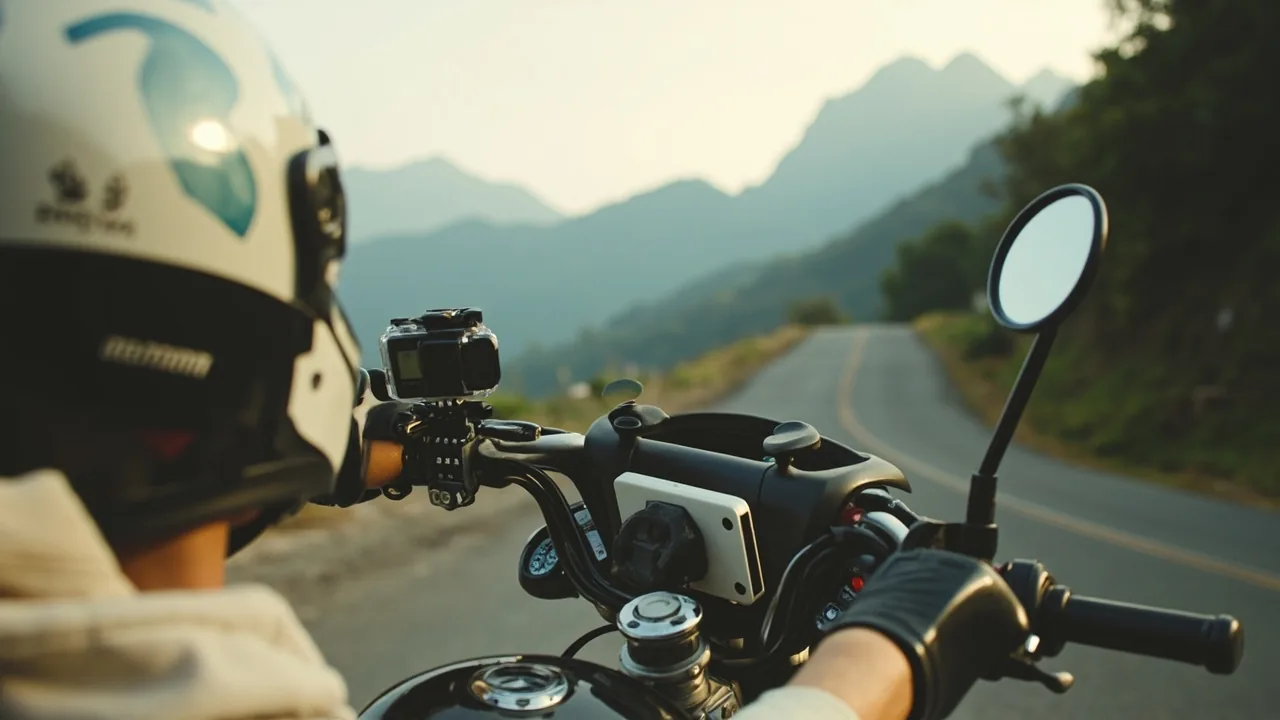
Ha Giang Loop Gear Guide 2026: Helmets, Cameras & Phone Mounts for Indian Riders
The Ha Giang Loop is 350 km of mountain passes with no guardrails on a 110cc-150cc motorbike. Your gear determines whether you remember it as the best ride of your life or the time you got rained on for nine hours with no waterproof bag. This guide covers helmets, cameras, mounts, and clothing with current 2026 prices in INR and VND.
Subodh’s Pro Tip: The loop is 350 km of tight corners, sudden fog, and the occasional truck coming the wrong way. Your gear list should be built around visibility and waterproofing, not Instagram aesthetics. Comfort and waterproofing beat Instagrammability on the loop.
Quick Answers
| What | Answer | Price (INR) |
|---|---|---|
| Is a helmet legally required for tourists in Vietnam? | Yes, mandatory for all riders and passengers on every road, year-round | ₹0 (included with rental) |
| Will rental shops in Ha Giang provide a half-shell or half-face helmet? | Yes, most give you a basic half-shell by default; ask for full-face if you have one | Free with bike |
| Best phone mount for the loop | Quad-lock or RAM X-Grip style with vibration dampener; budget RAM knock-offs work | ₹1,800-₹4,500 (~$18.69-$46.71) |
| Is an action camera (GoPro/Insta360) worth it? | Yes, the Ma Pi Leng Pass and Quan Ba viewpoint are some of the most photographed roads in Vietnam | ₹18,000-₹45,000 (~$186.86-$467.15) |
| How many days do I need for the loop? | 3 days / 2 nights is the standard; 4 days / 3 nights if you want to add Du Gia and the off-road detour | 0 |
Vietnam Helmet Law for Tourists (2026)
Vietnam’s helmet law is enforced, and it applies to foreigners the same way it applies to locals. Since the 2024 amendment, all motorbike riders and passengers, including tourists on rentals, must wear a helmet that meets Vietnamese Standard (TCVN) certification or an equivalent international standard (DOT, ECE, SNELL). A “half-shell” or “novelty” helmet with no certification is no longer accepted by traffic police on the Ha Giang-Hanoi route, and fines for tourists start at ₹1,472 (~400,000 VND or ~$15.28).
The good news: every rental shop in Ha Giang City (and the bigger Hanoi rental shops) supplies a TCVN-certified half-shell helmet as part of the bike rental. You do not need to bring your own from India. The bad news: most default helmets are beat-up half-shells with frayed straps and cracked EPS foam. Replace the rental helmet with your own full-face if you have one, or pay ₹368-₹736 (~100,000-200,000 VND or ~$3.82-$7.64) for a deposit on a better one from a Ha Giang City rental shop.
Safety Alert: Traffic police set up checkpoints on the highway between Ha Giang City and Quan Ba, especially on weekends. Riders without a certified helmet get fined on the spot. Keep your passport copy and International Driving Permit ready. Check your government’s latest travel advisory (Indian MEA at mea.gov.in) before departure for current road conditions and any regional advisories.
What Counts as a “Proper” Helmet for the Loop
- Full-face (DOT/ECE 22.06): Best protection, blocks wind and bugs on the Ma Pi Leng Pass descent. Indian brands like Steelbird SBA-21 and Studds Thunder are ECE-rated and cost ₹2,500-₹5,500 (~$25.95-$57.10).
- Modular (flip-up chin bar): Convenient for drinking water and talking to your group at stops, but slightly heavier. Steelbird SBA-2 and Vega Crux are popular.
- Half-face with chin bar: Acceptable under Vietnamese law, fine for slow sightseeing days, but chin-first impacts on the loop have caused serious injuries. Skip if you can.
- Half-shell “novelty” helmet: Not legal, not safe, will get you fined. Rental shops still hand these out to uninformed riders.
Best Phone Mounts for the Ha Giang Loop
The single most useful piece of gear after the helmet is a good phone mount. The loop has long stretches of straight road (Yen Minh to Dong Van, Quan Ba to Yen Minh) where you will want GPS running, and switchbacks where dropping your phone means a cracked screen and a wasted day. Indian riders on the loop tend to fall into three camps:
| Mount Type | Price Range (INR) | Best For | Notes |
|---|---|---|---|
| Quad-Lock (original) | ₹3,500-₹4,500 (~$36.33-$46.71) | Vibration safety, one-handed removal | Uses a twist-lock; the dual-stage dampener protects your phone camera module |
| RAM X-Grip | ₹2,800-₹4,000 (~$29.07-$41.52) | Large phones (iPhone 16 Pro Max, Pixel 9 Pro XL) | Spring-loaded arms fit any phone size |
| Budget Amazon knock-off (BOBO, YYG, Afrank) | ₹600-₹1,500 (~$6.23-$15.57) | Riders on a tight budget | Vibration can damage phone cameras over time, use a rubber dampener puck (₹200 (~$2.08)) under the mount |
The quad-lock is the gold standard, and the reason is camera damage, not grip. The Ma Pi Leng Pass road surface is rough enough that cheap mounts transfer high-frequency vibration into your phone’s OIS camera module, which can fog the lens or break the stabilizer. If you cannot afford a Quad-Lock, buy a budget mount AND a rubber anti-vibration puck. Travellers report the puck alone solves 80% of the issue.
Where to Mount It
Most Ha Giang rental bikes (Honda Wave, Honda XR 150, Suzuki Raider) have either handlebar clamps or a single mirror stem bolt. The handlebar position is better for navigation visibility but exposes the phone to rain. The mirror stem position is slightly more awkward to glance at but keeps the phone drier. Whichever you pick, mount it BEFORE you leave Ha Giang City and test it on the first 5 km of Highway 4C out of town, not halfway up a mountain pass.
Action Cameras: GoPro, Insta360, DJI
The loop is one of the most photogenic rides in the world. Every rider ends up wishing they had a proper camera, not just a phone. The three main options in 2026:
| Camera | Price (INR) | Why Indian Riders Pick It | Where to Mount |
|---|---|---|---|
| GoPro Hero 13 Black | ₹38,000-₹45,000 (~$394.48-$467.15) | Best stabilisation, easy to find accessories in Hanoi | Chin mount (helmet) or handlebar |
| Insta360 X5 (360°) | ₹45,000-₹52,000 (~$467.15-$539.81) | Reframe later, never miss a shot, no wind drag from a long boom | Helmet top, selfie-stick mode for Quan Ba viewpoint |
| DJI Osmo Action 5 Pro | ₹32,000-₹38,000 (~$332.19-$394.48) | Cheaper than GoPro, similar quality, magnetic mount | Handlebar or chest mount |
| Used GoPro Hero 10/11 (OLX/Amazon Renewed) | ₹15,000-₹22,000 (~$155.72-$228.38) | Best budget option, older model still beats most phones | Chin mount |
If you only have budget for one accessory, buy a chin mount (₹800-₹1,500 (~$8.30-$15.57)) or helmet-side mount. Handlebar footage gets monotonous on a 4-day loop because the camera angle never changes. The chin mount gives you the rider’s view of the road, which is what people want to watch.
Subodh’s Pro Tip: Rent, don’t buy. A local Ha Giang City rental shop rents GoPro Hero 11 with all mounts for around ₹920 (~250,000 VND or ~$9.55) per day. If you are only on the loop for 4 days, that is ₹3,680 (~1,000,000 VND or ~$38.20) total, far cheaper than buying a camera you will use once.
Is a Gimbal Worth It?
Short answer: no, unless you are already a vlogger.
A handheld gimbal (DJI RS series, Zhiyun Crane) is overkill for the loop because:
- You will not be holding a camera while riding. The whole point is the mount.
- Most modern action cameras (GoPro Hero 12+, Insta360 X5, DJI Action 5) have built-in horizon lock and Hypersmooth stabilisation that beats a gimbal for handlebar/chin footage.
- A gimbal adds 800g-1.2kg to your bag, and on the loop, every gram matters because you are constantly lifting bags onto bikes and into homestay storage.
The one case where a gimbal pays off: walking around Dong Van old town or Du Gia village in the evening, filming the homestay, the food, the fire pit. A small phone gimbal (DJI OM 7, Zhiyun Smooth 5) at ₹5,500-₹9,000 (~$57.10-$93.43) is fine for that. Skip the bigger ones.
Clothing: What to Wear on the Loop
The loop covers 350 km of elevation gain from 150m in Ha Giang City to over 1,500m at the Ma Pi Leng Pass. Temperatures swing from 30°C at noon to 14°C at night in the shoulder season (October-April). What you wear matters more than what camera you carry.
| Layer | What to Bring | Why |
|---|---|---|
| Base layer | 2x quick-dry synthetic tees (Decathlon Forclaz, Quechua) | Cotton stays wet, gets cold on the pass |
| Mid layer | 1x microfleece or light down jacket (compressible to fist-size) | Nights in Dong Van and Yen Minh are cold |
| Outer layer | 1x packable rain shell OR a cheap Vietnamese poncho (₹15,000-₹25,000 (~$155.72-$259.53) from any Ha Giang market) | Rain hits without warning between June-September |
| Legs | 1x zip-off travel trousers (Decathlon, Safari) + 1x quick-dry shorts | Zip-offs convert to shorts for hot midday stops |
| Footwear | Closed-toe boots (basic leather or synthetic, ankle support) + 1x sandals for homestay | Sandals on the bike = toes meet pavement |
| Gloves | Full-finger riding gloves (Steelbird, Rynox Storm Evo3) | Grip, vibration damping, protection if you slide |
| Buff/bandana | 1x thin Buff or similar | Dust on the dirt sections, cold wind on the pass |
Avoid: jeans (cold, slow to dry, restrictive), heavy leather jackets (hot, no venting, useless in tropical rain), white sneakers (visible dirt in 20 minutes), flip-flops on the bike (no grip on pegs).
For a more detailed month-by-month breakdown of what to pack for Vietnam in general, see our Vietnam packing list guide. For gear tips across Southeast Asia, check our Southeast Asia backpacking hub.
Protective Gear Beyond the Helmet
The helmet is the legal minimum. Real protection on the loop is a layered setup:
- Riding jacket with CE armour (Rynox Storm Evo3, Solace Rival, Solace Storm) at ₹3,500-₹7,500 (~$36.33-$77.86). Back protector + elbow + shoulder armour. Mesh jackets for summer, textile for monsoon.
- Riding gloves with knuckle protection (Rynox Air GT 3, Solace Breeze) at ₹900-₹2,200 (~$9.34-$22.84). Road rash on the palms is the most common minor injury.
- Riding boots or ankle-support shoes (Rynox Coaster, Solace Urban, basic TCX) at ₹3,000-₹7,000 (~$31.14-$72.67). High-tops work, trainers do not.
- Knee and elbow guards under trousers (Rynox, Solace) at ₹1,200-₹2,500 (~$12.46-$25.95). Optional but cheap insurance for new riders.
If you are doing the loop on a 110cc Honda Wave (semi-auto, no clutch), you can get away with the helmet, gloves, and jacket. If you are on a 150cc manual (Honda XR, Suzuki Raider) and plan to ride hard through the pass, full kit is worth the luggage space.
Electronics & Power on the Loop
The loop has limited charging infrastructure. Homestays have outlets, but most cafes on the route do not. Power cuts are common in Dong Van.
- Power bank: 20,000 mAh / 65W minimum. Do NOT exceed 100Wh (about 27,000 mAh) or airline security at Delhi/Mumbai will confiscate it. Indian brands like Ambrane Stylo 20, Mi Power Bank 4i, and Urbn Nano are cabin-bag-legal.
- Universal adapter: Vietnam uses Type A, C, and G sockets. Indian plugs (Type C/D/M) fit most Vietnamese Type A/C outlets, but a multi-port adapter is safer.
- Charging cables: Carry 2x USB-C (phone + camera + power bank), 1x Micro-USB backup. Homestays lend cables but the quality is hit-or-miss.
- Phone storage: 256GB minimum for 4K video. Loop footage fills 64GB cards in under 2 hours.
For more details on staying connected during the loop, including the best SIM/eSIM options for Indian travellers, see our Hanoi guide (most riders start the loop from Hanoi) and our Vietnam SIM card cost guide.
SIM Card / eSIM
A tourist SIM is the cheapest option for 4 days of GPS and video uploading. The canonical reference price for a Viettel/Mobifone tourist SIM (14-day, ~6GB data) is ₹478 (~130,000 VND or ~$4.97) (~₹450), available at the airport on arrival, in Hanoi Old Quarter shops, or at any Viettel store in Ha Giang City. Pick it up before you leave Hanoi so you have data the moment you hit the road.
If you prefer not to swap physical SIMs, traveller-friendly eSIM providers are widely available for Indian travellers. Activation is QR-code based, works on the loop, and you keep your Indian number for OTPs.
For step-by-step SIM top-up instructions once you are on the road, our Viettel/Mobifone recharge guide walks through the USSD codes and Viettel app flow.
Where to Eat on the Loop (For the Hungry Rider)
Long riding days mean lunch is whatever is on the roadside. The local food scene on the loop is small but solid, with a few standout spots inside Ha Giang City if you stay overnight before or after the ride.
Local Vietnamese spots worth a stop:
- Roadside restaurants in Yen Minh town for traditional Vietnamese dishes at the natural lunch stop between Ha Giang City and Dong Van. Travellers report the thang co (local horse stew) and grilled fish are reliable.
- A standard Vietnamese restaurant in Ha Giang City for a more standard Vietnamese menu, better for the first or last night before you start the loop. Comfortable indoor seating, less of a roadside stall vibe.
- A vegetarian Vietnamese restaurant in Ha Giang City for meat-free options. Useful on meat-heavy riding days when you want a break.
- A local grilled-beef clay-tile spot in Ha Giang City for grilled beef served on a hot clay tile, a local Ha Giang specialty. Heavy meal, good for sharing with the group after Day 1.
- A cosy Vietnamese restaurant in Ha Giang City for an end-of-loop dinner with familiar Vietnamese dishes and a friendly vibe.
For strict-veg or Indian food cravings, the vegetarian-friendly homestays in Ha Giang City are the closest option to Indian-style vegetarian. Limited menus, but the dal-rice and paneer-style curries rescue Indian riders who have had five meals of grilled meat in a row.
Common Mistakes Indian Riders Make on the Loop
- Skipping the full-face helmet because the rental shop only had a half-shell. The Ma Pi Leng Pass descent hits 1,000m of vertical drop in 8 km. A chin impact at 40 km/h on a half-shell is a hospital trip. Spend the extra ₹368 (~100,000 VND or ~$3.82).
- Buying a cheap phone mount without an anti-vibration puck. Phone camera damage shows up 6 months later as foggy or unfocused shots, by which time you are back in India and cannot return it.
- Wearing jeans and white sneakers “because it’s just a ride.” You will be muddy, cold, and uncomfortable within 4 hours. Decathlon zip-offs cost ₹1,500 (~$15.57) and solve both problems.
- Not bringing a 20,000 mAh power bank. Coffee shops on the loop are 30-50 km apart. If your phone dies at 2 PM with no GPS, you are guessing which fork of the road leads to Dong Van.
- Skipping the e-Visa because you read somewhere that Indians get visa-on-arrival. As of 2026, Indians must pre-apply via the official portal (https://evisa.xuatnhapcanh.gov.vn), $25 USD (~₹2,408 at current rates, 1 USD = ₹96.3294), 90 days, multiple entry. Apply 3 days before you fly.
- Booking only 1 night and trying to do the loop in 2 days. Three days is the minimum. Four days is the right answer if you want to add Du Gia and ride the back road instead of the highway. See our Vietnam sleeper bus safety guide if you are transiting from Hanoi.
- Leaving camera SD cards and spare batteries in the hotel in Hanoi. You cannot buy GoPro batteries in Ha Giang City. Pack 2x spare batteries and 2x 128GB SD cards before you leave home.
Safety Alert: Roads in the northern Ha Giang districts near the Chinese border can see periodic local traffic restrictions. Before you ride, check your government’s official travel advisory (Indian MEA at mea.gov.in) and Vietnam’s official tourism portal for current road status.
Subodh’s Take
The Ha Giang Loop rewards preparation, not enthusiasm. Indian riders who show up with a budget mount, jeans, and no power bank always end up buying the same gear in Ha Giang City for double the price. Spend the money on the helmet (full-face, ECE-rated), the mount (Quad-Lock or RAM with a puck), and the power bank (20,000 mAh, 65W). Skip the gimbal, skip the new GoPro (rent one), and use your phone for 70% of the photos. The loop is the kind of ride where the gear disappears and the road takes over, and that only happens if you packed right the first time.
FAQ
Can I rent all the gear I need in Ha Giang City?
Most of it, yes. Helmets (basic, certified), phone mounts (budget quality), rain ponchos, and power banks are all available at rental shops and the Ha Giang City night market. Higher-end mounts (Quad-Lock) and GoPros are best brought from Hanoi or rented from a local Ha Giang City rental shop. Do not count on finding a CE-rated riding jacket locally.
Is an International Driving Permit required for the loop?
Vietnam does not officially recognise the Indian Driving Licence for motorbikes over 50cc. Most rental shops will rent you a 110cc-150cc bike without an IDP, but if traffic police stop you on the highway, you risk a ₹1,840-₹7,360 (~500,000-2,000,000 VND or ~$19.10-$76.40) fine. Carry an IDP from your local RTO before leaving India to be safe. Verify the current requirement with the official Vietnam tourism portal and your government’s travel advisory before departure.
Should I book a guided tour or do the loop self-rented?
Guided tours from Ha Giang’s guided tour operators include the bike, helmet, mechanic, accommodation, meals, and a guide for ₹6,624-₹9,200 (~1,800,000-2,500,000 VND or ~$68.76-$95.51) per day. Self-rented loops cost ₹5,520-₹7,360 (~1,500,000-2,000,000 VND or ~$57.30-$76.40) per day for just the bike, plus you book your own homestays and meals. For first-time riders or anyone nervous on mountain roads, the guided option is worth it. Experienced riders save money going solo.
What happens if it rains for two days straight?
The loop does not close in rain. Most guided tours continue riding. You will be wet, cold, and the dirt sections become slippery, but it is manageable with a proper rain shell, waterproof bags (₹600-₹1,200 (~$6.23-$12.46) from Decathlon or any Ha Giang shop), and gloves. The bigger problem is fog on the Ma Pi Leng Pass, which can close the road for a few hours until visibility returns. Trust the guide or your own judgement if the fog is heavy.
How much should I budget for the 4-day loop?
Bike rental (Honda Wave): 200,000-300,000 VND/day. Petrol: ~80,000 VND/day. Homestays: 150,000-300,000 VND/night. Meals: 100,000-150,000 VND/day. Total: roughly ₹9,200-₹12,880 (~2,500,000-3,500,000 VND or ~$95.51-$133.71) for 4 days excluding the bike deposit (usually ₹7,360-₹18,400 (~2,000,000-5,000,000 VND or ~$76.40-$191.01) refundable).
Is the loop safe for solo female Indian riders?
Yes, but with the usual precautions. Travellers report the local H’mong and Tay communities are welcoming and curious. Stick to the well-known route (Ha Giang City → Quan Ba → Yen Minh → Dong Van → Meo Vac → Du Gia → back to Ha Giang), book well-reviewed homestays in Dong Van in advance, and ride with at least one other person. Avoid riding after dark, the roads have no street lighting past Yen Minh.
Do I need a VPN in Vietnam?
Yes, certain Western social media and Google services are intermittently throttled. An Indian SIM with roaming works for most things, but a paid VPN (Mullvad, ProtonVPN) is worth it if you rely on Gmail, Instagram, or WhatsApp voice calls. Free VPNs vary widely in trustworthiness; paid options are generally more reliable.
