How to Wash Clothes in Southeast Asia: A Backpacker’s Laundry Guide
Knowing how to wash clothes in Southeast Asia is one of those skills nobody thinks about before a trip, and then it becomes the entire job by day four. This guide covers the three real options travellers use.
For the bigger packing picture (what fabrics to bring, how many tees, monsoon vs. Dry season swaps), the Southeast Asia clothes guide covers the gear side. This article is specifically about what to do with those clothes once they’re dirty, starting tonight.
Quick Answers
| What | Answer | Price (INR) |
|---|---|---|
| Cheapest way to wash clothes in SE Asia | Drop-and-go laundry shop, ₹86-₹172 (~30-60 THB or ~$0.89-$1.78) per kg in Thailand, ₹55-₹92 (~15,000-25,000 VND or ~$0.57-$0.95) per kg in Vietnam | ₹86 |
| Can I wash clothes in a hostel bathroom? | Yes, hostel sinks are fair game for hand-washing small items, hotel hostels with bathroom sinks work best | — |
| How long does laundry take? | Standard turn-around is 24 hours, 30-minute express shops exist in tourist areas for 2-3x the price | — |
| Should I wash clothes in seawater? | Only as a last-resort emergency rinse, salt degrades fabric and washing machines, fresher options almost always exist nearby | — |
| How many sets of clothes do I need? | 3-4 quick-dry tees, 2 shorts, 5 underwear, 4 socks covers a 7-day cycle for one traveller | — |
The Three Real Options for Laundry on the Road
Southeast Asia gives backpackers three distinct laundry pathways, and most travellers end up using a mix of all three depending on how dirty they are, how long they’re staying in a city, and whether the next stop is a sleeper bus at 11 PM.
1. Drop-and-Go Laundry Shops (the workhorse)
These are the small, family-run shops with a “Wash & Fold 1 kg = ₹143 (~50 THB or ~$1.48)” sign out front, an enormous washing machine in the back, and the same hung-out-to-dry racks you can see from the street. They are the single cheapest, most reliable, and most-used laundry option across Thailand, Vietnam, Cambodia, and Laos. The model is brutally simple: you weigh your bag of dirty clothes on a scale, agree on a price per kilogram, pay 50% up front, and pick up the next afternoon folded and dry.
Costs vary by country and by whether you’re in a tourist hub or a small town. In Thailand, expect ₹86-₹172 (~30-60 THB or ~$0.89-$1.78) per kg in Bangkok, Chiang Mai, and the islands; in Vietnam, ₹55-₹92 (~15,000-25,000 VND or ~$0.57-$0.95) per kg works out to roughly the same level (check our Vietnam packing list for context); in Cambodia, ₹96-₹145 (~1-1.50 USD) per kg; and in Laos, ₹64-₹150 (~15,000-35,000 LAK or ~$0.67-$1.56) per kg. The turnaround is standard 24 hours, mostly because the drying phase is sun-dependent and the morning sun finishes the job.
A few practical rules. Always ask “pickup tomorrow what time?” and write it down. Anything left past closing goes in a pile behind the counter, and shops take a dim view of late pickups. Anything labelled “dry cleaning only” (sensitive synthetics, a merino base layer, anything with glued seams) should not go in these machines, the standard commercial wash cycles get hot enough to damage them. For everything else, the machines are gentler than you’d expect, the local staff know what they’re doing, and they will wash your clothes better than you will in a hostel sink.
2. Hostel Washing Machines and Self-Service
Many mid-range and upmarket hostels have self-service washing machines, usually in a corner of the common kitchen or behind reception. Pricing is typically ₹143-₹286 (~50-100 THB or ~$1.48-$2.97) per load with the machine, plus another ₹57-₹86 (~20-30 THB or ~$0.59-$0.89) for detergent (which the hostel sells in single-use sachets). This is faster than drop-and-go, but you still need to hang everything to dry, which is why the dryers in these hostels are often out of order or expensive.
Self-service works well when you have a clear stretch of time, an evening in, and a drying rack near a window or balcony. It does not work when you’re checking out in the morning and heading to a sleeper bus.
Subodh’s Pro Tip: Do one load of self-service laundry on your first day in any new city. Your clothes will be clean for the next day’s activities, you don’t have to plan around a pickup window, and the hostel staff see you doing laundry, which is a small but useful way to start a conversation about the city.
3. Hand-Washing in the Hostel Sink (the underdog)
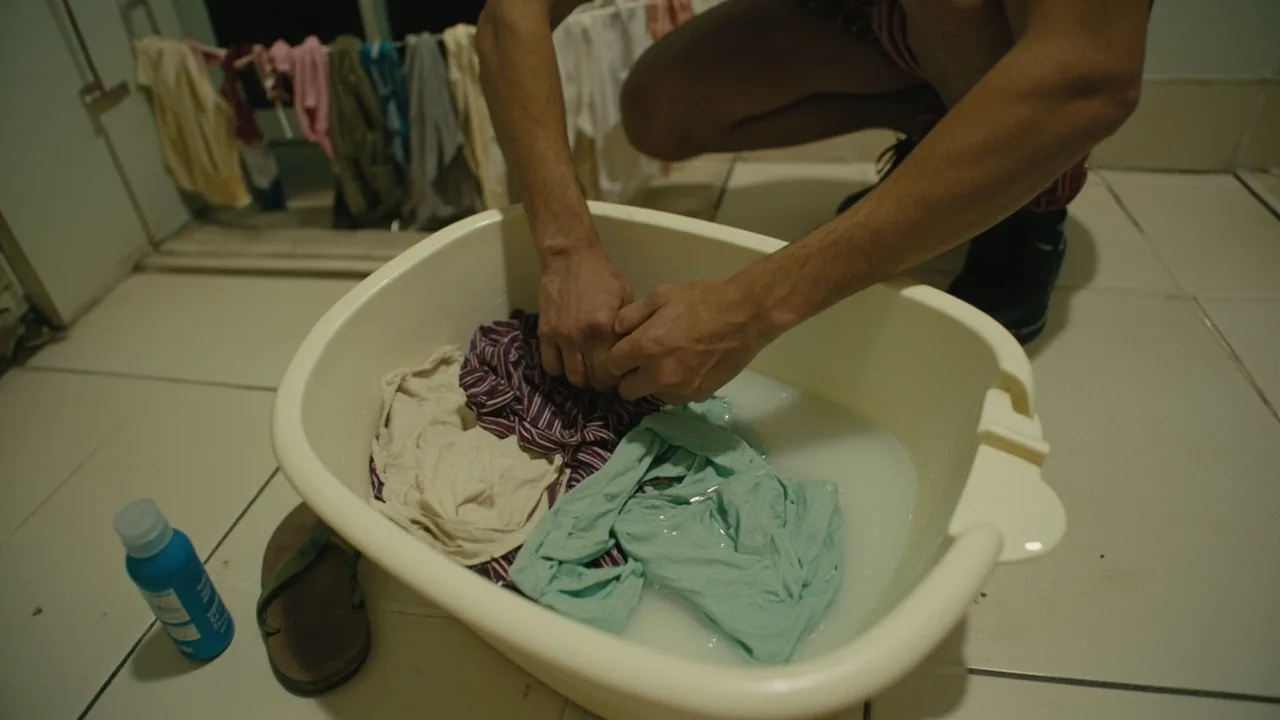
Hand-washing covers everything the drop-and-go shops and self-service machines miss: socks, underwear, a single damp tee that’s bothering you, swimwear, anything you need back inside four hours. Every hostel guest bathroom has a sink, soap, and a hanger line somewhere, and if it doesn’t, a quick Google Maps search for the nearest convenience store solves the detergent problem in under five minutes.
The key is technique. Hand-washing done badly is hard on clothes (twisting, scrubbing hot water, and wringing out the water all stretch the fabric). Hand-washing done right is gentler than any machine cycle, and travellers who hand-wash properly usually end up with clothes that outlast the ones that go through commercial machines repeatedly. The trick is the soak-and-press method.
The 30-Minute Laundry Rule (Step by Step)
This is the technique every long-term traveller lands on, and it does genuinely fit in 30 minutes including drying:
- Sort and soak (5 min): Separate colours from whites. Fill the sink with cool water, add a coin-sized amount of laundry soap or hostel shampoo, swish to dissolve. Drop in the clothes, push them under so they’re fully submerged.
- Soak, don’t scrub (15 min): Walk away. Set a phone timer for 15 minutes. The water and soap do the actual work here, not your hands. Heavily soiled areas (socks, collars, underarms) get a single light rub between thumb and forefinger at the 10-minute mark, no more.
- Rinse twice (5 min): Pull the plug. Refill with clean cool water. Press the clothes flat against the side of the sink to push water through, lift, repeat with a second rinse. Do not twist or wring.
- Press, don’t wring (3 min): Lay each item flat on a dry towel, roll the towel and press down with both palms. The towel absorbs most of the water. Repeat with a second dry towel if the first is saturated.
- Hang and shape (2 min): Hang on the line, balcony rail, or a hanger on a doorknob. Smooth out wrinkles with your hands while the fabric is wet, those creases set permanently once the item dries.
A single hand-wash load of 3–4 small items (two pairs of underwear, two pairs of socks, a tee) takes about 30 minutes including dry time on a rack under a fan. Doing it before bed means clothes are ready by morning.
What to Pack: The Laundry Kit
You don’t need much. Travellers report that they get by with what the hostel sells, what 7-Eleven stocks, and what’s already in their toiletry bag, but there are three small items that pay for themselves within the first week:
- A universal sink plug. Hostel sinks are hit-or-miss on whether the existing plug seals. A cheap rubber sink plug (₹80-₹150 (~$0.83-$1.56) from any Indian hardware store) means you can fill any sink. Packs flat.
- A roll-up laundry line. A 2–3 metre paracord line with a self-tensioning toggle weighs 30 grams and turns any balcony, bathroom, or window into a drying rack. The Southeast Asia toiletries guide covers the full kit.
- Microfibre quick-dry towel (30x30 cm or hand-towel size). Used dry, it’s the pressing towel in step 4 of the 30-minute rule. Used wet, it’s the body towel after a shower. Two roles for one item at 80 grams total.
Skip: any clothing labelled “dry clean only,” a travel iron (hostel laundry shops steam-press on request), and any folding drying rack larger than a paperback book.
For the broader packing call (which quick-dry fabrics hold up to weekly washing, how many tees to bring, what to skip), the Southeast Asia clothes guide is the right companion read.
Seawater: The Last-Resort Question
This is the one search-engine question that has its own gravitational pull among backpackers, and the answer is firm: do not wash clothes in seawater as a planned option. The salt crystals damage cotton and synthetic fibres, and the residual sodium builds up in the fabric and stiffens it permanently.
There is, however, a specific narrow scenario where seawater becomes useful: the single-rinse emergency. If a piece of clothing has been drenched in mud, sun-tan-oil, or food, and you have access to a tap but not to soap and you’re four hours from any laundry shop, a quick dunk in seawater to get the debris out is fine. Then rinse thoroughly in tap water the moment you reach a sink. The salt does not get into the fabric permanently if it is rinsed out within a few hours, but if you just dunk-and-hang to dry with the salt left in, you will see white crystallisation on the cloth and the fibres get brittle.
Safety Alert: Some hostels and small guesthouses do not have fresh water on tap at all hours, particularly during the dry season in Cambodia, Laos, and rural Vietnam. Always check the bathroom situation before booking a multi-day laundry routine around a hostel sink.
Laundry Pricing Across the Region
The drop-and-go laundry economy runs on weight, not per-piece, and the price-per-kilogram across the four core Southeast Asia backpacking countries is roughly:
- Thailand: ₹86-₹172 (~30-60 THB or ~$0.89-$1.78) per kg in tourist hubs, ₹57-₹114 (~20-40 THB or ~$0.59-$1.19) in smaller towns.
- Vietnam: ₹55-₹92 (~15,000-25,000 VND or ~$0.57-$0.95) per kg in Hanoi, Ho Chi Minh, and Da Nang. The Vietnam packing guide lists the same per-kg rate in body text.
- Cambodia: ₹96-₹145 (~1-1.50 USD) per kg (most shops accept USD cash or USD-equivalent riel).
- Laos: ₹64-₹150 (~15,000-35,000 LAK or ~$0.67-$1.56) per kg, slower turnaround since fewer shops exist outside Luang Prabang and Vientiane.
Express services (30-minute to 1-hour turnaround, usually using a dryer) cost 2 to 3x the standard rate. They make sense for travellers catching a flight tonight, but the heat and tumbling compress fabric faster than air-drying does, so it’s only a once-in-a-trip move for delicate items.
Common Laundry Mistakes Indian Backpackers Make
Bringing jeans. Jeans are heavy when clean, heavier when wet, and they take 24 hours to air-dry in humid weather. The same goes for thick cotton hoodies, woollens, and anything else from a winter suitcase. The Southeast Asia packing list does not feature jeans once for good reason.
Washing too often. Drop-and-go laundry at ₹143 (~50 THB or ~$1.48) per kg feels free, and that is how travellers end up doing laundry every second day and wearing through five tees in a month. A practical cadence is one big drop-and-go load per 7–10 days, plus a small hand-wash load of underwear/socks at the half-way point. That preserves fabric and saves you a not-trivial amount of money over the course of a month-long trip.
Using hotel shampoo on clothes. Hotel and hostel shampoo bars are milder than laundry detergent for a reason, they’re for hair. They will wash clothes, but they don’t lift body oil from collars and underarms as well as a real laundry detergent, and the soaps leave a residue that builds up over multiple washes. A small bottle or sachet of laundry detergent is worth its 30 grams.
Forgetting to remove everything from pockets before drop-and-go. This is the small-print caution every long-term traveller learns the hard way: forgotten boarding passes, business cards, hotel key cards, earbuds, and on at least one occasion a passport find their way into the wash. Take 30 seconds and check every pocket before handing your bag over.
FAQ
Can I wash clothes in a hostel sink?
Yes, hostel sinks are perfectly fine for hand-washing small items, that’s what they exist for. The soak-and-press method above works in any sink with a reliable plug. If the hostel bathroom sink has poor drainage or a leaking plug, the shower drain area is your second-best bet, just plug it with a wet towel.
What about the 30-minute express laundry, is it worth the price?
Only when you genuinely need it. Express services use a tumble dryer to shortcut the air-dry phase, and the heat and tumbling are harder on fabric than air-drying. For a traveller catching a flight tonight, paying 3x is a fair trade. As a default option, no.
How do I keep clothes smelling fresh in humid weather?
Three habits help. First, hang clothes to dry in a ventilated spot (under a fan, on a balcony with airflow), closed-air bathrooms breed mildew smell fast. Second, never put damp clothes into a backpack or a closed bag, even for an hour. Third, every 4–5 days, hand-wash or machine-wash with a teaspoon of vinegar added to the rinse, it neutralises the musty smell that builds up in humid climates.
Can I trust hostel laundry staff with expensive clothes?
For t-shirts, shorts, underwear, socks, and standard travel wear, yes. For expensive merino base layers, anything with glued seams, or branded items, hand-wash them yourself. Drop-and-go shops are not liable for damage to dry-clean-only items.
How many clothes should I pack for Southeast Asia?
The 5-4-3-2-1 method is a clean starting point: 5 socks/underwear, 4 tees, 3 bottoms (2 shorts, 1 light trouser), 2 swimwear/quick-dry layers, 1 rain jacket, 1 pair sandals, 1 pair walking shoes. That fits a 40L–50L backpack, covers any 7–10 day window, and weighs under 6 kg including shoes.
Is laundry cheaper in Cambodia or Vietnam?
Per-kilogram rates are similar across the four countries, so the deciding factor is usually turnaround time and density of shops. Ho Chi Minh City, Bangkok, and Phnom Penh have the highest density of drop-and-go shops, which makes same-day or next-day pickups easy. Smaller towns (Luang Prabang, Kampot, Pai) often have only one or two shops each, so build the rest day around that.
Subodh’s Take: Most backpackers over-think laundry because they assume the rules from home travel still apply. They don’t. Southeast Asia has a real, cheap, fast drop-and-go laundry economy that runs on weight and that the local staff do better than you can. Use it as your default, keep a small hand-wash routine for the urgent items, and the problem disappears by day two. Bring 3–4 quick-dry tees, leave the jeans at home, and budget ₹572 (~200 THB or ~$5.94) a week for laundry and you will never think about this again.
