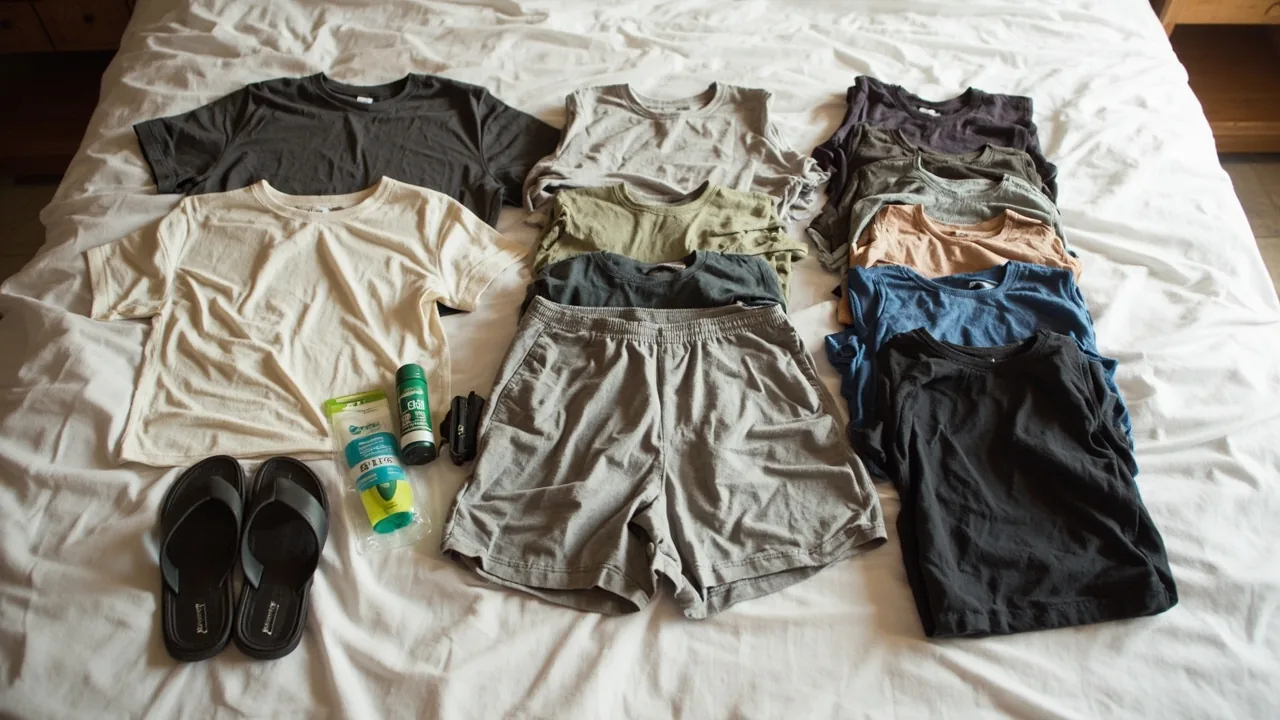
What to Pack: Best Clothes for Southeast Asia Travel (Backpacker Guide)
Packing light is the rule that saves every Southeast Asia trip. The region runs hot, humid, and rain-prone for at least half the year, so a 40L backpack with quick-dry clothing beats a 70L hardcase stuffed with jeans every time. This guide covers the 3-3-3 packing rule and the pieces that earn their weight.
For country-specific breakdowns, see our Thailand packing list or our best backpacks guide for the 40L-50L sweet spot.
Quick Answers
| What | Answer | Price (INR) |
|---|---|---|
| Backpack size for SEA backpacking? | 40-50L, hardcase suitcases cost you on sleeper buses | ₹3,000-₹8,000 (~$31.14-$83.04) |
| How many t-shirts for a 3-week trip? | 3 quick-dry tees (the 3-3-3 rule) | ₹600-₹1,200 (~$6.23-$12.46) |
| Best fabric for tropical weather? | Synthetic quick-dry, not cotton | ₹400-₹900 (~$4.15-$9.34) |
| Power bank limit on flights? | Under 100Wh (about 20,000 mAh at 5V) | ₹1,500-₹3,000 (~$15.57-$31.14) |
| Laundry cost per kg at hostels? | Cheap, drop-off and next-day pickup | ₹229-₹429 (~80-150 THB or ~$2.37-$4.45) |
Subodh’s Pro Tip: Treat the 3-3-3 rule as a starting framework, not a religion. If you sweat through shirts faster than expected, add one more tee. The rule keeps you from overpacking; it doesn’t replace using your eyes on day one.
The 3-3-3 Packing Rule Explained
The 3-3-3 rule is simple: 3 tops, 3 bottoms, 3 of everything else (socks, underwear, shoes categories). It comes from the broader 3-5-7 rule in packing (3 tops, 5 bottoms, 7 pairs of socks and underwear for longer trips), and the goal is the same. Fewer clothes, more laundry, lighter bag.
For a 21-day backpacking loop through Thailand, Vietnam, Laos, and Cambodia, the 3-3-3 rule works if you plan to do laundry every 5-7 days at hostels. Here is the actual list that fits in a 45L backpack:
- 3 quick-dry t-shirts (polyester or merino blends, not cotton)
- 3 pairs of bottoms (2 quick-dry shorts + 1 zip-off travel trousers, or 1 shorts + 2 trousers if you want modesty at temples)
- 3 pairs of socks (merino or synthetic; cotton stays wet)
- 3 pairs of underwear (synthetic; cotton traps moisture)
- 1 swimwear
- 1 light rain shell or poncho
- 1 packable down jacket for AC buses and highland nights
- 1 pair of walking shoes or trail runners
- 1 pair of sandals or sport zoris for hostel showers and beach days
That is the 3-3-3 rule for clothing, applied to Southeast Asia specifically. Cotton fails in this climate: it stays damp, breeds smell, and dries on a hostel line for 14 hours. Quick-dry synthetics wash in a hostel sink at 9 PM and are wearable by breakfast. Travellers report that merino t-shirts from Indian brands like Decathlon (Forclaz Trek 100) cost ₹900 (~$9.34) and last 3-4 days between washes without smelling, which means 3 tees cover a 9-12 day stretch.
The Ultimate Clothing Checklist
| Category | What to Pack | Why |
|---|---|---|
| Tops | 3 quick-dry tees (1 light, 1 dark, 1 long-sleeve for sun/temples) | Sun protection and temple modesty without buying locally |
| Bottoms | 2 quick-dry shorts + 1 zip-off trouser | Zip-off converts to shorts for islands |
| Outerwear | 1 packable rain shell + 1 light fleece or down jacket | Highland nights in Laos and northern Vietnam drop to 10-15°C |
| Swimwear | 1 swim trunk or rash guard | Most islands have a beach on day one |
| Underwear/socks | 3-5 pairs each, synthetic | Cotton rots in humid climate |
| Footwear | 1 walking shoe + 1 sandal | Two-pair rotation covers 99% of trips |
| Rain gear | 1 packable poncho (₹300-₹500 (~$3.11-$5.19)) | Cheaper than a Decathlon rain jacket and easier to dry |
| Cover-up | 1 light cotton sarong or scarf | Doubles as temple cover, beach towel, blanket, and laundry line wrap |
For monsoon specifics, see our monsoon packing list. For dry-season optimisation, the dry-season packing checklist covers November to February loops.
Monsoon vs. Dry Season Clothing
The clothing list shifts sharply between June-October (southwest monsoon) and November-February (dry season in most of the region).
Monsoon (June-October):
- Quick-dry synthetics become non-negotiable. Cotton stays wet for days.
- A packable poncho beats an umbrella because your hands stay free for hostel stairs and motorbike rides.
- Waterproof sandals (Teva-style or Decathlon Quechua) handle flooded streets in HCMC and Bangkok.
- A dry bag (5-10L) keeps your phone and wallet dry on longboat rides in Ha Long Bay or Koh Samui.
Dry Season (November-February):
- Breathable linen and cotton become usable for the first time all year. Chiang Mai and Siem Reap are at their driest.
- Sunglasses, a wide-brim hat, and SPF 50 sunscreen become priority items. UV index hits 11+ in March-April.
- A light fleece or packable down jacket goes in for highland nights: Sapa, Da Lat, Chiang Mai, and Phobjikha Valley can drop below 12°C.
- For February-April (the hot, dry shoulder), cut the fleece and double up on quick-dry tees. Bangkok regularly hits 38°C with 70% humidity.
The same backpack works for both seasons; you swap 3-4 items, not the whole kit.
Footwear That Lasts the Trip
Two pairs of shoes is the sweet spot. Travellers report that Decathlon’s Quechua MH500 mid-cut hiking shoes (₹2,500-₹3,500 (~$25.95-$36.33)) handle temple stairs, muddy treks in Sapa, and rainy Bangkok sidewalks without falling apart. For the second pair, sport sandals or zori-style flip-flops (₹500-₹1,200 (~$5.19-$12.46)) work for hostel showers, beach days, and pool decks. Anything more than two pairs is dead weight; anything less means wet feet every time it rains.
Avoid brand-new shoes for the trip. Break them in for at least 2-3 weeks before flying, or you’ll be buying blisters in Bangkok at 2x the Indian price.
Electronics & Tech Setup
For clothes-focused packing, electronics stay minimal:
- Universal adapter: Thailand uses A/B/C/F sockets (220V); Vietnam uses A/C/G (220V); Laos uses A/B/C/E/F (230V); Cambodia uses A/C/G (230V). One universal adapter (₹500-₹1,200 (~$5.19-$12.46)) handles all four countries.
- Power bank: Keep it under 100Wh (about 20,000 mAh at 5V). Anything over 100Wh gets confiscated at Indian airport security, and most airlines cap carry-on at 160Wh with airline approval.
- Charging cables: Two USB-C cables and one Lightning (if you carry an older iPhone). Cables die faster in humid climates, and a hostel at 11 PM is the worst place to find out you have one working cable.
- SIM and eSIM: Buy a local tourist SIM at the airport on arrival for 7-15 day data packs, or skip the queue with an eSIM that activates before you board your flight.
For deeper SIM breakdowns, our Airtel international roaming review helps if you’d rather skip the local SIM entirely.
Cultural Dress Codes: Temples vs. Beaches
Thailand, Cambodia, Laos, and Myanmar (for those crossing the border) all enforce strict temple dress codes. Shoulders and knees must be covered at the Grand Palace in Bangkok, Angkor Wat in Siem Reap, Wat Pho, and Luang Prabang’s temples. The cheapest fix is a single light cotton scarf or sarong (₹200-₹500 (~$2.08-$5.19) in India, double that locally) that wraps around shoulders or waist as needed.
Pack at least one piece that covers knees for both genders. Long quick-dry trousers work. Knee-length shorts do not, and you’ll be turned away at Wat Phra Kaew without a rental sarong from the counter (which costs ₹572 (~200 THB or ~$5.94) deposit and slows down your entry by 20 minutes).
Beaches and islands have no dress code. Swim trunks, board shorts, and bikinis are fine on Koh Phangan, Koh Tao, Gili Trawangan, and Mui Ne. The transition point is crossing from beach town to temple town: anywhere with a wat, pagoda, or mosque nearby, cover up.
Toiletries: Bring From India
Indian pharmacy prices for sunscreen, mosquito repellent, and decent shampoo are 40-60% cheaper than Thai or Vietnamese 7-Eleven equivalents. The exception is contact lens solution and oral rehydration salts, which are fine to buy locally. Our toiletries guide has the full list, but the climate-critical items are:
- SPF 50 sunscreen (Indian brands like Lotus, Minimalist, or La Shield: ₹400-₹800 (~$4.15-$8.30))
- DEET-based mosquito repellent (Odomos or Goodknight: ₹150-₹300 (~$1.56-$3.11))
- A small tube of antifungal cream (ringworm and foot fungus spread fast in humid dorms)
- Oral rehydration sachets and a strip of paracetamol
Skip heavy bottles of shampoo and body wash. 7-Eleven, Circle K, and Family Mart stock everything for under ₹286 (~100 THB or ~$2.97), and the bottle weighs more than the product.
Trail Laundry Strategy
Hostels across the region offer laundry services, usually ₹229-₹429 (~80-150 THB or ~$2.37-$4.45) per kg with same-day or next-day turnaround. The cost is low enough that 3 t-shirts and 2 shorts can cover a full 10-day stretch if you wash every 5 days. For a deep dive, our laundry guide covers sink-wash technique and which fabrics survive hostel spin cycles.
Common Packing Mistakes Indians Make
Mistake 1: Bringing a hardcase suitcase. Sleeper buses in Vietnam, Laos, and Cambodia have underfloor luggage compartments designed for backpacks. A 40-50L backpack with a rain cover survives the trip.
Mistake 2: Packing jeans. Denim weighs 1 kg per pair, stays wet for 12+ hours, and rots faster than synthetic fabrics in this humidity. One pair of quick-dry travel trousers covers every situation where jeans feel mandatory (temple towns, cool highlands, fancier restaurants).
Mistake 3: Ignoring the 100Wh power bank limit. A 26,800 mAh power bank sits at 99.8Wh, just under the cap. A 30,000 mAh bank at 3.7V is 111Wh and will be confiscated. Check the Wh printed on the label, not the mAh.
Mistake 4: Forgetting temple dress. Showing up to Angkor Wat in shorts and a tank top costs you a ₹48 (~2,000 KHR or ~$0.49) rental sarong and 30 minutes of queue. Carry a sarong in your daypack from day one.
Mistake 5: Overpacking “just in case” electronics. A second camera, a Kindle, a laptop, and three cables each add 2-3 kg to your bag. A single USB-C cable plus universal adapter handles most charging needs.
Quick Answers: Clothing-Specific
| What | Answer | Price (INR) |
|---|---|---|
| Best fabric for tropical weather? | Synthetic quick-dry (polyester or merino blend) | ₹400-₹900 (~$4.15-$9.34) |
| How many pairs of shoes? | 2 (one walking, one sandal) | ₹3,000-₹5,000 (~$31.14-$51.90) total |
| Do jeans work in SEA? | No; they stay wet and heavy | ₹1,500-₹2,500 (~$15.57-$25.95) |
| Sarong for temples: buy where? | Pack one from India to save time | ₹200-₹500 (~$2.08-$5.19) |
| Cotton or synthetic socks? | Synthetic; cotton stays damp | ₹200-₹400 (~$2.08-$4.15) per pair |
FAQ
Can I bring a suitcase instead of a backpack? You can, but you’ll struggle. Sleeper bus luggage holds, tuk-tuk racks, and motorbike taxi racks are all designed for backpacks. A hardcase adds 3-4 kg of dead weight and breaks faster on rough roads. Stick with a 40-50L backpack with a rain cover.
Are power banks allowed in cabin baggage? Yes, under 100Wh without airline approval, and up to 160Wh with airline approval. Anything over 160Wh goes in checked baggage (and is generally not allowed at all). Check the Wh on the label before you fly.
Can I buy sunscreen cheap in Thailand? You can buy it, but not cheap. A 50ml SPF 50 tube runs ₹715-₹1,144 (~250-400 THB or ~$7.42-$11.87) at Boots or Watsons, against ₹400-₹800 (~$4.15-$8.30) for the same volume from an Indian brand like Minimalist or La Shield. Stock up before you fly.
What is the 3-5-7 packing rule? 3 tops, 5 bottoms, 7 pairs of socks and underwear. It’s a longer-trip variant of the 3-3-3 rule for trips over 14 days, where you do laundry less often. For most 21-day SEA loops, the 3-3-3 with laundry every 5-7 days is lighter and cheaper.
Should I pack a rain jacket or a poncho? A packable poncho (₹300-₹500 (~$3.11-$5.19) in India) is lighter, cheaper, and easier to dry. A rain jacket is warmer for highland treks in Sapa or Chiang Mai in December, but costs 3-4x more and adds 200g. For most loops, the poncho wins.
Is cotton that bad in SEA? For socks and underwear, yes. Cotton holds moisture against your skin and breeds fungal infections within 3-4 days of continuous wear. For shirts, merino or quick-dry synthetic is far more forgiving. A single cotton overshirt for cool evenings in Hanoi is fine.
How much weight should my packed bag be? 7-9 kg for the main backpack is the sweet spot. Anything over 12 kg gets exhausting on day three, especially in humidity; if you can’t lift your bag over your head with one hand, repack.
Subodh’s Take
The 3-3-3 rule is the best starting point for any Southeast Asia packing list, but the real trick is choosing the right fabrics. Quick-dry synthetic tees, merino socks, a packable poncho, and one pair of trousers that covers your knees will get you through Thailand, Vietnam, Laos, and Cambodia without ever shopping for clothes on the road. Bring your sunscreen and mosquito repellent from India, leave the jeans and the second camera at home, and let laundry do the work. Your back will thank you by day three.
