Is an Indonesian Cooking Class in Bali Worth It? 2026 Review
An Indonesian cooking class in Bali costs ₹965—₹3,861 (~10—40 USD) for a half-day session that includes a market tour and 3—4 dishes. For Indian travellers on a Southeast Asia backpacking trip, it’s one of the highest-value food experiences in Indonesia. Planning the wider region? Our Southeast Asia backpacking hub covers the full multi-country route.
The short answer: yes, it’s worth it. You eat what you cook for lunch, learn spice-blending techniques you’ll use at home, and leave with printed recipe cards. This guide breaks down what’s actually included, how to pick a school, and five Indonesian recipes you can make in an Indian kitchen without hunting for specialty ingredients.
Quick Answers
| What | Answer | Price (INR) |
|---|---|---|
| Average half-day class | 4 hours, market tour + cooking | ₹965—₹2,316 (~10—24 USD) |
| Full-day class with multiple dishes | 6 hours, market tour + 3—5 dishes | ₹2,896—₹3,861 (~30—40 USD) |
| Budget / warung-run class | Group format, basic kitchen | ₹483—₹965 (~5—10 USD) |
| Private class (couples / small groups) | Custom menu, dedicated chef | ₹4,827—₹6,757 (~50—70 USD) per person |
| Vegetarian-friendly options | Most schools offer on request | Same price as standard |
| Indian-friendly / customisable menu | A handful of schools, book ahead | ₹2,413—₹4,344 (~25—45 USD) |
All prices verified against current operator quotes and traveller receipts from July 2026. Indonesia uses IDR for all local transactions. At current rates (1 USD = ₹96.53), a 200,000 IDR class works out to roughly ₹1,094.
How a Bali Cooking Class Actually Works
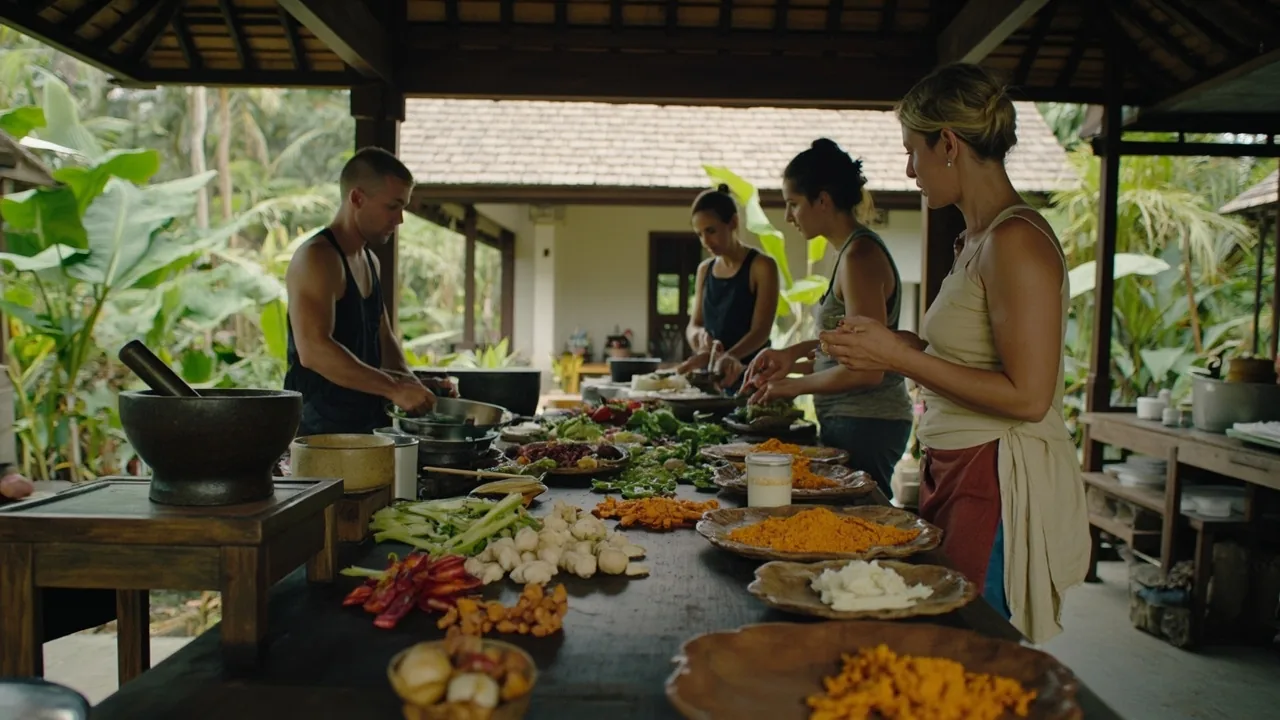
The typical class follows a set pattern. You arrive at the school between 8:00 and 9:00 AM, meet your chef-instructor, and walk or drive to a local market. Ubud’s traditional market and Seminyak’s Pasar Badung are two common starting points.
At the market, the chef explains Indonesian ingredients. You’ll learn the difference between grades of palm sugar, smell fresh kaffir lime leaves versus dried ones, and identify the specific chillies that go into sambal. This segment runs 30 to 60 minutes and is genuinely educational rather than tourist theatre.
Back at the kitchen, you cook 3 to 5 dishes over 2 to 3 hours. Common dishes include nasi goreng, mie goreng, gado-gado, satay with peanut sauce, and a sambal. Most schools give you a printed recipe card to take home. Classes end with a communal lunch of everything you cooked, often paired with fresh coconut water or Balinese coffee. Group sizes run 4 to 10 people; anything above 12 and you’re watching more than cooking.
Subodh’s Pro Tip: Email the school 48 hours ahead if you’re strict vegetarian or have allergies. Indonesian cooking uses shrimp paste (terasi) and fish sauce (kecap ikan) in dishes that look vegetarian, and not every school flags them. Most will adapt if you ask in advance.
What to Expect: School Formats and Pricing
Bali cooking schools come in three formats. Understanding the difference saves you money and disappointment.
Warung-run classes are the budget option. A local family or small restaurant opens their kitchen for a morning session. Groups run 6 to 12 people, the market tour is quick, and you learn 2 to 3 dishes. Cost: ₹483—₹965 (~5—10 USD). The food is authentic, but instruction is minimal and recipe cards are rare.
Mid-range schools are the most common. Purpose-built kitchens, English-speaking instructors, structured market tours, and printed recipes. Groups run 4 to 8 people. Cost: ₹1,448—₹2,896 (~15—30 USD). This is where most Indian travellers land and where the value is best.
Private-format schools offer custom menus and dedicated chefs. You pick the dishes in advance, the chef builds the session around your group, and you can request Indian-style spice levels. Groups are 1 to 4 people. Cost: ₹4,827—₹6,757 (~50—70 USD) per person. Best for vegetarian or allergy-heavy groups.
Subodh’s Pro Tip: The sweet spot is a mid-range school with groups under 8 people and a chef who cooks for a living rather than just teaches tourists. Skip the cheapest option and the most expensive private option.
What’s Included (and What’s Not)
Most half-day classes at the ₹965—₹2,316 (~10—24 USD) price point include:
- Market tour with ingredient explanation
- All ingredients and equipment
- Apron and recipe card
- Communal lunch of what you cooked
- One drink (usually fresh juice or Balinese coffee)
What’s NOT included and catches people out:
- Hotel pickup and drop (usually +₹483—₹965 (~5—10 USD) if offered)
- Extra drinks beyond the included one
- Tips (not expected in Bali, but appreciated for great teaching)
Full-day classes at ₹2,896—₹3,861 (~30—40 USD) add:
- One or two extra dishes (typically 4—5 total instead of 3)
- Sometimes a dessert course like dadar gulung (green coconut pancakes)
- Longer market tour covering two markets
- Welcome drink and snack
Vegetarian and Indian-Friendly Options
This matters for Indian travellers specifically. Indonesian cuisine uses fish sauce and shrimp paste as a base in many dishes, even ones that look vegetarian. A good class teaches you the substitutions — typically soy sauce or fermented soybean paste — and builds the menu around meat-free dishes like:
- Gado-gado (vegetable salad with peanut sauce)
- Nasi goreng (vegetarian version, using kecap manis instead of shrimp paste)
- Sate lilit (can be done with tofu instead of fish)
- Tempeh goreng (fried fermented soybean, naturally vegetarian)
- Sayur urap (steamed vegetables with grated coconut)
If you’re cooking the class yourself and want a fully Indian-adapted menu, private-format schools are your best bet. Most group classes will do vegetarian but draw the line at full customisation.
Subodh’s Pro Tip: Ask the school whether they use a translated recipe card or a verbal handover. Some local-format schools focus on Korean or Japanese guests and don’t always provide English recipe cards, which matters if you want to recreate dishes back home.
Five Indonesian Recipes to Make at Home
The whole point of a cooking class is leaving with skills you’ll actually use. Here are five Indonesian dishes that work well in an Indian kitchen without requiring specialty ingredients you can’t find:
1. Nasi Goreng (Indonesian Fried Rice) The national dish. Use day-old rice, kecap manis (sweet soy sauce, available at most Indian grocery stores), garlic, shallots, and an egg. Total cost per serving: roughly ₹50—₹75. The trick is high heat and not overcrowding the wok.
2. Sambal (Chilli Paste) Every Indonesian meal centres on sambal. The simplest version uses fresh red chillies, garlic, shallots, salt, and a squeeze of lime. Grind in a mortar and pestle for texture. Keeps in the fridge for two weeks.
3. Gado-Gado (Peanut Sauce Salad) Blanched vegetables, tofu, hard-boiled egg, and a peanut sauce made from ground peanuts, kecap manis, lime juice, and chilli. Vegetarian, cheap, and filling.
4. Sate Ayam (Chicken Satay) Marinate chicken in turmeric, garlic, and lemongrass for two hours. Grill on skewers and serve with peanut sauce. Works on a gas stove grill pan.
5. Tempeh Orek (Sweet Soy Tempeh) Cubed tempeh stir-fried with kecap manis, garlic, and chilli. Tempeh is increasingly available in Indian metro grocery stores. High protein, low cost.
Where to Eat Near Cooking School Areas
If your class runs 9 AM to 1 PM, you’ll finish hungry and want a real meal. The Ubud and Seminyak areas have excellent Indonesian options:
- SEMAJA Menteng (rated 4.8), for authentic Indonesian comfort food.
- 1928 (rated 4.7), a historic restaurant offering Indonesian classics.
- SATOO (rated 4.6), casual dining with a variety of Indonesian and international dishes.
For a fuller look at everyday food prices across Indonesia, see our Indonesian street food prices guide. And for understanding what dishes to prioritise, our Indonesia food guide covers the must-tries.
Getting There and Booking
Most cooking schools in Ubud are reachable by Gojek or Grab bike from any central accommodation (₹35—₹100 per ride). Seminyak and Canggu schools are slightly harder to reach by bike — expect to book a car or scooter. For transport details, our Bali transport guide covers all options.
Schools send a confirmation email within 24 hours of booking. You pay either upfront (small deposit) or on arrival in cash IDR. Cards are accepted at some schools but cash IDR is preferred, and you’ll avoid the 2—3% card surcharge some operators add. For ATM strategy, our using ATMs in Indonesia guide walks through the fee math.
Visa and Logistics for the Class Itself
You don’t need anything special for a cooking class beyond a valid visa. If you’re flying in from India, Indonesia offers visa-on-arrival for Indian passport holders at ₹2,918 (~35 USD) for 30 days, or an e-visa applied online at least 3 business days before departure. For full details, see our Indonesia visa-on-arrival guide and our Indonesia trip cost breakdown for budget planning.
Safety Alert: Cooking classes involve sharp knives, open flame, and unfamiliar ingredients. Wear closed-toe shoes, tie back long hair, and tell the chef about any allergies before the market tour. Most schools run safety briefings, but it’s worth paying attention rather than scrolling your phone.
Getting Connected
You’ll want mobile data to find the school on arrival, check the operator’s confirmation email, and translate menu items at the market. For Indian travellers, the cheapest option is a local SIM from Telkomsel or XL, sold at the airport for around ₹483—₹676 (~5—7 USD) for a 7-day tourist pack. An eSIM like Get Nomad eSIM works equally well and skips the airport counter queue. Data coverage in central Bali is solid on all networks. For more options, see our Indonesia SIM card guide.
Subodh’s Take
A cooking class in Bali is the single best ₹1,931 (~20 USD) you’ll spend on food in Indonesia. The market tour alone teaches you more about Indonesian ingredients than any cookbook, and the recipes come home with you. Pick a mid-range class with groups under 8 people and a chef who cooks for a living. The meal at the end feeds you for the day, which means your real cost is closer to ₹965—₹1,448 (~10—15 USD) once you subtract lunch.
FAQ
Are cooking classes in Bali worth it? Yes, especially for food-focused travellers. The combination of market tour, hands-on cooking, and a real Indonesian meal at the end makes a ₹1,448—₹2,413 (~15—25 USD) class one of the best value food experiences in Bali. For Indian travellers specifically, the spice-blending techniques translate directly to your home kitchen.
Do cooking schools in Bali accommodate vegetarians? Most do. Email ahead and they’ll usually build a veg-friendly menu using the same techniques, swapping shrimp paste for soy sauce and tofu for fish or chicken. Private-format schools are the most flexible.
How long is a typical cooking class in Bali? Half-day classes run 3 to 4 hours. Full-day classes run 5 to 6 hours and usually cover one or two extra dishes. Anything shorter is rushed.
Can I pay in Indian rupees or with UPI? No. Bali doesn’t accept UPI from Indian travellers, and almost no tourist-facing business takes INR. Bring IDR cash or use a forex card. Our ATM guide covers withdrawal fees and limits.
What should I bring to a cooking class? Wear closed-toe shoes and comfortable clothes you don’t mind getting splashed. Most schools provide aprons. Leave valuables at your hotel; there’s nowhere secure to keep a phone or wallet during cooking.
Are cooking classes safe in Bali? Yes. Reputable schools run safety briefings, equipment is standard, and ingredient handling is supervised. Tell the chef about allergies at the market tour stage. For broader travel safety context, see our Indonesia safety guide.
— Subodh
