Koh Chang Temple Etiquette: A Backpacker’s Guide to Getting It Right (2026)
Koh Chang temple etiquette boils down to five rules: cover shoulders and knees, remove all footwear at the door, never point your feet at Buddha images, ask before photographing monks, and stay quiet inside the ordination hall. Planning the wider region? Our Southeast Asia backpacking hub covers the full multi-country route.
Koh Chang is mostly a beach island. Most backpackers come for Lonely Beach, White Sand, and the waterfall hikes, not the wats, which is also why the overall island pace reads as a solo in Thailand first-timer’s itinerary kind of trip rather than a checklist run. That’s exactly why the temples here feel calm, are almost free of crowds, and are worth a half-day if you respect them properly. This guide covers the dress code, the footwear rule, monk interactions, photography dos and don’ts, and which temples deserve a spot on your itinerary.
Quick Answers
| What | Answer | Price (INR) |
|---|---|---|
| Entry fee (most wats) | Free, donations welcome | , |
| Sarong rental at the gate | Usually free, sometimes ₹57-₹144 (~20-50 THB or ~$0.60-$1.49) deposit | ₹57 (~20 THB or ~$0.60) |
| Main temple on Koh Chang | Wat Khlong Phlu | , |
| Best time to visit | Early morning (7-9 AM) or late afternoon (4-6 PM) | , |
| Dress code minimum | Shoulders + knees covered for everyone | , |
| Photo of monks allowed? | Only with their explicit permission | , |
| Monk interaction (women) | Never touch a monk or hand items directly | , |
What “Temple Etiquette” Means on Koh Chang
Temple etiquette in Thailand is a working set of customs that show respect to Buddha images, to the monks who live there, and to the space itself, and the same framework applies at the Buddhist and Hindu sites further east on the Pakse temple etiquette guide. On Koh Chang specifically, the etiquette is the same as mainland Thailand, with one small local twist: the temples here are active community wats, not tourist showpieces, so locals are forgiving but they are also watching.
The basics: shoulders and knees covered for everyone, shoes off before any hall, feet tucked under you when sitting, never turn your back to a Buddha image, speak softly, ask before photographing people. None of this is secret knowledge but every single week travellers walk into a wat in board shorts and tank tops and have to be wrapped in a borrowed sarong at the door. Don’t be that person.
Step-by-Step: How to Visit a Koh Chang Temple Without Getting It Wrong
Step 1: Dress for the wat before you leave the hostel
The single most common reason Indian backpackers feel awkward at a Thai temple is showing up in beach clothes. Pack one “temple outfit” in your day bag from the morning (a quick packing list for Southeast Asia usually covers this without overthinking it): long pants or a long skirt, a shirt with sleeves (a kurta works perfectly, since shoulders and knees are both covered), and slip-on shoes or sandals you can kick off in two seconds. Cotton is your friend in the Koh Chang humidity.
For women: any top covering the shoulders is fine. Sleeveless tops with a scarf thrown over the shoulder usually pass; a proper sleeve is safer. For men: board shorts are out. Long shorts past the knee are a borderline call, real trousers are better. For everyone: skip the offensive graphic tees and the ripped-jeans aesthetic. The dress code is about modesty, not fashion.
Step 2: Leave shoes, hats, and sunglasses at the door
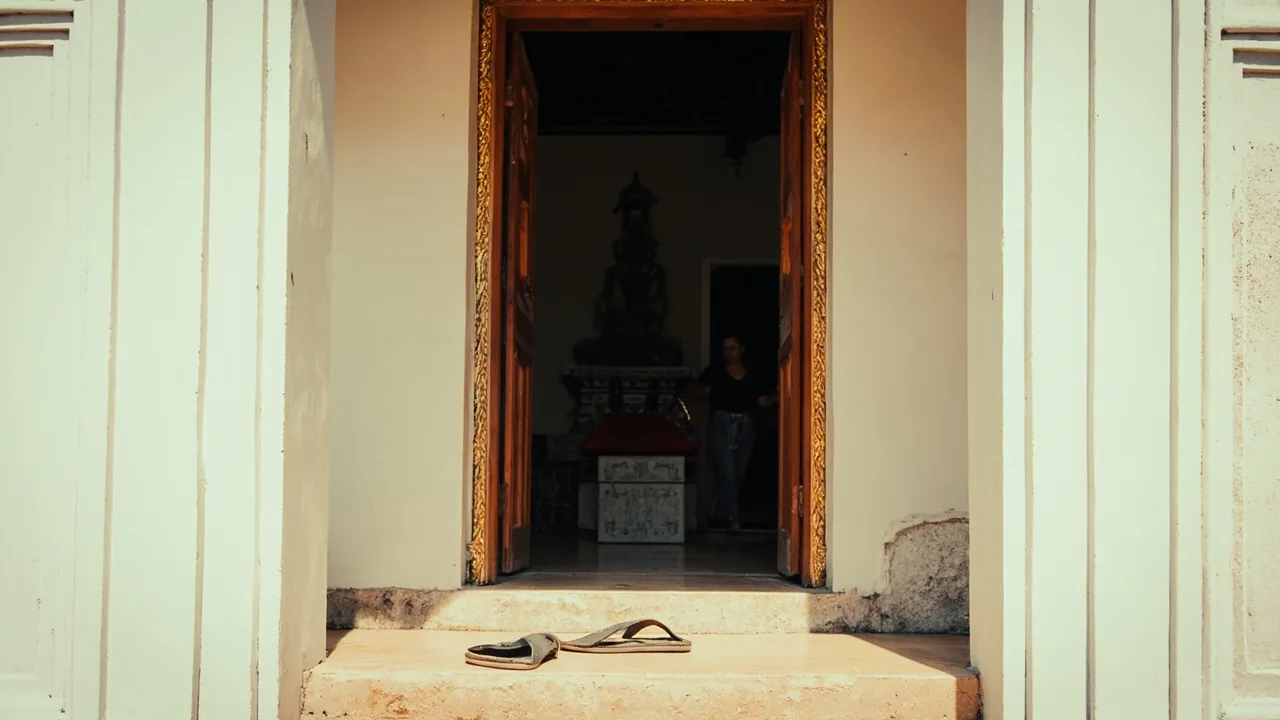
Every hall has a shoe rack or a clear “shoes off” zone just outside the threshold. Take everything off, including sandals, flip-flops, and especially your hat. Sunglasses too, even on bright days. Carry them in your hand or your bag. Pointing the soles of your feet toward anything sacred is the bigger taboo, so the moment shoes come off you also become aware of where your feet are pointing.
Some larger temples in Bangkok have lockers or numbered tokens. On Koh Chang the wats are small enough that you just leave your shoes on a rack with everyone else’s. Keep your valuables in your day pack and your day pack on your front when you sit down.
Step 3: Walk in slowly and lower your voice
Thai wats are not libraries, they are not museums, they are living religious sites. People are praying. Monks are meditating. Locals come to make merit. Match the energy of the room you’re entering. If a hall is silent, you are silent. If a chant is in progress, you wait outside until it ends, or you step in quietly and stand at the back.
Avoid: phone calls, loud laughter, vaping, smoking, alcohol smell, chewing gum with your mouth open, and any kind of music out of a speaker. None of these are technically illegal but all of them make you the person everyone remembers for the wrong reasons.
Step 4: Know what to do in front of a Buddha image
The main rules at the Buddha statue:
- Never climb on it, even for a photo, even if other tourists are doing it. Travellers report this is the fastest way to get a sharp rebuke from a monk or a local.
- Never point your feet at it. When sitting on the floor, tuck your legs behind you to one side (the “mermaid pose” locals use) or kneel. Pointing feet at a Buddha is one of the rudest things you can do in Thai culture.
- Women should not touch monks. If a woman needs to hand something to a monk, she places it on a cloth or on the floor within his reach (same logic shows up at mainland sites, as the Thailand-Malaysia border crossing guide notes for the shared Buddhist shrines at the frontier). He picks it up.
- If there’s a donation box, a small offering (₹57-₹144 (~20-50 THB or ~$0.60-$1.49)) is appreciated. Don’t drop a ₹2,872 (~1,000 THB or ~$29.79) note like a flex, the point is the gesture.
- Some images have a paste or chalk mark on the forehead or the body. Don’t wipe it off, it’s a recent blessing.
Step 5: Photography dos and don’ts
Photography is allowed in the temple grounds and usually in the ordination hall, with three hard limits: no flash inside, no photos of monks without permission, and no selfies making peace signs in front of a Buddha. The first two are about not disturbing the space; the third is just about dignity.
Ask permission before photographing any monk, any nun, or any local person who is praying. Pointing at your phone and gesturing “photo?” usually gets a clear yes or no. If someone covers their face or waves you off, the answer is no, move on. Drone use over temple grounds is forbidden by Thai law in most cases, do not even think about launching a Mavic over a wat.
Step 6: Talking to monks (and when not to)
Koh Chang has a few resident monks, mainly at Wat Khlong Phlu and the smaller community wats in the south of the island. They will sometimes sit near the entrance and chat with visitors in basic English. A few rules:
- Women do not touch monks. Not a handshake, not a high five, not even a friendly tap on the arm. Use a wai (palms together at chest, slight bow) as a greeting instead.
- Men can shake hands if the monk offers his hand first. Don’t initiate.
- Don’t sit higher than a monk. If a monk is sitting on a chair, sit on the floor or a lower seat.
- Don’t offer alcohol, cigarettes, or meat to a monk. The Buddhist monastic code prohibits handling these.
- Don’t give money directly to monks. The proper route is the temple’s donation box or the lay community that supports the wat.
- If a monk approaches you to practise English, that’s fine. If he walks past in silence, leave him in silence.
Which Koh Chang Temples Are Worth Adding to Your Itinerary
Koh Chang has fewer temples than the mainland, but the ones it has are worth a half-day if you’re already on the east side of the island or in the south, and the broader cost of getting here is covered in our Southeast Asia trip cost from India breakdown.
Wat Khlong Phlu (Wat Klong Plu)
The main temple on the island, set back from the road near the Klong Plu waterfall trail. The ordination hall has a beautiful old wooden interior and a revered Buddha image. Locals come here to make merit on Buddhist holy days. Free entry, donations welcome. Combine it with the waterfall hike, you’ll already be in the area.
Wat Buppha Aram (Bang Bao temple)
The community wat at the southern tip, near the Bang Bao fishing village pier. Smaller and quieter than Wat Khlong Phlu, more atmospheric if you want a temple that feels lived-in rather than visited. Worth seeing if you’re doing a south-coast day.
The temple on the Salakphet side
Smaller still, on the eastern mangroves. Most travellers pass through on the way to the Salakphet fishing village boat tours. Not a destination on its own, but worth ten minutes if you walk past.
Common Mistakes Indians Make at Thai Temples
Showing up in beachwear, then arguing at the door. The wat will lend you a sarong. Wear it for the visit. Don’t argue about Western dress codes, you’re in Thailand and the dress code is the dress code.
Touching a monk’s shoulder to thank him. Even by accident, even in a crowded hall. Women must not touch monks, full stop. Use the wai.
Pointing feet at a Buddha for a “funny” photo. Travellers do this, get shouted at, and post the clip anyway. The locals remember. Just sit properly.
Speaking loudly or on the phone inside the hall. The ordination hall is a meditation and prayer space. If your group needs to talk, walk back outside.
Donating a single large bill for show. A small offering of ₹57 (~20 THB or ~$0.60) given quietly is more sincere than a ₹1,436 (~500 THB or ~$14.89) note waved around for the camera. Donations fund the wat, the gesture should match the intent.
What Most Guides Don’t Tell You
Festival days change the rules. On Wan Phra (Buddhist holy days, which fall about every week on the Uposatha calendar) and on major holidays like Songkran, Makha Bucha, Visakha Bucha, and Asalha Bucha, the temple will be packed with locals making merit. You are welcome to join, but dress more formally, arrive earlier, and don’t block the donation line with a tripod.
The “no women near monks” rule has a practical reason. Thai Buddhist monastic code (the Vinaya) prohibits monks from physical contact with women, to protect both parties. This isn’t a Thai-customs quirk, it has 2,500 years of doctrine behind it. If you understand the why, the rule stops feeling strange.
Some Koh Chang temples close their main hall between 12 PM and 2 PM while monks eat and rest. The grounds stay open but the inner hall is locked. Don’t try the door, just walk the gardens and come back after 2 PM.
Sarongs at the door sometimes have a ₹144 (~50 THB or ~$1.49) deposit. You get it back when you return the sarong. Carry a small note in your pocket so you can produce it without fumbling through your daypack in front of a queue.
The Thai concept of “tam bun” (making merit) is the framing to keep in mind. Thai Buddhism treats visiting a wat, giving to monks, and being respectful in a temple as merit-making, a deposit into your spiritual account that improves this life and the next. You’re not following rules for the sake of rules, you’re joining a 2,500-year-old practice. Framing it that way also makes you a more thoughtful guest.
FAQ
What should I wear to a temple on Koh Chang?
Shoulders covered, knees covered, slip-on shoes. Long pants or a long skirt, a kurta or any sleeved shirt, sandals you can kick off fast. Avoid board shorts, tank tops, and anything see-through in sunlight.
Can women talk to monks at Thai temples?
Yes, talking is fine. Just don’t touch. Hand things to a monk via a cloth or place them within his reach, never directly. The wai (palms together, slight bow) is the right greeting for both sexes.
Is it OK to take photos inside a Thai temple?
Photos of the building, the Buddha image, and the grounds are fine without asking. Photos of monks and of people praying require permission. No flash inside any hall.
Do I need to pay an entry fee at Koh Chang temples?
No. Entry to Thai wats is free. Donations are welcome and a ₹57-₹144 (~20-50 THB or ~$0.60-$1.49) note in the box is appropriate. Sarong rental is usually free but may carry a ₹57-₹144 (~20-50 THB or ~$0.60-$1.49) refundable deposit.
Can I visit a Koh Chang temple during Buddhist holidays?
Yes, and it’s one of the best times to go if you want to see the wat in full local use. Expect bigger crowds, more monks, and more ceremony. Dress more formally and arrive earlier in the day.
What happens if I break a temple rule by accident?
Most Koh Chang monks and local visitors will give you a calm word, point at the right behaviour, and move on. Repeat or wilful violations can get you asked to leave. Genuine mistakes are forgiven, attitude is not.
Are Koh Chang temples safe to visit alone?
Yes, all the main wats on Koh Chang are safe to visit solo, including for women. Thefts are rare, the temples are open-air and well-trafficked, and locals will help you if you ask for directions.
Subodh’s Take
Koh Chang temples are the underrated half of the island. Every backpacker goes to White Sand and Lonely Beach, which is fine, but the wats are where the island shows you its actual life. Spend a morning at Wat Khlong Phlu after the waterfall hike. Cover up, take your shoes off, sit down, and stay quiet for ten minutes. You’ll see more of Thailand in those ten minutes than in a week of beach bars.
