Pakse Temple Etiquette: A Backpacker’s Guide to Respecting Lao Buddhist & Hindu Sites (2026)
Cover your shoulders and knees, remove your shoes before entering any prayer hall, never point your feet at a Buddha image, and never turn your back to a monk. That is the core of temple etiquette in Pakse.
Pakse sits at the confluence of the Mekong and Se Don (Xe Don) rivers in southern Laos, and unlike Vientiane or Luang Prabang, it gets few Indian tourists. The temples here are working monasteries, not museums, so locals are forgiving when visitors make small mistakes, but the basic framework of respect is non-negotiable. This guide covers the specific rules for Theravada Buddhist wats, the Chinese-style temple, and the handful of Hindu-influenced shrines in the Champasak region, focused on the differences between Lao Buddhist customs and Indian Hindu temple practices. For a broader overview of what to see and do in the city, see our complete Pakse guide for Indian travelers. For everything else across the region, the Southeast Asia backpacking hub covers every country.
What Is Temple Etiquette in Laos?
Temple etiquette in Laos is the set of physical, verbal, and behavioural rules that govern how visitors interact with Buddhist sacred spaces. Theravada Buddhism, the dominant faith in Laos, treats temple grounds (called wat) as both a place of worship and a residence for monks. Shoes are removed at the door, the head is considered sacred (never touch anyone’s head), and the feet are considered the lowest, dirtiest part of the body. There is also a strict gender protocol around monks, especially regarding physical proximity, donation rituals, and the sai bat (alms round). The rules differ from Indian Hindu temple customs in several ways, which is exactly where most Indian travellers get confused.
Quick Answers: Pakse Temple Rules at a Glance
| What | Answer | Price (INR) |
|---|---|---|
| Dress code | Cover shoulders AND knees | Free (just pack correctly) |
| Footwear | Remove before entering any prayer hall or building | Free |
| Hats | Remove before entering any structure | Free |
| Feet position | Tuck legs under you when seated on the floor | Free |
| Pointing | Never point feet at a Buddha image or at a monk | Free |
| Monks (women) | Never touch a monk or hand items directly to them | Free |
| Monks (men) | Can hand items directly; bow slightly when greeting | Free |
| Photography | Ask before photographing monks or worshippers | Free |
| Speaking | Whisper inside prayer halls | Free |
| Donation | Place in the offering box, not on the altar | ₹50-₹200 (optional) |
The Pakse-Specific Dress Code
Pakse sits in a hot, humid pocket of southern Laos where temperatures regularly hit 35°C with high humidity. The temptation for Indian backpackers used to tropical Indian summers is to wear shorts, sleeveless tops, and flip-flops. None of that works at Pakse’s temples.
What to Wear (Both Men and Women)
- Shoulders covered: a loose cotton t-shirt with sleeves, a kurta, or a light shirt works.
- Knees covered: long pants, capris to mid-calf, or a long skirt. Shorts are not acceptable, even on women.
- Footwear you can slip off easily: sandals with a back-strap are fine, slip-ons are perfect. You will be taking shoes off and putting them back on repeatedly.
- A scarf or sarong: useful as a backup cover-up. Many wats keep a stack of borrowed scarves at the entrance, but they are often thin and used.
What NOT to Wear
- Sleeveless tops, tank tops, or anything with thin spaghetti straps.
- Shorts of any length above the knee.
- Skirts or dresses that do not cover the knee while seated.
- Tight or transparent clothing.
- Shoes that are hard to remove (boots with complex laces).
Subodh’s Pro Tip: Travellers report that the most common reason Indian backpackers get turned away at Wat Luang’s main hall is shorts that look knee-length while standing but ride up when seated on the prayer hall floor. Sit down in your hotel room before heading out and check your hemline at floor-sitting level.
The Hindu-Specific Twist
Step-by-Step: How to Enter and Behave Inside a Pakse Temple
Pakse’s main religious sites include Wat Luang, the Chinese Temple along the Mekong, and a handful of smaller wats scattered in surrounding villages. The steps below apply to most of them.
Step 1: Approach the Gate
When you arrive at the wat’s entrance gate, pause briefly. A Lao flag or Buddhist flag at the entrance is a common sign of an active, open temple. Some wats post signs in Lao, English, or Thai. If you see monks gathered for a ceremony, you can usually still enter but should stay quiet and stay at the back.
Step 2: Remove Shoes and Hats
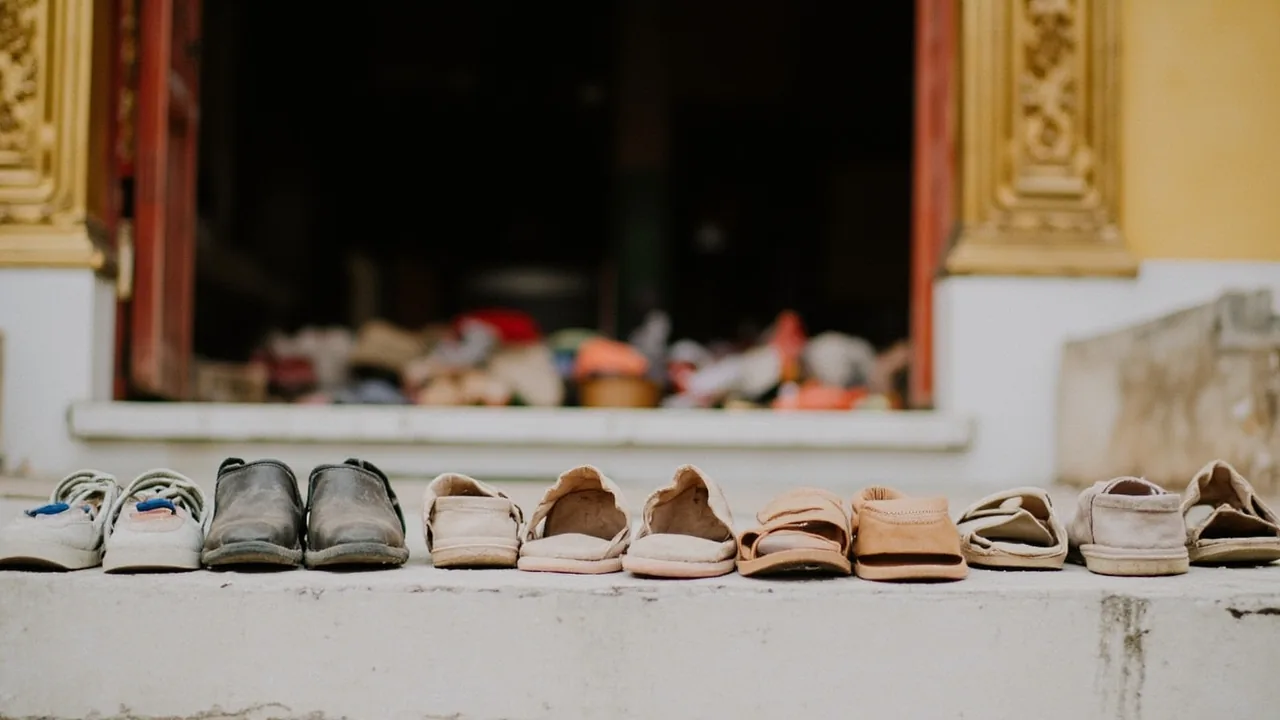
Find the shoe rack near the entrance of the main hall (sometimes called the sim or ubosot). It is often a wooden or metal rack, sometimes just a tiled floor space with other shoes piled there. Place your shoes neatly. Neater piles are generally appreciated. Remove hats and any visible caps before entering; sunglasses worn on top of the head are also considered informal.
Step 3: Step Over the Threshold, Not On It
In many Lao wats the threshold of the main door is raised or decorated; the common custom is to step over it rather than on it. Similar customs are observed across Buddhist, Hindu, and Chinese temples in the region.
Step 4: Lower Your Voice and Move Slowly
Once inside the prayer hall, speak in a low voice or stay silent. Do not run, avoid phone calls, and do not stand directly in front of monks who are praying. If you circumambulate a Buddha image, the customary direction in Theravada wats is clockwise, matching the path of the monks.
Step 5: Observe the Foot Rule
When seated on the floor (which is expected during ceremonies, or if a monk invites you in for a blessing), tuck your legs under you or sit cross-legged with your feet pointing away from the Buddha image. Never point the soles of your feet at the Buddha, at a monk, or at any worshipper. Indian travellers may already be used to a similar idea from Hindu temples, where the feet are kept away from the garbhagriha.
Step 6: Interacting with Monks
- If you are male: a small bow or nod when greeting a monk is considered polite. You can hand items directly to a monk, ideally with both hands as a sign of respect.
- If you are female: do not touch a monk, avoid sitting directly next to a monk, and do not hand items directly to a monk. If you need to give something (a donation, a gift), place it on a cloth or in the offering box, or hand it to a male friend who can pass it on. This is a notable difference from much of Indian temple culture, where women commonly hand prasad or donations to male priests.
- Photography: ask before photographing any monk. Some will agree, especially younger monks, but others will decline. A polite sabaidee (hello) with a small bow is generally well received.
Step 7: Leaving
When you exit, a respectful practice in many Lao wats is to step back a few paces before turning away from the main Buddha image. Some Indian travellers do this automatically from Hindu temple training; in Lao wats the rule is observed loosely but is generally appreciated. Put your shoes back on after stepping off the inner temple floor onto the outer tiles or steps.
Common Mistakes Indians Make at Pakse Temples
Mistake 1: Wearing shorts because “it’s too hot to wear pants” What happens: refused entry to the main hall, or asked to wait outside while your group goes in. Temple staff at major wats enforce the dress code consistently. How to avoid it: pack at least one pair of light cotton pants or a long skirt in your day bag. Markets and guesthouses in Pakse commonly sell inexpensive trousers or sarongs if you forget yours.
Mistake 2: Treating monks like Hindu sadhus What happens: women in particular can cause offence by handing items directly or standing too close. This is not a Lao quirk, it is a hard Theravada rule across Thailand, Myanmar, Cambodia, and Laos. How to avoid it: apply the rule above about female-to-monk transfers. If you have questions, ask your guesthouse owner, who will translate.
Mistake 3: Walking around barefoot in the wrong places What happens: paths between temple buildings can be rough, hot, or dirty underfoot; shoes are typically only required to be removed inside the prayer halls. How to avoid it: wear sandals you can slip off and on easily. Keep them on when moving between buildings on the temple grounds.
Mistake 4: Taking selfies in front of the Buddha image What happens: monks or temple staff will politely but firmly ask you to stop; this is reported most often near the Chinese Temple’s main altar. How to avoid it: take photos of the architecture from the side or from a respectful distance. If you want a photo of the Buddha image, stand at an angle that does not place you between worshippers and the altar.
Mistake 5: Bringing food or drink into the temple What happens: you will be asked to step outside and finish your water bottle. Some temples have a strict no-food policy. How to avoid it: finish your drink and your snack outside the gate.
What Most Guides Don’t Tell You About Pakse Temples
The “Sabbath” factor. Lao Buddhists observe Uposatha days tied to the lunar calendar (typically the full moon, new moon, and the two quarter moons). On these days, temples in Pakse often hold longer ceremonies. If you visit on a Uposatha day the temple can be busier, so speak quietly, sit at the back if you attend a ceremony, and avoid taking photos during sermons or chants.
The Vat Phou connection. Pakse is the gateway to Vat Phou, a UNESCO-listed Khmer temple complex roughly 90 km south of town by road. Vat Phou has both Hindu and Buddhist layers of history and is associated with Shiva worship. The basic dress code is the same as at Buddhist wats, and the foot-pointing rule is observed strictly because of the lingam inside the upper sanctuary. If you are heading there from Pakse, plan at least half a day and check current site rules on arrival. The bus to Si Phan Don from Pakse follows a similar route south - see our Pakse to Si Phan Don bus guide for timings and costs.
The alms round is rare in Pakse. Unlike Luang Prabang, where the dawn sai bat is a well-known tourist event, formal alms rounds in Pakse are limited and monks mostly eat at the wat. If you do encounter monks walking with alms bowls, observe quietly from a distance and do not join in, especially if you are female.
Where to Eat Near the Temples (Veg-Friendly)
After visiting the temples, the practical question is lunch. Most Pakse restaurants near the river serve Lao food with meat or fish as the base. The spots below are commonly recommended for vegetarian travellers. For a full list, see our vegetarian restaurants in Pakse guide.
- Samlee’s Garden Restaurant Pakse is a traditional Lao spot near the temple cluster, with a garden setting and clear labels for vegetarian options. Dish prices vary; a noodle plate typically falls in the lower double-digit thousands of LAK range.
- Heng’s Rice Noodle Shop is a local rice-noodle shop, good for a quick meat-free bowl of khao piak sen. Prices are typically budget-friendly, in the lower thousands of LAK per bowl.
- Mrs Khamla Fish Noodle Soups is named for fish noodle soup, but they do a vegetarian version on request and are often cited as one of the more accommodating kitchens in town for spice level.
- ITALAO Restaurant Pakse is an Italian spot with vegetarian pizza and pasta options, useful as a break from Lao food. Pasta dishes are typically in the mid-to-upper thousands of LAK.
- Champa Hom Restaurant is a quieter local Lao option with garden seating and a small vegetarian section on the menu. Menu specifics and prices should be checked on the day.
Safety Alert: Tap water in Pakse is not drinkable. Stick to bottled water at the temple gates and the restaurants above. Most temples have a free water station outside the prayer hall for visitors.
For Indian travellers specifically, dedicated Indian restaurants are not a common feature in central Pakse. A practical workaround at Lao spots is to ask for “phet mak phet” (spicy, no fish sauce) or to fall back on Italian options like ITALAO. Cities further afield, such as Ubon Ratchathani in Thailand, have a fuller range of Indian restaurants. Our Pakse transport guide covers tuk-tuks and local routes between the temples and restaurants.
Getting Connected in Pakse
You will want a working SIM or eSIM to check temple opening hours, translate Lao signs, and book the occasional tuk-tuk back from a wat on the outskirts of town. Lao Telecom (LTC) and Unitel both have shops near the central market. A 30-day tourist SIM with around 30 GB of data is typically in the tens of thousands of LAK; check current prices on the day as plans change frequently. If you prefer to skip the airport counter, consider an eSIM and activate before you fly. See our where to stay in Pakse guide for accommodation near the temples and market.
FAQ
Do I need to remove my shoes at the Chinese Temple in Pakse too? Yes. The Chinese Temple blends Mahayana Buddhist, Taoist, and Confucian elements, and the same shoe-removal rule applies at the main prayer hall. Outside shrines, shoes are often left on, but follow any local signs or what worshippers around you are doing.
Can women give alms to monks in Pakse? No, not directly. Women can place donations in the offering box, hand items to a male companion who will pass them to the monk, or give items via a cloth. Direct hand-to-hand contact between women and monks is the cultural violation, not the act of giving.
Is Vat Phou covered by the same etiquette? Yes, and even stricter on the foot-pointing rule. Vat Phou is Hindu (Shiva), built in the 9th to 13th centuries. Cover shoulders and knees, remove shoes inside the sanctuaries, and never point your feet at the lingam at the top.
What if I forget and wear shorts? Some wats lend a sarong at the door, but it is not guaranteed. The reliable move is to keep a sarong or light pants in your day bag. You can buy a packable one in Pakse for ₹108-₹173 (~25,000-40,000 LAK or ~$1.12-$1.79) from any morning market.
Can I take photos inside Wat Luang? Yes, generally, but avoid photographing monks without their permission, especially during prayer. Photography is fine in the courtyard and at the ordination hall, but flash photography inside the main sim is considered rude.
Are Pakse temples open every day? Most wats open daily from around 6:00 to 18:00. On Lao Buddhist Sabbaths (the four main lunar quarter days each month), opening hours are the same but the temple is busier with ceremonies. Travellers report that the early morning (6:00 to 8:00) is the quietest, most photogenic time.
Is there an entrance fee? Most wats in Pakse are free to enter, including Wat Luang and the Chinese Temple. Donations in the offering box are welcome. Vat Phou, the UNESCO site, charges an entrance fee in the tens of thousands of LAK; check the official ticket office for the current rate.
Subodh’s Take
Pakse temple etiquette overlaps with much of what Indian Hindu travellers already know (cover up, shoes off, feet away from the sacred), with two notable differences: women should not hand items directly to monks, and the alms-round tourism of Luang Prabang is largely absent here. If you respect the rules, dress modestly, and move slowly, monks and older worshippers are often warm to Indian visitors, and Pakse offers a quieter, more everyday experience of Lao Buddhism than the country’s better-known temple towns.
- Subodh
