Koh Tao Temple Dress Code: What to Know Before You Visit (2026)
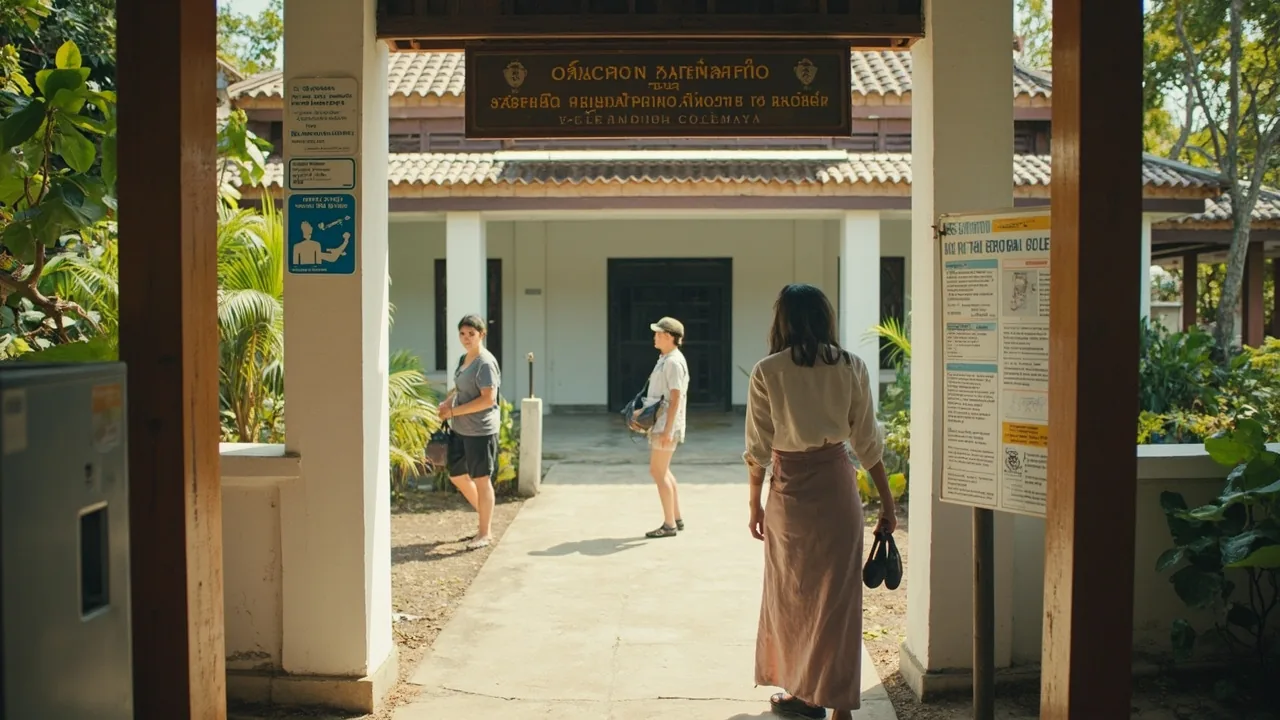
Koh Tao’s temples require shoulders and knees covered, shoes off at every doorway, and quiet voices in the prayer hall. The dress code is enforced strictly at the main Buddha statue on the Sairee hillside and smaller shrines in Mae Haad. This guide covers the exact rules and common mistakes that get travelers turned away.
Quick Answers
| What | Answer | Price (INR) |
|---|---|---|
| Shoulders covered? | Yes, always | , |
| Knees covered? | Yes, always | , |
| Shoes off? | At every doorway and steps area | , |
| Sarong rental | Most temples lend for free or small deposit | ₹0-₹57 (~0-20 THB or ~$0-$0.60) |
| Donations welcome | Yes, but not required | , |
| Photography allowed? | Outside yes, Buddha images usually no | , |
| Best time to visit | Early morning 06:00 to 09:00 (alms rounds); midday 11:00 to 14:00 is quieter in terms of activity | , |
What “Temple” Means on Koh Tao
Koh Tao does not have Bangkok-tier grand wats like Wat Pho or Wat Arun. The island has around a dozen small working temples and shrines, the largest temple on the Sairee hillside (sometimes called Sairee Temple) and a smaller Chinese-Thai shrine near Mae Haad pier. These are not tourist attractions with entrance fees. They are active places of worship used by local fishermen, dive instructors, and Thai residents daily.
That distinction matters because the etiquette is enforced by the temple’s own community, not by tourist-facing staff. The rules around shoulders and knees are not suggestions. They are how Thai Buddhists show respect to the Buddha images and the monks who use the space.
A second thing to know: many of Koh Tao’s viewpoints and trails pass small spirit houses (san phra phum) and shrine markers. The etiquette rules apply to those too, even though there is no formal temple building. Walking past a spirit house without acknowledging it or stepping over it carelessly is considered rude, and locals notice.
The Dress Code, Step by Step
Step 1: Cover your shoulders
This is the single most common reason Indian travelers get turned away at temple entrances on Koh Tao. Tank tops, sleeveless tops, and short-sleeve t-shirts where the shoulder strap shows are all flagged. You need a t-shirt or top with sleeves that fully cover the shoulder bone, ideally down to the upper arm.
A loose cotton t-shirt works. A kurta works. A dupatta thrown over one shoulder technically works but looks awkward and can slip. If you wear a shawl or scarf over a sleeveless top, that is acceptable at most Koh Tao temples, but stricter mainland wats in Bangkok or Chiang Mai may still refuse entry.
Step 2: Cover your knees
This is where Indian travelers get caught out the most. Knee-length shorts, capri pants, and three-quarter leggings are not acceptable at the larger temples on Koh Tao. The rule is that fabric must extend past the knee when standing. Full-length pants, full-length leggings, or a long skirt are the safe choices.
For men: long pants, jeans, or full-length trousers. For women: long pants, salwar, palazzo pants, maxi skirt, or a long dress. If you are coming straight from the beach, the temple will lend you a sarong that wraps around the waist and falls past the knees, but bringing your own long pants is simpler.
Step 3: Take off your shoes
Every temple on Koh Tao has a shoe rack or steps area outside the main prayer hall. You leave your footwear there, tip optional but appreciated if the rack is run by a volunteer. Socks are technically allowed but you will see locals walking barefoot, and socks on temple floors are seen as slightly odd. Flip-flops are fine because they slip off fast.
Step 4: Remove hats and sunglasses
Hats come off at the doorway. Sunglasses come off inside the prayer hall. Head coverings are a sign of disrespect in Thai Buddhist temples (unlike mosques or Sikh gurdwaras where covering the head is required). Leave the cap in your bag.
Step 5: Mind your hands and posture
Do not point your feet at a Buddha image. Do not sit with your feet pointing toward a statue or a monk. Women should not touch a monk or hand anything directly to one (place the object on a cloth or pass it to a male relative). Keep your voice low. No loud talking, phone calls, or music.
Step 6: Photography rules
Outside the main prayer hall, photography is fine. Inside the hall where the main Buddha image sits, most Koh Tao temples prohibit flash photography and many prohibit photos entirely. Look for signs. If in doubt, ask a caretaker before raising your phone.
Common Mistakes Indians Make
Showing up in beachwear and expecting the temple to “let it slide”
What happens: at the main Sairee hillside temple and the Mae Haad shrine, the gate volunteer will politely stop you and ask you to cover up. They will lend you a sarong, but if you refuse or argue, you will be asked to leave. Thai temple etiquette is not enforced by security guards; it is enforced by community elders who do not have time for back-and-forth.
How to avoid: bring a long pair of pants and a sleeved top in your day bag. If you are staying near Sairee and plan to walk to the temple after a dive or beach session, plan a quick clothing change. The temple visit takes 20 minutes; the wardrobe change takes 5.
Wearing shorts that are “almost” knee-length
What happens: a pair of shorts ending two inches above the knee reads as shorts to the gate volunteer. There is no “almost covered” zone. The rule is full coverage past the knee joint.
How to avoid: when packing for Koh Tao, bring at least one pair of full-length pants. Men in jeans, women in palazzos or salwar, both work. If you only packed for diving, buy a cheap pair of fisherman pants at the 7-Eleven near Mae Haad pier for ₹718 (~250 THB or ~$7.45).
Pointing feet at the Buddha while sitting for a photo
What happens: feet pointed at a Buddha image is one of the rudest things you can do in a Thai temple. Locals will not say anything to your face, but they notice, and monks have been known to quietly ask foreign visitors to adjust their position.
How to avoid: when sitting inside the prayer hall, sit with your legs tucked to one side or cross-legged, with your feet pointing away from any Buddha image, monk, or shrine. If there is a designated seating area, use it.
Loud group chatter and phone calls inside the hall
What happens: Thai temples are quiet meditation and prayer spaces. Loud laughter, group selfies with sound, and phone conversations are jarring in that setting. Locals will stare. Some will leave.
How to avoid: put your phone on silent before entering. Step outside to take calls or for any conversation longer than a quick exchange.
Touching monk robes or sitting next to a monk if you are a woman
What happens: physical contact between women and monks is governed by Buddhist monastic rules. Touching a monk’s robe, sitting next to a monk on a bench, or handing a monk an object directly is considered inappropriate.
How to avoid: if you are female, keep a respectful distance from any monk you encounter. If you need to give something to a monk (a donation, a flower), place it on a cloth he is holding, or hand it to a male companion who can pass it on.
What Most Guides Don’t Tell You
Sarongs at Koh Tao temples are free, but the deposit system varies
Unlike Phuket or Bangkok where sarong rentals can cost ₹57-₹115 (~20-40 THB or ~$0.60-$1.19), most Koh Tao temples lend a sarong for free or with a ₹57 (~20 THB or ~$0.60) coin deposit you get back when you return it. The catch: if you walk away with the sarong (intentionally or by accident), that temple has to replace it out of community funds. Bring your own cover-up and you skip the whole question.
The viewpoint temples have hidden etiquette
Koh Tao’s two best-known viewpoints, the generic Viewpoint hike off Sairee and the John-Suwan Mountain Viewpoint, both pass small spirit houses and shrine markers along the trail. Most travelers walk straight past them, which locals find mildly disrespectful. A small bow or a quiet “sawadee” as you pass is enough. You do not need to stop and pray. Just acknowledge the space exists.
If you plan to hike these, a local guide can point out the shrines and explain local customs as you go.
Koh Tao’s main temple has no set visiting hours, but early morning is best
The main Sairee hillside temple is open from around 06:00 until dusk, but the most respectful time to visit is early morning when monks are doing their alms rounds and locals are making merit. Midday (11:00 to 14:00) is fine but quieter in terms of activity. Sunset visits are popular for photos but the prayer hall is often closed for evening chanting.
The Sairee shrine has a small dress code sign in Thai only
The Mae Haad shrine near the pier posts its dress code rules in Thai script only. There is no English translation. If you show up and a sign is up, the gate volunteer will point at your knees or shoulders and mime the cover-up gesture. They will not be rude, but the lack of English signage is a common reason first-time visitors miss the rule entirely.
Koh Tao Activities Beyond the Temple
Planning the wider region? Our Southeast Asia backpacking hub covers the full multi-country route. Koh Tao is a diving island first, and a temple-visiting island a distant second. Most backpackers are here for the Open Water certification, which costs ₹22,960-₹34,440 (~8,000-12,000 THB or ~$238.29-$357.43) depending on the school and runs 3 to 4 days. Four dive schools come up consistently in traveler feedback:
- Big Blue Diving School Koh Tao tour: large school with multiple course options, good for first-timers.
- Koh Tao Impian Divers: Nederlandse duikschool tour: Dutch-run, smaller group sizes, strong instructor feedback.
- French Kiss Divers - Koh Tao tour: French-run, friendly atmosphere, popular with solo travelers.
- Unseen Tours - Koh Tao: for off-the-beaten-path cultural walks including lesser-known shrines.
For something different, the Treasure Island Challenge is a half-day activity that mixes hiking, problem-solving, and stops at viewpoints most tourists never see.
Where to Eat After the Temple
Koh Tao is not a vegetarian paradise, but there are solid local spots for breakfast or lunch after a temple visit. At current rates (1 THB ≈ ₹2.87), 200 THB ≈ ₹574.
- Love Koh Tao (rating 4.9): garden setting near Sairee, famous for massaman curry (₹517 (~180 THB or ~$5.36)) and seafood platters (₹1,005-₹1,579 (~350-550 THB or ~$10.43-$16.38)). Not strictly veg but has solid vegetable curries and pad pak (stir-fried greens, ₹345 (~120 THB or ~$3.57)).
- Krua Siam (Koh Tao) (rating 4.9): traditional Thai, casual setting, good for tom yum and green curry (₹431 (~150 THB or ~$4.47)). Vegetable options available on request.
- Croissant & Ko (rating 4.9): bakery cafe, best for egg-based breakfasts and pastries (₹172-₹345 (~60-120 THB or ~$1.79-$3.57)). Limited Thai food but good coffee.
- Chacha Beach Café & Restaurant (rating 5): beachfront, casual, mixed menu with Western and Thai dishes (₹517-₹861 (~180-300 THB or ~$5.36-$8.94)).
- Karaweik (rating 4.9): lively atmosphere near Mae Haad, good for group dinners, mixed Thai menu (₹574-₹1,149 (~200-400 THB or ~$5.96-$11.91)).
For strictly veg Indian food, the Indian restaurants on Koh Tao cluster around Sairee and Mae Haad. Most serve thali (₹517-₹718 (~180-250 THB or ~$5.36-$7.45)) and paneer-based curries. They are not on the shortlist above, but they exist. Ask your hostel for a recommendation on the day.
Getting Connected on Koh Tao
Koh Tao has 4G coverage on most of the island but drops to 3G or no signal on the John-Suwan hike and along parts of the south coast. Two practical options:
Physical SIM: AIS or TrueMove SIMs are sold at the 7-Eleven near Mae Haad pier. ₹859 (~299 THB or ~$8.91) for 7 days with 15 GB. Bring your passport for registration. AIS has slightly better coverage on the north end.
ESIM: If you do not want to swap your Indian SIM, Nomad eSIM (nomadesim.com) works in Thailand and activates on arrival. Priced in USD, plans start at ₹868 (~9 USD) for 5 GB over 30 days.
Safety and Common Sense
Koh Tao is generally safe for solo travelers, including women. The main risks are scooter accidents (hills are steep, brakes are old, sand on the road is a hazard after rain) and petty theft from unlocked bungalows. Use a hostel locker, lock your scooter with a disc lock, and avoid riding after dark on the south coast road.
For temple visits specifically: dress modestly, do not bring valuables into the prayer hall, and do not enter any temple if you have been drinking. Some temples will quietly turn away visitors who appear intoxicated.
Before any international trip, check the Indian Ministry of External Affairs travel advisory at mea.gov.in for current Thailand-specific guidance. If you are still choosing travel insurance, make sure the policy covers scooter accidents, which are the most common injury claim from Koh Tao. Embassy contact details for Bangkok and the honorary consulate in Phuket are also listed there.
FAQ
Do I need to cover my head in a Koh Tao temple?
No. Thai Buddhist temples require you to remove hats inside, not cover your head. Wearing a hat or cap inside a prayer hall is considered disrespectful.
Can I wear a sleeveless top with a shawl thrown over it?
At most Koh Tao temples, yes. At stricter mainland wats (Wat Pho, Wat Phra Kaew in Bangkok), no. For Koh Tao specifically, a shawl over a sleeveless top is generally accepted.
Are Koh Tao temples free to enter?
Yes. All temples on the island are free to enter. Donations are welcome but not required. The sarong loan is also free or has a small ₹57 (~20 THB or ~$0.60) deposit.
Can I take photos inside the prayer hall?
Most Koh Tao temples prohibit photos of the main Buddha image and flash photography in the prayer hall. Outside photos and photos of the temple grounds are fine. Look for signs or ask a caretaker.
What do I do if I show up in shorts?
The temple will lend you a sarong to wrap around your waist, free or for a ₹57 (~20 THB or ~$0.60) deposit. If you do not want to wear a sarong, you will be asked to wait outside or come back with proper clothing.
Is there a specific etiquette for women at Thai temples?
Women should not touch monks or hand objects directly to them. Sitting next to a monk on a bench is also considered inappropriate. The general dress code (covered shoulders and knees) applies equally to men and women.
Do children need to follow the same dress code?
Yes. Children should also have shoulders and knees covered. Parents traveling with young kids should bring a spare t-shirt and long pants in the day bag for temple visits.
Subodh’s Take
The dress code looks fussy until you see a Koh Tao local pausing at a shrine on the way to work, taking two seconds to bow and move on. That pause is what the rules are about: showing the space matters, even briefly. Bring one long pair of pants and one sleeved top in your day bag, and you will never have a problem. The temples on Koh Tao are small and quiet, and a five-minute visit done correctly is worth more than an hour of sightseeing done wrong.
