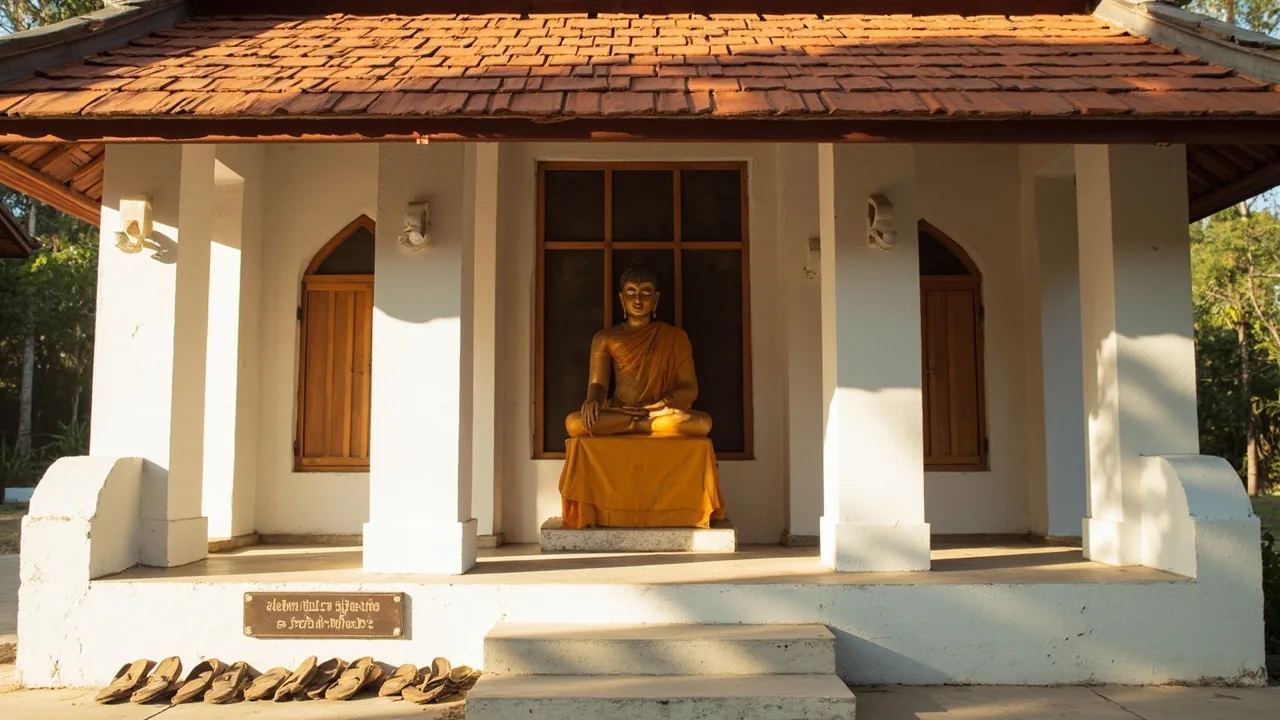
Koh Yao Yai Temple Etiquette: A Cultural Guide for Indian Backpackers
Koh Yao Yai temples follow standard Thai Buddhist etiquette: cover shoulders and knees, remove shoes before entering the ordination hall, never point your feet at a Buddha image, and ask before photographing worshippers. The island has a few small wats near the main villages, all casual, all welcoming to visitors who show up modestly dressed and quiet. Planning the wider region? Our Southeast Asia backpacking hub covers the full multi-country route.
Quick Answers
| What | Answer | Price (INR) |
|---|---|---|
| Is there a dress code at Koh Yao Yai temples? | Yes, cover shoulders and knees | , |
| Do I need to remove shoes? | Yes, before entering the ubosot (ordination hall) | , |
| Can I take photos inside? | Outside yes, inside the hall usually no | , |
| Best time to visit | Early morning (6-9 AM) or just before evening chanting | , |
| Entry fee | Free, donations welcome | , |
What Is a Thai Buddhist Temple (Wat)?
A wat (วัด) is a Thai Buddhist temple complex. The main building, called an ubosot or bot, is the ordination hall where monks are ordained and where the most sacred Buddha images sit. Surrounding structures typically include a chedi (stupa), a sala (open pavilion), monks’ quarters, and sometimes a crematorium. On Koh Yao Yai, the wats are smaller and quieter than Bangkok’s famous ones, but the etiquette inside is identical to any wat across Thailand. Treat every Buddha image, monk, and shrine the same way you would at Wat Pho. The island’s Muslim-majority population adds another layer: many Koh Yao Yai residents are Sunni Muslim, and the temples serve the Buddhist minority, often with a mosque a few hundred metres down the road. Both sites deserve equal respect.
Step-by-Step: Entering a Koh Yao Yai Temple the Right Way
Step 1: Dress before you leave the guesthouse
The single biggest mistake Indian backpackers make is turning up in beach clothes. Beach clothes and temple clothes are two different wardrobes. Bring a shirt that covers your shoulders (a kurta works), trousers or a long skirt past the knee, and a thin scarf or stole in your daypack for backup. At smaller island wats the dress code may be enforced gently (a sarong is sometimes loaned at the door), but the larger wats can turn you away at the gate.
Subodh’s Pro Tip: Pack a lightweight cotton longyi or a folded dupatta in your day bag. It costs nothing, weighs 80 grams, and saves you the embarrassment of being handed a faded rental sarong at the entrance.
Step 2: Approach the wat complex on foot
Don’t drive a scooter right up to the main hall. Park at the gate, walk in slowly, and pause at the boundary spirit house (a small orange or red shrine on a pedestal). Spirit houses are not Buddhist, they are animist-Brahman, but they’re sacred to the locals and you’ll see them at almost every Thai building. Don’t pose for selfies with them.
Step 3: Remove your shoes at the ubosot steps
Look for the row of sandals and flip-flops at the bottom of the stairs. Everyone leaves footwear there. If you don’t see any, that’s a sign the hall is closed, not that shoes are allowed. Carry your shoes with you if there’s no clear pile, or set them neatly to one side. Never wear shoes up to the door and then take them off at the threshold, that signals you don’t know what you’re doing.
Step 4: Watch where your feet point
Inside the ubosot, the Buddha image sits on an elevated altar at the front. Your feet must never face the Buddha, the monks, or the altar. Sit with your legs tucked sideways under you (the “mermaid pose” Thai women use), or kneel with your feet behind you. Men sit cross-legged. Don’t stretch your legs out in front of you as if you’re at a cinema. The same rule applies during the evening chanting ceremony (around 6 PM) when monks file in and chant Pali verses.
Step 5: Don’t touch the monks (and don’t get too close if you’re female)
Thai Theravada Buddhism is male-monastic, so on Koh Yao Yai you’ll see only male monks in saffron. Don’t touch them, don’t hand them anything directly (especially women, who should pass objects through a male intermediary or place them on a cloth). For Indian Hindu women used to taking darshan of sadhus and male priests, this is the most counterintuitive rule. A respectful two-arm distance is enough.
Step 6: Photos and phones
Outside the ubosot, photos are fine. Inside the ubosot, photos are usually not allowed, look for signs (often in Thai only) or just observe what locals do. If everyone has their phone in their bag, so should you. No flash photography anywhere. No selfie sticks. No posing with your back to a Buddha image. No photos of monks without permission, especially not of young novices.
Step 7: Make a small donation if you can
There’s no entry fee, but a small offering of ₹57-₹144 (~20-50 THB or ~$0.60-$1.49) in the donation box is appreciated. You can also buy joss sticks, flower garlands, or small gold leaf squares from the stall outside the wat (₹29-₹287 (~10-100 THB or ~$0.30-$2.98)). Place three incense sticks at the main Buddha, light them, bow slightly, then place a flower garland at a smaller shrine if one is provided. Don’t worry about getting the ritual exactly right, the locals notice the effort, not the choreography.
Common Mistakes Indians Make at Koh Yao Yai Temples
Mistake 1: Wearing shorts and tank tops
What people do wrong: Showing up in board shorts and a sleeveless tee from the morning’s beach session. What happens: You’ll be politely asked to cover up, or handed a sarong that’s been wrapped around a hundred other tourists that week. In a worst case, you’ll be turned away at the gate. How to avoid it: Plan temple visits for the second half of the day, after you’ve changed into proper clothes at your guesthouse.
Mistake 2: Sitting with feet pointing at the Buddha
What people do wrong: Plopping down cross-legged or stretching out tired legs after a scooter ride. What happens: A monk or temple keeper may quietly gesture for you to reposition, which is embarrassing in a quiet hall. How to avoid it: Sit in the mermaid pose or kneel. Watch how Thai visitors sit for 60 seconds, then mirror them.
Mistake 3: Loud group selfies
What people do wrong: Group of friends doing Instagram reels outside the ubosot, laughing, music playing. What happens: It’s not illegal, but the temple keeper will shoo you out fast and you’ll feel like the worst tourist of the day. How to avoid it: One quiet photo each, no music, no chanting-along reels. The quiet wats on Koh Yao Yai are 80 percent of their charm. Don’t break that.
Mistake 4: Touching the Buddha image or relics
What people do wrong: Reaching out to touch a Buddha statue for “good luck” or rubbing a sacred relic. What happens: This is a serious breach. Many old Buddha images have centuries of gilt flaking off; your fingers leave oils and acids. How to avoid it: Hands at your sides. Bow from a distance. If you want to make merit, put money in the box.
Mistake 5: Mistaking the local mosque for a temple (or vice versa)
What people do wrong: Koh Yao Yai has a Muslim majority, and the mosques (with minarets and Arabic calligraphy) sit alongside the wats, so the same temple etiquette around dress and shoes applies at both kinds of sacred sites. Wandering into the wrong building in beachwear. What happens: A polite but firm request to leave from either side. How to avoid it: Look at the symbols. Buddha images and saffron-robed monks = wat. Crescent moon, Arabic script, minaret = mosque. Both deserve shoes-off, modest-dress, quiet-voices respect.
What Most Guides Don’t Tell You
The cave shrines on the east coast have a different etiquette
A few of Koh Yao Yai’s smaller shrines are quiet, informal sites visited mostly during Buddhist Holy Days (Wan Phra). The rule about not pointing feet at the Buddha image still applies, and etiquette at these quieter spots is more about leaving the space as you found it. No litter, no loud music, no smoking.
The evening chanting (around 6 PM) is open to visitors
Most of the larger wats hold evening chanting (ทำวัตร) where monks chant Pali verses for 20 to 30 minutes. Anyone can sit in the back and observe, even without Buddhist belief. Just enter quietly, sit to the side (not in the monks’ path), and stay until the monks leave. Don’t walk in front of the seated monks or pass between them and the Buddha image. If a layperson hands you a small white lotus flower, accept it, hold it, and place it at the front altar after the chanting ends. You don’t have to chant along, just sit still.
Festivals and Holy Days change everything
If your visit overlaps with Songkran (mid-April), Visakha Bucha (May full moon), or Asalha Bucha (July full moon), expect the island’s wats to be packed with locals. Dress extra modestly, arrive before 7 AM, and don’t bring a scooter into the temple grounds. The biggest mistake travellers make during festivals is treating the wat like a tourist site. During these days the wat is a community centre, not a heritage stop.
What Else to Do on Koh Yao Yai
Temple visits rarely take more than two hours, so plan a half-day around them. The island is small, slow, and mostly Muslim-fishing-village Thailand, which makes it a refreshing contrast to Phuket’s chaos just across the channel.
Where to Eat Near the Wats
Koh Yao Yai has no hostels in the conventional backpacker sense, and the island’s dining scene is mostly family-run beach shacks. No shortlist restaurants are currently verified on Koh Yao Yai itself, so for Indian-friendly dining options you’ll want to look at the larger Thai islands instead. Ask your guesthouse for nearby halal beach shacks.
Local and regional spots
- No shortlist venues available on Koh Yao Yai at this time.
Getting Connected (SIM and eSIM)
Koh Yao Yai has patchy 4G outside the main villages, and the AIS and TrueMove networks both work on the island. A Thai tourist SIM from either provider is around ₹859 (~299 THB or ~$8.91) for 15 days with 15 GB of data, available at Phuket airport before you take the ferry. If you’d rather not swap your Indian SIM, an eSIM works from the moment your flight lands. For broader Thailand trip budgeting, see our guide.
Get Nomad eSIM is the cleanest option for Indian travellers: 1 GB for 7 days starts at around ₹482 (~5 USD), no passport upload, instant activation by QR code.
Safety and General Etiquette on the Island
Beyond temple etiquette, Koh Yao Yai is one of the safer Thai islands. Petty theft is rare, the local Muslim population is famously welcoming to Indian visitors, and violent crime against tourists is rare. The two practical concerns for Indian backpackers are:
- Scooter safety: Roads are rough, often unlit at night, and most accidents on the island involve tourists who haven’t ridden scooters before. Hire through your guesthouse, wear a helmet, and skip the night rides.
- Beach flag warnings: Some west-coast beaches have strong rip currents from May to October. Read the flag at the beach entrance and don’t swim if it’s red.
Safety Alert: For current travel advisories before flying, check the Indian Ministry of External Affairs travel advisory page (mea.gov.in) and the Thai government’s own tourism safety portal. Conditions can shift during monsoon season.
FAQ
Can I enter a Koh Yao Yai temple in shorts if I wrap a sarong?
Mostly yes, but it’s a gamble at the larger wats. A proper sarong tied at the waist that covers your knees is usually accepted. Board shorts under a sarong still look casual, so wear trousers or long shorts underneath.
Are Koh Yao Yai temples open every day?
Yes, daylight hours. Most wats open around 6 AM and close at sunset. The ubosot may be locked between morning and evening chanting for cleaning.
Can I attend an evening chanting as a non-Buddhist?
Yes. Sit at the back, stay quiet, and don’t walk between the monks and the Buddha image. You don’t have to chant, just observe.
Is it OK to give food to the monks?
Yes, but read the rules first. Thai monks eat only before noon and don’t eat meat they’ve selected themselves. The safest offering is uncooked sticky rice, fruit, or packaged snacks left in the donation bowl rather than handed directly to a monk.
Do I need to speak Thai to visit a wat?
No. A respectful wai (palms together, slight bow) and a quiet voice get you through any wat in Thailand. Thai people are forgiving of language gaps.
Are there separate rules for women during menstruation?
Some Thai wats ask women to skip the ordination hall during their period. This is a traditional belief, not enforced at the smaller island wats, but if you’re visiting during Asalha Bucha or a major holy day, you may see the rule signposted.
What’s the difference between Koh Yao Yai and Koh Yao Noi?
Koh Yao Yai is the bigger, less-developed island with more wats and more beaches. Koh Yao Noi is the smaller, more backpacker-oriented island with most of the hostels. Temple etiquette is identical on both.
Subodh’s Take
Koh Yao Yai temple etiquette isn’t complicated. It’s the same dress code, the same shoe rule, the same feet-direction rule you’ll find at every wat from Chiang Mai to Surat Thani. The island rewards the traveller who shows up quietly, dressed modestly, and treats the small island wats with the same respect they’d give to Bangkok’s royal temples. Most Indian backpackers already understand temple etiquette from Hindu temple visits back home: no leather inside some temples, no pointing feet at the deity, modest dress, quiet voice. The Thai version is softer but no less sincere. Follow the steps above and you’ll be fine, and you’ll probably have a more peaceful temple visit than you’ve had in years.
