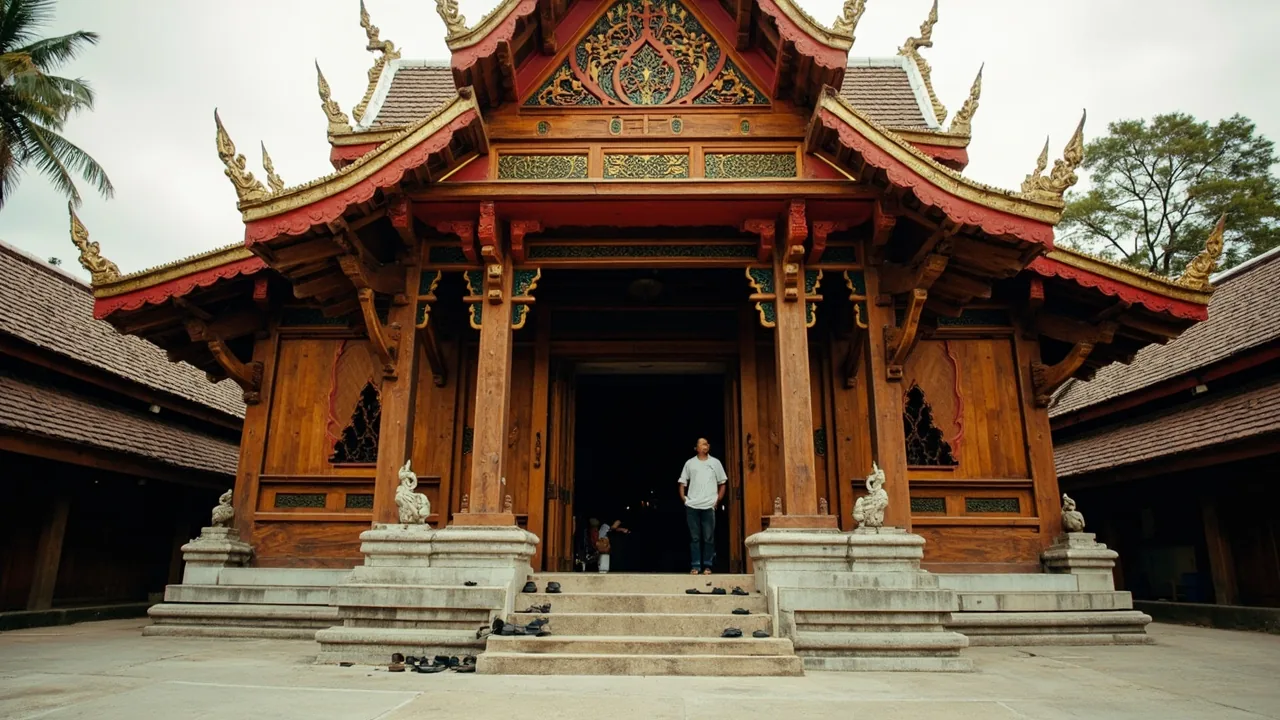
Koh Kood Temple Etiquette for Indians (2026): The Behaviour Guide
Koh Kood’s temples follow standard Thai Buddhist etiquette: cover shoulders and knees, remove footwear before entering the ordination hall, never point your feet at a Buddha image, and ask before photographing monks or worshippers. None of this is unique to Koh Kood, but the island is so quiet that one wrong move gets noticed, and locals remember poor etiquette.
If you only follow one Thai temple rule, make it the shoulders-and-knees one. It is the single most common reason Indian travellers get politely turned away at the door.
What Is Koh Kood, and Why Are Its Temples Different?
Koh Kood (sometimes spelled Koh Kut) is Thailand’s fourth-largest island, sitting close to the Cambodian border in Trat province. Unlike Phuket or Koh Samui, it has no big commercial wat catering to tour groups. The active temples here are small community wats serving the local fishing and rubber-tapping population. They are working places of worship, not photo sets.
That is what makes them different. A temple like Wat Salak Phet, in the old fishing village of the same name, has a 200-year-old wooden ordination hall (ubosot) that sits on a mangrove-lined tidal basin. Locals come here to pray, make merit, and leave offerings. There is no admission fee, no English signage, and few other tourists. When you walk in, you are walking into someone’s daily spiritual life.
For Indian visitors this matters for two reasons. First, the etiquette bar is higher than at Bangkok’s Wat Pho or Chiang Mai’s Wat Phra Singh, where tourist traffic has softened expectations. Second, the temples themselves are the reason many Indian travellers come to Koh Kood. The old Chao Por shrine at Ao Yai, the forest hermitages inland, and the bayside wats are as much “Koh Kood things to do” as any beach. Getting this right is the difference between a forgettable visit and the highlight of the trip. See our Southeast Asia backpacking hub for more country-level guides.
Quick Answers
| What | Answer | Price (INR) |
|---|---|---|
| Entry fee at Koh Kood temples | Free, donations welcome | , |
| Dress code | Shoulders AND knees covered | , |
| Footwear | Off at the ubosot door | , |
| Photography of statues | Usually fine (no flash) | , |
| Photography of monks | Ask first, never alone with female visitor | , |
| Best temple visit time | Early morning 6.30 to 8.30 am, or during the evening chanting at 6 pm | , |
| Female visitor contact with monks | No physical contact, keep distance | , |
All prices in this guide are in Thai Baht (THB). At the current rate of 1 THB ≈ ₹2.87, a 100 THB donation is roughly ₹287.
Step-by-Step: The Right Way to Visit a Koh Kood Temple
Step 1: Dress before you leave the bungalow
The dress code at every active Thai wat is the same: shoulders covered, knees covered, no tight clothing, no visible cleavage. A loose cotton shirt or kurta over a long skirt, palazzo, or full-length trousers works. For a broader breakdown, see our dress code guide for Southeast Asian temples. Indian travellers already dress this way day-to-day, which gives you a real advantage here. Travellers report that shorts and tank tops get refused at the ubosot door, even at the most tourist-friendly wats on the eastern seaboard.
Carry a thin scarf or sarong in your daypack. Even if you walked out of your bungalow “covered enough,” a scarf handles the awkward moment when the temple’s own sign asks for “more than just covered” and you realise your sleeveless top technically fails.
Shoes off means shoes off. There is no “I’ll just step inside for a photo” exception. Carry socks if you are squeamish about temple floors; they get walked on barefoot by hundreds of locals in a day.
Step 2: Walk in low and slow
Thai temple entrances are nearly always guarded by two guardian figures called lan than, half-bird half-human statues. Step around them, never on the platform they stand on. Walk through the gate’s side door if there are three: the central door is reserved for monks and royal figures, and stepping through the centre as a layperson is a quiet breach.
Once inside the compound, move at a relaxed pace. The wats on Koh Kood are small. You will cover the whole grounds in 10 minutes. Rushing reads as disrespectful and you will miss the small details, like the offering trays laid out at the foot of the main Buddha, which are worth a slow look.
Step 3: The ordination hall (ubosot) is the strictest room
The ubosot is the most sacred building on the grounds. It is usually a square or rectangular hall with a boundary stone (sema) at each corner. Treat it the way you would treat a sanctum in a Hindu temple back home.
- Leave shoes, hat, and sunglasses outside the door.
- Enter through the side door, never the back.
- Sit with your feet tucked behind you, pointing away from the Buddha image.
- Do not raise your feet on a bench, point your toes at anyone, or rest your feet on a donation box.
- Speak in a low voice. Phone on silent.
- Do not stand higher than a seated monk, including on a step.
If a service is in progress, sit quietly at the back until the chanting ends. Do not walk across the front of the hall.
Step 4: Outside buildings, statues, and the Bodhi tree
Around the temple compound, statues of Buddha, the four-armed Phra Phrom, or local guardian spirits are common. These are sacred. Travellers report that the most common mistake Indian visitors make at small Thai wats is sitting on a low Buddha statue’s lap for a “cute” photo. Never sit on, climb, or pose playfully with any statue, no matter how small or weathered.
The large Bodhi tree (the ficus religiosa, called “Pho” in Thai) is often wrapped in coloured sashes where people make wishes. Walk around it clockwise three times if you choose to join in, the same way you would circle a sacred tree at home.
Step 5: Photography that does not cause problems
Photography is allowed in the outer compound at nearly all Thai temples, including the wats on Koh Kood. Inside the ubosot, it depends on the temple. Look for a sign, ask the monk or caretaker if there is one nearby, and when in doubt, put the camera away.
Three hard rules:
- No flash inside any hall. It damages old murals and reads as intrusive.
- Never photograph a monk without asking. A raised hand palm-out is the polite “no.” If you get a smile and a nod, you may shoot.
- Never pose standing next to a monk for a selfie, especially if you are a woman. Buddhist monastic rules forbid physical contact between monks and women. Stand at arm’s length, do not touch, and avoid the selfie that looks friendly but reads as a violation on the monk’s side.
Step 6: Donations and merit-making
There is no entry fee at Koh Kood’s temples. A small donation (100-500 THB) buys you real goodwill and keeps the wat maintained. Drop it in the wooden donation box, never hand it to a monk directly. If you want to make a more formal offering, you can buy a set of jasmine garlands, incense, and gold leaf from the small kiosk at the entrance; this is the closest local equivalent to a Hindu temple offering.
To gain merit, light three incense sticks, bow once with hands in wai at chest height, and place the sticks in the bowl in front of the Buddha image. Bow again. The whole sequence takes 30 seconds and is the Thai equivalent of a quick darshan.
Step 7: Move on cleanly
When you leave, walk out the way you came in, putting on your shoes only at the temple gate, not on the ubosot’s threshold. A small bow at the gate towards the ubosot is a nice touch. Travellers report that doing this earns you a friendly nod from locals who notice you are following the form.
Common Mistakes Indians Make at Koh Kood Temples
Mistake 1: Showing up in beachwear. “What happens: You are asked to wait outside while someone from the temple finds you a sarong, which is embarrassing and slows everyone in your group. How to avoid it: Pack a cover-up in your day bag on temple days. Beach first, temple second, or the other way around, but never the same outfit for both.”
Mistake 2: Pointing feet at a Buddha image. “What happens: It is read as a serious insult. Locals will not say anything directly, but the temple staff will quietly watch you for the rest of the visit. How to avoid it: Tuck your feet under you when seated on temple floors. Never stretch your legs out in the direction of any statue, monk, or worshipper.”
Mistake 3: Touching a monk (especially women touching monks). “What happens: Female visitors who brush past a monk, accept a blessing with a handshake, or hand an offering directly will be politely refused. The monk has not done anything wrong; the monastic code forbids the contact. How to avoid it: Women, pass objects to a monk through another man, place items on a cloth, or set them down for the monk to pick up. Men, a wai at chest height is the correct greeting, no handshake needed.”
Mistake 4: Climbing on statues for photos. “What happens: You will get told to come down, loudly, and the photo you wanted is now a small social incident. How to avoid it: Treat every statue, even the small ones on the ground, as if a priest were standing there.”
Mistake 5: Loud talking or phone calls on the compound. “What happens: The wat has no posted rule against it, but it breaks the calm and marks you as the visitor who does not understand the space. How to avoid it: Silent phone from the moment you walk in, low voices, no music.”
What Most Guides Don’t Tell You
The monks here often speak more English than you expect
Koh Kood has had a small but steady flow of backpackers since the late 2000s. The monks at the main wats have learned practical English for the simple exchanges with visitors. A polite “Sawasdee krap” (male) or “Sawasdee ka” (female) opens most conversations. If a monk offers to explain a statue or festival, that is a real opportunity, not a sales pitch. Travellers report that conversations like this are some of the best cultural moments of an island visit.
The Chao Por shrine at Ao Yai is not technically a temple
Ao Yai’s Chao Por shrine (spirit shrine for the “Father Lord,” a Chinese-Thai guardian figure) sits on a small hill above the bay. It is more animist than Buddhist, and the etiquette is slightly looser. You can usually photograph it, you do not need to remove shoes at the small altar, and offerings of incense and red Fanta are common (the bright red drink is a long-standing local offering). Worth a visit for the view alone, even if you are not interested in the spiritual side.
Some wats hold a 6 pm chanting session that visitors can join
If you are on Koh Kood during the cool season (November to February), ask at your bungalow if the local wat is holding evening chanting. The sessions are short (20 to 30 minutes), seated on the floor, and you can join at the back. It is a chance to see the wat at its most alive, and unlike a daytime visit, you will see the community in full dress. Sit the way you would in the ubosot, feet tucked, voice quiet.
Temple etiquette overlaps with Thai etiquette in general
The shoes-off, shoulders-covered, feet-tucked rules are not temple-specific. You will be expected to remove shoes in many Thai homes, some small shops, and certain massage places. Treat the temple as your training run for the broader cultural code. Our temple etiquette in Southeast Asia guide covers the country-by-country variations. Useful background reading: our carry money guide for Indian travellers abroad goes into the cash side of things, which is what you will use for donations.
Forest retreats inland are a different category
Some travellers report finding small forest hermitages in the interior of Koh Kood, accessed by foot or motorbike. These are not tourist sites. If you find one, do not enter the monk’s kuti (dwelling) without being invited in. Leave any small donation, do not photograph the monk’s living quarters, and walk out the way you came in. This is not a place to seek out publicly; respect the privacy and the site stays open to the next visitor.
FAQ
Do I need to remove my shoes at every Koh Kood temple?
Yes, before entering the ubosot (ordination hall) and any prayer hall. Shoes stay on in the outer compound and on walkways. Look for the row of slippers at the door, that is the visual cue.
Can I wear my kurta and jeans?
Yes. A kurta over full-length trousers or a long skirt is ideal. It is also more comfortable than beach clothes in the temple’s cooler interior. Monks and temple caretakers are visibly more at ease when visitors arrive well-dressed.
Is there an entry fee?
No. All active wats on Koh Kood are free. A donation of ₹287-₹1,436 (~100-500 THB or ~$2.98-$14.89) is welcome and useful.
Can women enter the ordination hall?
Yes, women can enter all parts of a Thai wat, including the ubosot, with the same dress code as men. The single rule to remember is no physical contact with monks, including a handshake when receiving a blessing.
Are Koh Kood temples open to non-Buddhists?
Yes, all are open to visitors. You will not be asked your religion at the door. Just follow the same etiquette, stay quiet during services, and you are welcome.
What is the best temple to visit on Koh Kood?
Most travellers report Wat Salak Phet in the southern fishing village as the most atmospheric, because of the old wooden ubosot over the mangroves. The Chao Por shrine at Ao Yai is the most photographed, and the inland hermitages are the most peaceful. Plan for two or three temple stops, not just one.
Is it safe to visit temples alone?
Yes. Koh Kood is one of Thailand’s safest islands, and temples are open during daylight hours with regular local visitors. Solo female travellers should follow the same dress code and respect the monk-distance rules; see our solo female travel guide for Southeast Asia for broader context.
Getting Around to the Temples
Koh Kood has no public transport. To reach the inland and southern wats, you will need a rented scooter (₹718-₹1,005 (~250-350 THB or ~$7.45-$10.43) a day) or a songthaew arranged through your bungalow. Roads are paved on the main east-coast strip and rougher inland. Wear shoes you can walk temple floors in; flip-flops are fine for scooters but not for ubosot visits. For a full budget breakdown, see our Koh Kood on a backpacker’s budget guide.
From the mainland, the standard route is a minivan from Bangkok to Trat (check routes on 12go), then a ferry from Laem Sok pier. Many Koh Kood visitors also fly Bangkok to Trat on Bangkok Airways, which cuts the journey to about an hour. The ferries run once or twice a day in low season, more often in high season, and the crossing takes about 90 minutes.
Subodh’s Take
Temple etiquette on Koh Kood is the easiest part of the trip to get right and the most expensive part to get wrong, in social terms. Indian travellers already have a real advantage here: the dress code lines up with what you wear to a temple back home, and the respectful body language (low voice, eyes down, feet tucked) is second nature to anyone raised in a devotional household. Show up covered, walk in low, take your shoes off at the door, and you will have a better temple visit than 90% of the Western backpackers on the same pier. Koh Kood is small enough that the abbot of the local wat will hear about the Indian guest who took off his shoes without being asked. That is the kind of reputation worth having.
