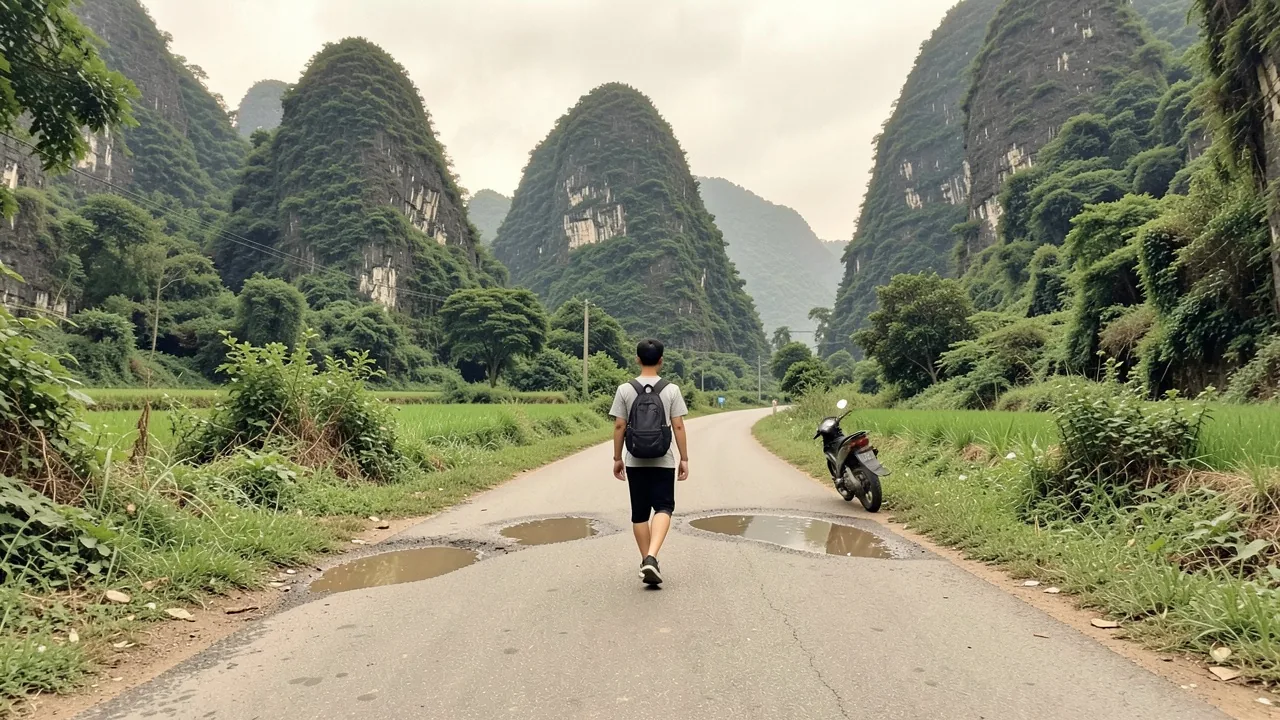
Ninh Binh Safety Guide for Solo Travelers
Ninh Binh safety is straightforward: violent crime against tourists is rare, the locals are welcoming, and the main risks are weather and rural traffic. This guide covers what is risky, what is not, and how to plan around seasonal friction for solo travelers in 2026. For related planning, see our guide on Sea Backpacking Hub.
Quick Answers
| What | Answer | Price (INR) |
|---|---|---|
| Is Ninh Binh safe for solo travelers? | Yes, very. Violent crime is rare; the main risks are weather, rural traffic, and ticket scams. | , |
| Best way to get there from Hanoi? | Direct bus from Giap Bat or Nuoc Ngam station, 2-2.5 hours, drop-off at your hotel. | ₹700-1,000 (~230,000-330,000 VND) |
| Is a day trip enough or should I stay overnight? | One full day covers Tam Coc/Trang An. An overnight lets you catch sunrise over the karsts and skip the worst day-tripper crowds. | , |
| Worst months for weather? | June-August (typhoon rain, flooding) and December-January (cold drizzle, fog over the caves). | , |
| Do I need cash for the boat ride and tickets? | Yes. Carry ₹1,836-₹2,938 (~500,000-800,000 VND or ~$19.06-$30.49) in small notes for entry tickets, rowboat fees, and the odd local tip. | ₹1,800-3,000 (~500,000-800,000 VND) |
Subodh’s Pro Tip: The boat rowers at Tam Coc are famous for trying to row you to extra “tip stops” mid-ride. Smile, decline politely, and keep the fare pre-agreed. They won’t abandon you, but they will sigh dramatically.
The Real Risks (What to Worry About)
Ninh Binh is safer than Hanoi, HCMC, or even most of Da Nang. But “safer than Vietnam’s big cities” is not “zero risk.” Here is the real ranked picture.
| Risk | Likelihood | Impact | How to Avoid |
|---|---|---|---|
| Rural scooter / motorbike traffic | High | Medium-High | Wear a helmet, avoid riding at dusk, never assume rural drivers will signal. See our Vietnam motorbike safety guide for the full breakdown. |
| Weather (typhoon rain, fog, cold) | Seasonal-High | Medium | Check the forecast 48 hours out. Avoid Tam Coc boat rides in heavy rain; the river level rises fast. |
| Overcharging at tickets / boat stands | Moderate | Low | Buy from the official ticket counter at the entrance, not from anyone who approaches you outside. |
| Sun and dehydration | Moderate-High | Low-Medium | Carry 1.5L water minimum; the limestone reflects hard and the shade disappears after 11am. |
| Petty theft at crowded piers | Low | Low | Keep your daypack on your front at Tam Coc and Trang An piers. |
| Food poisoning (“Bali belly / Hanoi belly”) | Low-Medium | Low | Eat at busy, sit-down spots; skip the raw herbs you can’t identify. |
| Violent crime | Low | Severe (if it ever happens) | Standard travel awareness; Ninh Binh’s tourist zones are well-patrolled. |
| Dengue / mosquito-borne illness | Low-Medium | Medium | DEET-based repellent at dusk, especially in the wet season. See our SE Asia health guide for general prevention. |
Safety Alert: The caves at Trang An flood suddenly during typhoon-season rain. If your hotel owner says “don’t go today,” listen. Boats have been stranded overnight in past floods.
Prevention and Preparation
Most of the safety work for Ninh Binh happens before you leave Hanoi.
Before you leave India:
- Vaccines: Routine vaccines plus Hepatitis A and Typhoid are recommended for Vietnam. Japanese Encephalitis is worth discussing with your travel doctor if you’re doing extended rural stays, though for a 1-2 day Ninh Binh trip the risk is low.
- Travel insurance: A standard SafetyWing-style policy covers emergency medical, evacuation, and trip interruption. Make sure it explicitly covers motorbike/scooter use if you plan to rent one, since most policies exclude two-wheeled vehicles unless you hold an International Driving Permit (IDP) with a motorcycle endorsement. A hospital admission in Vietnam without insurance can run ₹150,000-₹300,000 (~$1,557-$3,114) out of pocket for a single day of observation and IV fluids.
- Documents: Passport with at least 6 months validity, two printed passport photos (for the rare lost-passport emergency), and a digital scan of your passport + visa in Google Drive and emailed to yourself.
- E-visa: Indian passport holders need an e-visa for Vietnam. Apply online at the official immigration portal; allow 3 working days. The fee is USD 25.
Currency and cash: 1 INR ≈ 27 VND at the time of writing. For Ninh Binh specifically, carry ₹1,836-₹2,938 (~500,000-800,000 VND or ~$19.06-$30.49) per day. Cards work at hotels and the bigger restaurants, but not at boat piers, small family kitchens, or motorbike rental stands.
Packing for the day:
- Refillable water bottle (1L minimum)
- DEET-based repellent
- Sunscreen (SPF 50, water-based)
- Light rain jacket (June-August especially)
- Closed-toe sandals or walking shoes (the boat docks are slippery)
- A thin long-sleeve for sun protection without overheating
- Printed hotel address in Vietnamese
City-by-City Scams and Gotchas
Ninh Binh’s scams are mostly low-stakes ticket and taxi games. None are dangerous, but they add up.
At the bus station / drop-off:
- Drivers from informal “tour” vans will approach you offering Tam Coc + Trang An + Mua Cave for a flat price. These are usually fine, but check the inclusions (entry tickets vs. Just transport) before paying. Honest day tours from Hanoi run ₹2,938-₹4,406 (~800,000-1,200,000 VND or ~$30.49-$45.74) including tickets and lunch.
- The hotel-tied minibus from Hanoi is generally the safest bet. Your hostel will arrange pickup; confirm the pickup time the night before.
At Tam Coc and Trang An piers:
- Buy tickets from the official counter at the gate. Anyone walking around offering “cheaper tickets” or “skip the line” is selling either a counterfeit or a scam.
- Boat rower tips: pre-agree the tip (₹184-₹367 (~50,000-100,000 VND or ~$1.91-$3.81) per boat, split among 2-4 passengers is normal). Rowers do work hard, but the “extra cave” add-ons are unofficial.
- Photography on the boat is fine. People selling “boat photos” they printed after the ride are a persistent low-pressure hustle; you don’t owe them anything.
At Mua Cave viewpoint:
- The 500-step climb is real and steep. Slip-on sandals are a bad idea. Anyone selling “VIP shortcut” access at the top is running a small con; there is no shortcut.
- Motorbike parking at the base has a fixed ₹37-₹73 (~10,000-20,000 VND or ~$0.38-$0.76) fee; anyone charging 50,000+ is overcharging. Pay at the marked kiosk, not to a person waving you in.
In town (Ninh Binh city, Tam Coc town):
- Restaurants around the piers routinely overcharge by 30-50% versus the same food a block back. Eat at Vu Bao Ninh Binh Restaurant or the local spots on the main road away from the river.
- “Free” bicycle rentals at guesthouses are often conditional on a dinner booking. Read the small print or just rent from a shop for 30,000-50,000 VND/day.
- Tuk-tuk rides without a meter: agree on the price before getting in. From Tam Coc town to Trang An should be ₹184-₹294 (~50,000-80,000 VND or ~$1.91-$3.05), not 150,000+.
For comparison, Hanoi itself has its own set of scams (the shoemaker scam near the Old Quarter, fake taxi meters, the “closed today” Grand Palace trick). Ninh Binh is a much quieter version of the same playbook.
What to Do If It Happens
Here’s your real-world playbook for the three most likely incidents.
You get into a scooter crash (or fall off a bicycle):
- Get off the road. Move yourself and the bike to the shoulder.
- Call your hostel’s front desk. Most hostels in Ninh Binh will send someone to help translate at the local clinic.
- Vietnam emergency numbers: Police 113, Ambulance 115. Don’t expect English on the line. Your hotel staff will bridge the gap.
- Go to the nearest clinic. The main private option in Ninh Binh is Benh Vien Da Khoa Tinh Ninh Binh (provincial hospital). For anything serious, hospitals in Hanoi (Bach Mai, Vinmec) are 2 hours away.
- Contact your insurance. Take photos of the bike, the road, your injuries, the other vehicle if any. The police report is helpful but not always required for small claims.
- Don’t sign anything you can’t read. Have your hotel staff translate before you commit.
Your passport is stolen:
- File a police report at the local station. Get the stamped paper. The Vietnamese police are used to this process; it usually takes under an hour.
- Contact the Indian Embassy in Hanoi: 1A Pham Ngoc Thach Street, Hanoi. Phone +84 24 3824 4989. Email [email protected].
- Apply for an emergency certificate. You’ll need the police report, two passport photos, and a copy of your original passport (which is why you scanned it before leaving India).
- Without an emergency certificate, you cannot leave Vietnam. Get this done in Hanoi, not in Ninh Binh.
You get severe food poisoning:
- Hydrate aggressively. ORS sachets from a local pharmacy (ask for “Oresol”) work just like the Indian version.
- Imodium (Loperamide) is widely sold over the counter as “Lopamide” or “Imodium.” For diarrhea that won’t stop.
- If you can’t keep water down for 8+ hours, go to a clinic. IV rehydration at a private clinic in Ninh Binh costs ₹2,938-₹5,508 (~800,000-1,500,000 VND or ~$30.49-$57.17).
- Indian pharmacies stock Metrogyl (Metronidazole) and Pantocid (Pantoprazole); Vietnamese equivalents are easily available under local brand names. For more detail, our SE Asia hospital guide walks through what to buy and where.
Subodh’s Pro Tip: Save your hotel’s name and address in Vietnamese (ask them to write it on a card at check-in) and pin it in Google Maps offline. This single habit solves 80% of “I’m lost and my phone died” moments.
Indian-Specific Considerations
Medicines you might need (and what to ask for locally):
| Indian brand | Generic | Vietnamese equivalent / what to ask for |
|---|---|---|
| Electral / ORS | ORS | ”Oresol” sachets at any pharmacy |
| Crocin / Dolo | Paracetamol 500mg | ”Paracetamol” or “Panadol” |
| Metrogyl | Metronidazole | ”Metronidazole” (no prescription needed) |
| Pantocid | Pantoprazole | ”Pantoprazol” |
| Combiflam | Ibuprofen + Paracetamol | ”Ibuprofen” sold over the counter |
| Avomine | Promethazine (motion sickness) | “Promethazine” or “Avomin” |
Bring a 7-day personal kit from India. Pharmacy stock in Ninh Binh is thinner than Hanoi, and the same brands are pricier once you’re in the province.
Indian Embassy contact (Hanoi):
- Address: 1A Pham Ngoc Thach, Dist. Dong Da, Hanoi
- Phone: +84 24 3824 4989 (consular section)
- Emergency after-hours: +84 24 3772 4700
- Email: [email protected]
- Website: eoihanoi.gov.in
For Ninh Binh specifically, there is no honorary consulate; you’ll be directed to Hanoi for all consular services. Save the embassy number in your phone before you leave Hanoi.
Costs to plan for:
- Private clinic consultation (basic): ₹1,102-₹2,203 (~300,000-600,000 VND or ~$11.43-$22.87)
- IV rehydration + observation (4-6 hours): ₹2,938-₹5,508 (~800,000-1,500,000 VND or ~$30.49-$57.17)
- X-ray at private clinic: ₹1,469-₹2,570 (~400,000-700,000 VND or ~$15.25-$26.68)
- Local pharmacy course of antibiotics (5 days): ₹367-₹918 (~100,000-250,000 VND or ~$3.81-$9.53)
For broader medical-emergency context beyond Ninh Binh, our Vietnam emergency medical help guide covers Hanoi and HCMC hospitals in detail.
Cultural notes that matter for safety:
- Dress modestly at pagodas (Bai Dinh is the big one in Ninh Binh). Shoulders and knees covered. Free entry, donations welcome.
- Don’t point your feet at people or statues when sitting in temples.
- Bargaining is normal at markets but not at fixed-price ticket counters.
- Motorbike helmets are legally required even on passengers.
Getting Connected
You want a working phone the moment you arrive, not after an hour at a Viettel store. Two options:
-
eSIM (easiest): Buy a Vietnam eSIM before you fly. Get Nomad eSIM, install on landing, activate when you reach Vietnam. Data works the moment the plane’s wheels touch down. Plans typically start around ₹482 (~5 USD) for 5GB over 7 days.
-
Physical SIM: Viettel and Mobifone have counters at Noi Bai airport. The tourist SIM with 3-5GB/day for 7 days runs ₹734-₹1,102 (~200,000-300,000 VND or ~$7.62-$11.43). Bring your passport.
Either way, save offline maps of Ninh Binh province in Google Maps before you leave Hanoi. Cell coverage around the caves and viewpoints is patchy; offline maps will save you when the signal drops.
Where to Stay
Most Ninh Binh day-trippers base themselves in Tam Coc town, which is the closest cluster of hostels to the boat piers. Both options below are well-run, well-reviewed, and have staff who speak enough English to help with bookings, scooter rentals, and bus tickets.
| Hostel | Rating | Why it works for solo travelers | Book |
|---|---|---|---|
| Ninh Binh Buffalo Hostel | 9.6 | Social common area, easy group bookings for Tam Coc and Trang An boat tickets, dorm beds around ₹918-₹1,285 (~250,000-350,000 VND or ~$9.53-$13.34). | Check prices |
| The Banana Tree Hostel | 9.46 | Quieter than Buffalo, strong for solo female travelers, organized sunset tours to Mua Cave viewpoint. | Check prices |
| For a slightly different stay experience (and for travelers who want their own garden rather than a dorm), Trang An Garden Bungalow sits closer to the Trang An pier and is a calm base for early-morning boat rides. |
What to Eat (and Where)
Ninh Binh’s local specialty is dê (goat), prepared in half a dozen ways: grilled, steamed with lemongrass, hotpot, and curry. The province also does excellent cơm cháy (crispy rice) and ốc núi (mountain snails).
For goat dishes done right, Nhà hàng Sen Tràng An is the local favorite, with countryside-style cooking and a full dê menu. For a broader Vietnamese spread (including good pho and bún chả), Vu Bao Ninh Binh Restaurant and Cờ Lau Ninh Bình are reliable mid-range choices, with mains in the ₹294-₹551 (~80,000-150,000 VND or ~$3.05-$5.72) range. Nhà Hàng Madame Thư is the pick for a sit-down dinner with a more traditional Vietnamese menu. For a casual drink and a view, An Restaurant - Coffee doubles as a bar in the evenings.
If you need a dal-chawal reset, the Indian food scene in Ninh Binh itself is thin. Easiest plan: eat Indian one night in Hanoi before you leave, or take a packed meal from your Hanoi hotel. If you’re set on Indian in Ninh Binh, ask your hostel in advance, since most don’t keep an Indian-kitchen list the way Hanoi hostels do. For full Indian menus, you’ll find the real options back in Hanoi: Rutba Indian Restaurant for pure-veg and Jain food, Swad Kitchen 5 in the Old Quarter for butter chicken and garlic naan around ₹734-₹1,102 (~200,000-300,000 VND or ~$7.62-$11.43) per person, and The Indian Kitchen in Giang Vo for North Indian thalis around ₹734-₹1,469 (~200,000-400,000 VND or ~$7.62-$15.25) per person.
FAQ
Is Ninh Binh safer than Halong Bay or Sapa? Yes, for the day-to-day experience. Halong Bay has more tourist scams (especially around the cruise docks) and Sapa has more motorbike-related incidents on mountain roads. Ninh Binh sits in the middle: busier than rural Sapa, calmer than Halong cruise day.
Can I do Ninh Binh as a day trip from Hanoi? Yes, and most backpackers do. The earliest bus leaves Hanoi around 6:30am and gets you to Tam Coc by 9am. You’ll have 6-7 hours on the ground, enough for one boat ride (Tam Coc or Trang An) plus Mua Cave viewpoint. The last return buses leave around 5-6pm. If you can spare the night, stay overnight; the morning boats are quieter and the karst sunrise is worth it.
What about the weather? When should I avoid it? June through August is typhoon season; expect heavy afternoon rain and occasional flooding at the boat piers. December and January can be cold (10-15°C) with fog rolling through the caves, which kills visibility on the boat rides. The sweet spot is February-April and September-November, with mild temperatures and clear skies. Always check the 3-day forecast before booking your bus.
Is the boat ride safe? I’m worried about the caves. The Trang An and Tam Coc boats are flat-bottomed rowboats operated by licensed locals. The caves are wide and well-trafficked; capsizing is rare. The real risk is flash flooding during typhoon rain; check weather and skip the ride if storms are forecast. Always wear the life vests provided, even though they’re sometimes stowed under the seats.
Do I need a visa, and is the e-visa enough? Yes to both. Indian passport holders need a Vietnam e-visa (₹2,408 (~25 USD), 3 working days, applied online through the official immigration portal). The e-visa covers tourist entries at all major land crossings and airports, including Noi Bai in Hanoi.
Are there any areas I should avoid in Ninh Binh? Not in the safety sense. The whole province is rural and tourist-focused. The only “avoid” I’d note is the rice-paddy roads around Mua Cave at night; they have no streetlights and the irrigation ditches are easy to fall into after dark.
Subodh’s Take
Ninh Binh is the kind of place where 90% of the risk is weather and the other 10% is a ₹184 (~50,000 VND or ~$1.91) overcharge on a tuk-tuk. If you go in the right season (February-April or October-November), with ₹2,938 (~800,000 VND or ~$30.49) in cash, a working eSIM, and your hotel address written in Vietnamese, you will be fine. The only thing I’d genuinely warn against is the wet season boat rides during typhoon rain. Skip those, get a hot noodle soup instead, and wait for the next morning.
