Cambodia Packing List 2026: What to Pack (and What to Skip) for the Weather, Temples & Backpacking Routes
✅ Cambodia conditions last reviewed: 2026-07-17 (sources listed below)
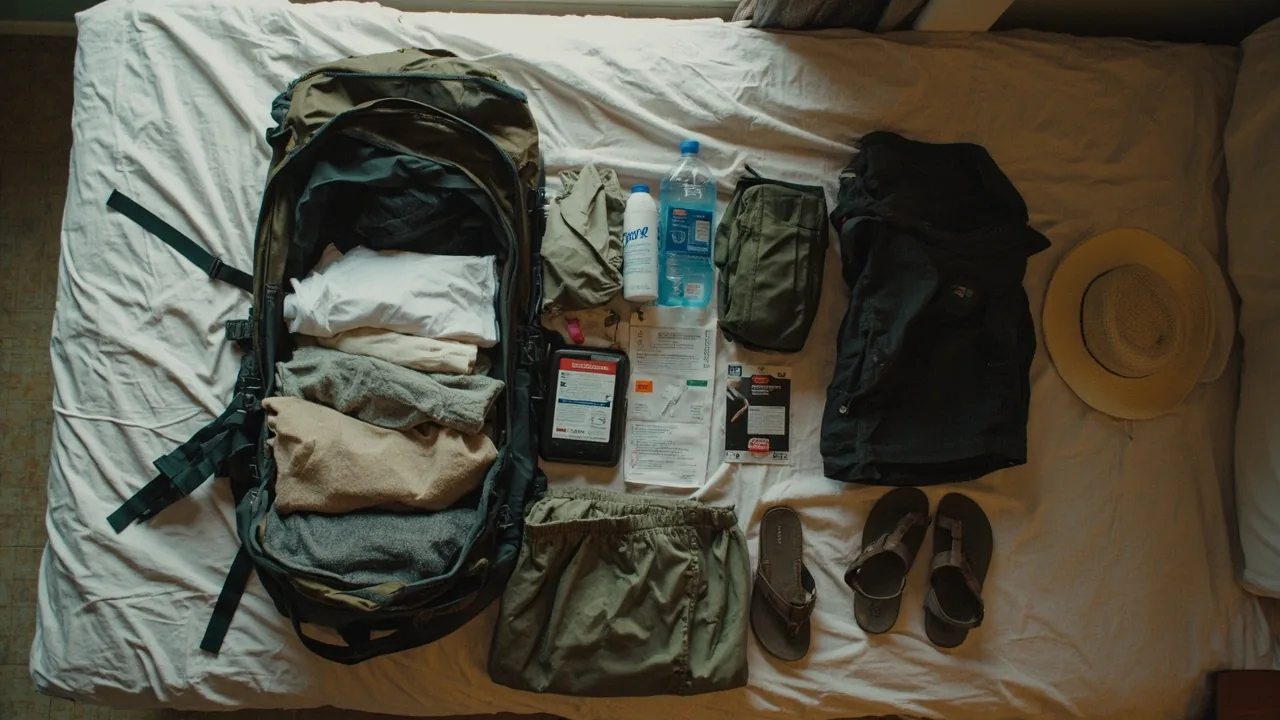
What do i need to pack for Cambodia? Start with a 40-50L backpack and build from there. Packing light is the single most useful backpacking skill you can build for a Cambodia trip. The country’s hot, humid weather, temple dress codes, and dirt-cheap convenience stores mean most “essentials” can be skipped or bought on arrival. This guide draws on the Cambodia Ministry of Foreign Affairs e-visa portal and the Indian MEA Cambodia travel advisory for July 2026. Planning the wider region? Our Southeast Asia backpacking hub covers the full multi-country route.
Subodh’s Pro Tip: Anything you can buy in a Phnom Penh 7-Eleven for ₹48 (~2,000 KHR or ~$0.49) should not take up space in your bag. Sunscreen, padlocks, deodorant, even sandals, all get cheaper the moment you land.
Quick Answers
| What | Answer | Price (INR) |
|---|---|---|
| Do I need a visa before flying? | Yes, e-Visa or visa on arrival for Indian passport holders. Both give 30 days single entry. | e-Visa ₹3,471 (~36 USD), VoA ₹2,892 (~30 USD) |
| Best months to visit Cambodia? | November to February (cool dry). Avoid July-September monsoon peak unless you want empty temples. | , |
| What plug type does Cambodia use? | Type A, C, and G. Indian Type C plugs work in most sockets. Carry a universal adapter for older Type G outlets in older hotels and guesthouses. | ~₹600 (~7 USD) |
| How much cash should I carry on arrival? | ₹19,281-₹28,921 (~200-300 USD) in clean USD notes for visa + first week. Exchange at the airport or any green “Mega” / “Canadia” ATM. | ₹19,000-₹29,000 (~$196.93-$300.58) |
| Do I need a power bank under 100Wh? | Yes. Anything over 100Wh / 20,000 mAh gets confiscated at Indian and Cambodian airport security. Carry a 10,000-20,000 mAh bank only. | ~₹1,200-₹2,000 (~$12.44-$20.73) |
Subodh’s Pro Tip: Cambodia runs on 230V / 50Hz, same as India. Your phone and laptop chargers are fine. Only the wall plug shape sometimes needs an adapter.
The 5-4-3-2-1 Cambodia Rule (The Framework That Fits a Backpack)
Most packing frameworks are built for two-week trips to Europe. Cambodia is hot, laundry is cheap, and you’ll wear the same three t-shirts on rotation. Here’s the rule that fits this country:
- 5 t-shirts (2 quick-dry synthetic for temple days and bus rides, 3 cotton/linen for evenings)
- 4 pairs of underwear / socks (one in the wash, one drying, two on you)
- 3 bottoms (2 light shorts + 1 long zip-off trouser for temples and night buses)
- 2 shoes (1 walking sneaker for Angkor + 1 durable sandal for hostel showers, beaches, and islands like Koh Rong)
- 1 light rain shell or poncho (June-October monsoon makes this non-negotiable, see our Cambodia monsoon packing notes)
This lands you around 6-7 kg of clothing, which fits comfortably in a 40L pack alongside a 1.5L water bladder, a laptop, and a toiletry pouch. Travellers who try the 3-3-3 rule (3 tops, 3 bottoms, 3 pairs of shoes) end up buying more laundry detergent at 7-Eleven than they save in weight.
The Ultimate Cambodia Packing Checklist
Clothing
- 5 t-shirts (mix of quick-dry and cotton)
- 2 light shorts
- 1 long zip-off trouser (temples, buses, mosquitoes)
- 1 light hoodie or fleece (December-February AC buses and Phnom Penh cinemas can get cold)
- 5-7 pairs of underwear and socks
- 1 swim trunk / quick-dry swim shorts
- 1 light rain jacket or packable poncho
- 1 sarong or scarf (temple cover-up, beach towel, market bargaining tool)
Footwear
- 1 pair of walking sneakers or trail shoes (Angkor Wat temple complex covers 400+ acres)
- 1 pair of durable sandals (Tevas, Chacos, or similar, not flimsy flip-flops for city walking)
- 1 pair of hostel flip-flops (just buy a 1 USD pair on day one)
Toiletries (carry small, refill in country)
- Toothbrush and travel toothpaste
- Travel-sized soap / shampoo bars (lighter than bottles)
- Roll-on deodorant (spray cans leak in heat)
- Sunscreen SPF 50 (4-5x cheaper in India, bring it from home)
- Mosquito repellent with 20-30% DEET (Malaria zones like Mondulkiri and Kratie need it)
- Razor and shaving cream
- Quick-dry travel towel (hostels never provide enough)
First Aid
- ORS sachets (10 from India, weight nothing, save you in monsoon diarrhoea)
- Paracetamol and Combiflam
- Loperamide (Imodium) for emergency traveller’s diarrhoea
- Cetirizine (allergies, dust)
- Dettol small bottle and a few band-aids
- Personal prescription meds with the prescription (border officers do ask)
- Oral rehydration + electrolyte tablets
Documents
- Passport (6+ months validity)
- Printed e-Visa approval letter or ₹2,892 (~30 USD) cash for VoA
- 2 passport photos (4x6 cm white background, required for VoA extension)
- Travel insurance PDF (printed, not just on phone)
- Vaccination card if you’ve had typhoid / hepatitis
- Photocopies of passport + visa stored in Google Drive and on a USB
Safety Alert: Cambodia’s road safety is the country’s #1 risk for backpackers. According to the Indian MEA travel advisory, road accidents account for most serious injuries to Indian visitors. Carry the embassy number (Phnom Penh: +855-23-210-912) and keep your travel insurance app on your phone home screen.
Monsoon vs. Dry Season Packing
Cambodia has two distinct seasons and your packing list shifts between them.
Wet season (May to October):
- Pack a real rain jacket or poncho. Cheap ₹193 (~2 USD) ponchos from Psar Thmei market melt within a week.
- Quick-dry synthetics beat cotton here. Cotton stays wet for 8+ hours in 90% humidity.
- Dry bag or ziplock pouches for passport, phone, and power bank. Tuk-tuk rides through Phnom Penh monsoons flood the floor.
- Waterproof sandals over sneakers. Tevas dry in 20 minutes.
- Mosquito repellent becomes non-optional. Stagnant water multiplies dengue risk.
Dry season (November to April):
- Cotton and linen breathe better. Pack 3 cotton tees instead of all synthetic.
- Sunglasses and a wide-brim hat for Angkor sunrise at 5:30 AM.
- SPF 50 sunscreen (reapply every 2 hours, Angkor has zero shade).
- Higher-capacity power bank. Dry season is peak tourist season, hostels are crowded, and outlets are contested.
- A light fleece for evening riverfront breezes in Phnom Penh and bus AC.
Subodh’s Pro Tip: November to February is peak. March to April hits 38-40°C with brutal humidity. If your schedule has any flexibility, target December, you get dry weather and half the December crowds of Christmas week.
Electronics & Tech Setup
Cambodia’s plug situation is a three-headed beast. You’ll find Type A (US two-pin), Type C (European two-pin, same as India), and Type G (UK three-pin) in most hotels and hostels. Your Indian phone charger (Type C) fits about 80% of outlets. Carry a small universal adapter with USB ports built in, it saves you carrying a power strip.
Power bank rules are strict and uniform across Indian and Cambodian security. Anything over 100Wh (about 27,000 mAh at 3.7V) gets confiscated. Stick to a 10,000-20,000 mAh bank. Airline crews at Delhi, Bangkok, and Phnom Penh routinely pull larger units at the gate.
Other tech worth packing:
- 2-3 charging cables (Type-C and Lightning, the ones you use)
- A wall charger with 2 USB ports (a small GaN multi-port charger)
- Headphones (any pair, but wired earbuds survive tuk-tuk dust better than premium AirPods)
- A universal adapter with built-in USB
- Offline Google Maps of Cambodia downloaded before you land
- A phone tripod or gorilla pod if you want sunrise shots at Angkor
Safety Alert: Cambodia’s humidity wrecks electronics. Travellers in Phnom Penh report phone speaker failure and laptop keyboard sticking within 2-3 weeks. Carry silica gel packets in every zip pocket and never leave devices in a closed backpack in direct sun.
For SIM cards, you’ll see tourist booths at Phnom Penh and Siem Reap airports selling Smart and Cellcard plans. A 7-day SIM with ~10GB data runs around ₹289 (~3 USD). That’s enough for Google Maps, Grab rides, and hostel Wi-Fi backup. If you want data the moment you land, the Smart Axiata eSIM store sells online activation, or you can compare options in our Cambodia SIM card guide for Indian travellers before you fly.
Cultural Dress Codes (Temples vs. Beaches)
Cambodia’s temple dress code is enforced strictly at Angkor Wat, Bayon, Banteay Srei, and the Royal Palace in Phnom Penh. Travellers without proper coverage get turned away at the gate. The rule is:
- Shoulders covered (no tank tops, no spaghetti straps)
- Knees covered (no shorts above the knee, no short skirts)
- Shoes off inside certain inner sanctuaries
Pack one light long-sleeve shirt or kurti specifically for temple days. A scarf or sarong wrapped around your waist works in a pinch but reads as “tourist trying to comply” and gets more scrutiny at Bayon’s upper terrace. Zip-off trousers are the cleanest solution: shorts for the walk, trousers for the gate.
For beaches (Koh Rong, Koh Rong Samloem, Kep, Sihanoukville if you go), Cambodia is informal. Swim shorts, bikinis, board shorts, all fine. Cover up for the ferry ride only.
Subodh’s Pro Tip: Buy a ₹193 (~2 USD) cotton scarf at Phsar Thmei (Central Market) in Phnom Penh. It doubles as a temple cover, a beach towel, a bus pillow, and a market bargaining prop. The ROI on a ₹193 (~2 USD) scarf in Cambodia is unbeatable.
Trail Laundry & Toiletries
Laundry in Cambodia is one of the genuine backpacker wins. Most guesthouses and backpacker hostels in Phnom Penh, Siem Reap, and Sihanoukville offer same-day wash-and-fold at around ₹96-₹145 (~1-1.50 USD) per kilogram (~₹96-145). Drop it off at 10 AM, it’s back by 6 PM, folded and bagged. Hand-wash in hostel sinks works for socks and underwear but you will not beat the heat.
7-Eleven, Circle K, and Mini Mart stock everything else:
- Toothpaste, toothbrush, soap, shampoo (all imported brands)
- Sunscreen (3-5x more expensive than India, so bring your own)
- Deodorant (Western brands, ₹289-₹482 (~3-5 USD))
- Razors, shaving cream
- Flip-flops and basic sandals
- Padlocks for hostel lockers
- Sim cards, chargers, earphones
Travellers who over-pack toiletries from India usually regret the weight by day four.
Common Packing Mistakes Indians Make
Mistake 1: Packing a hardshell suitcase. Cambodia’s tuk-tuks, sleeper buses, and Phnom Penh’s broken pavements destroy wheels. A 40-50L backpack is the only sane choice. Hard cases add per-bag surcharges on tuk-tuks and sleeper buses that vary by driver and route.
Mistake 2: Bringing jeans and heavy cotton hoodies. Jeans weigh 800g dry, 1.5kg wet, and take 24 hours to dry in monsoon humidity. One pair of lightweight zip-off trousers replaces jeans, hoodie, and rain pants in a single item (most weigh 300-400g on manufacturer specs).
Mistake 3: Ignoring the 100Wh power bank limit. Indian travellers risk having over-capacity banks pulled at Delhi, Bangkok, and Phnom Penh airport security. A 30,000 mAh bank is over the 100Wh cabin limit and is routinely refused at the gate. Stick to 10,000-20,000 mAh.
Mistake 4: Skipping the photocopies. Cambodia’s immigration still does manual passport checks at land borders, especially at Poipet and Bavet. A spare passport photo and a ₹2,892 (~30 USD) cash backup are commonly requested at the Poipet and Bavet land borders if your e-Visa printout is unclear. Keep copies separate from your passport.
Mistake 5: Bringing full-size sunscreen and shampoo bottles. Buy a 100ml refillable bottle at any Indian pharmacy for ₹80 (~$0.83). Saves 600g in your pack and 200ml of liquid you’re not allowed in cabin baggage anyway.
Subodh’s Pro Tip: Pack one extra day of meds, not one extra shirt. Cambodia’s pharmacies are good in cities but unreliable in Kampot, Kep, and the islands. If you need a specific prescription, bring the full course.
What to Skip
Skip these items, they sound essential and are not:
- Hair dryer. Hostels don’t have them. Your hair dries in 20 minutes in this humidity.
- Heavy laptop. A tablet or a Chromebook covers most traveller needs at half the weight.
- Travel pillow. Stuff a t-shirt into a zip-lock for the same effect.
- Multiple books. Kindle app on your phone handles 10 books at 200g.
- Fancy hiking boots. Cambodia’s trails in Mondulkiri are muddy but flat. Trail runners work better than boots.
- Towels. A PackTowl or similar quick-dry towel at 150g replaces a 600g cotton towel.
FAQ
Can I bring a suitcase instead of a backpack? Technically yes, practically no. Sleeper buses have limited luggage bays and charge ₹119-₹238 (~5,000-10,000 KHR or ~$1.24-$2.47) per extra piece. Tuk-tuks in Phnom Penh and Siem Reap charge by the bag. You’ll regret the wheels by day three.
Are power banks allowed in cabin baggage? Yes, under 100Wh (about 27,000 mAh at 3.7V, so a 20,000 mAh bank is safe). Anything over 100Wh needs airline approval and is rarely granted. Anything over 160Wh is banned outright in cabin baggage worldwide.
Can I buy sunscreen cheap in Cambodia? No, sunscreen in Cambodia runs ₹771-₹1,446 (~8-15 USD) per bottle (3-5x Indian prices). Bring two tubes from India and you’re set for a month.
Do I need a universal adapter? Most Indian Type C plugs work in Cambodia. Carry a small universal adapter with USB ports for the occasional Type G outlet in older hotels. Skip the bulky multi-adapter kits.
Is a rain jacket or poncho better for monsoon? A poncho is more practical: it covers your backpack too. A real rain jacket (not the ₹96 (~1 USD) emergency foil one) is better for cooler December rain. Skip the foil poncho, it tears within a day.
Do I need to print documents or is mobile enough? Print your e-Visa, travel insurance, and hotel booking. Cambodian immigration at land borders has been known to reject phone screenshots due to glare and battery issues.
Travel Insurance: Compare independent policies before buying; insurance is not sold by Bananarchy and no affiliate relationship is implied here. For a checklist of what coverage to look for on a Cambodia trip, see our Cambodia travel essentials for Indian tourists.
— Subodh---
