Southeast Asia Cooking Classes: The Honest Budget Guide for Indian Backpackers (2026)
Yes, you should book a cooking class in Southeast Asia, and no, you don’t need to spend a fortune to get one worth your time. That’s the whole answer in two lines. For related planning, see our guide on Sea Backpacking Hub.
This guide breaks down exactly where to go, what each class costs in the local currency, how to avoid the duds, and what happens if you’re vegetarian. I’ve watched Indian travellers go in expecting a tourist-trap stir-fry demo and come out four hours later with a tote bag full of curry paste they made themselves. That’s the version of the experience this article points you toward.
Subodh’s Pro Tip: Book the first class of the morning, usually 8:30 or 9 AM. The market visit is cooler, the produce is fresher, and groups are smaller because most travellers sleep in.
Quick Answers: Cooking Class Costs Across Southeast Asia
| What | Answer | Price (INR) |
|---|---|---|
| Best city for a cooking class? | Ubud, Bali (best vegetarian options) or Chiang Mai (most options in Thailand) | , |
| How much does a half-day class cost? | Check current rates on each school’s website or aggregator listings | , |
| How long is a typical class? | Half-day classes run 3–5 hours (includes market walk) | , |
| Market visit included? | Most reputable schools include a morning market walk | , |
| Vegetarian-friendly destinations? | Ubud (excellent), Chiang Mai (dedicated veg days), Bangkok & Hoi An (request in advance) | , |
| Best booking tip? | Book direct on the school’s WhatsApp, not through Klook/Viator | , |
Subodh’s Pro Tip: Any class under ₹2,287 (~800 THB or ~$23.74) is almost a demo-only experience where you watch the chef cook and get a single dish at the end. Travellers report those rarely feel worth the slot in your day. The hands-on format where you cook 3–4 dishes yourself starts at the prices above.
What Counts as a “Good” Cooking Class
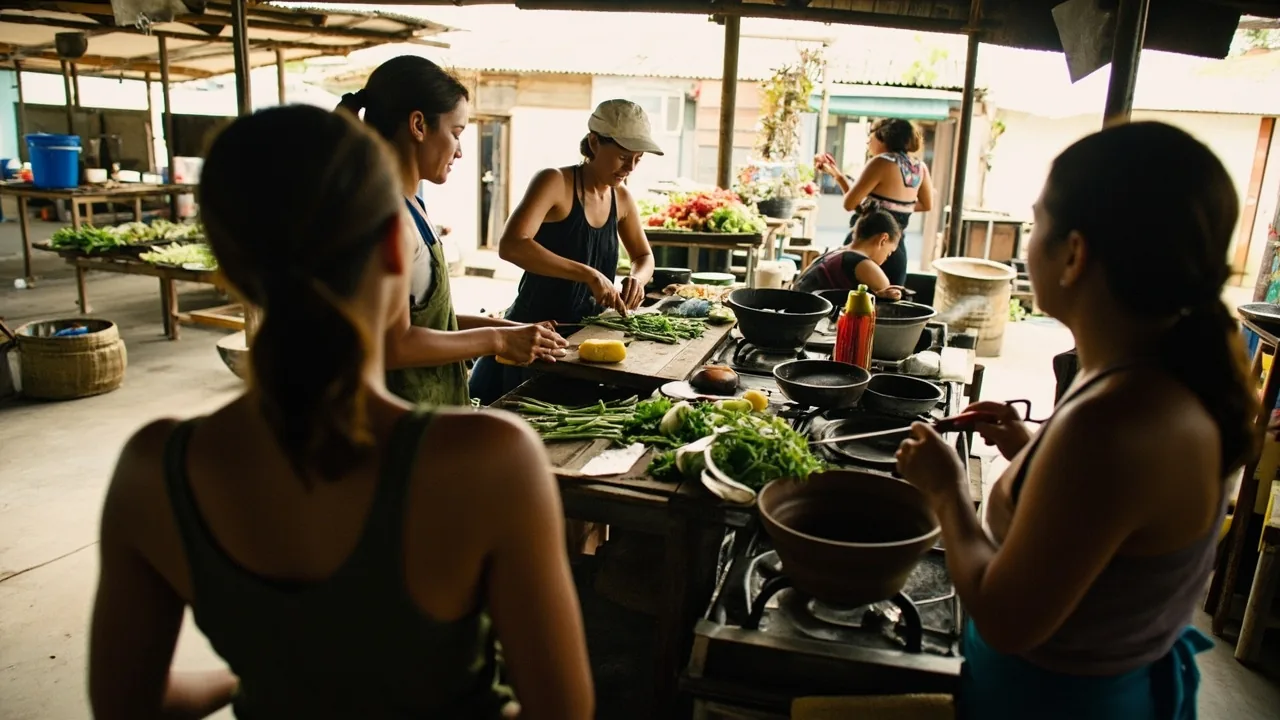
A class worth your time and money has four parts: a market walk with the chef explaining ingredients, a hands-on cook of 3–4 dishes, a sit-down meal of what you cooked, and a recipe booklet you take home. If any of those four is missing, you’re paying for a cooking demo, not a class. The market walk is the part Indian travellers love most, because the chef will name local leaves, roots, and pastes in both Thai/Vietnamese/Bahasa and English, and you’ll start recognising them in street food for the rest of the trip.
You’ll usually cook in a small open-air kitchen with 4–8 other students. Most schools offer a half-day morning slot (8:30 AM to 1 PM) and an afternoon slot (1:30 PM to 6 PM). The morning slot is the one to pick because the produce at the local market is at its best and the air is cooler for the walk.
Where to Book: The Honest Breakdown by Country
Thailand: Bangkok and Chiang Mai
Thailand is the easiest entry point for Indian travellers because the cuisine is already half-familiar (curry pastes, coconut milk, lemongrass) and the class infrastructure is mature.
In Bangkok, look at schools around Silom, Sathon, and the old town. Half-day classes with a market visit, 3–4 dishes, and a recipe card are widely available in this price range in Bangkok. The class format is rice paste, curry, stir-fry, and either tom yum or tom kha depending on the day. Vegetarian options exist, but you have to flag it at booking because the default menu is built around chicken or prawn. Tell them at the counter when you book and again when you arrive, most kitchens handle it cleanly.
In Chiang Mai, the cooking school scene is famous. Half-day classes are typically cheaper than full-day (with a longer market walk and 5–6 dishes) options. Chiang Mai is the place in Thailand with dedicated vegetarian schools, and several mainstream schools have a “vegetarian-only” day once or twice a week. If you’re a strict vegetarian and Thailand is your main stop, Chiang Mai has the most accommodating scene in the country.
Safety Alert: Bangkok cooking schools in tourist-heavy zones sometimes get quoted in baht on the website but billed in a different currency at the counter, or quoted a “tourist price” above the listed price. Always confirm the final price in THB on WhatsApp or by email before you show up.
Vietnam: Hoi An and Hanoi
Vietnamese cooking classes are cheaper than Thailand and the produce is, frankly, better. The country grows most of its herbs within a few hundred kilometres of where you’ll be cooking.
Hoi An is the standout destination. Half-day classes including a boat ride to a riverside market, 3–4 dishes (usually a pho or a bun, fresh spring rolls, a claypot or braise, and a banh), and a sit-down meal are widely available in this price range. The morning market walk is the highlight: Vietnamese herbs (rau thom, ngo gai, hung que, etc.) come in a confusing pile at first glance, but the chef will explain which is mint, which is Thai basil, which is Vietnamese mint, and which is perilla, all from a single wet bundle.
Hanoi also has a strong scene, with classes around the Old Quarter and the Long Bien market area. Expect to pay within this range for 3–4 dishes. Hanoi’s strength is northern Vietnamese dishes (pho, bun cha, cha ca) which differ a lot from Hoi An’s central Vietnamese tradition. If your trip covers both cities, Hanoi is the place to learn pho properly.
For a couple or two friends travelling together, Vietnam is usually where the per-person cost drops the lowest, because most schools charge the same per-person rate regardless of group size and the base prices are already low. This matters when you’re planning the trip budget overall, and it’s worth keeping in mind alongside your Vietnam trip cost estimate.
Bali (Indonesia): Ubud
Bali, specifically Ubud, is the destination Indian vegetarian travellers keep asking about, and the answer is that Bali is the best place in Southeast Asia to do a fully vegetarian cooking class. Indonesian cuisine is rich with tempeh, tofu, sambal, vegetable urap, peanut sauce, and gado-gado, which means a vegetarian menu is not a bolted-on afterthought here; it is the heart of the food.
Half-day Ubud classes with a traditional morning market visit, 5–6 dishes, and a sit-down lunch are widely available in this price range. The market walk here is different from Thailand or Vietnam: it’s a Balinese traditional market (pasar) with separate sections for spice vendors, vegetable sellers, and offerings. You’ll learn the difference between candlenut and macadamia, between tamarind pulp and tamarind concentrate, and the dozen varieties of sambal that show up on a single Balinese table.
Full-day classes (6–8 dishes, plus a Balinese offering-making session) are priced higher. If you have a single full day in Ubud and you want one big memory from the trip, this is the slot to spend it in.
Cambodia and Laos
Phnom Penh and Luang Prabang both have cooking classes, but the scenes are smaller and the quality range is wider than in Thailand or Vietnam.
In Phnom Penh, half-day classes with a market visit are typically priced in the USD range shown. A solid mid-range class will cover fish amok, Khmer curry, and a stir-fry, with the chef walking you through kampot pepper, palm sugar, and the local pastes.
In Luang Prabang, half-day classes lean toward laap, Mekong river greens, and sticky rice-based dishes. The market walk in Luang Prabang is one of the prettiest in the region, but the class scene is small (a handful of schools) and weekends book up two or three days out. Best time to visit is the dry season for cooler classes.
What to Cook: The Best Classes for Indian Flavours
This is the section Indian travellers Google. Some classes in Southeast Asia will let you pick your own menu; others assign a regional set. The honest truth is that Thai, Vietnamese, and Indonesian cooking overlap with Indian flavours more than you might expect, especially around curries, coconut-based gravies, and stir-fries.
Chili pastes and curry pastes. Thai curry paste (gaeng keow wan, gaeng panang) is built with lemongrass, galangal, shrimp paste, dried chilies, and herbs. You’ll pound it in a granite mortar the way Indian kitchens pound masala, and the sensory experience is closer to a Tamil or Kerala kitchen than to anything European. Indian travellers report the ah-ha moment coming when they realise how much of Southeast Asian cooking is the same family of techniques with different names.
Coconut-milk curries. Thai and Burmese curries, Indonesian gulai, and Khmer kari all use coconut milk as the base the same way Kerala fish curry or Goan crab curry does. If you’ve ever cooked a coconut-based curry at home, you’ll pick this up fast.
Fresh herbs and salads. Vietnamese summer rolls and Balinese urap are the most herb-forward dishes in the region. You’ll learn to identify a dozen aromatics in one morning walk, and most of them translate well into your home kitchen.
The hole, honestly, is dairy and wheat. Southeast Asia uses little of either, so Indian breads (roti, naan) and paneer-based dishes are not in any class curriculum. If you want to learn a paneer curry, save that for the Indian cooking channel on YouTube. The cooking schools here teach the local cuisine.
Common Mistakes Indians Make (and How to Avoid Them)
Booking on Klook or Viator without checking the school’s own site
Aggregator prices can be above the school’s direct price because the platform takes a cut and you pay for it. Always check the school’s website or Instagram first, message them on WhatsApp, and confirm directly. The school will sometimes offer a pickup that’s free if you book direct, which the aggregator charges for separately.
Assuming “vegetarian” will be handled without saying so
In Vietnam and Cambodia, “vegetarian” in a cooking class context can mean pescatarian (fish sauce included) or lacto-vegetarian (no fish sauce at all). If you’re strict about no fish sauce, no oyster sauce, no shrimp paste, say so at booking. Most schools handle it cleanly once you flag it, but they don’t volunteer the question.
Booking a class with no market visit
The market walk is the learning part. The cooking is the practice part. If a class skips the market, skip the class.
Showing up late and missing the market group
Schools leave on time. The market walk is usually 45 minutes and runs before the cooking. If you miss it, you’ve missed the most memorable part of the day.
Paying in dollars or rupees without checking the local price
In Thailand, pay in THB. In Vietnam, pay in VND. In Cambodia, USD is fine for classes. Your forex card will probably offer you a “pay in your home currency” option at checkout, which usually includes a markup. Always pay in the local currency.
What Most Guides Don’t Tell You
Three things about Southeast Asian cooking classes that don’t show up in the standard listicles.
The first is that the recipe book you take home is built around ingredient substitutions that work in Bangkok, Chiang Mai, Hoi An, or Ubud, but may not work in a Tier-2 Indian city. Kaffir lime leaves, galangal, and Vietnamese coriander are not always available at your local sabzi-wallah. If you live in a metro, online sourcing handles it. Outside metros, expect to spend the first three months hunting for substitute ingredients. This isn’t a reason to skip the class, it’s a reason to take good notes on which flavour profiles matter and which specific leaves are doing what.
The second is that classes cluster around 8–10 students, but the best classes cap at 4–6. The smaller schools charge more, but you get a real conversation with the chef and more cutting-board time per dish. If you’ve cooked at home before, the small-group format is where you’ll learn technique rather than just follow steps.
The third is that some schools will let you stay for the afternoon session at a discount. Travellers report that the 8 AM class wraps around 1 PM, the afternoon class starts at 1:30 PM, and if you ask politely, the school will let you roll into the second class for 40–60% of the second ticket’s price. Two classes in one day is a cooking-school marathon, but if you’re staying in Chiang Mai or Ubud for a few days, it’s worth asking.
FAQs
How much should I budget for one cooking class in Southeast Asia? Prices vary by school and city. Check current rates on each school’s own website or aggregator listings before booking. Check FX rates right now for the latest conversion to rupees.
Is a half-day class enough or should I do a full-day? A half-day morning class is the sweet spot for most Indian backpackers, because it leaves the afternoon free for the rest of your sightseeing. A full-day class is worth it if you’re spending multiple days in one city (Chiang Mai, Ubud, Hoi An) and want a single big memory of the trip.
Which destination is best for vegetarians? Ubud, Bali. Indonesian cuisine is built around vegetables, tempeh, tofu, peanuts, and sambal, so a fully vegetarian menu is not a compromise. Chiang Mai has dedicated vegetarian days at a few schools. Vietnam and Cambodia handle vegetarian requests, but you’ll need to flag fish sauce, oyster sauce, and shrimp paste explicitly.
Can kids join cooking classes? Most schools accept ages 10–12 and up. Under 8, the kitchen is not safe around hot woks. Some Ubud schools run a family-format class on weekends with mild tasks for younger children. Book by sending the school a WhatsApp with the kids’ ages.
Should I book in advance? For Chiang Mai, Ubud, and Hoi An during peak season (November to February), yes, book 2–3 days ahead. For Bangkok and Hanoi, you can usually book the night before. Travellers report that weekend slots in Ubud fill up first.
What do I wear? Comfortable closed-toe shoes, something you don’t mind getting a little coconut milk or sambal on, hair tied back. Schools provide aprons, but they don’t all have spare socks if yours get wet in the market walk.
Are these classes safe for solo female travellers? Yes. The format is small group, mixed gender, daytime hours, with a chef present the whole time. Schools in Bangkok, Chiang Mai, Hoi An, Hanoi, and Ubud have been running classes for over a decade and the studios are set up for mixed groups. If you have specific solo-female concerns, the solo female travel guide for Southeast Asia covers the broader trip.
Where to Stay (Cook From Your Hostel Kitchen)
Most cooking classes include the meal you cook, so your food is sorted for that day. For the nights in between, you’ll want a hostel with social common space, ideally one with a kitchen you can practise in. Hostel kitchens in Southeast Asia range from a hot-water sink and a microwave to a fully-equipped shared kitchen. Most are somewhere in between.
If you want to extend your learning after the class, ask the chef for one of the simpler recipes (a stir-fry or a curry paste) and try to make it at the hostel the next day. Coconut milk, garlic, chili, and lime are cheap and available at most wet markets. Some hostels explicitly welcome this; others prefer you keep the kitchen for instant noodles. Ask at reception. The hostel etiquette guide covers how to use shared kitchens without stepping on toes.
Subodh’s Take
The cooking class is the single best afternoon-spent activity in Southeast Asia, especially for Indian travellers who already cook at home and want to see what the local version of their own kitchen looks like. Don’t shop by price alone: skip the demos, skip the aggregator markup, confirm the menu is vegetarian in writing if that matters to you, and book the morning slot. Chiang Mai, Hoi An, and Ubud are the three cities where the experience is reliably worth the money. Bangkok and Hanoi are good but more variable. Phnom Penh and Luang Prabang are worth it if you’re already there for a few days; not worth a detour otherwise.
