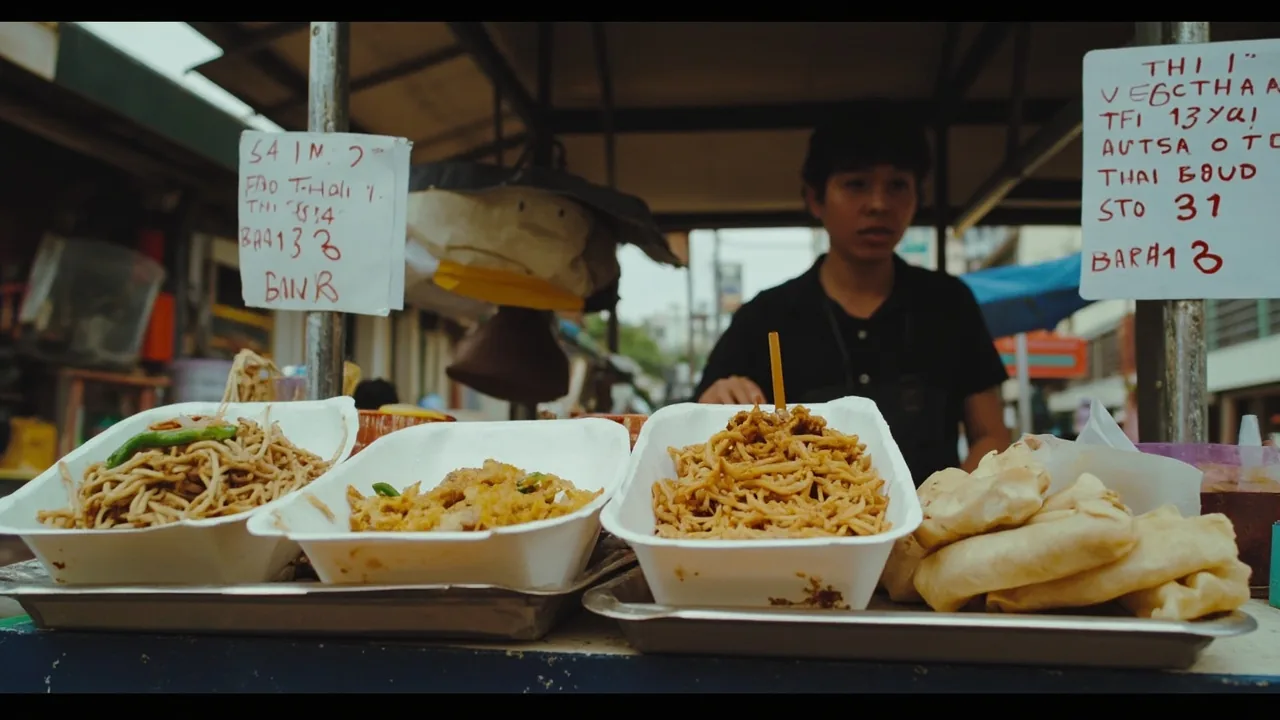
Thailand Vegetarian Food Prices 2026: What Veg Meals Cost in Bangkok, Chiang Mai & Phuket
Thailand veg food price ranges make it one of the easiest Southeast Asian countries for Indian travellers to eat vegetarian. The word “Jay” (เจ) is your ticket: a yellow flag at a street stall means the menu is vegan, no fish sauce, no oyster sauce, no egg, and usually no onion or garlic. See our Chiang Dao food guide.
At current rates, 1 THB works out to around ₹2.87 (~$0.03), so a 60 THB plate of noodles comes to about ₹172 (~$1.79), and a full day of three vegetarian meals lands at ₹572-₹858 (~200-300 THB or ~$5.94-$8.90) if you eat mostly street food. Below, I break down what veg food costs in Bangkok, Chiang Mai, and Phuket, which local dishes are safe by default, where to find Indian restaurants when you need a dal-chawal fix, and the phrases that save you from fish-sauce-laden curries. See our Southeast Asia backpacking hub for regional planning, and Where to Eat Indian Food in Koh Chang for island options.
Quick Answers
| What | Answer | Price (INR) |
|---|---|---|
| Veg pad thai at a Jay stall (Bangkok) | Order “Pad Thai Jay, no egg” at any yellow-flag stall | ₹172 (~60 THB or ~$1.78) |
| Mango sticky rice (street stall, all cities) | Sold at every night market and most 7-Eleven-style counters | ₹143 (~50 THB or ~$1.48) |
| Som tum (papaya salad), Jay version | Specify “Jay, no shrimp, no fish sauce” | ₹114 (~40 THB or ~$1.19) |
| Bottle of drinking water | From any 7-Eleven or street vendor | ₹20 (~7 THB or ~$0.21) |
| Full Indian thali (veg) at a North Indian restaurant | Phuket / Chiang Mai / Bangkok, per person | ₹715-₹1,287 (~250-450 THB or ~$7.42-$13.35) |
All prices above are the local-currency amount you pay at the counter. Conversion to ₹ is shown at the current rate of 1 THB = ₹2.87 in the daily budget section below.
The Local Culinary Landscape
Thai food looks vegetarian-friendly on the surface. There is stir-fried morning glory everywhere, tofu is sold in every 7-Eleven, and rice is rice. The problem hides in the sauces. Almost every savoury Thai dish contains at least one of the following: fish sauce (nam pla), shrimp paste (kapi), oyster sauce, chicken broth, or lard in the frying oil. Even a plate of plain-looking stir-fried vegetables is usually swimming in fish sauce and oyster sauce by default.
The other trap is how Thai people define “vegetarian”. A Thai host or street-stall aunty often considers chicken and seafood to be “not meat” and will cheerfully serve you a fish-sauce-laden chicken stir-fry when you say “ao Jay” (I want vegetarian). You have to be specific. The food scene is also strongly Buddhist-influenced during the annual Nine Emperor Gods Festival (Tesagan Gin Jay), when a noticeable share of stalls put out yellow flags and the country goes roughly 30 to 40 percent Jay for a week. Outside festival season, you are relying on permanent Jay stalls plus a handful of Indian, Chinese, and health-food restaurants.
Subodh’s Pro Tip: If you cannot find a yellow flag, find a stall with Chinese signage and ask “Gin Jay mai?” (Can I eat vegetarian here?). Chinese-Thai stalls almost always know what Jay means and have a separate section of the wok.
Key Phrases in Local Script
Print this table or screenshot it. The first phrase is the only one you need.
| English Phrase | What it Means | Local Script | Pronunciation |
|---|---|---|---|
| I am vegetarian (no meat, no seafood) | Asks for fully veg food | ไม่ทานเนื้อ ไม่ทานปลา | Mai tan nuea, mai tan pla |
| Jay food / Jay menu | Vegan-style, usually no onion/garlic too | เจ | Jay |
| No fish sauce | Removes the #1 hidden ingredient | ไม่ใส่น้ำปลา | Mai sai nam pla |
| No oyster sauce | Removes the #2 hidden ingredient | ไม่ใส่น้ำมันหอย | Mai sai nam man hoi |
| No egg | Important for pad thai | ไม่ใส่ไข่ | Mai sai khai |
| No shrimp paste | Critical for curries and chilli pastes | ไม่ใส่กะปิ | Mai sai kapi |
| No onion, no garlic | For Jain travellers | ไม่ใส่หัวหอม ไม่ใส่กระเทียม | Mai sai hua hom, mai sai kratiem |
| Is this Jay? | Quick check before ordering | เจ ไหม | Jay mai |
Safe Local Street Food Dishes
These are the dishes Indian vegetarians eat day to day in Thailand. Every one is either vegetarian or easy to make so with one or two phrase swaps. Prices are what you pay at a normal street stall in 2026.
Pad Thai Jay (ผัดไทยเจ). Stir-fried rice noodles with tofu, bean sprouts, chives, and crushed peanuts. The default recipe uses fish sauce and a sprinkle of dried shrimp on top. Order “Pad Thai Jay, no egg, no fish sauce” and any Jay stall will hand you a vegan version for ₹172 (~60 THB or ~$1.78). At a regular stall the same swap costs ₹200-₹229 (~70-80 THB or ~$2.08-$2.37). Canteen in Bangkok has a more polished take on modern Thai street food with a strong papaya salad and mango sticky rice game, well worth the detour if you want a sit-down version of the same dish.
Pad Krapow Jay (ผัดกะเพราเจ). Basil stir-fry with tofu and vegetables, served over rice with a fried egg on top. Order “Pad Krapow Jay, no fish sauce, no oyster sauce, no egg” and you get a fiery holy basil tofu plate for ₹172-₹229 (~60-80 THB or ~$1.78-$2.37). This is the default Indian-vegetarian lunch for a reason: it’s fast, it’s spicy, and it’s everywhere.
Som Tum Jay (ส้มตำเจ). Green papaya salad with tomatoes, lime, chilli, and peanuts. The standard Thai version contains fish sauce and dried shrimp. Specify “Jay, no shrimp, no fish sauce” and you’ll get a vegan version for ₹114 (~40 THB or ~$1.19) at a market. The Simple in Bangkok is a solid spot for a cleaner take on these classic Thai plates.
Mango Sticky Rice (ข้าวเหนียวมะม่วง). The one Thai dessert every vegetarian can eat without thinking. Coconut milk, sticky rice, fresh mango. No hidden ingredients anywhere. ₹143 (~50 THB or ~$1.48) at a street stall, often ₹172-₹229 (~60-80 THB or ~$1.78-$2.37) in tourist zones.
Khao Soi Jay (ข้าวซอยเจ). Chiang Mai’s signature coconut curry noodle soup. The traditional Chiang Mai version uses chicken or beef, but most khao soi shops in Nimman and the Old City now offer a Jay version made with tofu or mushrooms. Expect ₹172-₹257 (~60-90 THB or ~$1.78-$2.67) for a bowl, served with pickled mustard greens, red onion, and lime on the side.
Tofu Satay (เต้าหู้สะเต๊ะ). Skewered grilled tofu in peanut sauce. Found at most night markets. ₹57-₹86 (~20-30 THB or ~$0.59-$0.89) per skewer, completely vegetarian by default, ask for “no shrimp paste in the sauce” if you want to be sure.
Safety Alert: Mango sticky rice from a stall that’s been sitting in the sun for 6 hours is a different proposition from one with high turnover. Eat dessert from the stall with the longest queue, not the one with the most appealing display.
For a deeper look at night-market food tour options across Thailand, see our food tour booking guide for Indian backpackers. Planning your overall Thailand food budget? Our Thailand food cost per day breakdown has city-by-city numbers.
Recommended Vegetarian Restaurants
When you’ve had your seventh plate of basil tofu in three days and need a dal-chawal fix, head to one of these. All are strict vegetarian or have a marked veg menu. Prices shown are per-person typical spend.
Local / Regional Favourites (veg-friendly, Thai-led)
- The Simple (Bangkok). Simple, well-executed Thai plates, easy to order Jay. Expect ₹343-₹572 (~120-200 THB or ~$3.56-$5.94) per person.
- Foodee’s Phuket (Phuket). Casual Thai and international menu with several vegetarian options. Good fallback if you’re tired of night-market food. ₹429-₹858 (~150-300 THB or ~$4.45-$8.90) per person.
- Thai Food Good Taste (Chiang Mai). Local favourite in the Old City serving authentic Thai with a vegetarian section. ₹286-₹572 (~100-200 THB or ~$2.97-$5.94) per person.
- Lao Pa Sat Phuket Town (Phuket). Not a restaurant, it’s a traditional market with local food stalls. Multiple stalls here offer Jay options and fresh fruit. Budget ₹229-₹429 (~80-150 THB or ~$2.37-$4.45) if you graze.
Indian / Strict-Veg Restaurants
- Vrindavan (Phuket). North Indian pure vegetarian, upscale setting. Paneer dishes, dals, biryanis. ₹1,001-₹1,429 (~350-500 THB or ~$10.39-$14.84) per person.
- Shree Ganesha 2 Pure Veg & Jain Food (Phuket). The Jain-friendly name is the giveaway. North Indian veg and Jain menu, family-friendly. ₹715-₹1,144 (~250-400 THB or ~$7.42-$11.87) per person.
- Chai “N” Thai @ Nimman (Chiang Mai). Best-rated Indian food in Chiang Mai with a proper vegan section. North Indian and South Indian dishes. ₹572-₹1,001 (~200-350 THB or ~$5.94-$10.39) per person.
- Kanchan Indian Food (Home Made, Pure Veg). Family-run Punjabi veg spot, home-style cooking, fresh ingredients. Budget option at ₹429-₹715 (~150-250 THB or ~$4.45-$7.42) per person.
- Little Indian Kitchen (Chiang Mai Night Bazaar). Halal Indian, vegan-friendly, South Indian leaning. Great late-night option near the Night Bazaar. ₹429-₹858 (~150-300 THB or ~$4.45-$8.90) per person.
- Indique (Bangkok). Upscale Indian fine dining at around ₹1,144-₹1,429 (~400-500 THB or ~$11.87-$14.84) per person. Worth it for the butter chicken alone, full vegetarian menu available.
See dates & book your seat →
Food Safety & Hygiene
The biggest threat to your trip is not finding vegetarian food. It’s getting Delhi Belly from a sketchy stir-fry. These rules work in Thailand specifically:
- Eat at stalls with high turnover. If ten other Thais are eating there, the food is fresh and the wok is hot. A stall with no queue at 7pm has been sitting too long.
- Drink only sealed bottled water. A 7-Eleven bottle is ₹20 (~7 THB or ~$0.21), free. Avoid ice from unknown sources, though Bangkok, Chiang Mai, and Phuket all use commercially produced ice so most restaurant ice is safe.
- Skip the pre-cut fruit from roadside carts that has been sitting uncovered. Mango sticky rice from a stall that just cooked it is fine. Pre-cut watermelon that has been on a plate for an hour in 35°C heat is not.
- Jay-only stalls are your safest bet. If a stall has declared itself fully vegan with a yellow flag, it’s been doing this long enough to have its supply chain sorted.
- Carry ORS sachets. The Indian pharmacy brands like Electral are sold at every 7-Eleven and Boots in Thailand for around ₹86-₹114 (~30-40 THB or ~$0.89-$1.19) per sachet. Buy a few the day you land and put them in your daypack.
For a complete guide on what to eat and what to avoid across the region, see our street food safety guide for Indian backpackers.
Getting Connected
A local SIM with data is your fastest way to look up “Jay restaurants near me” on Google Maps when you’re starving. AIS, TrueMove, and DTAC all sell tourist SIMs at the airport, typically around ₹855 (~299 THB or ~$8.89) for a 7-8 day plan. The same SIM is often a bit cheaper at 7-Eleven inside the city. If you’d rather skip the airport queue, Get Nomad eSIM gets you connected before you board the flight.
Common Food Mistakes Indians Make
1. Ordering “Pad Thai, no chicken”. The default pad thai already contains dried shrimp and fish sauce. Specifying no chicken just removes a protein you were never going to eat. Always say “Pad Thai Jay, no egg”.
2. Assuming “vegetarian soup” means veg stock. Most Thai soups are built on chicken or pork stock. The Tom Kha you’ll be served at a tourist cafe often has chicken broth as the base even if you only see mushrooms and tofu in the bowl. Order “Jay, no chicken stock” or skip the soup category entirely.
3. Trusting “no meat” from a Thai staff member. If you ask “no meat”, many Thai staff will remove the visible chicken or pork but leave the fish sauce and oyster sauce because those are flavour, not meat. You must say “no fish sauce” explicitly, every time, for every dish.
4. Eating at the cheapest pad thai stall on Khao San Road. Khao San Road pad thai at ₹86 (~30 THB or ~$0.89) exists, but it’s often reheated from a morning batch and uses low-quality oil. You save ₹86 (~30 THB or ~$0.89) and lose a day of your trip to the toilet. Pay a little more at a stall with high turnover and a visible wok.
5. Loading up on fresh fruit from a street cart. The fruit is fine. The pre-cut display that’s been sitting uncovered in the humidity for 2 hours is not. Buy whole fruit and peel it yourself, or eat it from a stall that cuts it in front of you.
Daily Vegetarian Budget in Thailand
Realistic day-to-day spending on vegetarian food in Thailand for an Indian backpacker in 2026, assuming you eat two street meals and one restaurant meal per day:
| Meal | Where | Cost (THB) |
|---|---|---|
| Breakfast | Jay stall or 7-Eleven | ₹114-₹172 (~40-60 THB or ~$1.19-$1.78) |
| Lunch | Pad Thai Jay / Pad Krapow Jay at a stall | ₹172-₹229 (~60-80 THB or ~$1.78-$2.37) |
| Coffee / snack | Local cafe or 7-Eleven | ₹86-₹172 (~30-60 THB or ~$0.89-$1.78) |
| Dinner | Indian restaurant or sit-down Thai | ₹429-₹858 (~150-300 THB or ~$4.45-$8.90) |
| Mango sticky rice | Dessert | ₹143 (~50 THB or ~$1.48) |
| Bottled water (2 bottles) | 7-Eleven | ₹40 (~14 THB or ~$0.42) |
| Daily total | 350-560 THB |
At current rates, 1 THB is around ₹2.87 (~$0.03), so 500 THB a day works out to roughly ₹1,435 (~$14.90) for three full meals plus snacks. Phuket runs 20 to 30 percent more than Bangkok at the restaurant level but is similar at the street level. Chiang Mai is the cheapest of the three cities at both levels.
Subodh’s Take
Thailand is genuinely one of the best vegetarian-eating countries in Southeast Asia for Indian travellers, and Bangkok, Chiang Mai, and Phuket each handle it differently. Bangkok gives you the widest choice, Chiang Mai gives you the best prices, and Phuket gives you the best Indian-vegetarian fallback restaurants when you need a real thali. Print the phrase table above, look for the yellow flag, and you’ll eat well across all three cities.
FAQ
1. Is pad thai safe for vegetarians in Thailand?
Yes, if you order “Pad Thai Jay, no egg, no fish sauce”. The default pad thai contains fish sauce and dried shrimp. At a Jay-only stall with a yellow flag, the entire menu is already vegan and you can skip the long version. Expect ₹172 (~60 THB or ~$1.78) at a Jay stall and ₹200-₹229 (~70-80 THB or ~$2.08-$2.37) at a regular stall after the swap.
2. How do I find Jain food in Thailand?
Look for the yellow flag with red Chinese characters, it signals Jay food that is also usually no-onion-no-garlic. Beyond that, restaurants like Shree Ganesha 2 in Phuket and Chai “N” Thai in Chiang Mai explicitly label Jain options on their menus. Always reconfirm “no onion, no garlic” at the counter even if the menu says Jay.
3. Is fish sauce in everything?
Yes, in savoury Thai cooking it is the default seasoning. Pad thai, pad krapow, som tum, most curries, most stir-fries, and even some soups. The phrase “mai sai nam pla” (no fish sauce) is the single most useful sentence in this entire guide.
4. Can I eat vegetarian at McDonald’s or Burger King in Thailand?
Yes. Both chains have a McVeggie or plant-based burger on the Thai menu. The patty is genuinely vegetarian, but the buns and fries may share fryers with chicken, so strict Jains may want to skip. McDonald’s is more reliable than Burger King in Thailand for the veg option.
5. What is a typical vegetarian meal price at a Thai street stall?
₹114-₹229 (~40-80 THB or ~$1.19-$2.37) covers most single-plate veg meals at a street stall in 2026. That’s around ₹114 to ₹229 at the current rate of 1 THB = ₹2.87. A full day of three street meals plus water lands at ₹572-₹858 (~200-300 THB or ~$5.94-$8.90).
6. Is Chiang Mai cheaper than Bangkok for vegetarian food?
Yes, at both street and restaurant level. The same pad thai Jay costs ₹143 (~50 THB or ~$1.48) in Chiang Mai versus ₹172-₹229 (~60-80 THB or ~$1.78-$2.37) in Bangkok. Indian restaurants in Chiang Mai run ₹429-₹858 (~150-300 THB or ~$4.45-$8.90) per person, while Bangkok’s Indique-class spots run ₹1,144-₹1,429 (~400-500 THB or ~$11.87-$14.84) per person.
7. Do I need to tip at Thai street stalls?
No. Street stalls and small restaurants don’t expect tips. Round up the bill at a mid-range restaurant if service was good, but don’t feel obligated. The same goes for Indian restaurants in tourist zones.
