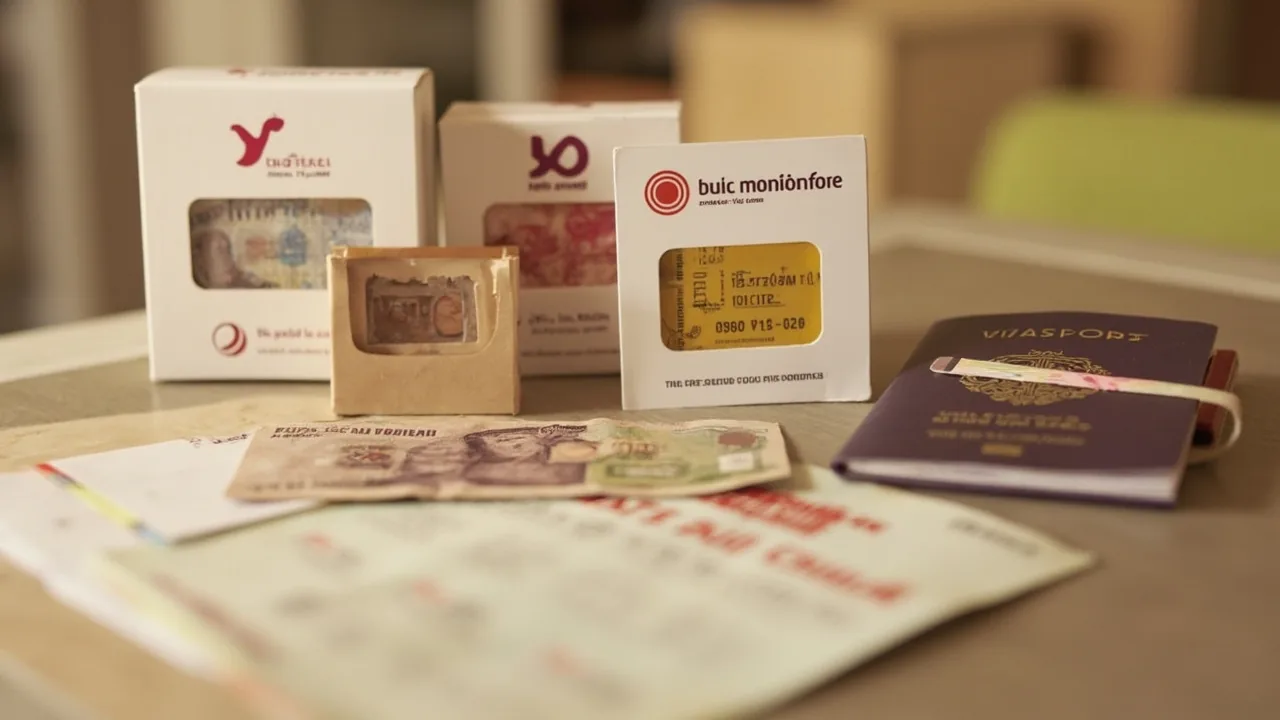
Vietnam SIM Card for Tourists: Where to Buy, What It Costs, and Which Plan to Pick
Vietnam sim card plans are essential. A working SIM in Vietnam is not optional. Grab is the only reliable way to call a GrabBike in HCMC, you cannot book a Hanoi walking-food tour without data, and your hostel will WhatsApp the door code on the Vietnamese number you give them at check-in. Do not be one of them. Planning the wider region? Our Southeast Asia backpacking hub covers the full multi-country route.
This guide walks through the three Vietnamese carriers that matter for tourists (Viettel, Mobifone, Vinaphone), the plans they sell foreigners, what each one costs in VND at current rates (verified at 1 INR = ~270 VND on the day of writing), and the airport-vs-shop-vs-eSIM trade-off. Plan for ₹478 (~130,000 VND or ~$4.97) for a 14-day prepaid tourist SIM with about 6GB of data, or ₹736-₹957 (~200,000-260,000 VND or ~$7.64-$9.93) if you want 30 days and more data.
Quick Answers
| What | Answer | Price (INR) |
|---|---|---|
| Cheapest 14-day tourist SIM (~6GB) | Viettel / Mobifone / Vinaphone tourist pack at any airport kiosk | 130,000 |
| Best 30-day tourist SIM (4GB/day) | Viettel tourist 30-day at airport or Viettel store | 260,000 |
| Where to buy at Hanoi airport | Yes, after baggage claim, arrivals hall kiosks | 130,000 to 260,000 |
| Where to buy at HCMC Tan Son Nhat | Yes, arrivals level kiosks | 130,000 to 260,000 |
| Passport needed | Yes, photo of passport is taken at the counter | 0 |
| eSIM alternative (no passport visit) | Get Nomad eSIM, activate before landing | varies by plan |
The Three Carriers in Plain English
Vietnam has three mobile carriers tourists ever see: Viettel (largest, owned by the military), Mobifone (second largest, oldest private operator), and Vinaphone (state-owned, smallest of the three). All three sell dedicated tourist SIMs. Coverage in cities and on tourist routes (Hoi An, Đà Nẵng, Hạ Long, Ninh Bình) is identical because they all use the same 4G LTE bands and have dense tower footprints where travellers go. The differences show up in two places: customer service if something breaks (Viettel has the most English-speaking staff), and whether your phone supports their specific LTE bands.
Subodh’s Pro Tip: Before you buy anything, open your phone, dial *#06#, and write down the IMEI. You will need it if the SIM stalls ask for it, and it costs nothing.
If your phone is bought in India in the last five years, you are fine with all three. If you are carrying an older 3G-only device, Viettel’s 4G has the widest reach in rural areas. Travellers report Vinaphone’s call quality beats the other two on long-distance voice calls to India, but you can ignore this if you plan to use WhatsApp for everything (you will).
The Actual Tourist Plans (2026)
These are the three packs every airport kiosk and Viettel store will try to sell you. Verified against Viettel and Mobifone official tourist sites on the date above.
Viettel Tourist SIM (most popular)
- 14-day pack: ~6GB data + 30 mins domestic calls + free incoming calls = ₹478 (~130,000 VND or ~$4.97)
- 30-day pack: ~4GB/day + 30 mins domestic calls + free incoming calls = ₹957 (~260,000 VND or ~$9.93)
- Activation: at the counter, takes 10 minutes, passport scan included.
- Where: airport kiosks (Hanoi Noi Bai, HCMC Tan Son Nhat, Đà Nẵng), any Viettel store in cities.
Mobifone Tourist SIM
- 14-day pack: ~6GB data = ₹478 (~130,000 VND or ~$4.97)
- 30-day pack: 4GB/day = ₹883 (~240,000 VND or ~$9.17) (slightly cheaper than Viettel)
- Activation: same, passport scan at the counter.
- Where: airport kiosks, Mobifone branded stores, many convenience stores (Co.opmart, Circle K in some locations).
Vinaphone Tourist SIM
- 15-day pack: ~6GB data = ₹478 (~130,000 VND or ~$4.97)
- 30-day pack: high-data plan, see counter for current price (₹552-₹810 (~150,000-220,000 VND or ~$5.73-$8.40)).
- Where: airport kiosks, Vinaphone stores, less common at convenience stores than Mobifone.
All three come with a free Vietnamese phone number, free incoming calls (this matters, hostels will call you to confirm bookings), and zero roaming. Travellers report the data caps reset at midnight local time, not at purchase time, so if you arrive at 11 PM you do not lose a day.
Safety Alert: Counter staff at Vietnam airports occasionally try to “help” you buy the wrong plan. They will scan your passport, ask you to confirm the plan in English, and many foreigners sign whatever form is in front of them without reading. Read the plan name out loud before they slot the SIM. If the receipt says anything other than “Tourist” or a stated price, say no.
Where to Buy: Airport, City Store, or eSIM
This is the question 90% of Indian backpackers ask on arrival, so here is the honest breakdown.
Airport kiosks (highest price, most convenient)
Hanoi Noi Bai and HCMC Tan Son Nhat both have official carrier kiosks in the arrivals hall, after baggage claim, before customs. They will sell you the ₹478 (~130,000 VND or ~$4.97) pack with zero hassle. The trade-off: airport prices are typically ₹74-₹184 (~20,000-50,000 VND or ~$0.76-$1.91) higher than a city Viettel store for the same plan. You are paying for the convenience of buying it at 2 AM when nothing else is open, or for not having to find a Viettel store on day one. Travellers report airport staff will sometimes throw in a free SIM adapter set or a small data top-up voucher, which makes the premium partially worth it.
Hanoi-specific note: the airports to figure out are Noi Bai (international) and Gia Lam (rarely used). The Noi Bai arrivals kiosks are signposted from baggage claim, traveller reports from June 2026 say wait time is 10-15 minutes max. HCMC’s Tan Son Nhat terminal 2 (international arrivals) has Viettel, Mobifone and Vinaphone counters all in a row.
Viettel/Mobifone/Vinaphone stores in the city (cheapest, slightly inconvenient)
City stores sell the same plans at ₹37-₹184 (~10,000-50,000 VND or ~$0.38-$1.91) less than airport, sometimes less during promotions. The catch: you have to find them. In Hanoi Old Quarter, the Viettel store on Đinh Tiên Hoàng street is 10 minutes’ walk from Hoan Kiem Lake. In HCMC, the Mobifone store on Nguyễn Huệ is central. Travellers report the staff at these stores speak better English than airport kiosk staff (counter-surprising, but the airport staff handle so many tired tourists that they default to fast/transactions, while store staff have time to explain the plan properly).
Convenience stores (Circle K, WinMart, Co.opmart) generally do not sell tourist SIMs in Vietnam, unlike Thailand where 7-Eleven is the default. This is the single biggest difference Indian backpackers should know.
eSIM (no physical visit, plan in advance)
Get Nomad eSIM and similar providers sell Vietnam-specific eSIM plans ranging ₹771-₹2,408 (~8-25 USD) for 5-30GB over 7-30 days. You scan a QR code before you fly, the eSIM activates on landing, no passport scan needed at any counter. The trade-off: you get a foreign or virtual number (not a Vietnamese number), so if a Hanoi hostel calls you, your actual SIM, not the eSIM, must be reachable. Travellers who book hostels in advance via Booking.com and only use apps for navigation mostly prefer eSIM. Travellers who walk in to guesthouses and call the homestay five times report preferring a physical SIM for the local number.
Subodh’s Pro Tip: Buy the airport tourist SIM on arrival (₹478 (~130,000 VND or ~$4.97), takes 15 minutes), and top up data as needed. If you do not need a Vietnamese phone number for bookings, the eSIM option is cleaner and often cheaper per gigabyte. Hybrid is fine too: travellers report having both a ₹478 (~130,000 VND or ~$4.97) physical SIM (for calls/text) and a small data-only eSIM (for their second phone or laptop) without any issues.
What Foreigners Pay (No Hidden Fees)
The ₹478 (~130,000 VND or ~$4.97) figure is what you pay. There are three things that get tacked on or that tourists get scammed on:
-
Activation/deposit: officially zero. Counter will sometimes ask for a ₹184-₹368 (~50,000-100,000 VND or ~$1.91-$3.82) “deposit” they “return when you leave.” Travellers report this is sometimes legitimate (SIM card return deposit) and sometimes a soft scam. If they want a deposit, ask for a receipt. If no receipt, walk away to the next counter.
-
Top-up vouchers: a card with a 16-digit code you scratch off and text to 900. These are sold everywhere: airport kiosks, convenience stores, Viettel stores. Buy only what you need in ₹184 (~50,000 VND or ~$1.91) denominations. Travellers report getting pressured into ₹1,840 (~500,000 VND or ~$19.10) vouchers they do not need.
-
Roaming back to India: if you turn on data roaming on a Vietnam SIM in Vietnam, no extra charge. If you take the Vietnam SIM to Cambodia or Laos, roaming charges of 50,000-200,000 VND/day kick in. If you plan to cross borders, buy a local SIM at each country instead.
Topping Up Once You’re Low on Data
Each carrier has its own top-up channel. Travellers report this is the single most common thing Indian backpackers get stuck on: they have 500MB left and no idea how to add more without a Vietnamese bank card.
The short version: scratch cards (gồng cào) at any convenience store or Viettel store, in 50,000 / 100,000 / ₹1,840 (~500,000 VND or ~$19.10) denominations. You scratch the back, send the code by SMS to 900, and data is added in seconds. Some carriers also support top-up via their app (My Viettel, My Mobifone) if you have a Vietnamese bank card, which you will not, so skip this. For a full how-to with screenshots of which number to text, see How to Top Up Your Vietnam SIM Card.
Safety Alert: Scratch-card scratch-off fraud exists. Travellers report counterfeit ₹368 (~100,000 VND or ~$3.82) scratch cards sold in some smaller convenience stores. Stick to Co.opmart, Circle K, WinMart, or the carrier’s own stores. If the card’s hologram looks off, do not buy it.
What About Calls and SMS to India?
The tourist SIMs above include 0 to 50 minutes of domestic calling and free incoming calls, but international calls to India are not included. To call India you have three options:
- Use WhatsApp / Signal / Telegram: this is what 95% of travellers do. Free, data-only, no SIM cost.
- Buy an international calling add-on: Viettel and Mobifone both sell “international 100” packs for ₹368-₹552 (~100,000-150,000 VND or ~$3.82-$5.73) giving ~100 minutes of calls to India. Counter staff will offer them, accept only if you plan to call. Travellers who need SMS OTPs for Indian banks/UPI while abroad should read the dedicated guide on Vietnam SIM cards with SMS for Indian travellers before buying, as some Indian banks block Vietnamese-issued numbers entirely.
- Buy a Voice-over-IP app with credit: more steps, less hassle long term, but overkill for a 2-week trip.
Coverage on the Tourist Routes
Coverage quality by route, verified against Viettel’s official coverage map and traveller reports:
- Hanoi: full 4G everywhere in the Old Quarter, French Quarter, west of Hoan Kiem Lake. Drop-outs in some alleys between Hoàn Kiếm Lake and the train street are usually network congestion, not no-signal.
- Hạ Long Bay: 4G on the main cruise docks, 3G on overnight cruises, near-zero on kayak trips. Treat cruise Wi-Fi as your backup.
- Ninh Bình: full 4G in town and at Tam Cốc boat dock. Coverage is patchy on rural motorbike routes to Bích Động pagoda.
- Hue, Hoi An, Đà Nẵng: full 4G on the beach strips and old towns. Drop-outs in the mountains between Hue and Hoi An if you take the Hai Vân Pass back route.
- Sa Pa: 4G in Sa Pa town, near-zero on the Fansipan cable car route and in Muong Hoa valley. Trekking guides usually carry a Wi-Fi hotspot if you need it.
- Ho Chi Minh City, Đà Lạt, Mũi Né, Nha Trang: full 4G.
Common Mistakes Indian Travellers Make
Five things that go wrong most often:
- Buying at the airport anyway instead of researching in advance. ₹478 (~130,000 VND or ~$4.97) is fair if you just want to skip the research. But many travellers arrive at 11 PM and get sold a ₹1,840 (~500,000 VND or ~$19.10) “tourist premium” pack they do not need. Read this article on the flight.
- Forgetting to check phone unlock status. Indian phones are sold unlocked by default, but cheaper models sometimes are not. If your phone is locked to Airtel/Jio, your Vietnam SIM will refuse to connect. Check this at home, not at the airport.
- Not registering your IMEI. Vietnam requires all foreign phones to be registered with a local carrier within 7 days or your SIM stops working. The airport tourist SIM includes this registration automatically (the counter does it). If you buy a SIM in a city store, confirm they have IMEI-registered the device.
- Buying a Vietnam SIM and then accidentally roaming back to India. If you keep the SIM active at home, you will be charged 50,000-200,000 VND/day the moment you land in India. Travellers report coming home to a ₹3,680 (~1,000,000 VND or ~$38.20) bill because they did not remove the SIM. Some travellers report swapping the SIM out before boarding their return flight to avoid this.
- Skipping the eSIM option when they had a perfect use case for it. If you are landing in Hanoi, taking a private transfer to a pre-booked hotel, and plan to spend most of your time on Grab and Google Maps, the eSIM is faster than the airport queue. Travellers with five-year-old phones and locked bootloader should still go with physical.
FAQ
Can I buy a SIM card at the airport after midnight? Hanoi Noi Bai and HCMC Tan Son Nhat arrival halls have SIM kiosks running 24/7, but the staff rotate and English gets worse at odd hours. Buy at the airport desk only if you need data right now; otherwise grab airport Wi-Fi and buy online.
Do I need a Vietnamese passport or visa to get a SIM card? No, your Indian passport is enough. They will scan it, take your photo, copy your address from the visa on arrival stamp or e-visa printout, and you are done in 10 minutes.
What if I lose my phone with the SIM in it? Call Viettel 1800 8098, Mobifone 1800 1090, or Vinaphone 1800 1091 from any phone (free). Freeze the line, ask for a replacement SIM at any store with your passport. Travellers report this works on the same day.
How much should I budget for data on a 2-week trip? The ₹478 (~130,000 VND or ~$4.97) 14-day pack (about 6GB) is enough for one traveller who uses WhatsApp, Google Maps, and Grab. Two travellers who share their phone as a hotspot will burn 6GB in 6-7 days. Travellers with longer trips or video calls should top up another ₹368 (~100,000 VND or ~$3.82) scratch card mid-trip.
Will Indian apps (UPI, IRCTC, banking SMS) work with a Vietnam SIM? UPI works fine on data. SMS OTPs from Indian banks are a mixed bag; many Indian banks block Vietnamese-issued numbers. Read Vietnam SIM with SMS for OTPs before you go if any of this matters.
What happens if I keep my Vietnam SIM and travel onward? If you cross to Laos or Cambodia, your Vietnam SIM gets roaming charges of 50,000-200,000 VND/day. Travellers report swapping in a local SIM at each border (a Phú Quốc SIM or a mainland Vietnam SIM is just the standard pack again if you re-enter). If you keep it and go back to India, expect the carrier to bill you at international roaming rates, which are painful.
Subodh’s Take
Buy the ₹478 (~130,000 VND or ~$4.97) Viettel tourist pack at the airport on arrival. It is the boring, obvious answer, and that is why it works. The plans are not complicated; the traps are the airport staff selling “premium” packs, the scratch-card scams at small convenience stores, and the IMEI registration that catches out travellers who bought city SIMs. If you have a locked phone, an unlocked phone plus eSIM is the cleanest option for a 2-week trip. If you are spending three months, the Viettel 30-day tourist pack at ₹957 (~260,000 VND or ~$9.93) saves you a top-up trip. Stop overthinking the carrier choice, all three are fine in cities, and your number one concern should be having data the moment wheels touch runway.
