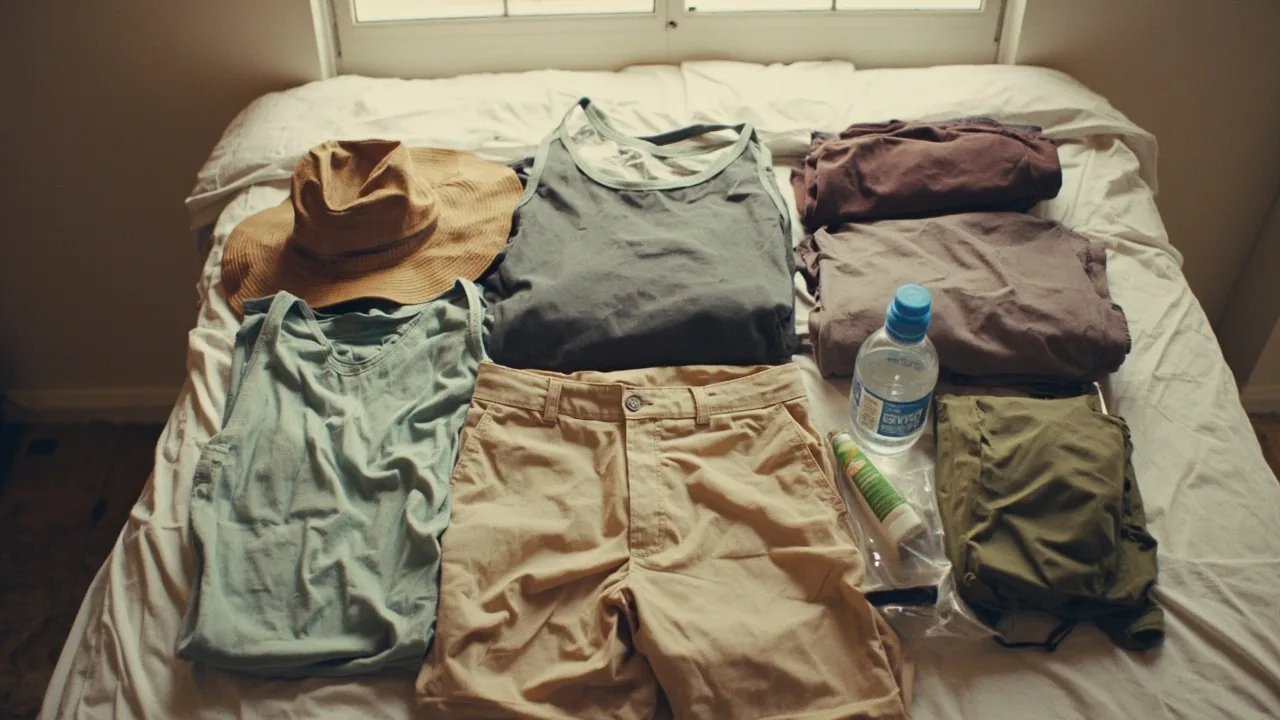
What to Pack for Southeast Asia’s Dry Season: A Backpacker’s Checklist
Dry season in Southeast Asia runs November through April in most of Thailand, Cambodia, Laos, and southern Vietnam, and February through May in northern Vietnam. That is six months of punishing sun, dust from laterite roads, and 32 to 38°C afternoons. This packing list for southeast asia dry season keeps your pack light and small enough to wrestle onto overnight buses. Three minimalist frameworks (5-4-3-2-1, 3-5-7, and 3-3-3) are applied below. Planning the wider region? Our Southeast Asia backpacking hub covers the full multi-country route.
Subodh’s Pro Tip: If your backpack weighs more than 10 kg fully packed, you have packed wrong. Most Indian travellers land in Bangkok or Ho Chi Minh City carrying 14 to 18 kg. The bus driver does not care. Your spine does.
Quick Answers
| What | Answer | Price (INR) |
|---|---|---|
| Best backpack size for dry-season SEA | 40 to 50 litres, frameless or internal-frame | ₹4,500 (~$46.64) |
| Power bank limit for cabin baggage | Under 100 Wh (about 27,000 mAh at 3.7V); 20,000 mAh is the safe target | ₹1,800 (~$18.66) |
| Sunscreen from India (50ml SPF 50) | Costs 3 to 4x more in Bangkok, Hanoi, and Phnom Penh than in India | ₹350 (~$3.63) |
| Hostel laundry cost per kg in SEA | Drop-off wash-and-fold, returned next morning | ₹150 (~$1.55) |
| Minimum universal adapter sockets to cover SEA | Type A, B, C, G; one adapter handles Thailand, Vietnam, Laos, Cambodia | ₹600 (~$6.22) |
Why Pack Light for the Dry Season
The dry season is when you will move most. Cool mornings push you onto sleeper buses at 9 PM. Border towns like Poipet, Vinh, or Huay Xai require hauling your bag across dusty parking lots. Old quarter hostels in Hanoi and Luang Prabang have staircases no lift can reach. Every extra kilo is a kilo you carry up three flights at midnight.
Most travellers land in Bangkok or Ho Chi Minh City carrying 14 to 18 kg. Pack like the person you will be in week six, not the person you are in week one.
The 5-4-3-2-1 Packing Rule, Applied to Dry-Season SEA
The 5-4-3-2-1 rule was built for a one-week trip, but the principle scales to a multi-week loop:
- 5 tops: 3 quick-dry t-shirts (one worn, two packed), 1 long-sleeve linen shirt for sun and temples, 1 thin merino or synthetic base layer for overnight buses with aggressive AC.
- 4 bottoms: 2 lightweight zip-off trousers (one converts to shorts), 1 pair of dry-fit shorts, 1 pair of thin athletic shorts for hostel sleep.
- 3 pairs of footwear: 1 walking sneaker (worn on the plane), 1 pair of sturdy sandals (Tevas or Decathlon Quechua MH500), 1 pair of thin flip-flops for hostel showers.
- 2 swimsuits or quick-dry towels: dry-season SEA is beach-heavy. Two pieces means one is always dry.
- 1 rain shell or packable poncho: dry season does not mean zero rain. A sudden downpour hits southern Thailand and the Mekong Delta even in March.
This rule gives you 15 items of clothing, fits in a 40L pack, and weighs under 3 kg.
The 3-5-7 Rule for Packing, and Why It Beats Overpacking
The 3-5-7 rule is a budget-and-volume framework, not a literal count:
- 3 bottoms you can mix and match with every top.
- 5 tops that all pair with those bottoms.
- 7 days of underwear and socks (or 4 pairs if you commit to washing every third night).
For dry-season SEA, the twist is heat rotation. A t-shirt soaked through at noon will not dry on your back in 90% humidity if you are walking around Angkor at 2 PM. Three quick-dry tees rotated through hostel laundry (drop-off by 9 PM, returned by 10 AM next day, typically ₹101-₹144 (~35-50 THB or ~$1.04-$1.49) or ₹29-₹44 (~8,000-12,000 VND or ~$0.31-$0.46) per kg) keeps you in clean clothes without packing extras.
Subodh’s Pro Tip: Skip jeans. They weigh 800g, hold sweat, take 18 hours to air-dry in humid weather, and offer zero UV protection. Light trousers in nylon or cotton-linen blend weigh 280g and dry in 90 minutes.
The 3-3-3 Rule for Packing: Three Months in One Bag
The 3-3-3 rule is the most aggressive of the three frameworks:
- 3 pairs of trousers
- 3 shirts
- 3 pairs of shoes
That is nine clothing items, plus socks and underwear, and the entire bag weighs 7 to 8 kg including electronics. Indian travellers who commit to 3-3-3 almost always add 1 cover-up shirt and 1 sarong mid-trip, but the discipline is the point. Travellers report that 3-3-3 is realistic only if you wash every other day and stay in hostels with attached laundry. The best backpack for SEA travel for this rule is a 35 to 40L frameless pack.
The Dry-Season Essentials Checklist
Clothing
- 3 quick-dry t-shirts (polyester or merino blend, not cotton)
- 1 long-sleeve linen or UV-protective shirt (for temples and sun exposure)
- 1 thin fleece or merino layer (overnight bus AC drops to 18°C)
- 2 lightweight zip-off or convertible trousers
- 1 pair of dry-fit shorts
- 1 pair of athletic shorts or sleep shorts
- 7 pairs of quick-dry underwear (ExOfficio or Decathlon Forclaz)
- 5 pairs of low-cut hiking socks (merino blend)
Footwear
- 1 walking sneaker or trail runner, worn on the plane to save 400g of pack weight
- 1 pair of sturdy sandals with heel strap (river crossings, hostel showers)
- 1 pair of thin flip-flops
Toiletries (carry only what you cannot buy at 7-Eleven)
- Sunscreen SPF 50, 50ml, from India. Verified against Bangkok pharmacy prices in May 2026, the same tube costs ₹804-₹1,149 (~280-400 THB or ~$8.34-$11.91) locally, three times the Indian price.
- Toothbrush, travel toothpaste, small soap bar or Dr. Bronner’s 30ml bottle
- 30ml roll-on deodorant (solid deodorant melts in checked baggage)
- Razor with one extra head
- Small microfibre towel, 80x130cm
- Insect repellent 30ml DEET-based (dry season has fewer mosquitoes than monsoon, but dengue risk never hits zero)
- Personal medication: ORS sachets, paracetamol, ibuprofen, loperamide, one course of ciprofloxacin or azithromycin (prescription from your Indian GP)
Electronics
- Universal travel adapter with Type A, B, C, and G sockets. Thailand, Cambodia, and Laos use B and C. Vietnam uses A, C, and G. A single adapter like the Epicka Universal or Skross World handles all four.
- 20,000 mAh power bank (74 Wh, well under the 100 Wh IATA cabin limit).
- Phone, charging cables (one USB-C, one micro-USB backup), and a small multi-port wall charger (Anker 30W or similar)
- Earbuds or small over-ear headphones
- Headlamp or small flashlight (rural guesthouses occasionally lose power)
Documents and Money
- Passport with 6+ months validity
- Printed visa-on-arrival form backup (Vietnam and Cambodia still prefer paper copies)
- Travel insurance policy printout
- ₹19,281 (~200 USD) emergency cash split across two locations
- Photocopies of passport and visa, kept separately from originals
Monsoon vs. Dry Season: What Changes
The monsoon packing list is heavier on waterproofs. For dry season, the priorities shift:
- Sunscreen and hats replace ponchos and dry bags. A 2mm neoprene stuff-cover is enough rain protection; an SPF 50 shirt and wide-brim hat are mandatory.
- Layer cotton-linen over quick-dry synthetics. Quick-dry still works for bus AC and temple visits; a cotton-linen overshirt adds breathability for humid afternoons.
- Sunglasses, not umbrellas. Dry-season dust in Chiang Mai, Pai, and Siem Reap is brutal. Polarised sunglasses that wrap around your face prevent dust irritation.
- Larger water bottle. Dehydration hits faster. A 1L Platypus or Nalgene is non-negotiable. Plastic bottles cost ₹20-₹57 (~7-20 THB or ~$0.21-$0.60) each and pile up in landfills.
Electronics & Tech Setup
The dry-season electrical grid is more reliable than monsoon, but you still need the right adapter. Thailand and Cambodia run on Type A (two flat prongs), Type B (two flat plus ground), and Type C (two round). Vietnam uses Type A, C, and the round-pin Type D. A single universal adapter with Type A, B, C, and D sockets covers all four countries.
For power banks, the IATA rule is 100 Wh maximum in cabin baggage. A 20,000 mAh power bank at 3.7V nominal is 74 Wh. A 27,000 mAh bank is right at 100 Wh and gets flagged by some airline scanners. Anything above 100 Wh must be in checked luggage. Stick to 20,000 mAh or below.
For connectivity, a physical SIM from AIS, Viettel, or Smart is cheap (₹571-₹859 (~199-299 THB or ~$5.93-$8.91) or ₹184-₹258 (~50,000-70,000 VND or ~$1.91-$2.67) for 8 days, 15 GB) and sold at the airport. If you want to land connected before you clear immigration, an eSIM from Nomad (nomadesim.com) gives you 1 GB of data the moment your plane touches down.
Subodh’s Pro Tip: Charge your phone and power bank to 100% before boarding your flight out of India. Cabin baggage scanners at Bangkok Don Mueang and Hanoi Noi Bai flag power banks above 30% charge sitting loose in your bag.
Cultural Dress Codes: Temples in the Dry Season
Northern Thailand, Luang Prabang, and Angkor enforce strict dress codes at temple complexes. Shoulders and knees must be covered. Shoes come off at every doorway, so wear sandals you can slip off without sitting down. The Cambodia packing list covers temple-specific gear in more detail.
Carry a 100g thin cotton sarong or scarf that doubles as a temple wrap, beach cover-up, and blanket on cold buses. The sarong costs ₹250 (~$2.59) to ₹400 (~$4.15) at Daiso or any Thai night market, half the price of buying one on Khao San Road.
Dry season is also the peak season for temple visits. Angkor Wat, Wat Pho, and Wat Phra That Doi Suthep see crowds from 9 AM to noon. Travellers report that arriving at 6:30 AM gives you empty reflecting pools and 28°C instead of the noon crush at 38°C.
Trail Laundry and Toiletries
Hostel laundry in SEA is reliable and cheap. Drop your bag at the front desk by 9 PM, fill out a slip with your room number, and pick up a folded kilo the next morning. Costs:
- Thailand: ₹115-₹172 (~40-60 THB or ~$1.19-$1.79) per kg
- Vietnam: ₹55-₹92 (~15,000-25,000 VND or ~$0.57-$0.96) per kg
- Cambodia: ₹193-₹386 (~2-4 USD) per kg
- Laos: ₹129-₹216 (~30,000-50,000 LAK or ~$1.34-$2.24) per kg
7-Eleven and Circle K stock toothpaste, shampoo, sunscreen, deodorant, and basic medicine. Do not pack what you can replace in 24 hours for under ₹150 (~$1.55).
Common Packing Mistakes Indians Make
Mistake 1: Bringing a Hardshell Suitcase
Suitcases do not roll on laterite, gravel, or sand, and they do not fit under sleeper-bus seats. Bring a backpack, even if you have never used one before. The 2026 backpack gear guide breaks down the 40 to 50L models that hold up to bus abuse.
Mistake 2: Packing Jeans and Heavy Cotton
Denim weighs 800g per pair, absorbs sweat, and takes 18 hours to dry in humid climates. You will wear jeans exactly twice, both times in Bangkok on the first day, then mail them home. Replace jeans with one pair of lightweight nylon trousers.
Mistake 3: Forgetting the Power Bank Wh Limit
A 30,000 mAh power bank sounds great. It is 111 Wh. It will be confiscated at Mumbai or Delhi security because it is over the 100 Wh limit. Buy a 20,000 mAh (74 Wh) bank instead. You get four phone charges and zero airport hassle.
Mistake 4: Carrying Full-Size Toiletries
A 200ml shampoo bottle is dead weight for day one. 7-Eleven in every SEA capital sells 30ml travel bottles of the same brands for ₹101-₹172 (~35-60 THB or ~$1.04-$1.79). Pack a 100ml empty silicone bottle and refill it locally.
Mistake 5: Packing for Cold Weather You Will Not Experience
The dry season is hot. Your hometown in December may be 8°C, but Chiang Mai in February is 32°C in the shade. Skip the fleece hoodie. Bring one thin merino layer for overnight buses and nothing else.
FAQ
Can I bring a suitcase instead of a backpack?
You can, but you will struggle at bus stations, on boat docks, and in hostel stairwells. Travellers report switching to backpacks after week one. If you must, use a 4-wheel spinner with a soft shell, not a hardshell.
Are power banks allowed in cabin baggage?
Yes, under 100 Wh. A 20,000 mAh bank at 3.7V is 74 Wh and flies without issues. Above 100 Wh must go in checked baggage, and anything above 160 Wh is banned.
Can I buy sunscreen cheap in Thailand?
No. Verified against Bangkok pharmacy prices in May 2026, a 50ml SPF 50 tube costs ₹804-₹1,149 (~280-400 THB or ~$8.34-$11.91). The same product in India is ₹110-₹180 (~$1.14-$1.87). Pack sunscreen from home.
Do I need a raincoat in the dry season?
Light rain still hits southern Thailand, the Mekong Delta, and northern Laos even in February. A packable poncho (under 100g, folds to a fist) costs ₹172-₹287 (~60-100 THB or ~$1.79-$2.98) and saves you when a sudden shower hits.
What plugs do I need for Thailand, Vietnam, Laos, and Cambodia?
Thailand, Laos, and Cambodia use Type A, B, and C. Vietnam uses Type A, C, and G. A single universal travel adapter handles all four. Buy one before leaving India; airport adapters cost ₹1,723 (~600 THB or ~$17.87) in Bangkok.
Is it safe to drink tap water in Southeast Asia?
No. Use a refillable bottle with a built-in filter (LifeStraw or Grayl), or buy 7-Eleven bottled water for ₹20-₹43 (~7-15 THB or ~$0.21-$0.45). The electronics and power guide has more on staying powered and connected.
Subodh’s Take
The dry season rewards travellers who pack for heat, sun, and movement, not the trip you imagined at home. Five tops, four bottoms, three shoes, two swimsuits, one rain layer, the 5-4-3-2-1 rule cuts to the bone and still leaves room for a sarong and a paperback. Bring a 20,000 mAh power bank, one universal adapter, and 50ml of sunscreen from India, then commit to laundry every third day. Your bag should weigh 9 to 10 kg fully packed. Anything heavier and you are carrying someone else’s wardrobe through a 38°C afternoon in Vientiane.
