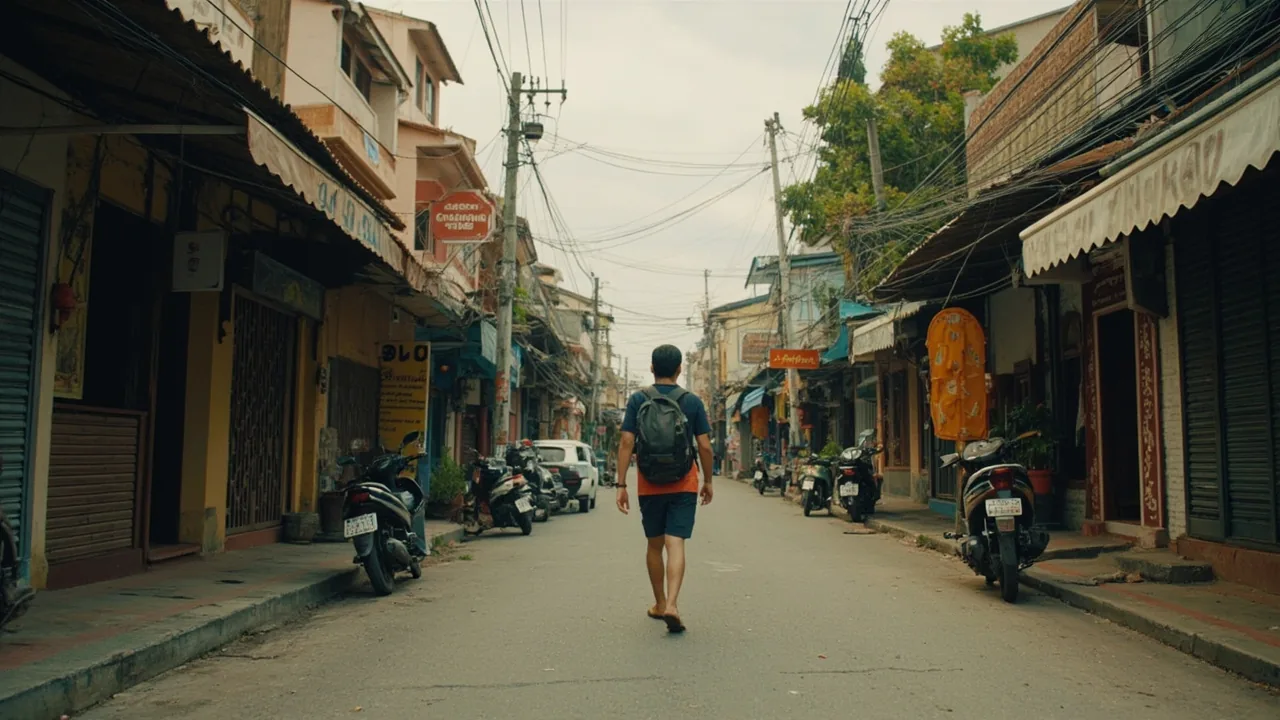
Where to Stay in Ho Chi Minh City: Best Neighborhoods for Backpackers
Ho Chi Minh City is the southern Vietnamese megacity of eight million motorbikes, drip-filter cà phê sữa đá, and a backpacker trail that runs straight down Bui Vien. You should base yourself here if you want a noisy, food-obsessed, easy-to-fly-into hub for the Mekong Delta, Cu Chi Tunnels, and onward buses to Cambodia. If you want quiet, beaches, or temples, skip it and go straight to Da Nang or Hoi An. HCMC is a city to eat and move through, not to relax in. This guide picks the right neighborhood for that, with current hostel prices and a clear answer for the most common question: District 1, District 4, or the Bui Vien strip. For related planning, see our guides on Sea Backpacking Hub and Hue.
Quick Answers
| What | Answer | Price (INR) |
|---|---|---|
| Best neighborhood for first-timers | District 1 (walkable, near Notre Dame, Ben Thanh, Bui Vien) | ₹3,200 (~860,000 VND or ~$33.15) |
| Cheapest dorm bed in backpacker zone | Bui Vien area (City Backpackers Hostel, mixed dorm) | ₹600 (~160,000 VND or ~$6.20) |
| Best neighborhood for food lovers | District 4 (local food, 5-min walk to District 1, cheaper rooms) | ₹3,000 (~810,000 VND or ~$31.10) |
| Cheapest way from Tan Son Nhat airport to District 1 | Public bus 109 | ₹65 (~17,500 VND or ~$0.67) |
| Indian vegetarian meal in District 1 | Tanishq Indian Vegetarian Restaurant (dosa + thali) | ₹220 (~60,000 VND or ~$2.30) |
How to Get There (From the Previous Stop on the Trail)
Most backpackers arrive in Ho Chi Minh City from one of three places: Cambodia (overland bus), Hanoi (domestic flight), or Bangkok (international flight). Here is what each costs and how long it takes today. You may also find Nha Trang useful for this trip.
From Phnom Penh by bus: 6-7 hours including the border crossing at Moc Bai/Bavet. The Mekong Express and Giant Ibis are the two operators travellers report as reliable. Booking on 12go a day or two ahead is enough. Book on 12go. Around ₹1,927-₹2,408 (~20-25 USD) one way. See also: Dalat.
From Hanoi by flight: 2h 10m on VietJet, Vietnam Airlines, or Bamboo. Returns from about ₹4,500 (~$46.71). Sleeper trains are 30+ hours and not worth it unless you specifically want the rail experience. Book on 12go. For related planning, see our guide on Sapa.
From Bangkok by flight: 1h 20m on VietJet or Thai VietJet. Returns from about ₹8,500 (~$88.23). Book on 12go.
From Da Nang by flight or sleeper: flight is 1h 20m and worth the money. Sleeper buses are 18 hours and brutal. Book on 12go.
If you are entering Vietnam at HCMC for the first time, Tan Son Nhat Airport is 8 km from District 1. The public bus 109 runs every 15-20 minutes from 6 a.m. To 6 p.m., takes about 45 minutes, and lands you at Ben Thanh Market for the price of a street-food bowl. Grab is faster (20-30 minutes) but runs ₹250-₹300 (~$2.60-$3.11).
Where to Stay: District 1 vs District 4 vs Bui Vien
This is the actual decision. Three zones get 95% of backpacker bookings, and they feel different enough that picking the wrong one ruins a trip.
District 1 (Pham Ngu Lao / backpacker cluster): This is the default and where most first-timers should stay. Walkable to Notre Dame Cathedral, the Central Post Office, War Remnants Museum, Ben Thanh Market, and Bui Vien walking street. The room stock is older and the streets are noisier, but you trade that for the ability to step out of your hostel and be at everything.
Bui Vien strip (inside District 1): If you specifically came to party, this two-block section is the backpacker ghetto. Cheap beer, hostels with rooftop bars, and noise until 2 a.m. Every night. Fine for two nights, exhausting for a week.
District 4: The underrated pick. Across the Kenh Te Bridge from District 1, this was a rough district 10 years ago and now has local food, Vietnamese coffee shops, and lower room prices. You can walk to District 1 in 10-15 minutes and save 20-30% on your nightly rate.
District 3: For a quieter stay with better cafes and old French architecture, but farther from the main sights. Better for a second HCMC visit when you have already done the highlights.
Recommended Hostels
| Hostel / Guesthouse | Cost/night | Vibe | Book Here |
|---|---|---|---|
| The Common Room Project (District 1) | ₹600-₹900 (~160,000-240,000 VND or ~$6.20-$9.30) | Industrial-chic, daily language exchanges, live music nights, social common room | Check prices |
| Saigon Authentic Alley Hostel & Tours (District 1) | ₹500-₹750 (~135,000-200,000 VND or ~$5.20-$7.75) | Small alley-side hostel, runs its own Vietnamese tours, homely feel | Check prices |
| T Zone House (District 1) | ₹450-₹700 (~120,000-190,000 VND or ~$4.65-$7.35) | Quaint guesthouse, quieter side street, good for couples | Check prices |
| O Tinh House (District 1) | ₹550-₹800 (~150,000-215,000 VND or ~$5.70-$8.30) | Capsule-style bunks, regular cultural exchange nights, community vibe | Check prices |
| City Backpackers Hostel (Bui Vien area) | ₹450-₹700 (~120,000-190,000 VND or ~$4.65-$7.35) | Party hostel, social bar, cheapest beds in the backpacker zone | Check prices |
| KnK Inn Sports Pub Rooftop Garden (District 4) | ₹700-₹1,000 (~190,000-270,000 VND or ~$7.35-$10.45) | Homestay with rooftop, sports pub below, panoramic city views | Check prices |
| Subodh’s pick: The Common Room Project for first-timers who want to meet people without committing to full Bui Vien chaos, and Saigon Authentic Alley if you specifically want a small, quiet base. If you are on a 4-day budget sprint and don’t mind noise, City Backpackers Hostel is the cheapest bed in the backpacker zone. |
What to Eat
Ho Chi Minh City is the food capital of Southeast Asia by a wide margin. The local food scene is built around cơm tấm (broken rice with grilled pork), phở, bánh mì, and Southern Vietnamese specialties you will not find in Hanoi. Here is what to eat, where, and what it costs.
Bánh mì (Vietnamese baguette sandwich) from Leslie’s Deli Saigon - Sourdough Baguettes | Bánh Mì Men Chua: ₹129-₹202 (~35,000-55,000 VND or ~$1.33-$2.10). This is a deli that takes the sandwich seriously, using leavened sourdough instead of the standard airy baguette. The pork belly version is the one to order. See Leslie’s Deli Saigon - Sourdough Baguettes | Bánh Mì Men Chua tours on GetYourGuide.
Cơm tấm sườn bì chả (broken rice with grilled pork, shredded pork skin, and egg) at any local quán: ₹147-₹220 (~40,000-60,000 VND or ~$1.52-$2.29). This is the HCMC signature dish, eaten at plastic-stool lunch spots from 11 a.m. To 2 p.m. Every day. Pick the busiest place, not the cleanest.
Bún bò Huế (spicy beef noodle soup) at Pandan Leaf Saigon Restaurant & Rooftop Bar: ₹239-₹330 (~65,000-90,000 VND or ~$2.48-$3.43). Pandan Leaf does a refined rooftop version, but the street bowls are just as good and half the price.
Phở bò (beef noodle soup) at any breakfast quán: ₹147-₹202 (~40,000-55,000 VND or ~$1.52-$2.10). Eat it for breakfast, standing at a metal table if you want the local experience.
Cà phê sữa đá (Vietnamese iced coffee with condensed milk): ₹55-₹92 (~15,000-25,000 VND or ~$0.57-$0.95) at any street stall. The Highlands Coffee chain is fine but touristy. For the real version, find a sidewalk plastic-chair spot and order “cà phê sữa đá, ít đường” (less sugar).
Bánh xèo (Vietnamese sizzling crepes): ₹220-₹330 (~60,000-90,000 VND or ~$2.29-$3.43) at street stalls. Mềm does a more refined restaurant version if you want air conditioning and a menu, but the dish itself is identical to the street version.
Vegetarian and Indian Food
For Indian travellers, HCMC has one of the better Indian food scenes in Southeast Asia, with multiple pure-veg options.
Tanishq Indian Vegetarian Restaurant in District 1 specializes in South Indian dosas and thalis, fully vegetarian. A masala dosa runs about ₹184 (~50,000 VND or ~$1.91) and a thali about ₹294 (~80,000 VND or ~$3.05). This is the closest you will get to a Chennai-style tiffin in Vietnam.
Saffron Indian Restaurant Ho Chi Minh City does both North and South Indian dishes in a more upscale setting. Good for a dal-chawal fix when you are homesick. Curries run ₹441-₹661 (~120,000-180,000 VND or ~$4.57-$6.86).
Shri Natraj Indian Cuisine is family-friendly and serves North Indian curries and tandoori. Butter chicken around ₹551 (~150,000 VND or ~$5.72), naan ₹147 (~40,000 VND or ~$1.52).
Subodh’s Pro Tip: If you are vegetarian, learn to say “chay” (Vietnamese for vegetarian) before you arrive. Most street stalls can do a veg version of any dish if you point and say “chay” clearly. The trick is to avoid the phở places that simmer their broth in pork bones overnight, which is most of them.
Safety Alert: Pork is in a surprising amount of Vietnamese food. Bún bò Huế is pork-and-beef, cơm tấm has pork skin, and many broths use pork bones. Read menus or ask “có thịt heo không?” (is there pork?) if you avoid it.
What to Do
Ho Chi Minh City has fewer must-see sights than Hanoi or Hoi An, but what it has hits hard. Here are the activities worth your time, ranked by value.
War Remnants Museum: The single most important stop in the city. Two hours minimum. The exhibits on Agent Orange and the photojournalism floor are heavy. Entry ₹147 (~40,000 VND or ~$1.52). Go early (8-9 a.m.) before the tour buses arrive. See War Remnants Museum tours on GetYourGuide.
Cu Chi Tunnels day trip: The 250 km network of Viet Cong tunnels outside the city. Half-day tours run ₹918-₹1,469 (~250,000-400,000 VND or ~$9.53-$15.25), full-day with a Mekong Delta stop runs ₹2,203-₹3,305 (~600,000-900,000 VND or ~$22.87-$34.30). Book a day ahead. See Saigon Adventure - Tours & Experiences tours on GetYourGuide.
Notre Dame Cathedral and Central Post Office: Free entry, 20 minutes. The post office is a Gustave Eiffel design and still functions. Walk by on your way to the War Remnants Museum.
Ho Chi Minh City Museum (Bảo tàng Thành phố Hồ Chí Minh): Housed in a colonial-era building, this is a quieter alternative to the War Remnants Museum and covers the city’s social and political history. Entry ₹110 (~30,000 VND or ~$1.14). See Museum of Ho Chi Minh City tours on GetYourGuide.
Saigon River sunset cruise: 1-1.5 hours, ₹551-₹1,102 (~150,000-300,000 VND or ~$5.72-$11.43) including a drink. The river is wide, the skyline is dramatic at sunset, and it is a cheap way to see the city without walking.
XO Tours - Saigon Food Tours and City Tours Led by Women: A well-regarded food tour operator that runs scooter-based street food tours and city tours. Worth booking through if you want a local guide to handle the language barrier and the motorbike traffic.
Statue of Ho Chi Minh in front of the People’s Committee building on Nguyen Hue walking street. Photogenic at night when the surrounding buildings light up. See Statue of Ho Chi Minh tours on GetYourGuide.
Subodh’s Pro Tip: Ben Thanh Market is the well-known covered market, but the prices are 3x what locals pay and bargaining is required for every stall. If you want souvenirs, go to Bến Thành Street Food Market in the evening for the same craft stalls at honest prices, or skip the market entirely and walk the Saigon Centre and Vincom malls for air-conditioned retail.
Skip-list
Bitexco Financial Tower Skydeck: ₹734 (~200,000 VND or ~$7.62) for the 49th-floor view. Fine but not better than the free view from any rooftop bar in District 1 with a ₹367 (~100,000 VND or ~$3.81) drink.
Water puppet show: Cultural, but 45 minutes of a language you don’t speak watching wooden ducks. Skip unless you are traveling with kids.
Getting Connected
Viettel or Mobifone physical SIM: The two reliable networks. Tourist SIMs at Tan Son Nhat Airport cost ₹734-₹1,102 (~200,000-300,000 VND or ~$7.62-$11.43) for 30 days with 3-5 GB/day, which is 2-3x the in-town price. Walk 200 meters to any street-side Viettel or Mobifone store in District 1 and you will get the same package for ₹367-₹551 (~100,000-150,000 VND or ~$3.81-$5.72). Bring your passport.
eSIM alternative: If you don’t want to swap physical SIMs, Get Nomad eSIM works in Vietnam before you land and activates within minutes of arrival.
WiFi at hostels in District 1 is generally reliable (10-20 Mbps). Cafes are slower. Grab a SIM if you need to navigate or call Grab regularly.
Daily Budget Breakdown
| Category | Budget/day |
|---|---|
| Dorm bed | ₹600 (~160,000 VND or ~$6.20) |
| Food (3 meals, mostly street) | ₹500 (~135,000 VND or ~$5.20) |
| Local transport (Grab + bus) | ₹350 (~95,000 VND or ~$3.65) |
| Activities (museums, one tour) | ₹600 (~160,000 VND or ~$6.20) |
| Misc / drinks | ₹350 (~95,000 VND or ~$3.65) |
| Total | ₹2,400 (~645,000 VND or ~$24.90) |
This is what a mid-range backpacker spends in HCMC, not what tourism blogs quote. You can drop it to ₹1,800 (~$18.68) by staying in a 6-bed dorm, eating all three meals at street stalls, and skipping paid activities beyond the War Remnants Museum.
FX rate at time of writing: 1 INR ≈ 270 VND (1 USD ≈ ₹96.53).
Visa / Entry Notes for Indian Passport Holders
Indian passport holders get a 30-day e-visa for Vietnam, which you must apply for online before arrival at the official immigration portal. The fee is ₹2,408 (~25 USD). Processing is 3 working days, though many travellers report same-day approval. You will need a passport photo in JPEG format, your passport scan, and a credit or debit card. Carry a printed copy of your e-visa approval letter to show at immigration.
For longer stays or multiple entries, you can apply for a 90-day multiple-entry e-visa at the same site for ₹4,817 (~50 USD). Indian travellers report no issues at HCMC immigration as long as you have a return ticket and a hostel booking for at least the first night.
Safety Alert: For current travel advisories before flying, check the Indian Ministry of External Affairs travel page at mea.gov.in and Vietnam’s official tourism advisory site. Conditions and entry requirements can change between when this article was verified and your actual travel date.
Common Mistakes Indian Backpackers Make in HCMC
Exchanging money at the airport: Tan Son Nhat’s currency counters give 3-5% worse rates than District 1 gold shops. Exchange USD or INR at any Vinamit, Hai Au, or Saigon Gold Shop on Le Loi Street in District 1 instead.
Taking unmetered taxis from the airport: Vinasun and Mai Linh are metered and honest. Any driver who approaches you inside the terminal saying “taxi, taxi?” is running a 2-3x markup. Use Grab instead, or walk to the public bus 109 stand.
Eating only at Indian restaurants: HCMC has the best street food scene in Southeast Asia and skipping it because you are nervous is a waste of the trip. Eat at busy stalls, watch your food being cooked, and stick to cooked-to-order dishes (phở, cơm, bánh xèo) over raw-prep dishes.
Where to Go from Here
| Destination | Mode | Duration | Price | Book |
|---|---|---|---|---|
| Hanoi | flight | 2h 10m | ₹8,863 (~92 USD) | Book on 12go |
| Bangkok | flight | 21h 10m | ₹79,576 (~826 USD) | Book on 12go |
| Sapa | sleeper | - | - | Book on 12go |
| Sihanoukville | bus | 14h | ₹3,854 (~40 USD) | Book on 12go |
| Siem Reap | flight | 14h 50m | ₹21,484 (~223 USD) | Book on 12go |
| Phu Quoc | sleeper | - | - | Book on 12go |
For most backpackers, the logical next stop is either Phnom Penh (6-7 hours by bus, around ₹1,927-₹2,408 (~20-25 USD)) for the Cambodia leg of the trail, or Da Nang / Hoi An (1h 20m flight) for central Vietnam. From Hanoi you can connect overland to Sapa or Halong Bay.
Subodh’s Take
Ho Chi Minh City is not pretty and it is not trying to be. It is loud, fast, food-obsessed, and the best base in Vietnam for backpackers who care more about eating well than ticking off temples. Stay in District 1 for your first three nights, walk to the War Remnants Museum on day one, eat your weight in bánh mì, and skip Ben Thanh Market. If the noise gets to you, escape to the Mekong Delta for a night or move north. HCMC rewards backpackers who show up hungry and leave before the humidity wins.
FAQ
Is Ho Chi Minh City safe for solo Indian women? Generally yes, especially in District 1 and the backpacker zone. Standard precautions apply: don’t walk alone on Bui Vien after midnight, use Grab instead of street taxis at night, and watch your bag in crowded markets. The Indian community in District 1 is large enough that you will see other Indian travellers frequently.
Can I get vegetarian Indian food in Ho Chi Minh City? Yes. Tanishq Indian Vegetarian Restaurant is fully vegetarian with South Indian dosas and thalis. Saffron and Shri Natraj have veg options. Outside the Indian restaurants, learn to say “chay” (vegetarian) and look for the Buddhist-rooted quán chay restaurants which serve vegetarian Vietnamese food.
How many days do I need in Ho Chi Minh City? Three full days covers the city highlights (War Remnants Museum, Cu Chi Tunnels, Saigon River cruise, food tour). Add a fourth day for the Mekong Delta. Most backpackers stay 3-4 nights before moving on to Phnom Penh or Da Nang.
Do I need a visa for Vietnam as an Indian citizen? Yes. Apply online for the 30-day e-visa at the official Vietnamese immigration portal before you fly. Fee is ₹2,408 (~25 USD). Carry a printed copy of the approval letter.
Is Ho Chi Minh City cheaper than Bangkok? About 15-20% cheaper for daily backpacker spend. Dorm beds, street food, and beer are all lower than Bangkok. The exception is domestic flights within Vietnam, which are priced similarly to Thai domestic flights.
What is the best time of year to visit HCMC? December to April is the dry season with lower humidity and rain-free days. May to November is the wet season with daily afternoon downpours. December and January are the busiest months and the hardest time to find a dorm bed without booking ahead.
Can I use UPI in Vietnam? Limited. Some larger restaurants and Saigon Centre mall accept UPI via partner apps, but cash (Vietnamese đồng) is still the default. Carry USD or INR to exchange at District 1 gold shops for the best rates.
