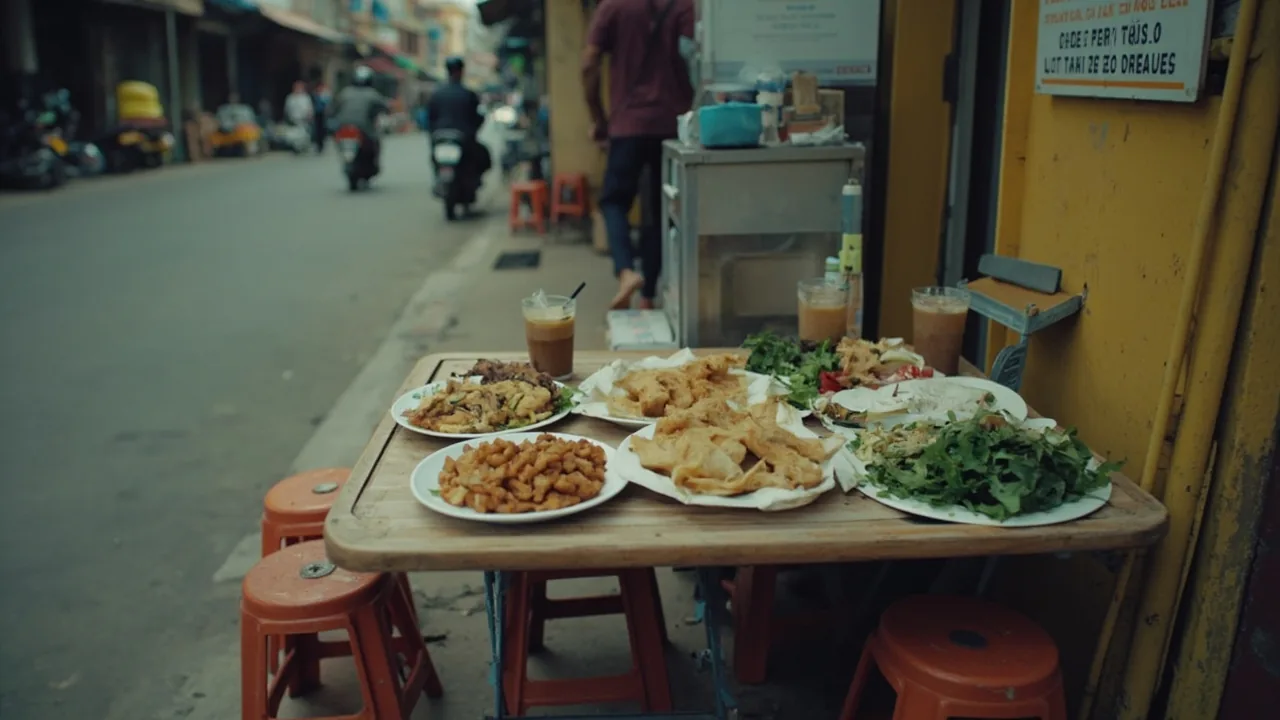
Vietnam Street Food & Vegetarian Guide for Indians (2026)
Vietnamese street food vegetarian options are everywhere once you know the signal word: “chay.” This guide covers Hanoi, HCMC, Hoi An, and Da Nang, plus the egg coffee and ca phe sua da map. For related planning, see our guide on Sea Backpacking Hub.
Quick Answers
| What | Answer | Price (INR) |
|---|---|---|
| Cheapest veg meal on the street (banh mi chay) | ₹55 (~15,000 VND or ~$0.57) | ₹50 (~$0.52) |
| A bowl of pho chay (vegetarian pho) | ₹147 (~40,000 VND or ~$1.53) | ₹130 (~$1.35) |
| Egg coffee at a Hanoi cafe | ₹129 (~35,000 VND or ~$1.34) | ₹115 (~$1.19) |
| Dorm bed in Hanoi Old Quarter | ₹662-₹1,325 (~180,000-360,000 VND or ~$6.88-$13.75) | ₹600-₹1,200 (~$6.23-$12.46) |
| 14-day tourist SIM (Viettel) | ₹478 (~130,000 VND or ~$4.97) | ₹450 (~$4.67) |
The only word you need: “chay” (pronounced “chai,” rhymes with “eye”). It means vegetarian or vegan, and it appears on menus, shop signs, and vendor boards across all four cities covered below. You may also find Hue useful for this trip.
What “Chay” Means and Why It Matters
Vietnam is a Buddhist-majority country, and vegetarian eating is built into the food system, not bolted on as an afterthought. The “chay” label shows up in three places you’ll encounter daily: street stalls with a small chay section carved out of the menu, fully vegetarian restaurants that are indistinguishable from any other Vietnamese place until you read the menu, and Buddhist buffets on the 1st and 15th of each lunar month that charge ₹294-₹552 (~80,000-150,000 VND or ~$3.06-$5.73) for all-you-can-eat veg. See also: Nha Trang.
The signal phrase at a stall: “Có chay không?” (“Do you have vegetarian?”). Most vendors will point at a small section of their menu, and the dishes are made with the same broths, just substituting mushrooms, tofu, or soy protein for meat. This reportedly works at most stalls in Hanoi Old Quarter, HCMC District 1, and Hoi An’s Old Town. For related planning, see our guide on Dalat.
For strict vegans, watch for “chay trứng” (vegetarian with egg) versus plain “chay.” Egg coffee and ca phe sua da use condensed milk but are not vegan unless the cafe specifically offers plant milk.
Where to Eat Vietnamese Street Food Vegetarian: City-by-City
This is the gap most competitor guides leave unfilled. Vegan and vegetarian street food availability varies more by city than by budget, so I’ll go city by city.
Hanoi
Hanoi has the strongest vegetarian street food scene in Vietnam, because of the city’s Buddhist roots and the large population of older vegetarians who eat out daily. The Old Quarter and the area around the Temple of Literature have the densest concentration of chay stalls.
For sit-down veg meals, Nhà An is the spot I send travellers to first when they need a break from plastic stools. It’s a Vietnamese local food restaurant with a vegan menu, rating 4.8, and the kind of place where you can order three or four dishes and have a real sit-down meal for around ₹736 (~200,000 VND or ~$7.64) per person. Hoang’s Restaurant (rating 4.9) is another Vietnamese vegan-friendly restaurant with a cozy vibe, good when you want something warm and quiet rather than a street stall.
For pho chay specifically, look for vendors in the Old Quarter alleys off Ta Hien Street. A bowl runs ₹129-₹166 (~35,000-45,000 VND or ~$1.34-$1.72) and uses a separate vegetable broth, so it does not taste like a watered-down version of the meat pho. Egg coffee (covered in its own section below) is a Hanoi specialty.
Ho Chi Minh City
HCMC is the easiest city in Vietnam for vegetarian travellers, because the Indian and Vietnamese veg scenes overlap in District 1 and District 3. De Tham Restaurant (rating 4.9) sits on De Tham Street in the backpacker zone and offers Vietnamese cuisine with a vegetarian menu that includes curries and stir-fries that feel closer to Indian flavours. A Taste Of Saigon - Old Market (rating 4.9) is another District 1 option with Vietnamese vegetarian dishes in a lively market setting.
For street food specifically, the Ben Thanh Market food court has a chay section at the back, and vendors along Pham Ngu Lao Street will make banh mi chay on request. The chay version uses pickled carrot and daikon, cucumber, cilantro, pate (soy-based), and chili sauce on a baguette. Cost: ₹55-₹92 (~15,000-25,000 VND or ~$0.57-$0.96). The flavour profile is closer to Vietnamese than to Indian, so don’t expect it to taste like a Mumbai sandwich.
Hoi An
Hoi An is the most tourist-friendly city for vegetarian street food, because the Old Town’s banh mi vendors and cao lau stalls already cater to international visitors who ask about veg. MẸT Hội An (rating 4.9) is the spot for a sit-down veg meal, served in a beautifully restored colonial building. It’s celebrated for its authentic Vietnamese cuisine, featuring the must-try Cao Lau noodle dish, and offers a serene vegetarian menu.
Hoi An’s banh mi vendors in the Old Town will make a chay version on request, and the morning market (around 6-9 AM) has a few vegetarian stalls with banh xeo chay (vegetarian crispy pancake) and mi quang chay (vegetarian turmeric noodles). Cost per dish: ₹74-₹147 (~20,000-40,000 VND or ~$0.76-$1.53).
Da Nang
Da Nang is the weakest of the four for vegetarian street food, because the city is more seafood-focused and the chay label is rarer on street stalls. You’ll find Vietnamese veg restaurants clustered around the Han Market area and a few along Bach Dang Street. For street food, your best bet is banh mi chay from vendors near the riverfront; for sit-down, walk-in to any place with a chay sign. Da Nang’s strength is the beaches and Ba Na Hills, not the food scene, so plan one or two veg meals and use the rest of your day for activities.
Must-Try Vietnamese Vegetarian Dishes
These are the dishes that justify the trip in vegetarian form, not just “things you can eat.”
| Dish | What it is | Cost | Where to find it |
|---|---|---|---|
| Pho chay | Vegetarian version of the classic noodle soup, vegetable broth, tofu, mushrooms | ₹129-₹166 (~35,000-45,000 VND or ~$1.34-$1.72) | Old Quarter alleys, Hanoi; District 1 stalls, HCMC |
| Banh mi chay | Baguette sandwich with soy pate, pickled veg, cucumber, cilantro | ₹55 (~15,000 VND or ~$0.57) | Every Vietnamese city, any banh mi vendor on request |
| Bun chay | Vegetarian version of the Hanoi grilled-pork noodle bowl, with tofu and mushrooms | ₹129 (~35,000 VND or ~$1.34) | Hanoi Old Quarter chay stalls |
| Cao lau chay | Regional noodle dish from Hoi An, vegetarian version available | ₹147 (~40,000 VND or ~$1.53) | MẸT Hội An; Old Town vendors on request |
| Banh xeo chay | Crispy turmeric pancake with mung bean and veg filling | ₹92-₹147 (~25,000-40,000 VND or ~$0.96-$1.53) | Morning markets, Hoi An and HCMC |
| Com tam chay | ”Broken rice” vegetarian plate, with grilled tofu and pickles | ₹129 (~35,000 VND or ~$1.34) | District 1 chay restaurants, HCMC |
| Xoi chay | Sticky rice with mung bean or veg, eaten for breakfast or as a snack | ₹55-₹92 (~15,000-25,000 VND or ~$0.57-$0.96) | Morning markets, all four cities |
Subodh’s Pro Tip: If you only have one meal in Vietnam and you’re vegetarian, make it bun cha chay in Hanoi. It’s the dish Anthony Bourdain ate with Obama in 2016, and the vegetarian version holds up.
Egg Coffee and Ca Phe Sua Da: The Vietnamese Coffee Map
Vietnamese coffee is its own category, and you need to know three drinks before you land.
Egg coffee (ca phe trung) is a Hanoi invention. The story goes that a bartender in the 1940s ran out of milk during a milk shortage and substituted egg yolk, whipped with sugar and condensed milk. The result is a thick, custard-like foam sitting on top of hot coffee, served in a small cup set in a bowl of hot water to keep the temperature right. Cost at a Hanoi cafe: ₹129 (~35,000 VND or ~$1.34). May Hanoi Train Street Restaurant - Coffee & Food (rating 4.9) does a sit-down version in a lively setting that combines the cafe experience with the train-street view.
Ca phe sua da is the everyday Vietnamese coffee: dark-roasted robusta coffee, often brewed in a phin (small metal drip filter), poured over ice with sweetened condensed milk. It’s strong, sweet, and a daily habit for most Vietnamese office workers. Cost at any street stall: ₹37-₹55 (~10,000-15,000 VND or ~$0.38-$0.57).
Bac xiu is the lighter version, more milk than coffee, and a better entry point if robusta feels too strong. Cost: ₹44-₹74 (~12,000-20,000 VND or ~$0.46-$0.76).
For the egg coffee specifically, the historic spot is in Hanoi’s Old Quarter. Several cafes in the area serve strong versions, but expect a queue and small seating. The Train Street cafes are the modern alternative, with the added theatre of trains passing a metre from your table.
Technique note: the foam sits on top because the egg yolk is whipped separately and floated over the hot coffee (per the recipe description above). Spoon the foam first, then sip the coffee underneath — drinking it straight collapses the texture.
Hygiene: How to Eat Street Food Without Getting Sick
Indian travellers are often wary of Vietnamese street food, and the wariness is reasonable. Stomach issues are common, but most of them come from a small number of avoidable mistakes.
The safe bets: stalls with high turnover (a busy stall uses fresh ingredients because nothing sits), food cooked in front of you (banh mi, pho, banh xeo), peeled fruits (the vendor cuts it after you order), and bottled or filtered water. A 500ml bottle of water costs ₹18 (~5,000 VND or ~$0.19) at any convenience store.
The risky bets: pre-cut fruit sitting out, ice from street vendors (most cafes and restaurants use commercial ice, which is fine; roadside stalls are hit or miss), raw vegetables washed in tap water, and shellfish from vendors you haven’t watched cook. The bigger risk in Vietnam is motorbike exhaust and air pollution in HCMC and Hanoi, so wash your hands before eating even at clean-looking stalls.
If you have a sensitive stomach, carry a small pack of ORS and a course of probiotics. The first three days are reportedly the worst, and your gut adjusts after that.
How to Get Around (Between Food Cities)
Each of the four cities above is a separate stop, so transport between them is part of the food map.
| Route | Mode | Cost | Duration | Booking |
|---|---|---|---|---|
| Hanoi to Hoi An | Sleeper bus | ₹920-₹1,472 (~250,000-400,000 VND or ~$9.55-$15.28) | 12-16 hours | Book on 12go |
| Hanoi to Da Nang | Sleeper bus or train | ₹920-₹1,840 (~250,000-500,000 VND or ~$9.55-$19.10) | 12-16 hours bus, 14-17 hours train | Book on 12go |
| Hanoi to HCMC | Reunification Express train | ₹1,840-₹5,520 (~500,000-1,500,000 VND or ~$19.10-$57.30) | 30-34 hours | Book on 12go |
| HCMC to Da Nang | Flight | ₹2,208-₹5,520 (~600,000-1,500,000 VND or ~$22.92-$57.30) | 1.5 hours | Book on 12go |
| Da Nang to Hoi An | Local bus or Grab | ₹74-₹294 (~20,000-80,000 VND or ~$0.76-$3.06) | 45 minutes | Book locally / Grab in person |
The Hanoi to HCMC train is the famous Reunification Express. The full journey takes over 30 hours, but you can ride overnight in a sleeper berth and save a night’s accommodation. The short-haul flight on the same route costs about the same and takes 1.5 hours, so the train is for the experience, not the efficiency. For more on the train, see our Reunification Express cost guide.
Getting Connected
For a food-focused trip, you need Google Maps, Grab (the ride-hailing app), and a translation app. The cheapest physical option is a Viettel or Mobifone tourist SIM with 14 days of data, costing ₹478 (~130,000 VND or ~$4.97) and including about 6GB. Buy it at the airport kiosk on arrival; the same SIM costs more at 7-Eleven.
If you’d rather not swap a physical SIM, Nomad eSIM covers Vietnam on most plans and activates before you land.
WiFi at cafes is strong in Hanoi and HCMC, patchy in Hoi An outside the Old Town, and unreliable in Da Nang’s backpacker dorms.
Daily Budget Breakdown (Vegetarian Traveller)
This is what Indian travellers spend on a veg-only food plan in Vietnam, not what travel blogs claim.
| Category | Budget/day |
|---|---|
| Dorm bed | ₹662-₹1,325 (~180,000-360,000 VND or ~$6.88-$13.75) |
| Food (3 meals, all veg) | ₹368-₹736 (~100,000-200,000 VND or ~$3.82-$7.64) |
| Local transport (Grab bike + bus) | ₹110-₹294 (~30,000-80,000 VND or ~$1.15-$3.06) |
| Activities | ₹184-₹552 (~50,000-150,000 VND or ~$1.91-$5.73) |
| Misc / drinks (coffee, water) | ₹110-₹221 (~30,000-60,000 VND or ~$1.15-$2.29) |
| Total | ₹1,435-₹3,128 (~390,000-850,000 VND or ~$14.90-$32.47) |
At the bottom of the budget range, you’re eating banh mi chay twice a day and dorm-staying. At the top, you’re doing one sit-down veg meal and one or two coffees. Verified 2026-07-17 at 1 INR = 270.27 VND (i.e. 1,000 VND ≈ ₹3.70).
Visa / Entry Notes
Indian passport holders need an e-Visa before arrival. Vietnam no longer offers visa-on-arrival for Indians. The cost is ₹2,408 (~25 USD), the validity is 90 days with multiple entries, and the application portal is evisa.xuatnhapcanh.gov.vn. Apply at least 3 working days before your flight; processing usually clears in 1-3 days but can take longer in peak season. Photo requirements: 4x6 cm, white background, taken within 6 months.
For full entry requirements, see our Vietnam visa how-to.
Common Mistakes Indian Travellers Make
-
Skipping street food entirely out of hygiene fear. The stall food is fresher than most hotel buffets, and the chay label is reliable. You miss half the country by eating only at restaurants.
-
Asking “Is vegetarian food available in Vietnam?” once and assuming the answer applies to the whole country. Hanoi, HCMC, and Hoi An are strong; Da Nang and beach towns are weaker. Plan your veg-heavy days for the first three.
-
Drinking ca phe sua da at a tourist cafe and concluding Vietnamese coffee isn’t for you. The street-stall version with a phin drip is a different drink, and 90% cheaper at ₹37 (~10,000 VND or ~$0.38).
-
Overpaying for “Indian food” in tourist zones. A veg thali in HCMC’s District 1 backpacker area runs ₹368-₹662 (~100,000-180,000 VND or ~$3.82-$6.88), but the same meal at a local Indian restaurant two streets back costs half that.
FAQ
Is vegetarian food available in Vietnam? Yes, widely, especially in Hanoi, HCMC, and Hoi An. Look for the word “chay” on menus and signs, or ask “Có chay không?” at any street stall.
What is the best vegan street food in Ho Chi Minh City and Hanoi? In HCMC, District 1 has the densest cluster of vegan-friendly Vietnamese spots, including De Tham Restaurant and A Taste Of Saigon. In Hanoi, the Old Quarter alleys have the strongest chay street-stall scene.
Where can I find egg coffee in Hanoi? The Train Street cafes are one modern alternative and easier to reach. May Hanoi Train Street Restaurant - Coffee & Food is one reliable option.
Is Vietnamese street food safe for Indian travellers? Stomach issues are common but avoidable: eat at high-turnover stalls, avoid pre-cut fruit and roadside ice, and carry ORS for the first few days.
How much does a vegetarian meal cost in Vietnam? A street banh mi chay is ₹55 (~15,000 VND or ~$0.57), a bowl of pho chay is ₹129-₹166 (~35,000-45,000 VND or ~$1.34-$1.72), and a sit-down veg meal at a restaurant is ₹294-₹736 (~80,000-200,000 VND or ~$3.06-$7.64) per person.
Can I find Indian vegetarian food in Vietnam? Yes, in HCMC’s District 1 and Hanoi’s Old Quarter there are Indian restaurants with veg thalis. The cost is higher than Vietnamese veg food (₹368-₹662 (~100,000-180,000 VND or ~$3.82-$6.88) for a thali) and the quality varies, so treat them as a backup rather than the main plan.
Subodh’s Take
Vietnam is the most underrated vegetarian food country in Southeast Asia. The chay system means you don’t compromise on the local food scene, you just eat a different version of it. If you’re a strict vegetarian Indian traveller who’s been writing off Vietnam because of the pho-and-pork reputation, this is the year to change your mind. Go to Hanoi first, eat bun cha chay on the first night, drink egg coffee on the second morning, and the rest of the trip plans itself.
