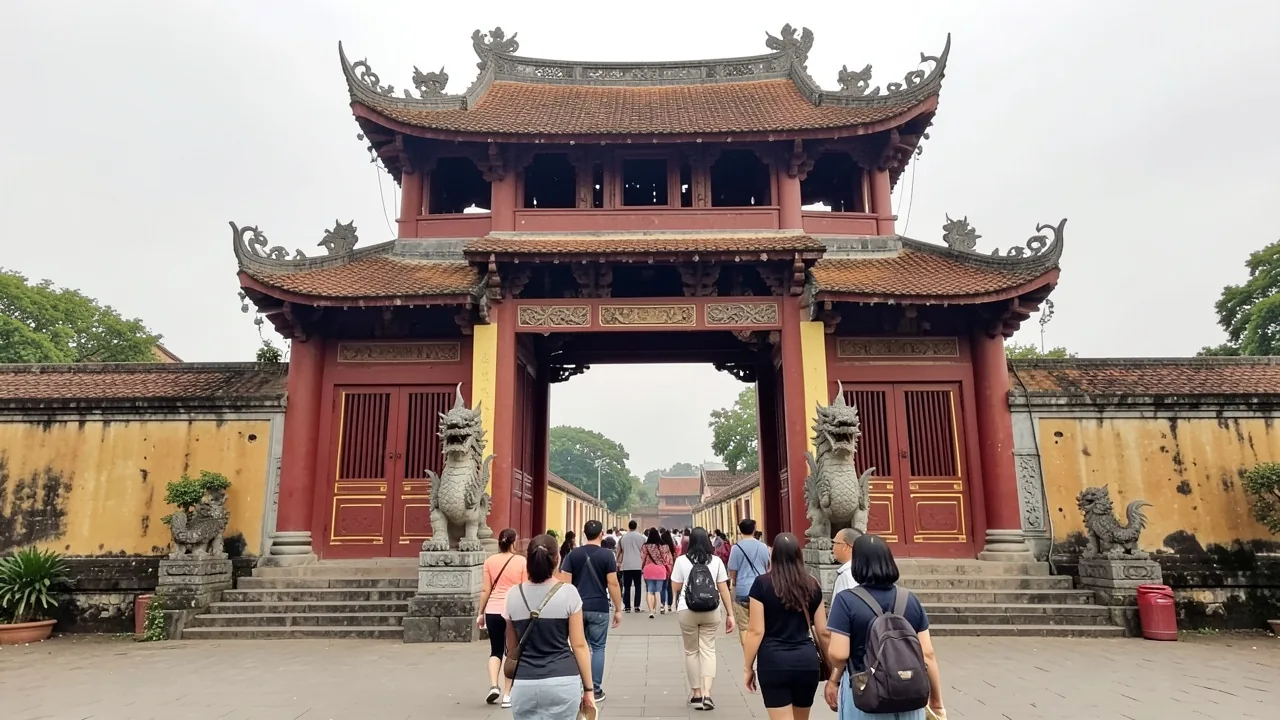
Hue: Imperial Citadel and War History (2026)
Hue is Vietnam’s old imperial capital, and this hue guide covers the Nguyen Dynasty halls inside the moss-coloured citadel and the tank-scarred south wall where the 1968 Battle of Hue played out. Most travellers skip past it between Da Nang and Phong Nha, and that is a mistake. For related planning, see our guide on Sea Backpacking Hub.
Quick Answers
| What | Answer | Price (INR) |
|---|---|---|
| Imperial Citadel entry (foreign adult) | ₹736 (~200,000 VND or ~$7.63) combo ticket covers Citadel + 3 royal tombs | ₹740 (~$7.67) |
| Sleeper bus from Da Nang | 2h 30m, the cheapest way in | ₹870 (~$9.01) |
| Dorm bed in central Hue | ₹387-₹883 (~105,000-240,000 VND or ~$4-$9.15) per night | ₹390 (~$4.04) to ₹890 (~$9.22) |
| Bun Bo Hue (beef noodle soup) at a local spot | ₹129-₹184 (~35,000-50,000 VND or ~$1.33-$1.91) | ₹130 (~$1.35) to ₹185 (~$1.92) |
| Viettel/Mobifone 14-day tourist SIM | ₹479 (~130,000 VND or ~$4.96), includes ~6GB data | ₹480 (~$4.97) |
How to Get There
Most Indian backpackers arrive in Hue overland from Da Nang, the previous logical stop on the central Vietnam loop. The Hai Van Pass road between the two takes about 2h 30m by bus; the train is slower and rarely worth it for this stretch unless you specifically want the scenic route. You may also find Nha Trang useful for this trip.
| Mode | Duration | Cost | Book |
|---|---|---|---|
| Sleeper bus (most common) | 2h 30m | ~₹869 (~9 USD) | Book on 12go |
| Local train Da Nang → Hue | 2h 45m to 3h 30m | ~₹442-₹736 (~120,000-200,000 VND or ~$4.58-$7.63) | Book on 12go |
| Private car via Hai Van Pass | 2h | ~₹3,313-₹5,153 (~900,000-1,400,000 VND or ~$34.32-$53.39) | Book via hostel reception |
Phu Bai International Airport sits 15 km south of the centre and has direct flights to Hanoi, Ho Chi Minh City, and several regional cities. Grab from the airport to central Hue runs ₹368-₹552 (~100,000-150,000 VND or ~$3.81-$5.72). See also: Dalat.
Subodh’s Pro Tip: the bus beats the train on this stretch unless you are doing the full Reunification Express Hanoi to Saigon run. The Da Nang to Hue section is short enough that the slower train times are not worth it. For related planning, see our guide on Sapa.
Where to Stay
Hue’s hostel scene clusters in the Pham Ngu Lao area, a few blocks west of the Perfume River. Dorms are cheaper here than in Da Nang or Hoi An, and most hostels throw in a free motorbike or bicycle for the day, which matters because the Citadel and the tombs spread out across a wide arc south of the city. You may also find Ho Chi Minh City Tourism Statistics useful for this trip.
| Hostel / Guesthouse | Cost/night | Vibe | Book |
|---|---|---|---|
| Nano Eco Hostel | ₹442-₹663 (~120,000-180,000 VND or ~$4.58-$6.86) | Quiet, eco-built, good for early sleepers | Check prices |
| a-mâze house | ₹479-₹736 (~130,000-200,000 VND or ~$4.96-$7.63) | Social common room, backpacker favourite | Check prices |
| Bonjour Hostel | ₹405-₹589 (~110,000-160,000 VND or ~$4.19-$6.10) | Central, helpful staff, free bicycles | Check prices |
| Amy Hostel Hue | ₹368-₹552 (~100,000-150,000 VND or ~$3.81-$5.72) | Family-run, quiet street | Check prices |
| Kha Hostel | ₹331-₹515 (~90,000-140,000 VND or ~$3.43-$5.34) | Budget pick, basic but clean | Check prices |
| Bon Ami Hostel | ₹479-₹699 (~130,000-190,000 VND or ~$4.96-$7.25) | Loud common room, social bar | Check prices |
| My pick for a one-night stop: Nano Eco Hostel. It is the rare Hue hostel that is genuinely quiet after 10pm, so if you are arriving on an overnight bus and need real sleep before tackling the Citadel, this is the move. If you want to meet other travellers and do not mind noise, a-mâze house is the better social pick. |
What to Eat
Hue is Vietnam’s culinary capital, the city that gave the country Bun Bo Hue (its signature spicy beef noodle soup), banh khoai (crispy turmeric pancake), and a whole category of small royal-style cakes that you will not find in Hanoi or Saigon. The food scene here skews more meat-and-seafood heavy than the rest of Vietnam, so vegetarians need to work a little harder, but the work pays off.
Bun Bo Hue at Nina’s Cafe (around ₹147-₹184 (~40,000-50,000 VND or ~$1.53-$1.91)). This is the dish Hue is famous for, a thick-rice-noodle beef and pork broth with lemongrass and chilli oil. Nina’s Cafe-Vietnamese Restaurant is one of the better-rated spots for it, with a clean tourist-friendly menu. Travellers report the broth at Nina’s is closer to the local standard than the diluted versions served in Da Nang.
Com Hen (clam rice) at a market stall (₹92-₹147 (~25,000-40,000 VND or ~$0.95-$1.53)). A working-class Hue lunch: cold rice tossed with tiny clams, peanuts, sesame seeds, and a heap of herbs. The best bowls are found in the small stalls inside Dong Ba Market along the riverside. Tell the stall owner you do not want the pork fat if you are not eating pork.
Banh Khoai at a riverside stall (₹55-₹92 (~15,000-25,000 VND or ~$0.57-$0.95)). A crispy yellow turmeric pancake stuffed with shrimp, pork, and bean sprouts. It looks like banh xeo from Hoi An but smaller and crunchier.
Royal-style vegetarian cuisine at Y Thao Garden Restaurant (around ₹294-₹552 (~80,000-150,000 VND or ~$3.05-$5.72) per dish). Y Thao Garden is one of the better-known spots for the vegetarian Hue royal cuisine tradition, a palace-derived style of small, intricate dishes using tofu, mushrooms, and lotus root. Set menus run higher, around ₹736-₹1,104 (~200,000-300,000 VND or ~$7.63-$11.44) per person, but the à la carte options work for budget eaters. The garden setting is a major plus.
Vietnamese fusion at N. Cafe & Food (₹221-₹442 (~60,000-120,000 VND or ~$2.29-$4.58) per main). N. Cafe & Food sits in the modern fusion lane, blending Vietnamese standards with French and cafe culture. Travellers report the lemongrass chicken and the coconut coffee are the standout orders.
Safety Alert: Hue’s food scene is safe for Indian travellers but the broth-heavy dishes (Bun Bo Hue, Bun Bo Nam Goc) are almost always pork-and-beef based. Stick to banh khoai and the vegetarian royal cuisine at Y Thao if you do not eat pork or beef.
Banh and coffee at Vị Huế Restaurant & Café (₹110-₹331 (~30,000-90,000 VND or ~$1.14-$3.43)). Vị Huế does a good job blending traditional Vietnamese breakfast (banh beo, banh loc) with a modern cafe setting, useful for vegetarians who can point at the small-cakes section and order a sampler.
Traditional cakes at Nhà hàng Bánh Gánh Huế (₹74-₹221 (~20,000-60,000 VND or ~$0.76-$2.29) per dish). If you want to try Hue’s famous small cakes (banh beo, banh nam, banh loc) all in one go, this is one of the local go-tos. Several of the dishes are vegetarian by default.
What to Do
Hue is small enough that you can hit the Imperial Citadel, the main war sites, and one or two royal tombs in a single full day. Most backpackers stay one night, two at most. Here is what to prioritise.
Imperial Citadel (Dai Noi) and the Nguyen Hue tombs. Half a day, ideally the morning before the heat peaks. The ₹736 (~200,000 VND or ~$7.63) combo ticket covers both the Citadel and three royal tombs spread across the southern suburbs. The Citadel is a UNESCO World Heritage site, the seat of the Nguyen Dynasty from 1802 to 1945, and the scale alone justifies the entry fee: a 10-metre-high stone wall ringed by a moat, with the imperial enclosures, throne halls, and temple complex still partially restored inside. Much of the inner palace was destroyed during the 1968 battle, and the restoration is open about it, with English signage on what is original versus rebuilt. Set aside at least three hours. Book Hue Imperial City tour
Subodh’s Pro Tip: skip the imperial theatre inside the Citadel and book a separate Duyet Thi Duong Royal Theater performance instead if you want to see a traditional show. The in-Citadel version is a truncated demo, the standalone theatre is the real deal. Book Duyet Thi Duong Royal Theater tour
Thiên Mụ Pagoda, across the Perfume River. An hour, free entry, donations welcome. The seven-storey Phuoc Duyen Tower is one of Vietnam’s most recognisable religious structures, and the riverside setting makes it the best sunset stop in Hue. Combine with a dragon boat ride from the river dock for a half-day out. Book Thiên Mụ Pagoda tour
The War Sites in the southern suburbs. Two to three hours. The Citadel tells the imperial story, but the city’s war history sits in the southern half of the old city, including the abandoned south wall where North Vietnamese forces breached the citadel in early 1968. Two museums matter most: Bảo tàng Đại tướng Nguyễn Chí Thanh, dedicated to one of the North’s senior generals, and the smaller roadside memorials along Phu Cat Lau. Hire a motorbike or Grab for this circuit.
Royal Tombs (Tu Duc, Khai Dinh, and Minh Mang). Three hours if you visit all three, but the combo ticket only requires two. Tu Duc is the most atmospheric, set on a lake inside a pine forest, with the emperor’s tomb hidden inside a quiet garden. Khai Dinh is the most ornate, a French-cathedral-meets-Chinese-temple concrete mash-up that takes 40 minutes to see properly. Minh Mang is the most Confucian and the most under-visited. Most backpackers hire an Easy Rider for the tombs circuit, which combines transport with a half-day cultural tour. Book Amazing Easy Riders tour
Phong Nha day trip. Full day, ₹1,351 (~14 USD) one-way for the bus. If you have two nights in Hue instead of one, the caves at Phong Nha are worth the detour, and most tour operators run day trips that include the boat ride into Phong Nha Cave and a stop at Paradise Cave. Stay overnight in Phong Nha if you can, the town is quieter than Hue and the caving infrastructure is sharper. Book From Hue: Phong Nha Cave & Paradise Cave Guided Boat Tour tour
Perfume River and Hidden Canals Electric Boat Cruise. Two hours, modest price, the most relaxing hour you will spend in Hue. The electric boat glides up the Perfume River and into side canals that dragon boats skip, with a running commentary in English about the riverside temples and the 1968 fighting. A good late-afternoon choice after a morning at the Citadel. Book Hue: Perfume River & Hidden Canals Electric Boat Cruise tour
Hands-on detour: traditional cake-making workshop. Two hours, modest price, useful for vegetarians. If you want a break from sightseeing, the Hue traditional cake-making workshop run by local instructors is a working session on Hue’s royal-style small cakes (banh beo, banh loc, banh it), most of which are vegetarian or vegan by default. You eat what you make for lunch. Book Hue: Traditional Cake-Making Workshop with Local Instructor tour
Getting Connected
Viettel and Mobifone both run ₹479 (~130,000 VND or ~$4.96) tourist SIMs valid 14 days with about 6GB of data. Both work fine for Grab and Google Maps in central Hue, and you can grab one at Phu Bai Airport arrivals or any phone shop in town. If you prefer the eSIM form factor, the Get Nomad eSIM regional Vietnam packs activate before you land and slot into a second eSIM slot if your phone supports it.
WiFi is reliable at most Hue hostels and cafes, though the heritage walls in the older part of the city can knock signal down to 3G in spots. If you are staying more than one night and rely on Google Maps for the tombs circuit, the tourist SIM is worth the ₹479 (~130,000 VND or ~$4.96).
Daily Budget Breakdown
Verified 2026-07-21 at 1 INR = 270.27 VND (1 USD = ₹96.33).
| Category | Budget/day |
|---|---|
| Dorm bed | ₹387-₹883 (~105,000-240,000 VND or ~$4-$9.15) |
| Food (3 meals) | ₹331-₹736 (~90,000-200,000 VND or ~$3.43-$7.63) |
| Local transport (Grab + motorbike fuel) | ₹221-₹442 (~60,000-120,000 VND or ~$2.29-$4.58) |
| Activities (Citadel combo ticket amortised over one day) | ₹736 (~200,000 VND or ~$7.63) |
| Misc / drinks | ₹147-₹294 (~40,000-80,000 VND or ~$1.53-$3.05) |
| Total | ₹1,822-₹3,092 (~495,000-840,000 VND or ~$18.88-$32.03) |
These numbers reflect what travellers report spending at the ground level: dorm bed at the low end of the Hue range, three mix of street and café meals, two Grab rides a day, and the Imperial Citadel combo ticket. Most backpackers come in under ₹2,209 (~600,000 VND or ~$22.88) a day if they skip the Easy Rider and walk or cycle.
Where to Go From Here
Hue sits in the middle of the central Vietnam corridor, with fast buses to Da Nang and Hoi An to the south, the Phong Nha caves up north, and sleeper connections further afield for the longer leg.
| Destination | Mode | Duration | Price | Book |
|---|---|---|---|---|
| Da Nang | bus | 2h 30m | ₹869 (~9 USD) | Book on 12go |
| Phong Nha | bus | 4h | ₹1,351 (~14 USD) | Book on 12go |
| Hanoi | sleeper bus | ~14h | ₹1,351 (~14 USD) | Book on 12go |
| Ho Chi Minh City | flight | 1h 35m | ₹7,819 (~81 USD) | Book on 12go |
| Ninh Binh | sleeper | 19h | varies | Book on 12go |
| Nha Trang | bus | 13h 15m | ₹2,992 (~31 USD) | Book on 12go |
For most backpackers, the question is not Da Nang or Phong Nha, it is which one to do first. Travellers heading south to Hoi An and Da Nang after Hue should bus down and save the northbound Phong Nha run for the return leg if they are doing a loop.
Visa / Entry Notes
Hue is not an entry point; you clear Vietnamese immigration at Hanoi, Ho Chi Minh City, or Da Nang before arriving. Indian passport holders must apply for an e-Visa before arrival, no visa-on-arrival available.
Vietnam e-Visa (Indian passport): ₹2,413 (~25 USD), 90 days, multiple entry. Apply at the official portal at https://evisa.xuatnhapcanh.gov.vn at least three working days before departure. Photo requirement: 4x6 cm, white background, taken within the last six months. Carry a printed copy of your e-Visa approval letter, immigration at smaller airports sometimes asks for paper.
Common Mistakes
Skipping the Citadel because you read it was destroyed. Half the Imperial Citadel interior was destroyed in 1968 and is unrestored, but the remaining palace complex, the outer walls, the moat, and the restored throne halls are still the single most impressive piece of Nguyen-era architecture in Vietnam. The “skip it, it’s all rubble” advice floating around budget forums is from people who went in for twenty minutes and never read the signage.
Trying to do the Citadel, the tombs, and Phong Nha in one day. Each one is a half-day on its own. Pick two max if you only have one full day in Hue.
Hiring a motorbike in Hue without checking the brakes. Hue’s backpacker motorbike rental pool is older than Da Nang’s and the damp coastal air rusts brake pads fast. Test the front brake at low speed before paying.
Safety
Hue is one of the safer cities on the central Vietnam stretch for Indian backpackers. Petty theft is low compared to Ho Chi Minh City, the police presence in the tourist areas is visible, and the drivers are more cautious than in Hanoi. The two real risks are the same as everywhere on the coast: motorbike traffic (drive carefully in the first 24 hours, your reaction time is not Vietnamese-tuned yet) and tropical sun during the Citadel walk (carry water).
Before you travel, check the current travel advisory from the Government of India (Ministry of External Affairs, https://www.mea.gov.in) and confirm Hue falls within their standard Vietnam advisory. Hue has historically been considered low-risk by every major advisory, but conditions can shift.
Indian travellers are warmly received in Hue, the city has little of the tourist-friction some destinations show up north. Dress modestly when visiting the Citadel and Thiên Mụ Pagoda (covered shoulders and knees for both sexes), and you will have a smooth visit.
FAQ
Is Hue safe for solo Indian women? Yes. Hue is one of the calmer cities in Vietnam, with lower petty theft rates than Ho Chi Minh City and a quieter night scene. Use the same motorbike and Grab precautions you would everywhere else on the coast.
Can I get Indian food in Hue? Yes, several Indian restaurants operate around the Pham Ngu Lao hostel area, mostly serving North Indian curries and thalis at tourist-friendly prices (₹294-₹663 (~80,000-180,000 VND or ~$3.05-$6.86) per dish). Vegetarian options exist but ask to confirm no onion/garlic if you observe stricter food rules. The Y Thao Garden royal cuisine option is the local vegetarian tradition and worth trying alongside the Indian spots.
How many days do I need in Hue? One full day if you are just hitting the Citadel and one tomb. Two days if you are adding the war sites and a Perfume River boat cruise. Three days if you are also day-tripping to Phong Nha.
Is the Hue war tour worth it for first-time Vietnam visitors? Yes, especially if you have already seen the Cu Chi Tunnels near Ho Chi Minh City. Hue tells the war story from the North Vietnamese side, with the city-level destruction, the Citadel battle, and the senior-command museum. It balances the picture.
Best time to visit Hue? February to April has the lowest rainfall and mild temperatures. Avoid September to November, the peak of the rainy season in Hue.
Can I do a day trip from Hue to Hoi An? Technically yes (it is about 3 hours each way via the Hai Van tunnel), but you will burn most of the day in transit and Hoi An deserves a night on its own. Better to do it on the way south, with an overnight in Hoi An.
Subodh’s Take
Hue is the city most backpackers shortcut, and I get it; it sits awkwardly between the beach-town energy of Da Nang and the cave infrastructure of Phong Nha. But the Citadel is the single most underrated piece of Vietnam’s history. Stay two nights, walk the inner walls, take the dragon boat up to Thiên Mụ at sunset, and eat your way through the small-cake stalls. That is enough to make Hue the most reflective stop on your whole trip.
