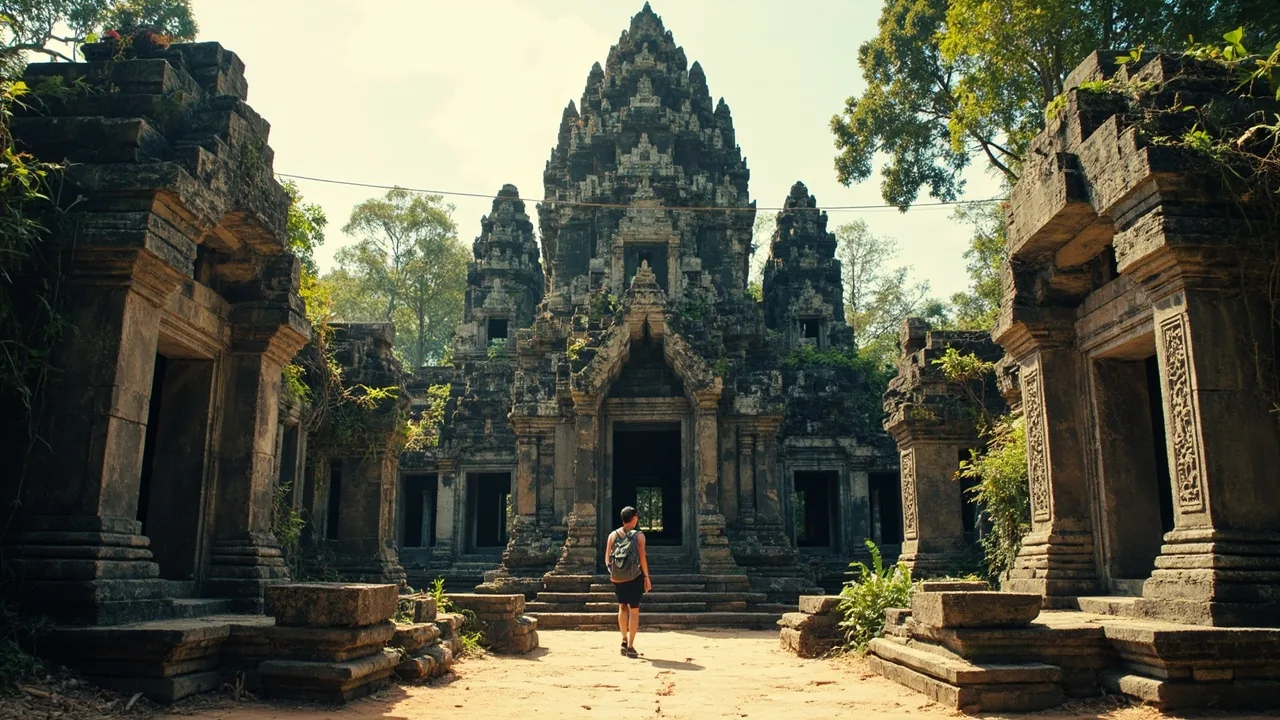
Ancient Temples of Southeast Asia: A 3-Week Temple-Focused Itinerary for Backpackers
Southeast Asia’s ancient temples of world draw backpackers from everywhere. Thailand has Sukhothai and Ayutthaya, both UNESCO sites, within a day of Bangkok. Myanmar’s Bagan has over 2,000 surviving temples on one flat plain. Laos packs Luang Prabang’s gold-leaf wat cluster plus the clifftop fortress of Wat Phou into a single week. Most entry fees are 1 USD or less.
This 21-day route runs Bangkok to Siem Reap, hitting Thailand first (the cheapest entry point with most Indian flights), looping north into Laos for Luang Prabang, then dropping south through Cambodia to finish at Angkor. The ground loop covers Thailand, Laos, and Cambodia.
It assumes you’ve already read our broader 3-week Southeast Asia temple trail for the corridor summaries. For the full region guide, see the Southeast Asia backpacking hub.
📍 Distance: \~4,200 km overland (Bangkok → Siem Reap loop)
⏱️ Fastest option: fly Bangkok→Siem Reap direct = 1h 10m
💰 Cheapest option: 21-day ground loop = ₹28,000–35,000 excluding international flights
✅ Best option: Bangkok → Chiang Mai (train) → Luang Prabang (slow boat) → Siem Reap (overland)
Quick Answers
| What | Answer | Price (INR) |
|---|---|---|
| Visa for Thailand (Indian passport) | Visa-free 60 days (verify with MEA before flying) | ₹0 |
| Visa for Cambodia | Visa on arrival ₹2,500 (~30 USD) or e-visa ₹3,000 (~36 USD) | ₹2,500–₹3,000 |
| Angkor 1-day pass | Foreigner rate, 1-day validity | ₹3,567 (~$37) |
| Bangkok → Chiang Mai sleeper train | A/C berth, 13–15 hr | ₹3,443 (~$35.71) |
Option 1. Cheapest: All-Ground, No Domestic Flights
The cheapest version of this loop never leaves the ground. Bangkok to Siem Reap can be done by train to Aranyaprathet, tuk-tuk to the Poipet border, share-taxi across, and a connecting bus to Siem Reap in a single day for under ₹2,872 (~1,000 THB or ~$29.79). The slow boat from Chiang Mai to Luang Prabang (Chiang Khong → Huay Xai) costs roughly ₹3,589 (~1,250 THB or ~$37.23) in the cheap deck class, the signature Mekong journey with no flight equivalent.
Over 21 days, ground transport totals roughly ₹18,000-₹20,000 (~$186.71-$207.46) combined for buses, share-taxis, the slow boat, and one night train. Accommodation in shared dorms runs ₹574-₹1,723 (~200-600 THB or ~$5.96-$17.87) a night in Thailand, ₹345-₹647 (~80,000-150,000 LAK or ~$3.58-$6.71) in Luang Prabang, and ₹771-₹1,350 (~8-14 USD) at Angkor guesthouses. Food at street stalls: ₹115-₹230 (~40-80 THB or ~$1.19-$2.38) a meal, ₹65-₹108 (~15,000-25,000 LAK or ~$0.67-$1.12).
Comfort is real but limited. The slow boat has wooden benches, no A/C, a metal roof, and one toilet. Bring water, toilet paper, and patience.
The single biggest entry fee is Angkor’s 1-day pass at ₹3,567 (~37 USD). Most Thai temple entries are ₹287 (~100 THB or ~$2.98) or less for foreigners. Total entry fees across the loop: roughly ₹8,000-₹10,000 (~$82.98-$103.73).
Option 2. Best Experience: The Bangkok Train + Slow Boat Combo
If I had to pick one way to do this loop, it’s train to Chiang Mai, then slow boat down the Mekong to Luang Prabang.
The overnight train from Bangkok to Chiang Mai costs ₹3,446-₹4,307 (~1,200-1,500 THB or ~$35.74-$44.68) for an A/C sleeper berth, second class. Book on site at the station or through a reputable travel agent. The journey takes 13–15 hours, runs overnight, and saves a night’s accommodation. Second-class A/C is correct for backpackers: four-berth compartments, fold-down seats, sheets and a pillow provided. First class is mostly cosmetic difference.
From Chiang Mai, take a minivan to Chiang Khong (a Thai border town) for ₹718-₹1,005 (~250-350 THB or ~$7.45-$10.43), then board the slow boat at Huay Xai (Laos side). The Mekong slow boat from Huay Xai to Luang Prabang is two days, with an overnight stop in Pakbeng. Slow boat tickets through Pakbeng are ₹3,589-₹4,020 (~1,250-1,400 THB or ~$37.23-$41.70), bookable on the spot at the Huay Xai pier on the morning of departure.
Tip: Book the slow boat the morning of, not the night before. Guesthouses in Chiang Khong often sell bundled packages you may not need. Show up at the pier early with your passport, pay the operator directly, and pick your own seat.
The slow boat itself is half the temple experience. The Mekong cuts through jungle, limestone karsts, and tiny river villages. Most travellers describe it as a high point of the entire SEA loop, more memorable than any single wat.
Option 3. Fastest: Fly Bangkok to Siem Reap Direct
If you have two weeks instead of three and don’t care about the Laos segment, a Bangkok → Siem Reap direct flight costs ₹6,000-₹14,000 (~$62.24-$145.22) one-way on AirAsia, VietJet, or Bangkok Airways. Flight time: 1 hour 10 minutes door-to-airport.
This is the right call if your trip is already compressed, but you lose Chiang Mai, Luang Prabang, and the entire Mekong stretch. The cost saving of skipping ground transport (~₹18,000) is wiped out by the flight if you’re flying solo. The flight only makes sense if you’ve already accepted you’ll skip Laos.
Compare: the full Bangkok → Siem Reap overland route can be done for under ₹2,872 (~$29.79). For most Indian backpackers, that’s a no-brainer over flying.
Border Crossing: Chiang Khong → Huay Xai (Thailand. Laos)
The Chiang Khong / Huay Xai crossing is the cleanest border on this loop. The Thai side (Chiang Khong, in Chiang Rai province) is a coordinated immigration office 5 km from town. Tuk-tuk from the pier to the border is ₹144 (~50 THB or ~$1.49). On the Laos side, Huay Xai’s immigration office is 3 km from the pier.
For Indian passport holders, Laos issues visa on arrival for ₹2,500 (~30 USD) for a 30-day single entry. Bring two passport photos, USD cash, and proof of onward travel. Immigration usually takes 30–45 minutes total per side. The crossing is open 6 a.m. to 10 p.m. Thai time.
Safety Alert: Money changers at Huay Xai give better rates than Chiang Khong. Once you’re through, change ₹3,000-₹5,000 (~$31.12-$51.87) worth of baht into kip at a licensed counter, not with anyone who approaches you in the immigration queue. Thai baht is also accepted at most guesthouses in Luang Prabang, so you don’t need a full kip stack yet.
Border Crossing: Poipet (Thailand. Cambodia). Skip If You Can
The Aranyaprathet-Poipet crossing is the most common overland route between Bangkok and Siem Reap, but it’s also the most reported-on for scams, touts, and aggressive share-taxi drivers. After the immigration window closed during COVID, the process has been streamlined but not perfected.
From Bangkok, take a bus to Aranyaprathet (₹718 (~$7.45)), then a tuk-tuk to the Thai border post. On the Cambodia side, Poipet issues visas on arrival for ₹2,500 (~30 USD), or you can apply for an e-visa online for ₹3,000 (~36 USD); the e-visa costs slightly more but lets you skip the VOA queue. The VOA counter is functional but slow, and the touts hovering around it will try to sell you a “fast track” for ₹1,928 (~20 USD) that’s the same line.
Total crossing time on a quiet day: 90 minutes. On a busy weekend: 3+ hours. After immigration on the Cambodia side, share-taxis to Siem Reap run ₹1,157-₹1,446 (~12-15 USD) per seat in a shared minivan. Private is ₹3,856 (~40 USD). Bargain the shared price down from the first ask.
Indian Passport Specifics
Thailand is visa-free for Indian passport holders for 60 days as of 2026, but always reconfirm on the MEA travel advisory page before flying. Cambodia’s e-visa is the cleanest entry, apply at least 7 days before travel via the official Cambodian e-visa portal; the standard tourist e-visa fee is ₹3,000 (~36 USD). Laos VOA works fine.
For Myanmar (Bagan, if you detour), Indian passport holders need an e-visa in advance (₹4,170 / ~50 USD); no VOA is available. Decide this 30+ days out. If you haven’t planned it, skip Bagan and use the extra days in Luang Prabang or Siem Reap instead.
Carry photocopy of passport, two extra passport photos, and proof of onward ticket (bus or flight out of Cambodia). Indian embassies in Bangkok and Phnom Penh are reachable for lost passport emergencies.
When NOT to Take This Loop
Skip this loop entirely in August and September. Northern Thailand floods, Luang Prabang streets turn to ankle-deep rivers, and the Mekong slow boat doesn’t run reliably. If those are your only dates, our monsoon season route covers where to go instead.
November to February is peak season. Crowds at Angkor peak December 20 to January 5. If Bagan’s balloon sunrise is the goal, that’s only available October to March.
A specific note on Bagan: Myanmar’s political situation means some governments update advisories frequently. Check your MEA advisory and the US State Department page for the latest before booking any Myanmar segment. The overall security environment can shift.
Getting Connected
Coverage is mostly solid across this loop, Thailand and Cambodia both have reliable 4G. Luang Prabang has good AIS roaming and Lao Telecom SIMs (~25,000 LAK for a week). Dead zones on the slow boat: you’ll have 2–4 hours with no signal between Chiang Khong and Luang Prabang. That’s the whole point of the slow boat. Bring a book.
For Thailand, AIS or TrueMove SIMs cost ₹571-₹859 (~199-299 THB or ~$5.93-$8.91) at 7-Eleven. Cambodia’s Smart and Cellcard both sell ₹482 (~5 USD) tourist SIMs with 7 days of data. If you’d rather skip the physical SIM dance, regional eSIM providers offer single data plans covering Thailand, Laos, and Cambodia.
Where to Stay
Budget dorms in Thailand run ₹574-₹1,723 (~200-600 THB) a night. In Luang Prabang, ₹345-₹647 (~80,000-150,000 LAK). At Angkor, guesthouses cost ₹771-₹1,350 (~8-14 USD). Book on arrival for the best rates; hostels in Siem Reap and Luang Prabang fill up in peak season (November–February).
FAQ
Which temple site should I skip if I’m short on time? Luang Prabang is excellent, but if you only have 18 days instead of 21, cut a day there and add it to Angkor. The 3-day Angkor pass (₹5,977 / ~62 USD) gives you time to cover the main temples plus Banteay Srei without rushing.
Can I do Angkor on a budget? Yes, if you skip the balloon ride (₹12,050 (~$125)), the sunrise tour vans, and the licensed temple guide. The 1-day pass is ₹3,567 (~37 USD). Bicycle rental at Siem Reap guesthouses is ₹193-₹289 (~$2-$3) per day. Food is ₹96-₹289 (~$1-$3) per meal at the Old Market stalls.
Is the slow boat safe? Statistically safer than the buses. The boats are operated by licensed Laos companies and the route is heavily travelled. Bring a life jacket if you’re nervous. Most operators provide them.
How much cash should I carry across the Poipet border? None on the Thai side (you’ll spend remaining baht at the border restaurants). On the Cambodia side, ₹9,640 (~$100) covers the visa, the share-taxi, three days of expenses, and SIM card. Bring clean, unfolded USD bills with no tears, Cambodian money changers reject them.
Is Bagan worth the visa hassle? For most Indian backpackers, no. The flights are ₹28,921 (~300 USD)+ round-trip from Bangkok, the visa is ₹4,820 (~50 USD), and the temples are stunning but smaller and more spread out than Angkor. If you have a 3-week window and Bagan is a dream, add it as a 4-day Myanmar extension. If not, the temples in Sukhothai, Ayutthaya, and Angkor give you the same “ancient temple of world” feeling for less logistics.
Subodh’s Take
Most Indian backpackers try to fit too many temples in. Angkor alone is worth 4 days. Luang Prabang deserves 3. If you have to cut, cut Bagan; it needs its own trip and a separate Myanmar visa. Twenty-one days, three countries, and five major temple complexes is the right density. Any denser and you’re sleeping in buses.
