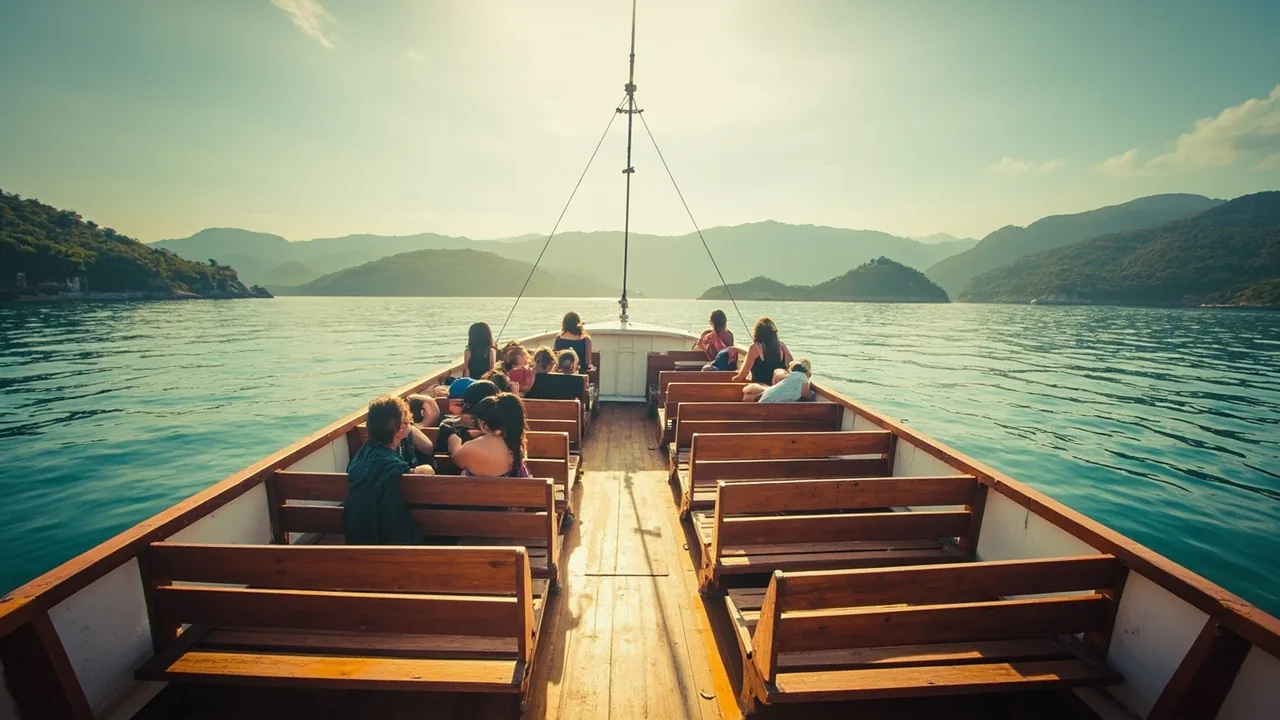
The 3-Week Sea Loop: Thailand, Laos, Vietnam & Cambodia by Boat
This sea loop southeast asia route covers 4,200 km across Thailand, Laos, Vietnam, and Cambodia over 21 days.
📍 Distance: 4,200 km (including the Mekong river stretch) ⏱️ Fastest option: 5 days of ferries, flights and buses (fly the long hauls) 💰 Cheapest option: ~₹38,000 (~$394.18) for 21 days on boats, buses and dorms ✅ Best option: Mekong slow boat + sleeper bus combo
Three weeks is the sweet spot for this sea loop southeast asia crossing. Long enough to cross four countries, short enough that you cannot waste a day. The “sea loop” idea is simple: lean on the Mekong and the Gulf of Thailand for the long, scenic kilometres, and fly or bus the stretches where the river bends the wrong way.
This is the version that runs on ferries, slow boats, and one border boat crossing on the Mekong. It also works on a backpacker budget, because river transport is the cheapest long-distance option in the region. For the full breakdown of every country on this corridor, see the SEA Backpacking Hub.
Quick Answers
| What | Answer | Price (INR) |
|---|---|---|
| Is 3 weeks enough for 4 countries? | Yes, if you skip the detours | Budget ~₹38,000 (~$394.18) |
| Cheapest way to cross the loop? | Slow boat Huay Xai to Luang Prabang, sleeper buses elsewhere | ₹861 (~300 THB or ~$8.94) |
| Best border crossing? | Huay Xai (Thailand) to Huay Xai (Laos) by boat | ₹287 (~100 THB or ~$2.98) |
| Do Indians need a visa for every country? | Thailand visa-free (60 days). See visa details in Indian Passport Specifics below. | ₹8,194 (~$85) total |
| Can the whole loop be done by boat? | No, you need 2 flights (Vietnam to Cambodia) | ~₹4,800 (~$49.79) |
The Route at a Glance
The loop runs clockwise from Bangkok: down the Mekong into Laos, along the river to Vietnam, down the Vietnamese coast, then west across the Gulf of Thailand to Cambodia.
Bangkok → Chiang Mai → Chiang Khong → Huay Xai → Pak Beng → Luang Prabang
→ Vientiane → Hanoi → Hạ Long → Hué → Hội An → Da Nang → HCMC
→ Phnom Penh → Bangkok
The water-heavy segments are Chiang Khong to Luang Prabang (Mekong slow boat, 2 days), Hạ Long bay (overnight cruise, 1 night), and the Gulf crossing from Vietnam to Cambodia (speedboat or sleeper bus via the land border at Chau Doc). Everything else is bus or train.
Option 1. Cheapest: Mekong Slow Boat + Sleeper Buses
The cheapest version of this loop is built around the Mekong slow boat from Huay Xai to Luang Prabang. At roughly ₹3,159 (~1,100 THB or ~$32.76) for the boat plus ₹1,436 (~500 THB or ~$14.89) for a guesthouse stop in Pak Beng, it is the cheapest two-day transport segment in mainland Southeast Asia.
From Bangkok to Chiang Mai, take the overnight train (third-class air-con, fan, or berth depending on budget). The 14-hour sleeper from Krung Thep Aphiwat Central Terminal to Chiang Mai runs ₹1,723-₹3,446 (~600-1,200 THB or ~$17.87-$35.74) depending on class. Travellers report the third-class fan carriage is the best budget sleeper in the region, though the air-con second class is easier to sleep in. See the Bangkok guide for station tips and the Chiang Mai guide for what to do once you arrive.
After Luang Prabang, the cheapest onward route is the sleeper bus to Vientiane (₹689 (~240 THB or ~$7.15), 11 hours, overnight), then the international bus from Vientiane to Hanoi via the Nam Phao border crossing. That bus runs ₹1,289 (~350,000 VND or ~$13.37) and takes around 24 hours with the border stop. It is not comfortable but it is the cheapest land route across Laos and into Vietnam.
In Vietnam, use the open-tour buses: Hoi An Express, The Sinh Tourist (Sinh Café), and FUTA. A Da Nang to HCMC sleeper is around ₹1,289 (~350,000 VND or ~$13.37) for 18 hours.
The final leg, HCMC to Phnom Penh, is cheapest by road through the Moc Bai border crossing. Buses run ₹921 (~250,000 VND or ~$9.55) and take 7 hours including the border. The river speedboat alternative via Châu Đốc is faster but costs around ₹3,374 (~$35).
Option 2. Best Experience: Slow Boat, Sleeper Train, Bay Cruise
This is the version Subodh would pick if a friend had three weeks and asked, “show me the trip.” It balances the river scenery with rest days.
Day 1 to 4: Bangkok to Chiang Mai by sleeper train (third-class fan, ~₹1,723 (~600 THB or ~$17.87)). Two nights in Chiang Mai.
Day 5 to 7: Chiang Mai to Chiang Khong by minivan (₹1,005 (~350 THB or ~$10.43), 6 hours), then the Mekong slow boat from Chiang Khong / Huay Xai across to Laos (the actual crossing takes about 30 minutes, ~₹287 (~100 THB or ~$2.98), organised by your guesthouse in Chiang Khong). Overnight in Huay Xai.
Day 7 to 9: The two-day slow boat from Huay Xai to Pak Beng to Luang Prabang. Book the local boat, not the tourist boat, and stay in a riverside guesthouse in Pak Beng (~80,000 LAK).
Day 10 to 12: Luang Prabang to Vientiane by slow boat if the river is high enough, otherwise sleeper bus. Vientiane to Hanoi by air (~₹4,800 (~$49.48), 1.5 hours) to save a full travel day.
Day 12 to 16: Hanoi to Hạ Long bay by tourist bus (₹737 (~200,000 VND or ~$7.64)), overnight cruise on a mid-range boat (~₹3,200 (~$32.99)). Then the Reunification Express sleeper train from Hà Nội to Hué (~₹1,800 (~$18.56)) and onward to Da Nang. Spend a day in Hội An before continuing south.
Day 17 to 19: Da Nang to HCMC by air (~₹3,500 (~$36.08)), one night in HCMC.
Day 19 to 21: Speedboat from HCMC to Cái Bè in the Mekong Delta, then river boat to Châu Đốc, then boat across to Phnom Penh. The full river route via the Victoria speedboat runs ~₹3,374 (~35 USD) and takes about 11 hours including the border.
Total transport for the best-experience version is roughly ₹18,000 (~$186.71) to ₹22,000 (~$228.21) depending on how you splice flights. The slow boat from Huay Xai is the single segment travellers talk about for years. Skipping it for a flight is the most common mistake.
Option 3. Fastest: Fly the Long Stretches
If you have three weeks but only want to spend ten of those days in transit, fly the Vientiane-Hanoi and Da Nang-HCMC legs and keep the Mekong slow boat for the scenery.
AirAsia, VietJet, and Lao Airlines run the regional hops. Book the Vientiane-Hanoi sector at least two weeks ahead for the lowest fare. The Da Nang-HCMC sector is competitive; Vietnam Airlines is rarely cheaper than VietJet but is more reliable if you have a tight onward connection.
Total flying cost for the three internal sectors is roughly ₹9,500 (~$98.54) to ₹12,000 (~$124.48). Combined with the slow boat segment and a sleeper train in Vietnam, the trip compresses to around 18 days of transport and 3 days of actual sightseeing buffer.
Worth paying the premium when: you are arriving in Bangkok late on day one and need to be in Hanoi by day nine.
Not worth it when: you have 21 full days and the weather is clear, because the sleeper bus from Luang Prabang to Vientiane at sunrise is genuinely one of the best travel mornings in the region.
Border Crossings
The loop crosses four international borders. Here is what to expect at each one, in order.
Chiang Khong / Huay Xai (Thailand to Laos)
This is the easiest border crossing on the loop. Your guesthouse in Chiang Khong will organise a longtail boat across the Mekong to the Lao immigration post at Huay Xai. Cost is ₹287-₹431 (~100-150 THB or ~$2.98-$4.47), included in most slow-boat packages.
On the Lao side, Indian passport holders get visa-on-arrival for ₹2,892 (~30 USD). Bring two passport photos and USD cash. The whole process takes 30 to 60 minutes.
Travellers report that the single biggest tip is to keep your passport in your hand from the moment you step off the boat. The Thai exit stamp and Lao entry stamp are at separate buildings, and porters will offer to carry your bag for a tip you did not ask for.
Vientiane / Hanoi (Laos to Vietnam)
If you fly, this is a normal international check-in. If you take the land bus via Nam Phao, the border post is small and the staff are used to backpacker buses. Vietnamese e-visa must be applied for in advance; the 90-day multiple-entry tourist visa is ₹2,410 (~25 USD) and is processed in 3 working days.
Moc Bai / Bavet (Vietnam to Cambodia, by road)
The road crossing from HCMC through Tây Ninh is the cheapest Vietnam-to-Cambodia border. The Vietnamese bus drops you on one side, you walk across with your passport, and a Cambodian bus picks you up on the other side. Cambodian visa-on-arrival is ₹2,892 (~30 USD). Walk past the helpers and go to the main counter.
Châu Đốc / Phnom Penh (Vietnam to Cambodia, by boat)
If you want a water crossing, the speedboat from Cái Bè to Phnom Penh via Châu Đốc handles the Cambodian visa on board. Officers board at the border point on the river. Same ₹2,892 (~30 USD) fee, same passport photo. This route is more expensive (~₹3,374 (~$35)) but avoids the chaos of the Moc Bai land crossing.
Indian Passport Specifics
Indian passport holders get visa-free entry to Thailand (60 days), visa-on-arrival for Laos and Cambodia, and e-visa for Vietnam. Total visa cost is roughly ₹8,194 (~85 USD) if you pay in USD at every counter.
Carry four passport photos. Most VOA counters will accept a digital photo on your phone in 2026, but physical photos still save time.
Embassy contacts that matter:
- Royal Embassy of Cambodia, New Delhi: +91 11 4222 5090
- Vietnamese Embassy, New Delhi: +91 11 2687 9868
- Lao Embassy, New Delhi: +91 11 2612 9191
- Thai Embassy, New Delhi: +91 11 2415 7900
For general safety guidance, check the MEA travel advisory at mea.gov.in before departure. Generic risks on this route include petty theft at bus stations, occasional flooding during monsoon, and seasonal haze from agricultural burning in northern Thailand and Laos.
When NOT to Take This Route
The Mekong slow boat is affected by low-water season, typically December through February (sometimes into March), when the river gets shallow for the long boats between Huay Xai and Pak Beng. Some operators cancel entirely; others swap to a smaller boat that takes three days instead of two. If you are travelling in this window, book the Lao Airlines flight from Chiang Mai to Luang Prabang instead.
The northern Vietnamese coast (Hạ Long, Hué) sees typhoons from July through September. The Reunification Express keeps running but the bay cruises get cancelled at short notice. If your three-week window falls in monsoon, flip the loop: do Vietnam first, then Thailand, Laos, Cambodia, with the slow boat segment last so you have a buffer day.
August is the worst month for this route overall. Mekong flooding, Vietnam typhoon season, and Thai rainy-season road closures all overlap.
Getting Connected
Mekong corridor SIM coverage is patchy. The slow-boat segment has dead zones between Pak Beng and Luang Prabang where neither AIS (Thai) nor Lao Telecom has signal. Vietnamese carriers Viettel and Vinaphone have strong 4G along the Reunification Express route. Cambodia’s Smart and Cellcard are reliable in Phnom Penh, weaker in the Mekong border zones.
For most of this loop, an eSIM is the cleaner option. You can switch between Thai, Lao, Vietnamese and Cambodian carriers without losing your Indian number. Get Nomad eSIM covers all four countries on this loop on a single regional plan.
If you prefer a physical SIM, buy at the airport on arrival in Bangkok. AIS tourist SIM at ₹859 (~299 THB or ~$8.91) for 15 days with 15 GB is the standard pick.
FAQ
Do Indian passport holders need a visa for every country on this loop? No. Thailand is visa-free for 60 days. Laos and Cambodia offer visa-on-arrival, and Vietnam requires an e-visa. Total cost is about ₹8,194 (~85 USD) if paid in USD at each counter.
Is the Mekong slow boat safe? Yes. The boats carry 60 to 100 passengers, life jackets are provided, and the river is calm through the Chiang Khong-Pak Beng stretch. The biggest risk is sun exposure, not the water. See the slow boat guide for detailed pricing and scheduling.
How much cash should I carry for the Mekong slow boat? Bring ₹4,307 (~1,500 THB or ~$44.68) for the boat and Pak Beng guesthouse, plus ₹863 (~200,000 LAK or ~$8.95) for food and the Luang Prabang entry stamp. The slow-boat operators do not accept card.
Can I do this loop in reverse? Yes. Counter-clockwise (Bangkok → Cambodia → Vietnam → Laos → Thailand) works well if you start in late February or March, hitting the slow boat after the worst of the low-water season. Starting in January still puts the Huay Xai-Luang Prabang leg in the shallow window.
Is the night bus from Luang Prabang to Vientiane safe? Yes, it is a standard Lao tourist bus. Roads are paved. Drivers are professional. Keep your bag zipped and wear a layer, the air-con is aggressive.
Subodh’s Take
- Subodh
