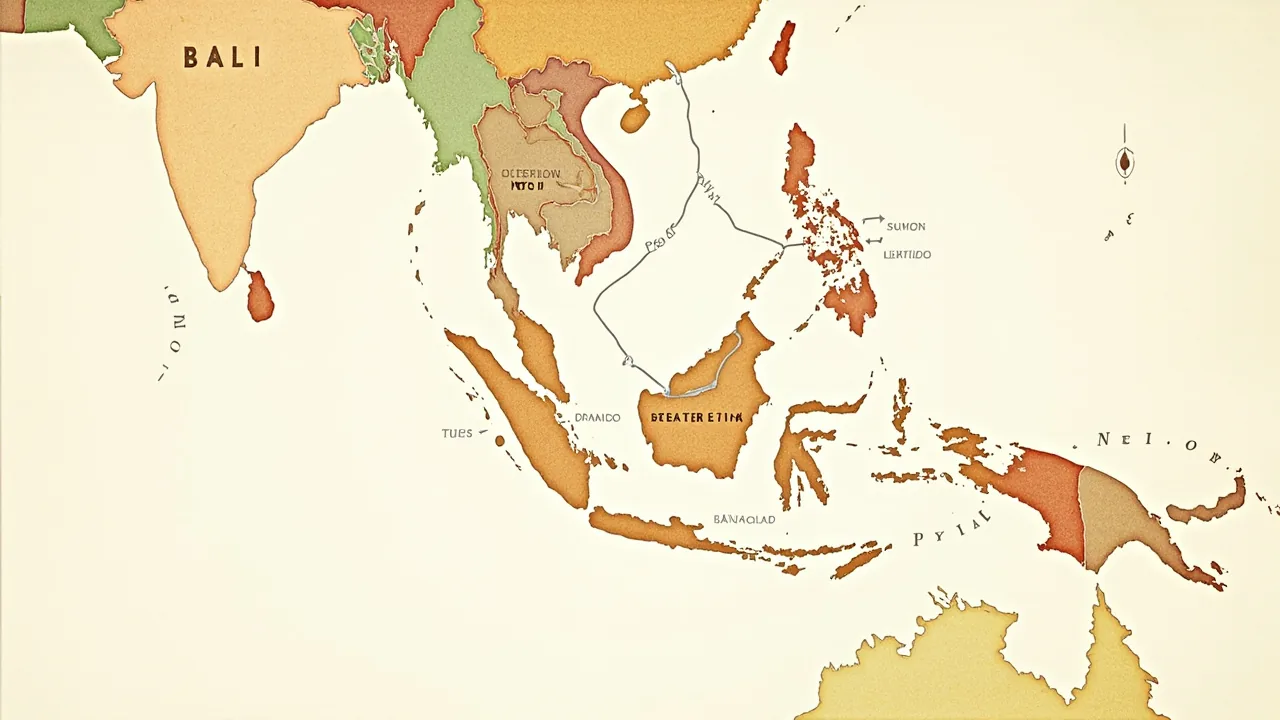
Southeast Asia Dry Season Route (Nov-May): The Complete Backpacking Corridor Guide
Yes: the dry season route southeast asia november to may is the corridor most Indian backpackers should be planning around. November through May is when the whole Banana Pancake Trail is open, dry, and safe to loop; the wet season shuts half of it down. The sequence below covers Bangkok through Thailand, Laos, Vietnam, and Cambodia in that order.
The total overland loop is roughly 4,500-5,000 km across four countries, best done over 28-35 days, with land-border transport (buses + slow boat + sleeper trains) running ₹18,000-₹25,000 (~$186.71-$259.33) and no domestic flights required inside the corridor.
Quick Answers
| What | Answer | Price (INR) |
|---|---|---|
| Best window to start | First week of November, from Bangkok | ₹0 (you fly into Bangkok) |
| Number of countries on the loop | 4 (Thailand, Laos, Vietnam, Cambodia) | Free to enter (visa aside) |
| Cheapest land border crossing cost | Chiang Khong to Huay Xai (Thailand to Laos) | ₹2,153 (~750 THB or ~$22.35) |
| Fastest way to skip a corridor | Bangkok Airways or VietJet regional hop | ₹4,800-₹9,600 (~$49.79-$99.58) |
| Visa budget for the full loop | Thailand + Laos + Vietnam + Cambodia VoA | ₹6,300-₹8,400 (~$65.35-$87.13) |
Why November to May is the Window
Southeast Asia has two monsoon systems: the southwest monsoon (June to October) drenches mainland SEA, and the northeast monsoon (November to March) shifts rain to the Philippines and parts of Vietnam’s central coast. The November to May corridor gives you mainland Thailand, Laos, Cambodia, and most of Vietnam in their dry, low-humidity months.
If you start in early November from Bangkok, you move north while it is cool (Chiang Mai in December averages 22°C, pleasant for trekking), catch the slow boat on the Mekong before the January fog gets heavy, hit Vietnam from north to south as the central coast dries out in February, and end in Cambodia by April or early May before the wet-season humidity returns in June. Travellers who reverse this and go north to south into May usually arrive in Hanoi too late: by then, the northern mountains are getting humid and the Ha Giang loop visibility drops.
One practical warning: late December and early January see the Hanoi to Sapa and Ha Giang stretches get foggy, which means the Ha Giang Loop’s signature viewpoints can be obscured for 2-3 days at a stretch. Plan for it. If you want clear views, push Ha Giang to late January or February.
The Route, Corridor by Corridor
This is the sequence. Each segment links to the dedicated 12go booking page for that exact corridor. For the full overview of backpacking across the region, see the SEA Backpacking Hub.
Segment 1: Bangkok to Chiang Mai (Thailand, domestic)
The classic first leg. ~700 km, north through the central plains.
Cheapest: State railway overnight sleeper, 3rd class fan, around 12-14 hours. Book 2-3 days ahead in person at Hua Lamphong or via 12go. Bangkok to Chiang Mai sleeper costs roughly ₹2,297-₹3,446 (~800-1,200 THB or ~$23.83-$35.74) depending on class.
Best: Special Express train, 1st class sleeper (air-con), about ₹2,010 (~700 THB or ~$20.85), 11 hours. You wake up in the mountains around dawn. Add the ~₹431 (~150 THB or ~$4.47) surcharge for the berth.
Fastest: AirAsia or Nok Air, 1 hour 10 minutes, around ₹4,307-₹7,179 (~1,500-2,500 THB or ~$44.68-$74.47). Worth it only if you are short on time. The sleeper train is part of the trip; the flight is just transport.
Segment 2: Chiang Mai to Chiang Khong to Huay Xai (Thailand to Laos border)
The northern gateway. From Chiang Mai, a minivan to Chiang Khong (the Thai border town) takes about 5-6 hours and costs ₹1,005-₹1,292 (~350-450 THB or ~$10.43-$13.40). The Friendship Bridge here is the most traveller-friendly land border between the two countries.
At the Thai side, you get exit-stamped. Walk across. On the Lao side, you get visa-on-arrival for Laos (Indian passport holders pay a flat ₹2,892 (~30 USD), plus a small weekend/after-hours surcharge if applicable). Always carry USD cash for the fee: the ATM line at this border is unreliable.
From Huay Xai (Laos side), you have two options: a slow boat down the Mekong to Luang Prabang (2 days, 1 night in Pakbeng), or a speedboat (6 hours, much rougher, twice the price). The slow boat is the headline of this corridor.
Segment 3: Huay Xai to Luang Prabang (Laos, Mekong slow boat)
The most photographed transport leg in Southeast Asia.
Slow boat (standard): ₹518-₹539 (~120,000-125,000 LAK or ~$5.37-$5.59). 2 days, overnight stop in Pakbeng, arrives Luang Prabang late afternoon Day 2. Wooden longboat, padded seats, life jackets, toilets onboard (basic). The Pakbeng overnight is not included; budget ₹216-₹432 (~50,000-100,000 LAK or ~$2.24-$4.48) for a basic guesthouse.
Speedboat: ₹1,079 (~250,000 LAK or ~$11.19) or more. 6 hours. Loud, dangerous in low water, locals do not recommend it during dry season (December-February) because the water level drops and rocks become a hazard.
Bus+ferry combo via Pakbeng: Sometimes offered by guesthouses for ₹561-₹777 (~130,000-180,000 LAK or ~$5.82-$8.06). Faster than the slow boat, slower than the speedboat, and you still sleep in Pakbeng but skip the full-day river stretch.
Take the slow boat. You will not regret it.
Segment 4: Luang Prabang to Vientiane (Laos, domestic)
~400 km south, mostly on the winding Route 13.
Sleeper bus (VIP): 24 hours if it is a sleeper, around ₹561-₹777 (~130,000-180,000 LAK or ~$5.82-$8.06). The VIP buses with flat-bed seats are tolerable; the regular ones are punishing.
Minivan: 8-10 hours, ₹475-₹647 (~110,000-150,000 LAK or ~$4.92-$6.71). Faster than the sleeper bus, but every bump hits your spine.
Vang Vieng stopover: Most travellers break this with 1-2 nights in Vang Vieng. The bus does not care if you get off; you catch the next one. Add ₹432-₹647 (~100,000-150,000 LAK or ~$4.48-$6.71) for the next-day ticket.
There is no good way to do this leg. Pick the VIP sleeper and sleep through it. For more on Laos, see the Laos Travel Guide.
Segment 5: Vientiane to Hanoi (Laos to Vietnam border)
Two options here: the long bus (Vientiane to Hanoi direct, ~24 hours via the Nam Phao-Cau Treo border), or break it.
Cheapest: Vientiane to Vinh (Vietnam central coast) sleeper bus, then train up to Hanoi. About 18-20 hours total. Budget ₹1,079-₹1,510 (~250,000-350,000 LAK or ~$11.19-$15.67) for the bus, then ₹1,289-₹1,842 (~350,000-500,000 VND or ~$13.37-$19.10) for the train Vinh to Hanoi.
Best: Break it. Fly Vientiane to Hanoi on VietJet or Lao Airlines, 1 hour 30 minutes, around ₹6,472-₹10,788 (~1,500,000-2,500,000 LAK or ~$67.14-$111.90). This saves a full day and you skip the worst road in the corridor (the Cau Treo border road is notoriously rough and landslides close it in rain, though that is a wet-season problem).
Nam Phao-Cau Treo border (the overland option): Open 7 AM to 7 PM Lao time, similar on Vietnam side. Indian passport holders get Vietnam visa-on-arrival at Hanoi airport; for overland, you must arrange an e-visa in advance (₹2,410 (~25 USD), single entry, 30 days). E-visa takes 3 working days, apply at the official Vietnam Immigration site.
Segment 6: Hanoi to Ha Giang Loop (Vietnam, internal)
The northern mountains. The Ha Giang Loop is the headline activity here, 3-4 days on motorbike (or with an “easy rider” guide on the back of theirs).
Getting there: Sleeper bus from Hanoi to Ha Giang city, 6-7 hours, ₹921-₹1,289 (~250,000-350,000 VND or ~$9.55-$13.37). Or the morning bus via Quan Ba.
Easy Rider (recommended if you cannot ride): ₹4,420-₹6,629 (~1,200,000-1,800,000 VND or ~$45.84-$68.77) per day for a guide with motorbike. They drive, you sit behind, you see the same scenery. This is the standard option for Indian backpackers who don’t have an international motorbike license.
Self-ride: ₹921-₹1,473 (~250,000-400,000 VND or ~$9.55-$15.28) per day for a semi-automatic rental. Your Indian license is not valid in Vietnam, and police checkpoints do exist. Travellers report being fined ₹1,842-₹7,366 (~500,000-2,000,000 VND or ~$19.10-$76.41) if stopped without the right paperwork. Easy Rider removes this risk.
See the dedicated Ha Giang Loop Backpacking Guide for the full breakdown.
Segment 7: Hanoi to Hue to Da Nang to Hoi An (Vietnam, north-to-south coast)
The Reunification Express train, or open bus. This is the Vietnam stretch every backpacker recognizes.
Sleeper train (Hanoi to Hue): 12-14 hours, soft sleeper, ₹2,210-₹3,315 (~600,000-900,000 VND or ~$22.92-$34.38). Worth it.
Open bus (Hanoi to Hoi An via Hue and Da Nang): Sinh Tourist or FUTA, around ₹2,578-₹3,315 (~700,000-900,000 VND or ~$26.74-$34.38), 16-18 hours with stops. You can buy the full ticket through and break it at Hue and Da Nang for a night each.
Hoi An is the natural mid-corridor pause. Plan 2-3 nights. Tailoring, lanterns, cooking classes. Indian backpackers especially appreciate the vegetarian food options in the old town. For more on Vietnam, see the Vietnam Travel Guide.
Segment 8: Hoi An to Ho Chi Minh City (Vietnam, north-south)
Open bus via Da Nang, Nha Trang, Dalat, Mui Ne: Around 18-24 hours total depending on stopovers. Budget ₹2,210-₹3,315 (~600,000-900,000 VND or ~$22.92-$34.38). Most travellers break this with overnight stops at Nha Trang (beach) and Mui Ne (sand dunes).
Flight: VietJet, Bamboo, Vietnam Airlines, 1 hour 20 minutes, ₹3,683-₹9,208 (~1,000,000-2,500,000 VND or ~$38.20-$95.51). Worth it if you have already done Nha Trang and want to save a day.
Segment 9: Ho Chi Minh City to Phnom Penh (Vietnam to Cambodia border)
The Moc Bai-Bavet crossing, the busiest land border between the two countries.
Direct bus: 6-7 hours including border, ₹921-₹1,289 (~250,000-350,000 VND or ~$9.55-$13.37). Bus picks you up in District 1, drops you in Phnom Penh. Easy.
Indian passport specifics: Cambodia grants visa-on-arrival at land borders for Indian passport holders. ₹2,892 (~30 USD) + ₹193 (~2 USD) processing. Carry USD cash, small denominations, no torn bills. E-visa also available online (₹2,892 (~30 USD), 30 days), faster at the border because you skip the queue.
Segment 10: Phnom Penh to Siem Reap (Cambodia, internal)
Bus: 6-7 hours, ₹964-₹1,446 (~10-15 USD). Mekong Express, Giant Ibis, or similar. Comfortable, air-con, Wi-Fi in some.
Boat (Tonle Sap, fast): 4-5 hours, ₹3,374-₹4,338 (~35-45 USD), only during high water (roughly July-December, when the lake fills up). Not reliable in dry season, which is the window you are travelling in.
Take the bus. The boat option is mostly closed during the corridor you are most likely to use.
Indian Passport Specifics
Visa on arrival works at all four countries for Indian passport holders, but the process differs.
| Country | VoA for Indians | Fee | Notes |
|---|---|---|---|
| Thailand | No (exempted until further notice) | Free | 60-day stay, just stamp on arrival |
| Laos | Yes | ₹2,892 (~30 USD) | USD cash only, no card |
| Vietnam | At airport only; e-visa for land borders | ₹2,410 (~25 USD) e-visa | Apply 3+ days before at official site |
| Cambodia | Yes | ₹2,892 (~30 USD) + 2 processing | USD cash, small bills |
The most consistent mistake is travellers turning up at the Vietnam overland border without an e-visa and having to take a day-trip detour back to Hanoi to fly. Pre-apply.
Documents to carry beyond your passport:
- Passport-size photos (4-6, some borders still want paper photos)
- USD cash in small denominations (₹96 (~1 USD)) for visa fees and border tuk-tuks
- Printed hotel/hostel address for the next leg (rarely asked, but happens)
- Yellow fever vaccination certificate (only if coming from a yellow-fever country; India is on the safe list, but carry the WHO card if you have it)
Indian embassy contacts in the region:
- Bangkok: +66 2 670 2400
- Vientiane: +856 21 413 200
- Hanoi: +84 24 3824 4989
- Phnom Penh: +855 23 210 912
When NOT to Take This Route
June to October: Skip the corridor entirely. The Mekong slow boat gets cancelled when water is too low (slow) or too high (dangerous). The Ha Giang loop has landslides. The Vietnam central coast gets typhoons. The alternative for June-October travellers is southbound-only (Bangkok to Phuket to Krabi to Koh Samui), staying on islands and the Andaman coast. Monsoon season guide for the breakdown.
Late December to early January (peak holiday): Book all sleeper buses and trains 5-7 days ahead. Walk-ups at the Chiang Mai to Chiang Khong minivan on 28 December are impossible.
Chinese New Year (late January or February, varies): The Ha Giang loop and Sapa see huge domestic tourism spikes. Hostels double in price. Avoid if you want quiet.
Getting Connected
The corridor has decent 4G coverage in cities and most bus routes. Dead zones: the Mekong slow boat stretch from Huay Xai to Pakbeng has intermittent signal, often only on the Lao side of the river. The Ha Giang loop has gaps in the Dong Van and Meo Vac stretches.
For SIM, buy a local SIM at each border. Thai AIS or DTAC at Bangkok airport (₹859 (~299 THB or ~$8.91) for 15 days, 15 GB), Lao Unitel at the Huay Xai border (₹216 (~50,000 LAK or ~$2.24) for 5 GB), Vietnamese Viettel in Hanoi (₹737 (~200,000 VND or ~$7.64) for 30 days, 120 GB), Cambodian Cellcard or Smart at the Phnom Penh airport or border (₹482-₹964 (~5-10 USD) for tourist packs).
If you want to skip the SIM shuffle, Get Nomad eSIM covers all four countries on one data plan. Useful for the first week before you decide if you want a local SIM.
FAQ
Can I do the slow boat from Huay Xai to Luang Prabang with an Indian passport? Yes, no special permit needed. Carry your passport, the boat operator takes your passport overnight in Pakbeng for processing; you get it back at breakfast. This is standard.
Is the Hanoi overnight bus safe for solo female travellers? Genuinely fine, but pick the right operator. FUTA (Phuong Trang) and The Sinh Tourist are the established ones. Avoid unmarked minivans. Travellers report occasional theft from overhead bins on cheaper buses; carry your passport and cash on your body.
How much cash should I carry for the full corridor? Roughly ₹19,281-₹28,921 (~200-300 USD) in mixed denominations plus ₹5,000 (~$51.87) in back-up Indian rupee. ATMs are in every city and town along the route, but the Chiang Khong-Huay Xai border has flaky ATMs, so carry USD for the Laos visa.
Do I need a motorbike license for the Ha Giang Loop? Your Indian license is not valid in Vietnam. Easy Rider (guide with bike) is the workaround for Indian passport holders. Self-ride means risking a fine at police checkpoints. Travellers report ₹1,842-₹7,366 (~500,000-2,000,000 VND or ~$19.10-$76.41) fines if stopped.
What’s the cheapest country in the corridor? Laos by a wide margin. A dorm bed is ₹259-₹432 (~60,000-100,000 LAK or ~$2.69-$4.48), street food is ₹43-₹108 (~10,000-25,000 LAK or ~$0.45-$1.12) per dish, beer is ₹43-₹65 (~10,000-15,000 LAK or ~$0.45-$0.67). Cambodia is second-cheapest. Thailand and Vietnam cost more, especially Bangkok and the Vietnam coast.
Can I skip Bangkok and start in Chiang Mai? Yes, fly Chiang Mai direct via Bangkok Airways or Thai Airways from Bangkok connection. But you lose 1-2 days of Bangkok visa-run flexibility (if you need it). Most Indian travellers start Bangkok, see the Grand Palace and Khao San, then go north. See the Thailand Travel Guide for a full country breakdown.
Is Cambodia safe in 2026? The standard backpacker circuit (Phnom Penh, Siem Reap, Sihanoukville) is generally safe. Generic categories of risk to be aware of: occasional political demonstrations in Phnom Penh (avoid Tuol Tom Poung during), and scam risk at the border (always ignore “you need a visa agent” touts, they are lying). Check your government’s travel advisory before departure: MEA travel advisories for Indian travellers. For the full Cambodia breakdown, see the Cambodia Travel Guide.
Subodh’s Take
The November to May corridor is the safest, driest, most-logically-sequenced version of this loop. Indian travellers who try to do it in July or August because that is when flights are cheap usually end up losing 3-4 days to weather and a lot more to frustration. Pay the off-season flight premium, start in early November, and let the dry season do the planning for you.
