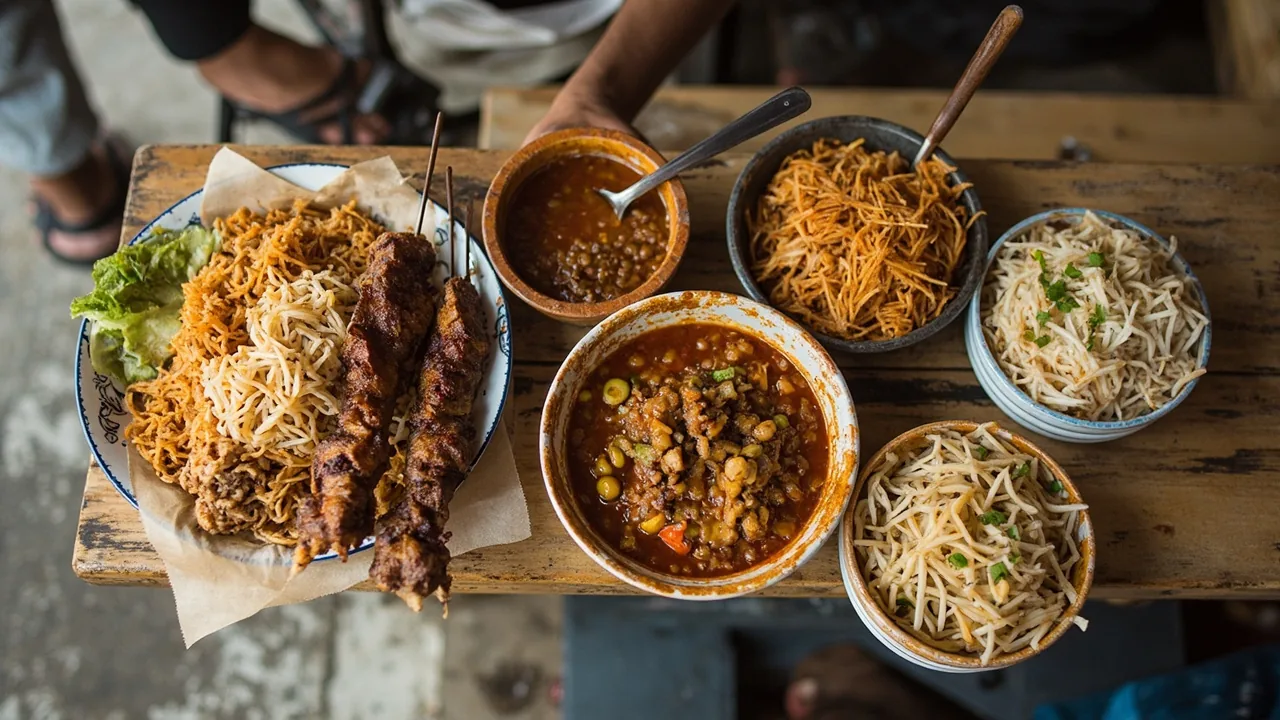
Indonesian vs Filipino Food: How the Two Cuisines Differ
Short answer: Indonesian food is generally spicier and more regional; Filipino food is gentler, sour-savory-sweet, and more comfort-forward. Across 5 key dimensions — spice, sweetness, technique, ingredients, and street food culture — the two cuisines diverge sharply.
Indonesian food rewards you with sambal on everything, coconut milk where you don’t expect it, and a paste-based spice logic that runs through every region. Filipino food delivers adobo that braises while you nap, sinigang that hugs you back with tamarind sourness, and a sweet-savory balance that borders on dessert. If you’re also weighing Malaysian vs Singaporean food, both of these cuisines sit on the same Southeast Asian flavor spectrum but with distinct identities.
Verified for factual accuracy on 2026-07-17 against May 2026 traveler reports and current regional cuisine references for Java, Sumatra, Luzon, and the Visayas.
Quick Answers
| What | Answer | Price (INR) |
|---|---|---|
| Core flavor identity (Indonesian) | Chili + paste (bumbu) + coconut or peanut | — |
| Core flavor identity (Filipino) | Sour (vinegar/tamarind) + soy + a soft sweetness | — |
| Heat source (Indonesian) | Sambal (fresh chili paste) on the side | — |
| Heat source (Filipino) | Siling labuyo (bird’s eye chili) on the side | — |
| Signature dish (Indonesian) | Nasi goreng, rendang, sate | — |
| Signature dish (Filipino) | Adobo, sinigang, lechon | — |
| Rice role (Indonesian) | Plain steamed rice as the base for almost everything | — |
| Rice role (Filipino) | Garlic fried rice (sinangag) that often is the meal | — |
| Spice tolerance (Indonesian avg) | High; chili is non-negotiable | — |
| Spice tolerance (Filipino avg) | Mild to medium; chili is offered, not assumed | — |
Quick Comparison Table
| Factor | Indonesian | Filipino |
|---|---|---|
| Daily food budget | Rp 80,000 to Rp 150,000 | PHP 350 to PHP 700 |
| Number of distinct regional cuisines | 6+ (Sundanese, Javanese, Padang/Minang, Balinese, Manado, Acehnese) | 3+ (Tagalog, Visayan, Bicolano) with strong Spanish-Chinese overlays |
| Veg options in restaurants | Solid (gado-gado, tempeh, sayur asem) | Limited; expect to ask and to get adobo with the pork swapped out |
| Sweetness in savory dishes | Low | Noticeably high (banana ketchup, tocino, hamonado) |
| Soup culture | Light, clear, herb-driven (soto, sup) | Sour-broth dominant (sinigang) plus hearty stews |
| Eating out late | Warung open till 22:00 in most cities | Karinderya closes earlier; malls and fast food fill the gap |
| Spice paste foundation | Bumbu (shallot, garlic, chili, turmeric, galangal) | Achuete + garlic + vinegar; patis (fish sauce) as the salt |
| Chili on table? | Sambal, always | Sili, sometimes |
| Food scene for tourists | Bali and Jakarta food tours, Padang rumah makan, Yogyakarta warungs | Manila and Cebu dining neighborhoods, Pampanga regional restaurants |
| Signature snack | Gorengan (fried fritters), kerak telor (Jakarta) | Balut (duck embryo, only if you dare), puto, kwek-kwek |
| Vibe | Spice-forward, paste-driven, fiercely regional | Comfort-forward, sour-savory-sweet, family-table energy |
| Best for | Travelers who want strong regional differences and a chili habit | Travelers who want home-cooking energy and don’t mind sweetness |
Choose Indonesian Food If…
- You want spice heat as a default, not as an add-on. Sambal isn’t optional in most warungs.
- You like the idea of six genuinely different regional cuisines in one country. Padang food alone eats like a separate country from Java.
- Coconut milk and peanut sauce make you happy. Both are everywhere: opor, gado-gado, sate Padang, gulai.
- You’re vegetarian-curious and want options beyond “just rice.” Tempeh, tahu, gado-gado, urap, and sayur asem are built into the daily menu.
- You’re into the idea of nasi goreng eaten at 11pm sitting on a plastic stool. That is the Indonesian canon.
Choose Filipino Food If…
- You want the meal to taste like someone made it for you. Adobo, sinigang, kare-kare all read as home cooking raised to a national standard.
- You prefer sourness over heat. Tamarind (sinampalok) and cane vinegar (sukang Iloco) are signature moves.
- Sweet-savory flavors don’t throw you off. Filipino savory food can read “almost dessert” thanks to banana ketchup, tocino, longganisa, and hamonado.
- You’re traveling with non-spice-tolerant eaters. Filipino food has a gentler default heat level.
- You want one national dish (lechon) that’s worth booking a flight to Cebu specifically for.
Indonesian Food. Pros and Cons
Pros:
- Real regional variety. Sundanese, Javanese, Padang/Minang, Balinese, Manado, and Acehnese food each have a distinct flavor fingerprint, and you can hit three on one island-hopping trip.
- Sambal culture rewards spice lovers. Every meal comes with a built-in dial.
- Vegetarian-friendly in a way most of Southeast Asia isn’t. Tempeh originated here and is on every warung menu.
- World-class street food infrastructure. Warung, kaki lima, and pasar malam are everywhere and cheap.
Cons:
- Spice heat is non-negotiable. If you don’t like chili, you will end up with rice and krupuk for a week.
- Pork is regional, not national. Bali has babi guling; Java mostly does not. Muslim-majority regions keep you away from pork dishes.
- Dishes can look similar across regions (rice + protein + sambal + veg) even when the flavor is different. First-time visitors sometimes call it “monotonous” before they catch the regional logic.
- Hygiene variance is real at the street-food end. Stick to busy warungs and you’ll be fine, but it takes a little street sense.
Filipino Food. Pros and Cons
Pros:
- Adobo and sinigang alone justify the cuisine. Both are on every shortlist of great Southeast Asian dishes and they’re made well almost everywhere.
- Comfort food energy. Filipino savory food hits the “someone cooked this for me” frequency.
- Best lechon in Southeast Asia, full stop. Cebu’s lechon is the reference version and the La Paz lechon manok (chicken version in La Paz, Benguet) is its own pilgrimage.
- English on menus, in conversations, and in food tour bookings. Manila especially is operationally easy for first-time visitors.
Cons:
- Sweetness in savory food is polarizing. Banana ketchup isn’t a novelty, it’s on actual restaurant tables.
- Spice tolerance is low by SEA standards. If you want heat, you have to specifically ask for it (and often specifically seek a Bicolano or Muslim-Filipino restaurant).
- Regional cuisine is less differentiated than Indonesia’s. Luzon food, Visayan food, and Mindanao food are distinct but the gaps are smaller.
- Vegetarian options outside Manila are thin. Most “veg” dishes still use shrimp paste (bagoong) or fish sauce (patis).
The Ingredients Side by Side
The base pantry is where the divergence starts. Both cuisines use rice as the floor, garlic as the second ingredient, and fish or shrimp paste as the umami lever. After that, the paths split.
Indonesia builds flavor with bumbu, a paste of shallots, garlic, candlenuts or macadamia nuts, fresh turmeric, ginger, galangal, lemongrass, and chili. Coconut milk is the second pillar; gulai, opor, and many Balinese dishes use it the way Indian cooking does. Palm sugar (gula merah) appears in some Javanese sauces and Padang satays, but it’s a side note. Peanuts show up in everything from gado-gado sauce to sate Padang. Soy sauce (kecap manis) is sweet, thick, and a major flavor in its own right, not just a seasoning. Tamarind is used in some Padang and Javanese dishes, but not as centrally as in the Philippines.
The Philippines builds flavor with garlic, achuete (annatto seeds, which give kare-kare its orange color), vinegar (cane or coconut), and patis (fish sauce). Coconut milk appears in laing, ginataang, and Bicolano cooking, but is regional rather than universal. Banana ketchup (made from saba bananas, sugar, vinegar, and spices) is on every table in Manila. Tomatoes show up more often than in Indonesian food. Siling labuyo (bird’s eye chili) is offered, but rarely assumed.
What this means for your tongue: Indonesian food leans toward a paste-thickened, coconut-or-peanut enriched, chili-led plate. Filipino food leans toward a thinner, sour-savory broth, often finished with fish sauce, with chili as a side quest.
The Techniques Side by Side
Indonesian technique vocabulary:
- Tumis: sautéing the bumbu paste in oil until fragrant. This is the foundation move.
- Goreng: frying, but with a paste foundation. Nasi goreng isn’t fried rice with ketchup; it’s day-old rice fried into a bumbu that’s been cooked separately first.
- Rendang: a slow, dry-braised Minang dish where coconut milk is cooked down for hours until it absorbs into the meat. Not curry, not stew. Something in between.
- Bakar: grilled, usually with a sweet kecap-manis marinade. Sate, ayam bakar, ikan bakar.
- Rebus and kuah: boiling and broth-based soups. Soto, sop, rawon.
Filipino technique vocabulary:
- Adobo: protein braised in vinegar, soy sauce, garlic, peppercorns, and bay leaves. The canonical Filipino technique and the dish that gives the cuisine its name.
- Sinigang: protein or seafood simmered in a tamarind-soured broth with tomatoes, radish, eggplant, long beans. The signature sour soup.
- Lechon: whole pig (or chicken) roasted over coals for hours, skin turning into glass-like chicharrón. The defining celebratory technique.
- Kilaw: something close to ceviche. Fresh raw fish or meat “cooked” in vinegar and calamansi juice with ginger and chili.
- Inihaw: grilling over charcoal, often with a banana-leaf wrap.
If Indonesian food is a paste-cuisine, Filipino food is a braise-cuisine. Both can be spicy, but the Indonesian chili is built into the foundation; the Filipino chili is offered at the end.
Signature Dishes Side by Side
| Dish | Country | What it is | Why it matters |
|---|---|---|---|
| Nasi goreng | Indonesia | Day-old rice fried in a separate bumbu paste, often with kecap manis, an egg on top | The defining street dish of Java and Bali |
| Rendang | Indonesia (Minang/Padang origin) | Beef slow-braised in coconut milk and spices until dry | Often ranked among the world’s most flavorful dishes |
| Sate | Indonesia | Skewered grilled meat, served with peanut sauce (Madurese), Padang sauce, or kecap | Every region has its own version; a real sampler platter |
| Gado-gado | Indonesia | Blanched veg, tofu, tempeh, egg, rice cake, with peanut sauce poured over | The clearest vegetarian Indonesian classic |
| Soto | Indonesia | Clear or yellow herb broth with chicken, beef, or offal, noodles or rice | The every-region-has-its-own version principle, applied to soup |
| Nasi padang | Indonesia | A spread of pre-cooked Padang dishes on a single table; you pay for what you eat | A whole cuisine-as-meal; the icon of West Sumatra |
| Adobo | Philippines | Protein braised in vinegar, soy, garlic, peppercorns, bay leaves | The national dish; every household makes it differently |
| Sinigang | Philippines | Tamarind-soured soup with meat or seafood, tomatoes, long beans, radish | Filipino comfort food in canonical form |
| Lechon | Philippines | Whole pig roasted over coals, glassy skin | Cebu’s version is the global reference; Pampanga and La Paz are rivals |
| Kare-kare | Philippines | Oxtail stew in a peanut sauce, thickened with rice, served with bagoong on the side | The closest Filipino dish to an Indonesian flavor profile |
| Pancit | Philippines | Stir-fried noodles, Chinese-origin, now fully Filipino | The everyday noodle dish, party-table essential |
| Sisig | Philippines | Chopped pork face and ears, grilled, served on a sizzling plate with calamansi and chili | The Filipino answer to “bar food that punches” |
Regional Specialties Worth Knowing
Indonesian food is, if anything, more regional than national. Knowing three to four regions gets you a meaningful spread.
- Padang (West Sumatra): Rendang, sate Padang (with thick yellow sauce), dendeng balado, gulai tunjang. Padang rumah makan let you pick from a stacked display of pre-cooked dishes; you only pay for what lands on your table.
- Java: Sundanese food around Bandung (lot of fresh veg, sambal on the side, lalapan), Javanese food around Yogyakarta (gudeg, the jackfruit stew that’s sweet and brown, plus nasi kucing). Javanese food skews sweeter than most Indonesian regional cuisines.
- Bali: Babi guling (suckling pig), bebek betutu (slow-cooked duck), lawar (minced meat with coconut and spices). Bali’s cuisine also has a strong pork tradition you won’t find in Java.
- Manado (North Sulawesi): spicy, heavy on seafood, coconut and chili everywhere. Tinutuan (porridge) and ayam woku are local references. If you can take heat, Manado is the move.
Filipino regional food has less spread, but the gaps are real.
- Luzon / Tagalog: Adobo, sinigang, kare-kare, longganisa breakfasts. Pampanga is often called the culinary capital of the Philippines; bring an appetite.
- Visayas: Lechon country. Cebu’s lechon is the global reference; it skips the typical stuffing in favor of a salt-garlic-lemongrass rub that lets the pig taste like itself.
- Bicol (southern Luzon): Laing (taro leaves in coconut milk with chili), pinangat, Bicol express. The one regional cuisine where heat is a default, not an add-on. Closest Filipino cousin to spicy Indonesian food.
- Mindanao / Muslim Filipino: Beef rendang (yes, Filipino rendang exists and it’s different), pastil, pianggang. Indonesian flavor profile minus the pork.
Subodh’s Pro Tip: If you’ve already done Bali and want to see how the other half of the archipelago eats, Manila + Cebu is a strong two-city taster. If you have three weeks, add Bicol or Pampanga.
Cost Comparison
| Expense | Indonesian street meal (IDR) | Filipino karinderya meal (PHP) |
|---|---|---|
| Single dish (nasi campur / ulam + rice) | Rp 25,000 to Rp 45,000 | PHP 80 to PHP 150 |
| Full nasi goreng at a warung | Rp 25,000 to Rp 40,000 | (less common as a stand-alone) |
| Adobo + rice + drink at a karinderya | (less common as a stand-alone) | PHP 100 to PHP 180 |
| Restaurant meal (mid-range) | Rp 80,000 to Rp 200,000 | PHP 350 to PHP 700 |
| Local fruit (mango / rambutan / mangosteen) | Rp 15,000 to Rp 30,000 / kg | PHP 60 to PHP 150 / kg |
| Bottled water | Rp 5,000 to Rp 8,000 | PHP 20 to PHP 35 |
| Coconut (young, fresh) | Rp 15,000 to Rp 25,000 | PHP 30 to PHP 60 |
| Es teh / sago / dessert | Rp 8,000 to Rp 18,000 | PHP 30 to PHP 80 |
| Top food experience (rendang set / lechon kilo) | Rp 150,000 to Rp 250,000 | PHP 1,500 to PHP 2,500 (lechon by the kilo) |
| Beer (local) | Rp 35,000 to Rp 60,000 | PHP 70 to PHP 150 |
Verified FX context: 1 IDR ≈ ₹0.0053; 1 PHP ≈ ₹1.65 (1 INR ≈ 188.7 IDR; 1 INR ≈ 0.605 PHP). Today’s date 2026-07-17. For Indian travelers, this means a Rp 35,000 beer lands around ₹185 (~$1.92), and a PHP 100 karinderya meal is roughly ₹165 (~$1.71). Most backpacker meals in either country stay under ₹300 (~$3.11).
Subodh’s Pro Tip: Food-only travel in either country lands in the same budget band as Thailand. If you’re comparing Indonesian costs more broadly, the Bali vs SE Asia breakdown is the useful cross-check.
The Bananarchy Take
The honest answer is that the cuisines aren’t competing for the same taste. Indonesian food rewards people who want to feel like the meal has a regional logic and a chili habit. Filipino food rewards people who want comfort, sour-savory balance, and a national dish (lechon) that’s worth a flight on its own.
If you’re vegetarian, Indonesia is the easier choice by a wide margin; gado-gado, tempeh, and tahu-based warungs are everywhere, while Filipino veg requires specific hunting outside Manila.
If you’re traveling with family or non-spice-tolerant eaters, Filipino food is the safer pick. Adobo is mild enough for kids and the sour-sweet profile is widely accepted.
If you’re going for one trip and want to feel like you’ve “understood” a regional food tradition, Indonesian food has more depth. The gap between Padang, Bali, and Javanese food is bigger than the gap between Tagalog, Visayan, and Bicolano food.
For travelers planning both, the natural sequence is Indonesia first (Java + Bali for the regional sampler) then Manila + Cebu for the Filipino canon. If you want another Southeast Asian cuisine comparison, Thai vs Cambodian food shows how two neighboring countries can taste completely different.
Browse Philippine food experiences on GetYourGuide if you want to compare a Manila or Cebu crawl against your Indonesia memories.
Getting Connected
Indonesian SIMs are easy. Buy a Telkomsel or XL Axiata starter pack at the airport, register it with your passport, and you’re online for under Rp 100,000. Filipino SIMs (Globe or Smart) are similarly cheap at the airport (PHP 100 to PHP 200 for tourist packs), with eSIM options now widely supported. Both countries work with Get Nomad eSIM as a no-physical-SIM alternative, which is useful if you’re hopping between the two.
Can You Do Both?
Yes, and it’s a strong two-country trip. The natural route is Indonesia first (5 to 7 days minimum, ideally 10 to 14) then Manila and Cebu (5 to 7 days). Direct flights from Jakarta to Manila run around 3.5 to 5 hours; from Manila to Cebu is 1 hour. A 14+7 split (Indonesia heavier) gives you the regional variety and the Filipino canon without rushing.
The combined trip lands in the same price band as a full Thailand-Vietnam itinerary. Filipino SIM, transport, and food are all on par with Indonesian costs, so adding the second country doesn’t double your daily spend. If you’re deciding between Philippines and Cambodia instead, the Cambodia vs Philippines cost breakdown covers the budget angle.
If you’re a Southeast Asia food person already, this is a logical pair. If you’ve only done Thailand, starting with Thai vs Vietnamese food and then adding Indonesia is a gentler ramp. For the full regional picture, our SEA backpacking hub covers every country side by side.
FAQ
Is Filipino food spicier than Indonesian food? No. Indonesian food is generally spicier by default. Filipino food uses chili (siling labuyo) but it’s offered, not assumed.
Which country has better street food? Indonesia has more street-food infrastructure and more regional variety. The Philippines has excellent karinderyas (small eateries) but a smaller street-food culture outside Manila and Cebu.
Which cuisine is better for vegetarians? Indonesia. Tempeh, gado-gado, tahu, urap, and sayur asem are standard. The Philippines has fewer default vegetarian dishes and shrimp paste (bagoong) shows up in many “veg” plates.
Are Indonesian and Filipino food related? Both grew out of Austronesian roots with rice, fish sauce, and coconut as common anchors. Beyond that, they took different paths: Indonesia absorbed Indian, Middle Eastern, and Chinese paste-cuisine influences; the Philippines absorbed Spanish, Chinese, and American braise-and-stew influences. The result is two cuisines that share a base but diverge sharply.
Which one should I try first if I’ve never been to either? Pick by profile. If you want spice and regional variety, go Indonesia first. If you want comfort food and don’t mind sweetness, go Philippines first.
Is Filipino food too sweet? For some travelers, yes. The sweetness comes from banana ketchup, tocino, longganisa, and hamonado. You can avoid most of it by sticking to adobo, sinigang, kare-kare, and grilled meats.
Where does rendang come from? Rendang originated with the Minangkabau people of West Sumatra, Indonesia. A Filipino version exists (especially in Mindanao Muslim cuisine) but the original and most famous rendang is Indonesian.
Subodh’s Line
Indonesian food makes you pay attention to the plate; Filipino food makes you feel like the plate is paying attention to you. Pick the one that matches the trip you’re trying to have.
