Singapore Tourist Scams: What Indians Get Caught By in 2026
Common tourist scams in Singapore hit Indian travellers who lose ₹3,736 (~50 SGD or ~$38.76) to ₹14,946 (~200 SGD or ~$155.03) to hustles locals barely notice: rigged taxi meters, tourist SIM deals 30 percent pricier than airport kiosks, or strangers insisting the MRT is closed. Scammers are polite, professional, and English-speaking, which is why they work on visitors expecting chaos.
This guide covers the scams that Indian backpackers fall for in 2026, verified against current traveller reports, the Singapore Police Force advisories, and consumer forums like HardwareZone and Reddit’s r/singapore. FX rate used throughout: 1 SGD = ₹74.6855. If something here changes by the time you fly, check the official SPF ScamShield page before you land.
Subodh’s Pro Tip: Singapore scams rarely feel like scams in the moment. The driver is friendly. The SIM seller is patient. The ATM “fee” is small. The trick is to know what the legit version of each interaction costs, so when someone quotes you double, your gut fires before your wallet opens.
Quick Answers
| What | Answer | Price (INR) |
|---|---|---|
| Police emergency hotline | 999 (free, 24/7, English, Tamil, Hindi available) | Free |
| Police non-emergency / scam report | 1800-722-6688 (ScamShield hotline) | Free |
| Tourist SIM card, 7 days, ~50GB data | Singtel/M1 tourist pack at Changi Airport kiosks | ₹1,121 (~15 SGD or ~$11.63) |
| Legit taxi flag-down from Changi to Orchard | Comfort/Citycab metered fare, late evening | ₹1,868-₹2,616 (~25-35 SGD or ~$19.38-$27.13) |
| Standard tourist overcharge by unmetered tout | Driver quotes flat “city” rate | ₹3,736-₹5,978 (~50-80 SGD or ~$38.76-$62.01) |
| ATM third-party fee at non-bank machines in Geylang/Bugis | Per-transaction skim charge | ₹374-₹747 (~5-10 SGD or ~$3.88-$7.75) |
Scams Indians Get Hit By in Singapore
1. The Unmetered Taxi / Private Car Touting Scam
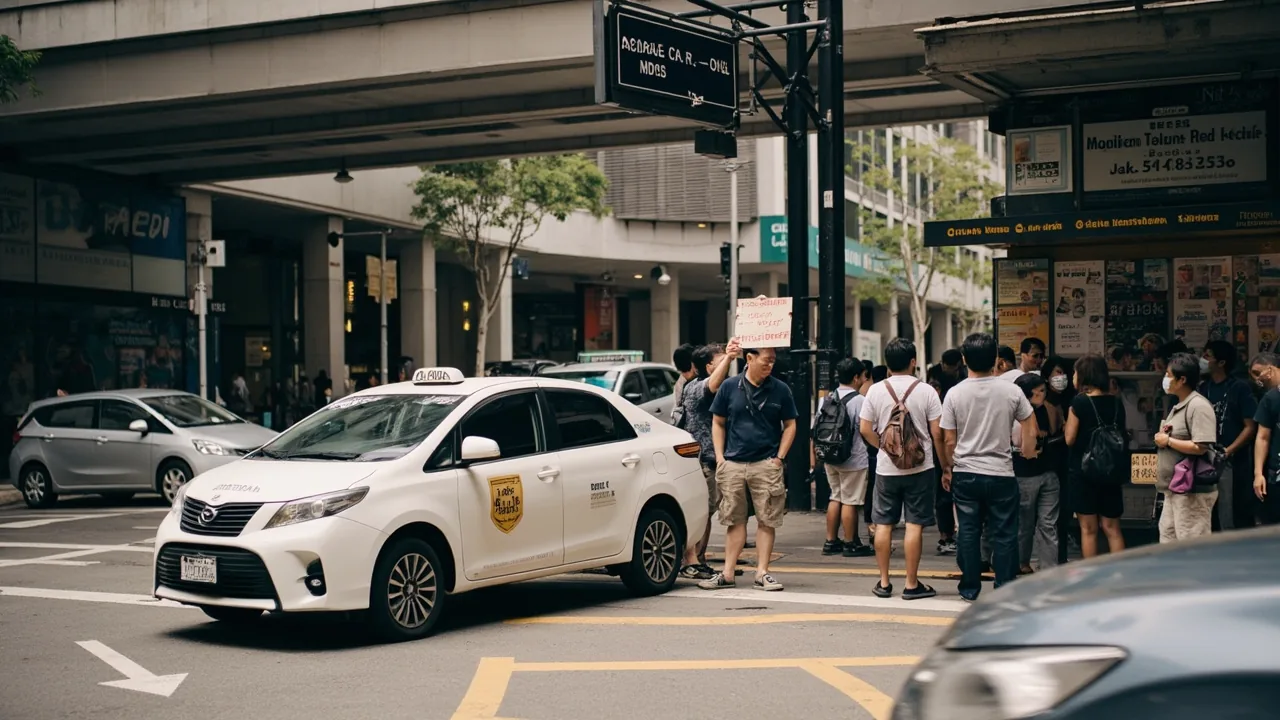
This is the single most common way Indians lose money in Singapore, and it usually happens at Changi, outside Mustafa Centre in Little India, or after a late night at Clarke Quay.
How it works: a man in a private car (often a Toyota Vios or Honda City, never a Comfort or Citycab logo) approaches you at the taxi stand and says the queue is “90 minutes” or the MRT is “closed.” He offers a flat fare of ₹3,736 (~50 SGD or ~$38.76) to ₹5,978 (~80 SGD or ~$62.01) to Orchard, Marina Bay, or Bugis. A metered Comfort or Citycab from Changi to Orchard at any time of day is ₹1,868 (~25 SGD or ~$19.38) to ₹2,616 (~35 SGD or ~$27.13) including the airport surcharge. You are paying double to triple.
The hook for Indians specifically: many first-time visitors see the Changi taxi queue and panic at 30 people in line, then accept the “private car” offer because it looks like Grab. It is not Grab. Grab would show a fare of ₹1,345 (~18 SGD or ~$13.95) to ₹1,868 (~25 SGD or ~$19.38) on your phone. An unmarked Vios quoting ₹4,484 (~60 SGD or ~$46.51) cash is a tout.
How to spot it:
- The driver does not pull into the official taxi queue.
- The car has no taxi decals, no meter visible, no top light.
- He quotes a flat number instead of pointing at a meter.
- He insists on cash or asks you to pay to his personal PayNow/phone number.
What to do:
- Walk past him to the official taxi stand, even if the queue is 40 minutes. Use the queue marshals’ screen to see live wait times.
- Open the Grab app on airport Wi-Fi and book there. The pickup point is signposted on every terminal.
- If you have already gotten in and he starts the trip without turning on a meter, get out at the first stop. Yes, it is awkward. No, do not pay.
2. The Rigged or Premium-Rate ATM in Geylang, Bugis, and Lucky Plaza
ATMs in bank branches (DBS, OCBC, UOB) are safe. ATMs in convenience stores, money changers, and standalone kiosks in tourist-heavy zones are a different story.
How it works: two versions of this scam. The first is the older card-skimming rig, less common now but still reported, where a hidden reader on the card slot captures your data while a pinhole camera watches your hand. The second, more common version in 2026, is the “dynamic currency conversion” trap: an ATM that is genuinely owned by a bank but displays a screen offering to charge you in your home currency (“charge in INR?”) at a terrible rate, plus a flat ₹374 (~5 SGD or ~$3.88) to ₹747 (~10 SGD or ~$7.75) “foreign transaction fee” that a DBS or OCBC branch ATM would never charge.
The hook for Indians specifically: people who just arrived at Changi and need ₹14,946 (~200 SGD or ~$155.03) in cash walk into the first ATM they see at the MRT station, which is often a non-branch machine operated by a third party. The screen says “welcome, foreign card” and offers a 4 percent markup plus fee. They accept because they are tired and hungry.
How to spot it:
- The ATM is in a convenience store, money changer, or behind a shuttered shop, not inside a bank branch.
- The screen offers you a choice between SGD and your home currency. Always choose SGD. Your Indian bank will do the conversion at a fair rate.
- There is a “service fee” of more than 1 SGD displayed upfront.
What to do:
- Use only ATMs inside DBS, OCBC, or UOB branches, or the dedicated DBS/POSB ATMs inside MRT stations (these are official and charge 0 SGD for most Indian bank cards).
- If you used a sketchy ATM and your statement later shows a mystery fee or a small “test” charge, lock the card immediately via your bank’s app and call the Singapore Police anti-scam hotline at 1800-722-6688.
3. The Fake Attraction Ticket Seller Outside Universal Studios, Sentosa, and Marina Bay Sands
How it works: a man standing near the Sentosa Express monorail entrance or the MBS tourist coach drop-off sells “discount tickets” to Universal Studios, the Singapore Flyer, or the SkyPark observation deck. He shows you a printed voucher, quotes 30 percent below the gate price, and asks for cash or a PayNow transfer to his personal account. The voucher is either a real ticket purchased with a stolen credit card (which gets voided at the gate) or a forgery.
The hook for Indians specifically: Indians travelling as a family of four see the math (₹4,484 (~60 SGD or ~$46.51) per ticket instead of ₹6,576 (~88 SGD or ~$68.22)) and try to save ₹7,473 (~100 SGD or ~$77.52) total. They hand over cash, walk to the gate, get turned away, and the seller has vanished.
How to spot it:
- The seller is not behind a counter, has no shop, and no business card.
- He pressures you to pay in the next 60 seconds (“only two left”).
- The “discount” is exactly 30 percent, which is the human brain’s favourite fake sale percentage.
- He will not accept credit card or let you scan a QR code that links to a registered business.
What to do:
- Buy from the official Sentosa, USS, or MBS websites, or from Klook/KKday with verified business ratings.
- If the price sounds too good, it is too good. A legit USS adult ticket is around ₹4,932 (~66 SGD or ~$51.16) to ₹6,576 (~88 SGD or ~$68.22) depending on the day. Anyone selling at ₹2,989 (~40 SGD or ~$31.01) is selling trouble.
4. The MRT “Closed” / “Cash Only” Fare Dodge
How it works: at smaller MRT stations (Bendemeer, Jalan Besar, Geylang Bahru), a friendly local tells you the gantry is “broken” or “cash only today” and offers to swipe you through with his card if you pay him ₹149 (~2 SGD or ~$1.55) cash. In some versions, he walks you to a “different gate” that turns out to be a private parking lot.
The hook for Indians specifically: this one mostly hits Indians who land at a non-central station late at night, are not sure how the EZ-Link system works, and accept help to avoid the embarrassment of looking lost.
How to spot it:
- MRT gantries do not break in a way that requires you to pay a stranger cash.
- There is no “cash only” mode on the Singapore MRT. You tap an EZ-Link card, a contactless bank card, or buy a Standard Ticket.
- Anyone asking you to follow them away from the gantry to “another entrance” is not staff.
What to do:
- Buy a Standard Ticket from the machine at any station (you get a deposit, top up, and get the deposit back when you return the card).
- Tap your contactless Visa or Mastercard directly at the gantry, your Indian card usually works.
- If lost, press the help button on any gantry and a station staff member will assist in English.
5. The Sim Lim Square / Lucky Plaza “iPhone Cash Deal” Scam
How it works: at Sim Lim Square (the electronics mall near Rochor) and Lucky Plaza (the Orchard mall popular with the Indian and Filipino diaspora), small phone shops offer “cash only, no box, Singapore set” deals on iPhones and flagship Samsungs at ₹14,946 (~200 SGD or ~$155.03) to ₹29,892 (~400 SGD or ~$310.07) below retail. The phone is either stolen, a parallel-import grey market unit that will not have local warranty, or in older cases, a working display model with a swapped logic board.
The hook for Indians specifically: many Indians visiting family in Singapore want to bring an iPhone home as a gift or upgrade. The “Singapore set” pitch appeals because it implies warranty and authenticity. The cash discount and “no box, save tax” story makes the deal feel clever.
How to spot it:
- No box, no receipt, no GST registration shown.
- Cash only, no card.
- Pressure to decide in the shop, not “think about it.”
- The shop is on the upper floors of Sim Lim Square, not a brand-authorised reseller on the ground floor.
What to do:
- Buy electronics from authorised Apple, Samsung, or Challenger stores where the price is the price.
- If the discount is more than 15 percent below retail with no box and cash only, walk out.
- For a full breakdown of how Sim Lim specifically targets tourists, see our Singapore laws and fines guide.
Safety Alert: Singapore’s reputation for safety makes victims hesitate to report. The SPF ScamShield division explicitly wants tourists to file reports because scam patterns only emerge when multiple tourists flag the same plate number, PayNow account, or phone number. You will not be fined, you will not be deported, and English-language reporting is fully supported.
Haggling, Markets, and Where You Should Never Bargain
Singapore is not Bangkok and it is not Hanoi. The default assumption in 2026 is that prices are fixed, GST is included, and bargaining is rare outside three places: Mustafa Centre in Little India (24-hour mall, late-night haggling is expected on electronics and souvenirs), Chinatown street market (Pagoda Street and Smith Street trinket stalls), and Bugis Street market (clothes and accessories).
Rules of thumb that work without offending anyone:
- At Mustafa Centre, opening offer on electronics and luggage is fine, but most items are already marked at “last price” with a small flex of 5 percent to 10 percent on big-ticket items.
- At Chinatown and Bugis stalls, start at 50 percent of the asking price for souvenirs and clothes, settle at 60 percent to 70 percent. Vendors expect it.
- Never haggle at a hawker centre, a food stall, or a 7-Eleven. The price is the price, and the line behind you does not care.
- Never haggle at Watsons, Guardian, Uniqlo, or any chain. Staff will look at you like you proposed marriage.
If you want a fuller etiquette primer that includes hawker tipping, see the Singapore tipping and hawker food guide.
SIM Cards & Connectivity
This is where first-time Indian visitors reliably overpay, because Changi’s arrival hall has seven SIM kiosks shouting at once and every one of them looks like the official answer.
What you need: a 7-day tourist pack with around 50 GB of data. Two real options:
- Singtel or M1 tourist SIM at Changi Airport kiosks (official stores, ground floor of each terminal): ₹1,121 (~15 SGD or ~$11.63), includes about 50 GB, valid 7 days. Pick this up on arrival.
- StarHub pre-paid at any 7-Eleven or Cheers in the city: similar price, slightly less data, more hassle. Only worth it if you forgot to buy at the airport.
- Get Nomad eSIM for India-Singapore: an eSIM you activate before you fly, lands working at Changi, no passport handover at a kiosk, around ₹1,121 (~15 SGD or ~$11.63) for 7 days and 50 GB.
What to avoid: the “unlimited data, free incoming calls, 30-day plan, only ₹1,868 (~25 SGD or ~$19.38)” pitch from the roving SIM sellers in the arrival hall who approach you before you even clear customs. Most of these are real SIMs but they are loaded with 3 GB of low-speed data, not “unlimited,” and the call credit is 0 SGD. Read the small print on the card before you walk away.
Essential Language and Cultural Rules Indians Overlook
Singapore is multicultural, but small missteps read louder than they do in Bangkok. Four things that matter:
- Chew on the left side of your mouth and discard gum properly. Chewing gum import is restricted, possession is legal but spitting gum on the floor is a ₹22,419 (~300 SGD or ~$232.55) fine for a first offence. Yes, Indians who chew paan or freshener strips get hit with this. Bin it.
- Never bring durian onto the MRT or into a hotel. It is a smell offence and a ₹37,365 (~500 SGD or ~$387.59) fine on public transport.
- Feet and head etiquette at temples (Sri Mariamman, Buddha Tooth Relic): remove shoes when signs ask, never point your feet at a statue or a seated monk, and never touch anyone’s head, including children, in playful fashion. The temple staff will tell you, but quietly.
- Public displays of temper are read differently here. Singaporeans do not raise voices in public. If you are angry about a bill or a taxi, say “I would like to speak to your manager” or “please call the police” instead. The Singapore laws and fines guide covers what counts as offensive behaviour and what the fine is.
Common Street Mistakes Indians Make in Singapore
Mistake 1: Believing “Singapore is safe” means scams do not happen. Singapore is safe in the violent-crime sense. It is not safe in the overcharge sense. Tourists still lose money every week. Theft is rare, but being polite and saying yes to a stranger with a “deal” is exactly the pattern hustlers exploit.
Mistake 2: Carrying all cash in one wallet. Most Indian travellers arrive with ₹74,730 (~1,000 SGD or ~$775.17) to ₹149,459 (~2,000 SGD or ~$1,550.35) in cash because the forex card did not arrive in time. Fine. But carry ₹14,946 (~200 SGD or ~$155.03) in your pocket and the rest in a money belt, a hotel safe, or split across two cards. If you hand over your whole wallet during one of the above scams, the loss is double what it should be.
Mistake 3: Trusting anyone who says the MRT is closed. The MRT does not close. Trains run from 5:30 AM to around midnight daily, with selected stations staying open later on weekends. Anyone telling you otherwise is steering you to a paid alternative. Our Singapore MRT 24-hour timing guide covers the actual operating hours.
Mistake 4: Paying a “tour guide” you met in the lobby of your hotel for a day trip to Sentosa or Universal Studios. Hotel concierges in mid-range hotels (3-star chains) sometimes pass your name to freelance drivers who quote ₹14,946 (~200 SGD or ~$155.03) for what is a ₹2,242 (~30 SGD or ~$23.26) Grab round trip. Book attractions and transport yourself through the official sites, Klook, or Grab.
Mistake 5: Assuming hawker food is unsafe because it is cheap. The opposite is true: Singapore hawker centres are among the cleanest mass-catering operations in Asia, and the Indian stalls at Tekka Centre, Little India Arcade, and Lau Pa Sat are run by Tamil and Punjabi families who feed Indian tourists exactly the kind of home-style food Western restaurants cannot replicate. If you want veg food without cooking in a hostel kitchen, head to Tekka Centre (officially called Little India Arcade Market) or Lau Pa Sat. For sit-down North Indian meals, three solid options our team has cross-checked with current traveller reviews: Sahebs on Orchard Road (traditional Punjabi), Zaffron Tandoori at Boat Quay (rich tandoori, lively riverside setting), and Black Pepper Multicuisine for North and South Indian dishes in a more upscale setting.
FAQ
1. What is the police hotline in Singapore for tourists?
999 for any emergency (free, 24/7, English, Mandarin, Malay, Tamil). For non-emergency scam reports, the ScamShield hotline is 1800-722-6688, also free. The Singapore Police Force actively wants tourists to call because scam reports feed into the national ScamShield database that flags repeat offenders.
2. Is the MRT free at certain times in Singapore?
No. The MRT is never free, and the people who tell you it is at the gantry are running the cash-fare dodge covered above. Some stations and malls run free shuttle buses to nearby attractions (e.g. The free shuttle from HarbourFront Centre to Sentosa on weekends), but the MRT itself is pay-as-you-tap. For a deeper breakdown, see our guide on whether public transport in Singapore is free.
3. How do I get a refund if I am scammed?
Cash scams are hard to refund because the money is gone. Card scams are recoverable if you call your bank within 24 hours. EZ-Link card anomalies can be disputed at any TransitLink ticket office. If you paid a tout via PayNow to a personal account, file a police report immediately and give them the PayNow phone number; SPF has recovered funds this way, especially for amounts over ₹7,473 (~100 SGD or ~$77.52).
4. Are hawker centres in Little India and Geylang safe for Indian vegetarian travellers?
Yes, more than safe. Tekka Centre (the Little India Arcade Market), Geylang Serai Market, and Changi Village Hawker Centre all have dedicated vegetarian Indian stalls, mostly Tamil-run, with prices of ₹299 (~4 SGD or ~$3.10) to ₹598 (~8 SGD or ~$6.20) per meal. The full rundown is in our Indian food in Singapore guide.
5. Should I use the forex card or cash in Singapore?
Forex cards from Indian issuers (HDFC, ICICI, Axis) work fine at major retailers and ATMs, but small hawker stalls and some Sim Lim shops are cash-only. Bring ₹14,946 (~200 SGD or ~$155.03) to ₹29,892 (~400 SGD or ~$310.07) in cash for daily use and keep the rest on the forex card. The Singapore money exchange and payment guide covers the best rate to walk in with.
6. Is Singapore safer than Bangkok or Bali for Indian tourists?
Statistically, yes, by a wide margin, especially for petty theft and violent crime. The trade-off is that Singapore’s scams are polite, English-medium, and harder to spot. A day-bang-for-rupee, Thailand is better value for backpacking, but Singapore is the safer 48 hours. The full comparison lives in our is Singapore safe for Indian travellers piece. For scams across the region, see the Southeast Asia backpacking hub.
7. What is the one scam every Indian should know before flying?
The unmetered airport taxi tout at Changi. It is the most common, the most expensive, and the easiest to avoid: walk past any private car offering a flat fare, queue at the official Comfort/Citycab stand, or open Grab on airport Wi-Fi. Average saving: ₹2,242 (~30 SGD or ~$23.26) to ₹3,736 (~50 SGD or ~$38.76) per ride, which compounds across a four-day trip.
Subodh’s Take
Singapore is one of those places where the safest-looking person at the gantry can be the most expensive mistake of your trip. The good news is that almost every scam here has a clean, free fix on the other side: a queue, a kiosk, an app, a station help button. You do not need to be suspicious, just slightly slower. Take ten extra seconds before any cash leaves your hand, and you will go home with the same wallet you flew in with.
Before you go, check the latest Singapore Police Force advisories at police.gov.sg and the Indian Ministry of External Affairs travel page at mea.gov.in for any active scam waves or advisories specific to your travel dates.
