Famous Things to Buy in Cambodia: The Indian Traveller’s Shopping Guide (2026)
Cambodia is one of the few Southeast Asian countries where the souvenir shelf still feels genuinely local. Kramas aren’t mass-produced in a Shenzhen factory, and you can walk into Psar Chas in Siem Reap or the Russian Market in Phnom Penh and buy things that, with a small amount of awareness, are made by the people standing next to you.
This guide covers what to buy, where to buy it, what to skip, and how to get it home without a customs disaster at Chennai or Mumbai. Prices were checked against stall signage and vendor quotes at Russian Market and Psar Chas in July 2026.
Quick Answers
| What | Answer | Price (INR) |
|---|---|---|
| Best single souvenir from Cambodia | A krama (checkered cotton scarf), woven in Cambodia, 100% cotton | ₹191-₹477 (~8,000-20,000 KHR or ~$1.98-$4.94) |
| Most underrated buy | Kampot pepper, the real kind, PGI-protected | ₹772-₹1,448 (~8-15 USD) for 100g (₹763-₹1,431 (~32,000-60,000 KHR or ~$7.91-$14.83)) |
| Where to shop in Phnom Penh | Russian Market (Psar Tuol Tom Poung), Central Market (Psar Thmei) | entry free |
| Where to shop in Siem Reap | Artisans Angkor (Apsara authority workshop), Psar Chas (Old Market) | entry free |
| Skip this | ”Antique” stones and Buddha statues offered by tuk-tuk drivers | don’t even quote it |
How to Get There (Wherever You Are Coming From on the Trail)
Most Indian backpackers arrive in Cambodia through one of three doors: a flight into Phnom Penh, an overland from Bangkok via Poipet, or a bus from Ho Chi Minh City via Bavet. For souvenir purposes, fly. There is no reason to do a 9-hour Bangkok to Siem Reap minibus when you can fly Bangkok Airways or AirAsia for under ₹5,792 (~60 USD) if you’re flexible on dates.
If you are already on the Banana Pancake Trail and rolling overland from Bangkok to Siem Reap, the direct minibuses cost around ₹2,413-₹3,379 (~25-35 USD) from Khao San Road operators and take 8-10 hours including the border. From Ho Chi Minh City, Giant Ibis and Mekong Express run clean, air-con overnight buses from ₹1,738-₹2,413 (~18-25 USD) to both Phnom Penh and Siem Reap. From Vientiane or 4000 Islands, expect a slow bus that involves at least one transfer in Phnom Penh.
Visa on arrival for Indian passports is ₹2,896 (~30 USD) cash at the airport (expect queues). The e-visa from the official portal costs ₹3,475 (~36 USD) and lets you skip the line — use it if you want a faster process. Carry a 4x6 cm photo, white background. The border at Poipet accepts e-visa only, not VoA, so plan accordingly if you are crossing overland. For full details see our Cambodia border crossings guide and our Southeast Asia backpacking hub.
What to Buy (Ranked by Value-for-Money)
1. Krama: The Default Cambodian Souvenir
Buy this first, then go home. Everything else here is optional; the krama is mandatory if you want to leave with something authentic.
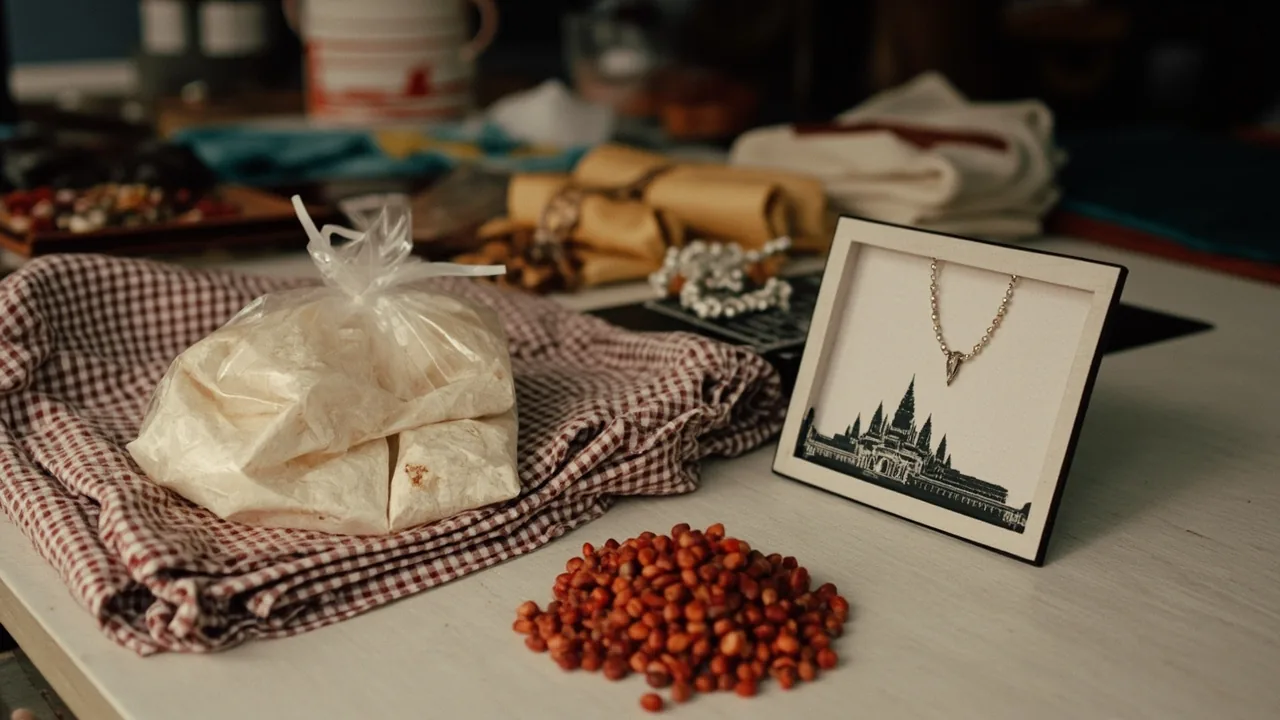
The krama is a checkered cotton scarf, traditionally used as a head wrap, a towel, a baby carrier, a gym bag, a sun shield, and a hundred other things. Every Khmer household has a stack of them. The cheap ones at Psar Chas (Old Market, Siem Reap) cost ₹193-₹290 (~800-1,200 KHR or ~$2-3) and are fine as a wrap or scarf, but they are often a poly-cotton blend that bleeds colour in the wash. Pay ₹483-₹772 (~5-8 USD) and you will get a real 100% cotton krama, sometimes handwoven, with a tighter weave and brighter checks.
Two real producers to look for: Artisans Angkor sells a “Natural Krama” for about ₹477-₹763 (~20,000-32,000 KHR or ~$4.94-$7.91) in silk-cotton blends and pure silk variations (₹1,448-₹2,413 (~15-25 USD)) that are some of the best souvenirs you can carry home. Several social enterprises in Siem Reap produce and export traditional kramas, and their ₹772-₹1,448 (~8-15 USD) pieces are heirloom quality — look for “social enterprise” or “fair trade” labelling when browsing.
Where to buy:
- Psar Chas (Old Market), Siem Reap, stall #89 area, ₹193-₹483 (~2-5 USD) for basic, push for the “100% cotton” tag
- Russian Market, Phnom Penh, the upstairs textile section near the back, same price range, less haggling
- Artisans Angkor showroom, Siem Reap, fixed prices, ₹483-₹2,413 (~5-25 USD)> Subodh’s Pro Tip: A real krama has a thin red-stripe border on one short edge. That is how it has been woven for centuries. The tourist stall kramas with no border are the ones that fall apart in three washes.
2. Kampot Pepper: The Real One
Kampot pepper got a PGI (Protected Geographical Indication) from the EU in 2016, which means the real stuff is grown in a specific five-province zone of southern Cambodia and nothing else can legally be labelled “Kampot pepper.” Most of what is sold as Kampot pepper in Bangkok and Phnom Penh markets is not Kampot pepper. It is Vietnamese pepper in a Cambodia-design tube.
The real call: green peppercorns in salt water (the most prized, sold in glass jars), red peppercorns that are sun-dried on mats and have a dark-fruit sweetness, and black peppercorns that hit your sinuses harder than Tellicherry or Malabar. At the Kampot Pepper Promotion Association stalls in Phnom Penh’s Russian Market or directly from a Kampot farm (most will ship), you are paying real prices for real pepper.
What to pay:
- 100g jar black pepper: ₹477-₹763 (~20,000-32,000 KHR or ~$4.94-$7.91)
- 100g jar red pepper: ₹763-₹1,145 (~32,000-48,000 KHR or ~$7.91-$11.86)
- 100g salted green peppercorns: ₹954-₹1,431 (~40,000-60,000 KHR or ~$9.88-$14.83)
- 1kg bulk black (bring a friend to split): ₹3,339-₹4,770 (~140,000-200,000 KHR or ~$34.59-$49.42)
For an Indian kitchen that already stocks Malabar and Tellicherry, the red and salted green are the ones worth bringing home. They are flavours you cannot replicate.
Where to buy:
- Specialist pepper stalls inside Psar Chas (Siem Reap, behind the main food court)
- Farm visits in Kampot are a half-day detour, our Kampot guide has a full pepper-farm map
- Online direct from Kampot farmers via the Association website, ships internationally
3. Cambodian Lacquerware: The Item You Came For
This is the one the search results for “cambodian lacquerware souvenirs” all push, and with good reason: Cambodian lacquerware is genuinely special and genuinely different from the Thai, Vietnamese, or Myanmar versions you’ll see at every other market in the region.
The technique: artisans in villages around Phnom Penh (particularly Prek Eng, on the way to the silk islands) shape objects from bamboo, wood, or coconut shell, then apply up to 12-15 coats of resin lacquer harvested from the melanorrhea tree, sanding and polishing between each coat. The final pieces are hand-painted or etched with Khmer motifs, Angkor scenes, or Apsara dancers. A lacquer bowl takes 3-6 months from raw material to finished piece.
What you get for the price:
- Lacquer coaster set (4 pieces): ₹954-₹1,717 (~40,000-72,000 KHR or ~$9.88-$17.79), the standard “starter” souvenir
- Lacquer bowl, medium (15-20cm), hand-carved: ₹2,385-₹4,293 (~100,000-180,000 KHR or ~$24.71-$44.48)
- Lacquer jewellery box, with carved hinges and multiple sections: ₹3,816-₹7,633 (~160,000-320,000 KHR or ~$39.54-$79.07)
- Lacquer Apsara wall panel, 30x40cm: ₹5,724-₹11,449 (~240,000-480,000 KHR or ~$59.30-$118.61)
- Lacquer vase, large, fully hand-carved: ₹7,633-₹19,082 (~320,000-800,000 KHR or ~$79.07-$197.68)
Where to buy:
- Artisans Angkor, Siem Reap, the gold standard for fair-traded lacquerware, fixed prices, but everything is from Cambodia’s Siem Reap and Phnom Penh workshops
- Specialist lacquerware shops in Phnom Penh, fewer pieces, higher quality
- Workshops in Prek Eng village, direct from the artisans, you can watch them at work
- Avoid anything labelled “Laotian” or “Vietnamese” lacquer, that is not Cambodian by any measure
Safety Alert: Real lacquerware is sealed with resin, so it is food-safe for dry and cold items. Do not use cheap lacquerware for hot soups. The cheaper pieces with thinner lacquer coats will leach into food above 70°C.
For the right thing, read the description carefully. A “hand-carved” piece has visible tool marks on the inside. A “moulded” piece is fine for coasters and jewellery, but the carvings are smooth and uniform with no visible chisel marks — that is the giveaway it came off an assembly line.
4. Cambodian Silk: Apsara Authority Run, Not a Tourist Stall
Cambodia’s silk tradition nearly died in the 1970s. Dedicated silk-weaving centres in Siem Reap work to keep the technique alive. Their silk scarves and sarongs are real Cambodian silk, woven from silkworms raised in Cambodia (most Cambodian “silk” sold in markets is Thai or Chinese silk).
What you get:
- Silk krama or scarf, handwoven, ~50x180cm: ₹1,431-₹2,862 (~60,000-120,000 KHR or ~$14.83-$29.65)
- Silk sarong, full: ₹2,385-₹4,293 (~100,000-180,000 KHR or ~$24.71-$44.48)
- Silk pillow cover, ~40cm square: ₹1,908-₹3,339 (~80,000-140,000 KHR or ~$19.77-$34.59)
- Silk by the metre: $25-40/m (₹2,385-₹3,816 (~100,000-160,000 KHR or ~$24.71-$39.54) per metre)
Where to buy:
- Artisans Angkor silk centre, Siem Reap, certified fair trade
- The dedicated silk-weaving centre in Siem Reap, linked to the Angkor park authorities
- The Russian Market has a small upstairs silk section, but you need a torch and good bargaining. Quality at the Russian Market varies; some stalls sell Thai silk labelled as Cambodian.
Subodh’s Pro Tip: A real Cambodian silk has a “burn test” you can do in the shop. Pull a single thread from the edge of the fabric, light it with a lighter, and smell it. Real silk burns slowly, curls away from the flame, and smells like burnt hair. Synthetic silk melts and smells like plastic.
5. Palm Sugar (Skor Thnot): The Underrated Buy
Cambodian palm sugar is harvested from sugar palms in the countryside around Kampong Cham and Kompong Chhnang. The sugar comes in three forms:
- Soft palm sugar blocks, sold in palm-leaf cups, ₹95-₹191 (~4,000-8,000 KHR or ~$0.99-$1.98) each at any market
- Hard palm sugar rounds, ₹191-₹382 (~8,000-16,000 KHR or ~$1.98-$3.95), wrapped in palm leaf
- Liquid palm syrup, in glass bottles, ₹286-₹477 (~12,000-20,000 KHR or ~$2.97-$4.94)
For Indian kitchens: palm sugar has a deep caramel flavour with a smoky edge that jaggery does not have. It works brilliantly in chai, in dal, and as a glaze for roasted vegetables. The blocks keep for 6-12 months without refrigeration.
Where to buy:
- Any Russian Market food stall
- Phsar Chas dry-goods section
- A direct order from a palm-sugar cooperative in Kompong Chhnang ships internationally
6. Cambodian Coffee
Cambodian coffee is grown in Mondulkiri and Ratanakiri provinces, mostly robusta with some arabica from the higher elevations. The best is the Mondulkiri arabica, often sold under local Cambodian labels. For Indian travellers coming from a coffee culture that already takes the bean seriously, the buy here is more for the packaging and the gift angle than the cup itself.
What to pay:
- 250g pack, ground or whole bean: ₹382-₹668 (~16,000-28,000 KHR or ~$3.95-$6.92)
- 500g pack: ₹668-₹1,145 (~28,000-48,000 KHR or ~$6.92-$11.86)
- Pre-packaged gift box with 3 varieties: ₹1,145-₹1,717 (~48,000-72,000 KHR or ~$11.86-$17.79)
Where to buy:
- Any major supermarket (Aeon, Lucky)
- Airport duty-free shops at Phnom Penh and Siem Reap
- Mondulkiri farm tours have direct-buy options, our beyond Angkor guide covers the farm-to-bag chain (read it before booking any tour)
7. Silver: Fine Pieces Only
Cambodian silver is largely hill-tribe silver (Khmer Krom, Cham, and Chinese-Khmer), most of it hallmarked 925. The buys:
- A pair of earrings, simple Khmer filigree: ₹1,431-₹2,385 (~60,000-100,000 KHR or ~$14.83-$24.71)
- A pendant or amulet box: ₹1,908-₹3,816 (~80,000-160,000 KHR or ~$19.77-$39.54)
- A statement necklace, hand-forged: ₹5,724-₹14,311 (~240,000-600,000 KHR or ~$59.30-$148.26)
For Indian jewellery buyers, the prices are not bargain-level compared to Jaipur. What you are paying for is the Khmer design language, the Apsara and lotus work, and a trip memento. Skip anything that looks like Thai silver and pay attention to the weight.
8. Angkor-Themed Art and Stone Carvings
Apsara dancer reproductions, hand-carved stone Buddhas, and small Angkor-Wat replicas are everywhere, but quality varies from “made by a real artist in Battambang” to “cut by a child in a backyard workshop outside Siem Reap.” Real stone carvings from Banteay Srei or Angkor-inspired wooden pieces run ₹2,862-₹14,311 (~120,000-600,000 KHR or ~$29.65-$148.26) for table-top size.
If you are not experienced with stone, take a hard pass on the slate-grey Buddhas sold off a cloth on Pub Street. They are almost always Vietnamese imports.
9. Rum and Wine: A Surprising Local Product
Cambodia has a small but growing craft rum scene. Single-cane rum distilled in Phnom Penh is the standout — ₹1,908-₹2,862 (~80,000-120,000 KHR or ~$19.77-$29.65) for a 700ml bottle, with caramel and cane notes that work brilliantly neat. For Indian travellers who have had the same bottle of Old Monk in their kitchen for the last decade, the upgrade is meaningful. Ask at Russian Market or Central Market spirits stalls for locally distilled options.
Cambodia also produces a wine from Kampot pepper and a snake wine of questionable origin and even more questionable taste. Stick to the rum.
Where to Shop: The Real Markets
Phnom Penh
- Russian Market (Psar Tuol Tom Poung) is the highest-quality market in the country. Spread out, two storeys, low pressure on tourists, with serious textile, jewellery, and antique sections in the back. Go between 9am and 11am to avoid the 35°C heat. Allow 2-3 hours.
- Central Market (Psar Thmei), the recognisable art-deco dome from 1937. Better for tailors, watches, and the dry-goods section, worse for souvenirs than the Russian Market. One hour is enough.
Siem Reap
- Psar Chas (Old Market) is the tourist market, and it is calibrated for tourists, so prices are higher and haggling is expected. The food section in the back is excellent for palm sugar, pepper, and dried fish, the textile section upfront is decent for kramas if you bargain hard.
- Artisans Angkor, the showroom on the road between town and Angkor, is where serious buyers go. Fixed prices, no haggling, every piece has a provenance card with the artisan’s name. The selection runs everything from coffee to high-end lacquerware. Allow 90 minutes.
For the full Phnom Penh walk-through, see our Phnom Penh guide and our Phnom Penh budget guide.
Where to Stay (Even If You Are Just Buying)
If you are doing a serious shopping trip and want to be near the Russian Market, stay in BKK1, which is the Indian-friendly district in Phnom Penh with walking distance to the market and several Indian restaurants. For the Siem Reap shopping + Angkor combination, stay near Pub Street so you can drop purchases back at the hostel mid-day.
| Hostel / Guesthouse | Cost/night | Vibe | Book Here |
|---|---|---|---|
| Onederz Hostel Phnom Penh | ₹954-₹1,431 (~40,000-60,000 KHR or ~$9.88-$14.83) | Modern, dorm beds 8-12, rooftop pool, walking distance to Russian Market | Check prices |
| Mad Monkey Phnom Penh | ₹859-₹1,336 (~36,000-56,000 KHR or ~$8.90-$13.84) | Backpacker party hostel, central BKK1 location | Check prices |
| The Big Easy Phnom Penh | ₹763-₹1,145 (~32,000-48,000 KHR or ~$7.91-$11.86) | Quiet riverside guesthouse, Indian-friendly neighbourhood | Check prices |
| Onederz Hostel Siem Reap | ₹859-₹1,240 (~36,000-52,000 KHR or ~$8.90-$12.85) | Pool, near Pub Street and Psar Chas, perfect for shopping runs | Check prices |
| Mad Monkey Siem Reap | ₹954-₹1,431 (~40,000-60,000 KHR or ~$9.88-$14.83) | Party hostel, walking distance to Old Market and Pub Street | Check prices |
| My personal pick for a 3-night shopping trip is Onederz in either city. The rooms are clean, the security secures your bag of purchases (real concern when you’re carrying ₹28,959 (~300 USD) worth of lacquerware back to your dorm bed), and the walk to either market is short. |
What to Eat (In Case You Need a Break From Shopping)
Markets are tiring. Here are the Cambodian dishes you should be eating between purchases.
- Fish amok (₹386 (~4 USD)): Cambodia’s national dish, a curried fish mousse steamed in banana leaf. Try Smokin’ Pot Authentic Cambodian Restaurant and Cooking School for a version that earns its 4.9 rating.
- Num pang (₹145 (~1.50 USD)): the Cambodian sandwich, a baguette stuffed with pickled veg, papaya, and either pork or chicken. Cambodia Kitchen is a quieter alternative to the street stalls.
- Lok lak (₹338 (~3.50 USD)): stir-fried beef in a Kampot-pepper sauce, served over rice with a lime dip. HoubHoub Cambodian Restaurant (BKK1) does a strong version.
- Bai sach chrouk (₹193 (~2 USD)): grilled pork with rice noodles, the Khmer breakfast, found at any morning market.
- Cambodia draft beer (₹72 (~0.75 USD) per can): Anchor is the standard, cheap, decent, and a useful cold companion after three hours of bargaining at Psar Chas.
For a dal-chawal fix or a vegan masala dosa, MDSK (Best Vegan Masala Dosa & Indian Street Food Phnom Penh) at 4.7 stars is the spot, reviewers flag the vada pav as the standout. For a sit-down Indian meal, Indian Restaurant in BKK1 does basic North Indian food and Don’s Mumbai Chaat offers a Mumbai-street-food menu. Skip Phare, The Cambodian Circus as a dinner option if you are on a tight budget; the dinner-show package is ₹3,339-₹4,293 (~140,000-180,000 KHR or ~$34.59-$44.48) per head, but the ticket-only show at ₹1,717-₹2,385 (~72,000-100,000 KHR or ~$17.79-$24.71) is one of the best things to do in Siem Reap.
Phnom Penh’s food scene is broader and cheaper than Siem Reap’s. For a list of cheap eats specifically, see our cheap things to do in Phnom Penh guide.
What to Skip (The Tourist Traps)
- Lacquer elephants from tuk-tuk drivers. They are not Cambodian-made lacquerware, they are Thai imports stacked in someone’s storage unit. Pay real money for a real piece at Artisans Angkor.
- “Antique” Buddha statues. Cambodia has strict laws on exporting religious artefacts. If a tourist is allowed to buy it, it is not old.
- Snakeskin and any wildlife-skin products. Illegal to export, and the species are protected under CITES.
- Ivory, bone, or any animal-horn items. Cambodia has some of the strictest wildlife laws in Asia, but the enforcement at street level is hit or miss.
- Sapphires and rubies. Most “Cambodian sapphires” sold to tourists are Thai or Sri Lankan. Genuine Cambodian stones exist but need a Bangkok gem-lab certificate to verify, and even then at this price range they are not worth the risk.
- Cosmetic brand knock-offs at Central Market. Counterfeit enforcement has tightened in 2024-2026 and Indian customs will seize on return.
- “Genuine whiskey” sold by anyone carrying a bottle to your tuk-tuk. The methanol risk is real and it has killed tourists in the past.
Getting Connected (For Online Price
The Smart and Cellcard tourist SIMs are the two realistic options. The 7-day tourist SIM with around 10GB data runs ₹286 (~12,000 KHR or ~$2.97) at the airport kiosks or ₹191 (~8,000 KHR or ~$1.98) if you walk out to a Smart or Cellcard shop in town. Either network has 4G coverage in Phnom Penh and Siem Reap, and patchy 3G almost everywhere else.
If you do not want to swap your Indian SIM, an eSIM is the cleaner option. Get Nomad eSIM covers Cambodia on most of its regional plans, and you can compare the same pepper price you just paid against what it sells for at home within seconds.
WiFi reliability at markets and hostels is decent, but the Russian Market and Psar Chas both have weak WiFi, so an offline backup of your shopping list is useful.
Daily Budget Breakdown (Shopping Trip, 3 Days)
| Category | Budget/day |
|---|---|
| Dorm bed | ₹668-₹1,145 (~28,000-48,000 KHR or ~$6.92-$11.86) |
| Food (3 meals) | ₹477-₹954 (~20,000-40,000 KHR or ~$4.94-$9.88) |
| Local transport (tuk-tuk) | ₹286-₹572 (~12,000-24,000 KHR or ~$2.97-$5.93) |
| Activities / sightseeing | ₹477-₹954 (~20,000-40,000 KHR or ~$4.94-$9.88) |
| Souvenir spending | variable, see below |
| Misc / drinks | ₹191-₹382 (~8,000-16,000 KHR or ~$1.98-$3.95) |
| Total (no souvenirs) | ₹2,099-₹4,007 (~88,000-168,000 KHR or ~$21.74-$41.51) |
This is what our travellers spent, not what blogs say. Reference rate used: 1 USD = 4,000 KHR.
A realistic souvenir budget for a 3-day trip:
- Budget buyer (₹2,896-₹4,826 (~30-50 USD)): krama, small pepper jar, one set of lacquer coasters
- Mid buyer (₹7,722-₹14,479 (~80-150 USD)): add a silk scarf, a medium lacquer bowl, a Cambodian coffee pack
- Big buyer (₹24,132-₹48,264 (~250-500 USD)): one statement piece, full-size lacquerware, multiple silk items, several pepper jars for gifting
Subodh’s Pro Tip: Factor ₹2,862-₹4,770 (~120,000-200,000 KHR or ~$29.65-$49.42) for an extra suitcase or a hard-shell pack-of-lacquerware at a Siem Reap travel shop before you fly out. Lacquer bowls crack if they slam into each other in check-in luggage, and Cambodian baggage handlers are no gentler than anywhere else.
Buying Strategy by City
Spend the first day shopping, then return to buy more of what you liked. The reasons:
- Markets change from day to day, especially the Russian Market, where vendors rotate sections
- Your first purchase tells you what a fair price is for the second round
- You have time to check your Indian import rules
| Item | Best price in Phnom Penh | Best price in Siem Reap | Buy where |
|---|---|---|---|
| Krama | ₹191-₹477 (~8,000-20,000 KHR or ~$1.98-$4.94) | ₹191-₹477 (~8,000-20,000 KHR or ~$1.98-$4.94) | either |
| Kampot pepper | higher (sellers know) | higher | online direct from Kampot |
| Lacquerware | broader range, more unique pieces | slightly higher, more selective | Phnom Penh (Russian Market or Prek Eng) |
| Silk scarves | similar prices | slightly higher | Artisans Angkor, Siem Reap |
| Palm sugar | lower | similar | either, fresh daily |
Common Mistakes Indian Travellers Make
-
Haggling too aggressively. Phnom Penh vendors at the Russian Market will drop a price by 20-30% on a real haggle. Siem Reap vendors at Psar Chas will drop by 10-20%. Going below 60% of asking is rude and gets you ignored. For a $5 krama, you will save $1-2 by bargaining. That is not a meaningful saving.
-
Buying lacquerware with a Visa card markup. Most Russian Market stalls will quote a higher price if you say “Visa.” Always ask for the cash price first. The discount is usually 10-15%.
-
Missing the duty-free threshold on return. India allows ₹50,000 of personal imports duty-free when returning by air from most countries outside Nepal, Bhutan, and Myanmar (₹15,000 by land). Souvenirs under ₹19,306 (~200 USD) per item generally stay clear of customs hassle. Items above the duty-free limit attract basic customs duty of approximately 35-40%.
-
Forgetting the size limits. Cambodia charges a 50% levy on tourist items exported without an export permit for items over a certain value. Antiques and large stone pieces are the ones flagged. Anything under ₹19,306 (~200 USD) of normal souvenirs, you can leave the country without any paperwork.
For specific Cambodian import rules at Indian customs, carry the receipts and stay under ₹19,306 (~200 USD) per item category. Customs at Chennai and Mumbai are strict on declared amounts over $1,000.
FAQ
What is the most famous thing to buy in Cambodia?
A krama (the checkered cotton scarf) is the most recognisable Cambodian souvenir, but Kampot pepper and Cambodian lacquerware are the highest-quality souvenirs you can carry home. The krama is the safe default; the lacquerware is the buy for someone who wants a real piece.
Are souvenirs cheaper at Russian Market or Central Market in Phnom Penh?
Russian Market (Psar Tuol Tom Poung) is cheaper on textiles, jewellery, and most Cambodian-made goods. Central Market is more for cosmetics, watches, and tailors. The Russian Market is also less crowded at midday.
How much should I budget for souvenirs in Cambodia?
A 3-day shopping trip spending ₹2,862-₹4,770 (~120,000-200,000 KHR or ~$29.65-$49.42) is realistic for a light buyer with one or two krama and a pepper jar. Mid-range buyers spend ₹7,633-₹14,311 (~320,000-600,000 KHR or ~$79.07-$148.26). Big-ticket lacquerware buyers spend ₹23,852-₹47,704 (~1,000,000-2,000,000 KHR or ~$247.10-$494.19) and ship the rest.
Is Cambodian lacquerware different from Thai or Vietnamese lacquerware?
Yes. Cambodian lacquer uses resin from the melanorrhea tree native to the region, with up to 15 coats of application. Thai lacquerware is more often Burmese or Yunnanese imports and uses a different resin. Vietnamese lacquer is closer in technique but the design language is different. Real Cambodian lacquer from a recognised workshop will have a workshop provenance card.
Can I take Cambodian lacquerware home in check-in luggage?
Yes, pack it in hard-shell luggage with bubble wrap or clothes between pieces. Check-in luggage is fine; the issue is movement, not the cabin-cabin distinction. For high-value pieces, ship direct from Artisans Angkor or Prek Eng workshops via DHL for ₹2,862-₹4,770 (~120,000-200,000 KHR or ~$29.65-$49.42) to your Mumbai or Chennai door.
Is "Kampot pepper" from the market real?
Most is not. The PGI label applies only to pepper grown in Kampot and Kep provinces. Real Kampot pepper has a sticker or seal from the Kampot Pepper Promotion Association. The unmarked stuff is usually Vietnamese.
What is the cheapest genuine Cambodian souvenir to bring as a gift?
Palm sugar, at ₹97-₹193 (~1-2 USD) per palm-leaf cup (₹95-₹191 (~4,000-8,000 KHR or ~$0.99-$1.98)), or a basic krama at ₹191-₹286 (~8,000-12,000 KHR or ~$1.98-$2.97). Pack 10 of each in your suitcase and you will have gifts for the entire house.
Subodh’s Take
Cambodia’s souvenir shelf is one of the strongest in Southeast Asia because the country lost a generation of artisans in the 1970s, so every krama weaver, every pepper farmer, and every lacquer artisan you meet is part of a working recovery. The supply chain is small enough that the person who made the thing can often tell you how much they were paid for it. Buy the krama and the pepper first, they are cheap enough that you cannot lose. Then, if you have ₹9,653-₹19,306 (~100-200 USD) left in your bag, spend it on a real piece of lacquerware from Artisans Angkor or a Prek Eng workshop. That piece will still be in your house in 20 years.
