Hostel Check-In Guide: What to Expect, When to Arrive & Dorm Etiquette for First-Timers
Your first hostel check-in feels weird if you’ve only ever stayed in hotels. There’s no polished lobby, no bellhop, no key card handed over with a smile. Instead, you walk into a common room full of strangers, find a reception desk that looks more like a kitchen counter, and someone asks for your passport. This guide walks you through exactly what happens from the moment you push open the door to the moment you climb into your bunk, so you don’t stand there looking lost. For related planning, see our guide on Common Scams in Jakarta How Indian Travelers Get Targeted and How to Avoid Them.
Quick Answers
| What | Answer | Price (INR) |
|---|---|---|
| Standard check-in time at most hostels | 14:00 to 15:00 (2-3 PM) | Free |
| Standard check-out time | 10:00 to 11:00 AM | Free |
| Luggage drop before check-in | Almost always free, just ask | Free |
| Late-night arrival (after midnight) | Possible if the hostel has 24-hour reception; some use a lockbox code | Free |
| Key deposit (for locker or room key) | Common, refunded at check-out | ₹960 (~$9.96) to ₹1,930 (~$20.03) |
Subodh’s Pro Tip: Your passport is the most important thing at check-in. Most hostels in Southeast Asia will hold it at the front desk overnight as a deposit for the room key or locker. They’ll return it the next morning. If you’re nervous about handing it over, ask to see their license and read online reviews before you book. You may also find Where to Stay for Full Moon Party useful for this trip.
What Happens at Hostel Check-In
A hostel check-in is shorter and more functional than a hotel one. Here’s the sequence at almost every hostel in Thailand, Vietnam, Laos, Cambodia, the Philippines, and Indonesia. See also: How to Get Around Siquijor.
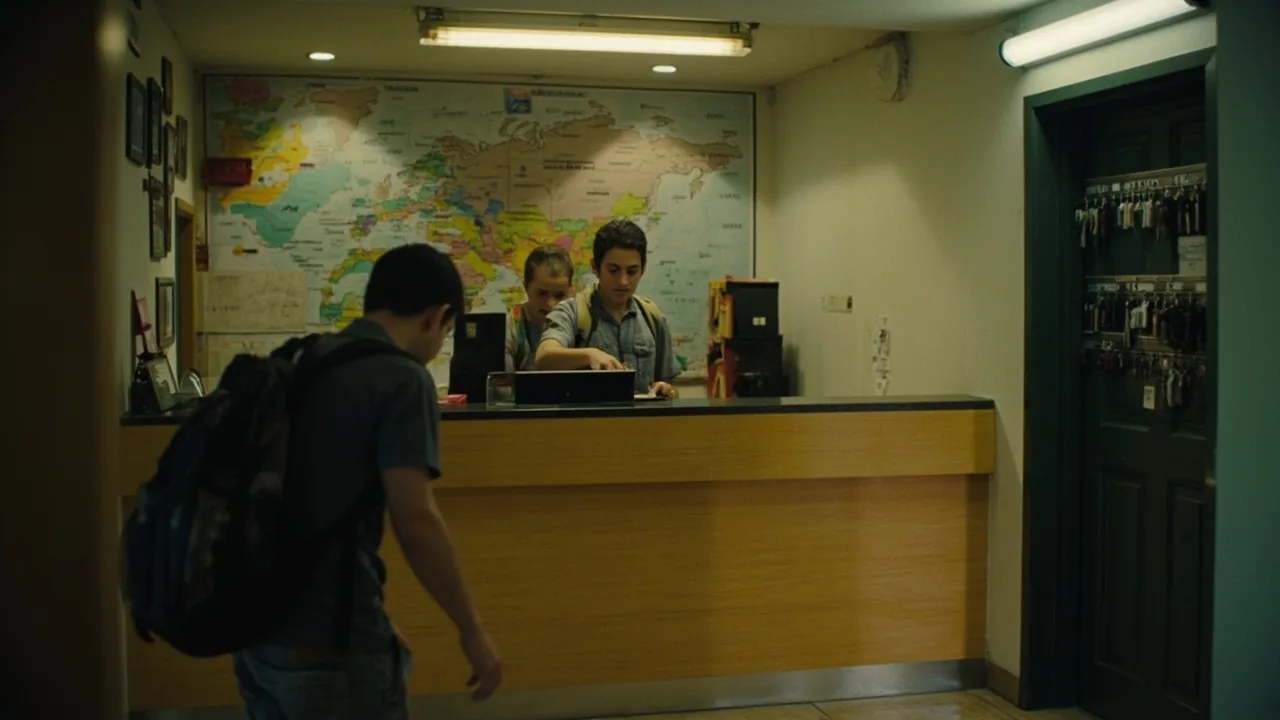
Step 1: You arrive at the front desk. The reception area is usually a counter inside or just behind the common room. There’s no formal lobby. You might walk past a kitchen, a row of lockers, and a noticeboard covered in tour flyers before you find the person at the desk. For related planning, see our guide on Labuan Bajo Scams Grab Gojek Transport Guide.
Step 2: They ask for your passport. This is standard. The hostel needs to register your details with local immigration or tourism police. In Vietnam and Cambodia, this is a legal requirement, not a hostel quirk. Your passport usually comes back within 12 to 24 hours. You may also find Getting Around Palawan El Nido Coron Puerto Princesa useful for this trip.
Step 3: You pay the balance. If you booked online through Hostelworld, Booking.com, or Agoda, you’ve usually paid a small deposit (around ₹960 (~$9.96) to ₹1,930 (~$20.03)) at booking. The remaining balance is paid at check-in, mostly in cash and in the local currency. Most hostels do not accept cards for the walk-in balance.
Step 4: They explain the room, locker, and key system. You’ll get told which floor, which room number, and which bed. You’ll also get either a physical key or a code for the room door. Lockers under or beside the bunk take either your own padlock or a loaner from the desk.
Step 5: They hand you a paper slip or wristband. Older hostels give a paper receipt with the Wi-Fi password and check-out time printed on it. Newer ones give a wristband you wear for the duration of your stay. Either way, don’t lose it.
Step 6: You walk to your room and pick a bed (in dorms). More on this below, but the etiquette matters.
The whole process takes 5 to 15 minutes if it’s quiet. It can take 30 to 45 minutes if a group just checked in ahead of you or the staff is new.
When to Arrive: Early Arrival and Late-Night Check-In
Early Arrival (Before 2 PM)
Almost every hostel lists check-in from 2 PM or 3 PM. Earlier than that, the previous night’s guests are usually still in bed or just leaving. The beds haven’t been cleaned yet.
What you can do:
- Drop your bags at reception. Every hostel I’ve used in Southeast Asia lets you leave luggage at the front desk for free before check-in. They’ll tag your bag and put it behind the counter or in a storage room.
- Use the common room, kitchen, or rooftop. The hostel is a public space, not your room. Sit, charge your phone, refill your water bottle, read maps.
- Take a shower. Some hostels have a separate bathroom that’s not attached to a specific room. Ask if you can shower after a long bus ride.
You cannot:
- Get into your dorm room before the official time. Housekeeping needs the space.
- Expect a free upgrade because you arrived early. You’re still paying the same rate.
Late-Night Arrival (After 10 PM, Especially After Midnight)
This is where hostel standards vary the most. A 24-hour reception is the gold standard, but not every hostel has one.
Hostels with 24-hour reception: Big chains and city-centre hostels in Bangkok, Ho Chi Minh City, Hanoi, Phnom Penh, and Bali almost always have someone at the desk 24/7. You can arrive at 3 AM and check in like it’s noon.
Hostels without 24-hour reception: Smaller hostels, especially on islands (Koh Phangan, Koh Tao, the Gili Islands) and in smaller towns (Vang Vieng, Luang Prabang, Sihanoukville), often close reception around 10 PM or midnight. They will tell you this when you book.
The two solutions for late-night arrival:
-
Lockbox code. Many hostels now use a lockbox by the front door with a code. You get the code by WhatsApp or email a few hours before you arrive. Inside the box is your room key, a paper map, and a note. You check yourself in, drop the cash payment in an envelope, and sort out the formalities in the morning.
-
Pre-arranged late arrival. Email or WhatsApp the hostel at least 24 hours before and tell them your bus gets in at 11:30 PM. They’ll either keep someone on the desk or send you the lockbox code. If you don’t tell them and just show up at 1 AM with no warning, you’ll be sleeping in a taxi.
Subodh’s Pro Tip: Always send a message the day of arrival, even if check-in is at 3 PM. “Hi, our bus arrives at 1 PM, can we drop bags early?” takes 30 seconds and prevents the awkward moment of standing at a closed reception at midnight.
Hostel 24-Hour Reception: How It Works
A “24-hour reception” doesn’t mean someone is awake and friendly at 4 AM. It usually means:
- A night manager is on shift, often sitting behind the same desk doing admin on a laptop.
- They are slower, quieter, and less chatty than daytime staff.
- The common room is usually empty or has a few night owls.
- Hot water might be off in some hostels at 3 AM (solar-heated systems cool down overnight).
- The kitchen is closed.
The night manager can still help with: a lost key, a late check-in, an emergency (theirs and yours), taxi booking, and medical referrals. They’re not there to plan your day trip.
Safety Alert: If you arrive late and the hostel looks empty, locked, and unresponsive, do not bang on the door. Find a 24-hour cafe nearby (7-Eleven, a Circle K, a local coffee chain), wait 30 minutes, and try again. If still no response, call the booking platform’s customer service line. Hostelworld and Booking.com have 24-hour support that can ring the hostel for you.
Dorm Etiquette: The Unwritten Rules Every First-Timer Should Know
Hostel dorms work because most people follow a small set of unwritten rules. Break them and you’ll know from the looks you get. Follow them and you’ll make friends for life.
1. Quiet Hours (Usually 10 PM to 7 AM)
Almost every hostel posts quiet hours somewhere near the dorm entrance. The standard is 10 PM to 7 AM, but some go stricter (9 PM to 9 AM) in smaller dorms or party-hostel dorms that need a recovery window.
What this means in practice:
- No phone calls in the dorm. Take them to the common room, bathroom, or hallway.
- No speaker, no music, no YouTube without earphones.
- No loud packing or unzipping at midnight. Do it in the bathroom or before you go to bed.
- Rustling plastic bags is the single most annoying dorm sound. Move toiletries into a small cloth pouch the night before.
2. Locker Use: Bring a Padlock
Most dorms have lockers under the bed, beside the bed, or in a separate locker room. Two locker systems are common:
Bring-your-own-lock system: Common in Thailand, Vietnam, the Philippines. The locker has a hasp, you bring a small padlock (20-30 gram size). You can buy one at any hardware shop for ₹286 (~100 THB or ~$2.97), ₹184 (~50,000 VND or ~$1.91), or equivalent.
Loaner-lock system: Common in Cambodia and Laos. You get a lock at check-in with a numbered tag. You return the lock at check-out and get the deposit back.
What to store in the locker:
- Passport (when not at reception)
- Cash, forex card, debit/credit cards
- Phone charger and power bank
- Any medication
What NOT to store in the locker:
- Your day backpack (too big, use the luggage shelf)
- Anything you need at 3 AM (keep phone and earphones by your pillow)
Subodh’s Pro Tip: Two padlocks is better than one. One for the locker, one for your daypack zippers. A ₹300 (~$3.11) lock from a D-Mart in India saves you from a ₹30,000 (~$311.40) phone theft in a 10-bed dorm. Bring two.
3. Bed Selection: Where to Sleep in a Dorm
Some hostels assign beds. Most let you pick. If you get to choose, here’s how first-timers and experienced dorm-stayers pick:
Bottom bunk pros: Easy access, no climbing, more private feeling, you can sit up easily.
Bottom bunk cons: Everyone walks past you, your stuff is in the line of foot traffic, you’re the first target for bed bugs (which fall from above), and people sit on your bed to tie shoes.
Top bunk pros: Less foot traffic, harder for casual thieves to reach, feels more private, you see the ceiling not 7 other people.
Top bunk cons: Climbing in and out at 2 AM for the bathroom, hard to sit up, no headboard to lean against.
Best bed for first-timers: A middle bunk near the bathroom door, away from the room door. You avoid both window drafts and the noise of the door opening every five minutes. Avoid the bed directly under the aircon (some hostels run AC at 16°C and it freezes you out).
4. Respecting Roommates
The big three:
- No light pollution. Your phone screen is the enemy of every sleeper around you. Use night mode, brightness at 0%, and never open the door to the dorm with the room lights on. Use your phone’s torch, not the overhead light.
- No rustling at midnight. Unpack before you sleep, not at 1 AM when you get back from a bar.
- Alarm without noise. Vibration only. If you need sound, use a single earbud.
The medium three:
- Snoring is not a crime. Some people snore. If the person in the next bunk sounds like a cargo ship, buy earplugs from a 7-Eleven (₹14 (~5 THB or ~$0.15), ₹11 (~3,000 VND or ~$0.11), around ₹15 (~$0.16)). Don’t wake them up to tell them they snore; they know.
- Sex is not appropriate in shared dorms. Two people, one bed, others watching is bad form. Book a private room if you’re travelling as a couple.
- Smells travel. Skip the heavy perfume, skip the cigarette smoke on your clothes, skip the instant noodles at 4 AM. If you must eat in the dorm, do it silently and clean up.
5. Bathroom and Shower Etiquette
- Flip-flops (sandals) in the shower. Always. Bathroom floors in budget hostels are rarely spotless.
- Don’t leave your towel on the hook for an hour after you shower. Someone else needs it.
- Don’t leave your toiletries bag on the sink. Take it back to your locker.
- If a shower is in the dorm room (rare but happens), don’t use it after 10 PM. The noise is brutal.
6. The Common Kitchen
- Label your food with your name and check-out date. Anything unmarked gets binned.
- Wash your dish the moment you finish. A sink full of dirty dishes by 9 AM is grounds for hostel karma debt.
- Don’t cook strong-smelling food (fish sauce, curry) at 7 AM when others are sleeping. The kitchen is open, but your timing is yours.
Common First-Timer Mistakes at Hostel Check-In
These are the things Indian backpackers new to hostels get wrong, and how to fix them before you even arrive.
Mistake 1: Arriving without local cash for the balance. Most hostels require the remaining balance in cash, in local currency. Book on Hostelworld with a ₹960 (~$9.96) deposit and you still owe ₹1,930 (~$20.03) to ₹3,860 (~$40.07) in cash on arrival. Fix: hit an ATM on the way from the bus station or airport.
Mistake 2: Not knowing the difference between a dorm and a private room. A 4-bed dorm means 4 people. An 8-bed dorm means 8. A 12-bed dorm means 12, plus their snoring. Fix: if you’re not sure about dorm life, book a 4-bed female dorm (if you’re a solo woman) or a 4-bed mixed dorm for your first night. Upgrade or downgrade after.
Mistake 3: Bringing a giant suitcase. A 30 kg hard-shell trolley does not fit in a dorm bunk. The luggage shelf is usually 60 cm wide. Fix: pack a backpack or a duffel if you can. If you must bring a suitcase, book a private room for the first night.
Mistake 4: Forgetting earplugs and a sleep mask. Every dorm has a corridor light, a 5 AM riser, and a snorer. Fix: earplugs from any pharmacy in India before you fly (₹50 (~$0.52) for a 10-pair pack), and a contoured sleep mask (₹150 (~$1.56) on Amazon).
Mistake 5: Not reading the cancellation policy. Hostelworld bookings usually have a 24- to 48-hour free cancellation window. Miss it and you pay the full amount. Fix: read the policy at booking, screenshot it, and put a reminder in your phone.
Luggage Storage: Before, During, and After Your Stay
Most hostels let you store luggage for free:
- Before check-in: drop bags at reception.
- After check-out: drop bags at reception. Most allow up to 24 hours of free storage. Some charge ₹190 (~$1.97) to ₹480 (~$4.98) per bag per day.
- Between two separate bookings at the same hostel: usually free.
If the hostel won’t store your bags, the train station or bus station almost always has a paid luggage counter (₹143 (~50 THB or ~$1.48) to ₹286 (~100 THB or ~$2.97), ₹73 (~20,000 VND or ~$0.76) to ₹184 (~50,000 VND or ~$1.91) per bag per day depending on size).
Subodh’s Take
Hostel check-in is the easiest part of hostel life. Walk in, hand over the passport, pay the balance, get the key. The harder part is the small habits you build after: keeping your phone on silent, packing your bag before 10 PM, putting your stuff in a locker every time you leave the dorm. Do those things and your first hostel stay will feel less like camping and more like a cheap hotel with built-in travel friends.
FAQ
What time can I check into a hostel? Most hostels in Southeast Asia allow check-in from 2 PM or 3 PM. Earlier than that, you’ll need to drop your bags at reception and wait. Late check-in (after 10 PM) is possible at hostels with 24-hour reception or with a pre-arranged lockbox code.
Do hostels take a passport at check-in? Yes, almost all hostels in Vietnam, Cambodia, Thailand, and the Philippines hold your passport at the front desk for the duration of your stay. It’s returned when you check out. This is standard practice and required by local tourism police.
Can I check in at midnight? Only if the hostel has a 24-hour reception or you have a lockbox code. Smaller hostels on islands and in rural towns often close reception at 10 PM. Email or WhatsApp the hostel 24 hours ahead if your bus arrives late.
Is there a key deposit at hostels? Yes, common. The deposit is usually ₹960 (~$9.96) to ₹1,930 (~$20.03), refunded when you return the key at check-out. Some hostels now use codes instead of physical keys, in which case there’s no deposit.
Do I need to bring my own padlock? Yes, especially for hostels in Thailand, Vietnam, and the Philippines. A small 20 to 30 gram padlock from any D-Mart or hardware shop in India (₹100 (~$1.04) to ₹300 (~$3.11)) fits most dorm lockers. Cambodia and Laos hostels more often give you a loaner lock.
Can I choose my bed in the dorm? At most hostels, yes. Bottom bunk is easier but sees more foot traffic; top bunk is quieter but harder to climb in and out at night. Pick a middle bunk near the bathroom for the best first-timer experience.
What if I need to cancel my hostel booking? Hostelworld bookings have a 24- to 48-hour free cancellation window. Outside that window, you’ll be charged for at least the first night. Read the cancellation policy at booking time and screenshot it.
