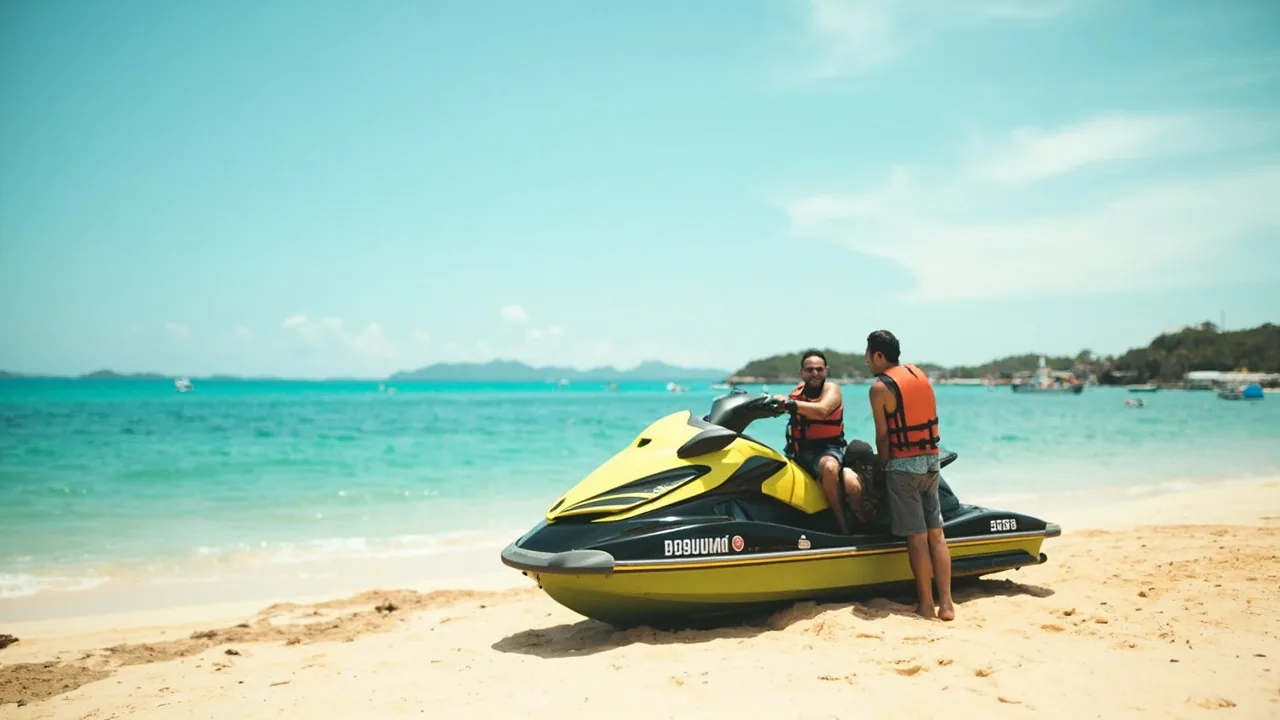
Jet Skiing in Phuket: Costs, Best Spots, and What Indian Travelers Should Know Before Riding
A jet ski in Phuket rents for ₹4,301 (~1,500 THB or ~$44.58) for 30 minutes and ₹7,169 (~2,500 THB or ~$74.30) for an hour at the registered beach counters. Most Indian travellers can ride without a Thai license on a tourist rental, but the damage-deposit scam at unregistered stalls costs more than the rental itself, so where you book matters far more than what you book. Planning the wider region? Our Southeast Asia backpacking hub covers the full multi-country route.
Quick Answers
| What | Answer | Price (INR) |
|---|---|---|
| 30-minute rental (registered counter) | Self-drive, single rider | ₹4,301 (~1,500 THB or ~$44.58) |
| 60-minute rental (registered counter) | Self-drive, single rider | ₹7,169 (~2,500 THB or ~$74.30) |
| Guided island tour (with instructor) | Phuket or surrounding islands | ₹8,602-₹12,904 (~3,000-4,500 THB or ~$89.16-$133.74) |
| Damage deposit (some counters) | Held on card, refundable | ₹8,602-₹14,338 (~3,000-5,000 THB or ~$89.16-$148.60) |
| Thai license required? | No, on tourist rentals under 30 hp supervision | , |
| Best area for beginners | Kata or Karon (calmer water) | , |
| Where the damage scam happens | Unregistered stalls at Patong, Kamala | , |
| FX rate this article | 1 INR = 0.3485 THB (1 THB ≈ ₹2.87) | , |
What Is a Jet Ski in Phuket, and How Does the Rental Work?
A jet ski in Phuket is a stand-up or sit-down personal watercraft (PWC) rented by the half hour or hour from beachfront counters at Patong, Kata, Karon, Kamala, Chalong, and Rawai. The rental model in Phuket is different from Goa or the Maldives: most operators are Thai-owned small businesses sitting on public beach access, with the craft tied to a floating buoy offshore. You ride, you come back, you pay. If you’re planning your first Thailand trip from India, our first trip abroad India guide covers the basics that apply here too.
Two rental types exist. A self-drive rental hands you the keys (or, more often, the lanyard kill-switch cord) and expects you to ride solo or with a passenger on a marked bay. A guided tour keeps an instructor on a separate craft ahead of you and takes you around an island, often with snorkel stops; the instructor handles the route, you handle the throttle. Beginners should choose the guided option, because Thai rental operators will hand the keys to almost anyone and the craft is more powerful than it looks.
Step-by-Step: How to Rent a Jet Ski in Phuket Without Getting Burned
Step 1: Pick the right beach for your skill level
Phuket’s west-coast beaches have different water conditions. Kata and Karon sit at the bottom of a bay and have the calmest water on the island, with most of the bay marked as a slow-speed riding zone. Patong has the most stalls and the busiest water, plus the densest cluster of swimmers close to the shoreline, which is also where most accidents happen. Chalong Bay on the east coast is a proper riding area with long sight lines and almost no swimming tourists, which makes it the safest place for first-timers who want to open the throttle.
Step 2: Book through a registered counter or a tour operator, not a freelance tout
The registered counters (look for a permanent shop with a signboard, a printed price list, and a counter number on the rental form) charge ₹4,301 (~1,500 THB or ~$44.58) for 30 minutes and ₹7,169 (~2,500 THB or ~$74.30) for an hour. The freelance touts walking the beach offering “₹2,868 (~1,000 THB or ~$29.72), special price, only today” are almost always the scam stalls, even though the craft itself looks the same.
If you want the guided route (recommended for first-timers), the easiest way is to book through a tour platform with reviews. A guided island tour including instructor and snorkel stops runs ₹8,602-₹12,904 (~3,000-4,500 THB or ~$89.16-$133.74) per person. Ask your hotel’s tour desk or the registered beach counter to recommend a current operator, which matters more here than anywhere else because the scam damage varies by stall.
Step 3: Inspect the craft and photograph everything
This is the single most important step and the one most Indian travellers skip. When the operator walks you to the craft, take four photos: the front-left, the rear-right, the top deck, and a close-up of any existing scratch. Send each photo to yourself on WhatsApp, because WhatsApp timestamps the image and the timestamp is your proof if a damage dispute happens later. A travel insurance policy with trip-interruption cover also helps if a dispute derails your day. Mark every pre-existing mark on the rental form before you sign. The phrase the Thai operators use is “same same, no problem”; you should reply with “yes, but I write it down”, and write it down.
Step 4: Get the briefing and ride
The operator will give a 2-minute launch briefing: where to ride, where the no-go zones are (usually 50 metres from swimmers, sometimes 200 metres from anchored boats), how to start (attach the lanyard, press the start button), and how to stop (release the throttle, pull the kill-switch). Wear the life jacket. Don’t drop the lanyard into the water; if you fall off, the craft cuts out on its own.
First-time riders almost always twist the throttle too hard. Open it slowly, accelerate in a straight line for 5 seconds, then turn. The craft does not behave like a scooter, it behaves like a motorcycle on ice.
Step 5: Return and inspect together
Bring the craft back at exactly the time you paid for. Stay with the operator while they inspect it. Walk around the craft together. If they point at a scratch, look at your four timestamped photos on WhatsApp. If the scratch is in your photos, it was there before. If it is not, ask to see the broken piece and confirm it is fresh (not dried salt, fresh gel-coat scuff).
Pay only the rental fee plus any genuine fresh damage. Do not pay “scared money” in the hope of leaving faster. If the operator is aggressive, walk to the tourist police booth (every Thai beach has one within 200 metres) and call them. This rarely escalates, but the threat of calling the booth ends most disputes in under five minutes.
The Damage Scam, Explained
The Phuket jet ski damage scam has been running, in various forms, since the early 2000s. It works like this:
- You rent a craft from an unregistered stall at Patong or Kamala for an attractive price.
- You return it after 30 minutes.
- The operator points at a fresh-looking scratch or a broken plastic panel and demands ₹14,338-₹86,025 (~5,000-30,000 THB or ~$148.60-$891.62) to “fix” it.
- He holds your passport or blocks your exit until you pay.
- Tourists, who do not speak Thai and do not know their rights, pay.
The catch is that the “fresh” damage was on the craft before you touched it. The operator rubs salt into the scratch to make it look wet and new, or shows you a piece they broke that morning. Travellers from every country fall for this, including Indian travellers who tend to pay quickly because they want to avoid a confrontation in a foreign country.
The fix is procedural, not heroic. Photograph the craft before you ride (the same four photos above). Book through a registered counter or a tour platform, because the scam needs anonymity to work. If a dispute starts anyway, ask for the tourist police. The Phuket Marine Office has been pushing registered counters since 2023, and the scam is now mostly confined to freelance touts at Patong and the south end of Kamala, which is why registered counters and tour platforms are the safer default for first-time riders.
Thai License Rules: Do You Need One?
This is the part most guides get wrong. The honest answer for an Indian tourist on a Phuket holiday rental is: no, you do not need a Thai license to ride a jet ski on a short tourist rental. Here’s why:
Thailand’s Marine Department classifies personal watercraft differently from cars. A PWC ridden recreationally as part of a beachside rental for under an hour, with the operator’s safety briefing and within the marked rental zone, is treated as a supervised activity, not a licensed operation. The rental operator carries the commercial liability.
You do need a Thai boat license (which includes a PWC endorsement) if you:
- Ride outside the marked rental zone (for example, taking a jet ski from Chalong across to Koh Lon on your own)
- Operate the craft without supervision, as part of a multi-day rental
- Are a Thai resident
For a first-time Indian tourist renting for 30 or 60 minutes at a beach counter, this is not a problem. You will not be asked for a license, and there is no checkpoint asking for one.
If you want the formal license anyway, the Thai Boat License (including the PWC module) costs roughly ₹2,868 (~1,000 THB or ~$29.72) at the Marine Department office in Phuket Town, takes one day including a short theory test in Thai and English, and is valid for five years. Most Indian travellers will not bother because the supervised rental covers exactly what they want to do.
Best Spots to Jet Ski in Phuket
| Spot | Best for | Conditions | Watch out for |
|---|---|---|---|
| Chalong Bay | First-timers, long rides | Sheltered, deep, almost no swimmers | Boat traffic at the entrance |
| Kata / Karon | Beginners, families | Calm water inside the bay | Marked swim zones, stay outside |
| Patong | Experienced riders, groups | Busy water, full-length bay | Freelance touts, swimmers near shore |
| Kamala | Quieter rides | Sheltered, less crowded | South-end stalls have scam reputation |
| Rawai (east coast) | Scenic, longer tours | Flat water, long sight lines | Far from main hotel zone |
For Indian travellers based in Patong (which most package-tour visitors are), the simplest plan is to take a guided tour that leaves from Chalong rather than rent at Patong beach. You get the better water, the safer conditions, and the tour operator’s liability covers the kind of damage dispute that ruins the holiday otherwise. Many of these tours include the Phi Phi or Koh Lon loop, so you ride the jet ski between snorkel stops, which is the experience most Indian travellers came for.
Common Mistakes Indian Travellers Make
Renting from the first beach stall you see. The first stall at Patong (the one closest to Bangla Road) is the highest-pressure sales spot on the island. Walk 200 metres further down the beach and you reach the registered counters with printed price lists.
Not photographing the craft. The single biggest reason Indian travellers end up paying scam damage is that they have no proof the scratch was already there. Four WhatsApp photos solve it.
Paying the “scared money” instead of calling the tourist police. The whole scam depends on the tourist paying quickly. If you do not pay quickly, the operator moves on. The tourist police booth is 200 metres from every beach; the number is 1155.
Booking the cheapest option and assuming it is the same craft. Two craft at two prices often come from the same rental fleet, but the cheap one has the older hull with more pre-existing damage, which means more dispute potential. The price difference (₹2,868 (~1,000 THB or ~$29.72) vs ₹4,301 (~1,500 THB or ~$44.58)) is not worth the hassle.
Riding without knowing the no-go zones. The marked swim zones off Kata and Karon are enforced, and Thai Marine Police will fine you ₹2,868 (~1,000 THB or ~$29.72) if you ride through a swim zone. Stay outside the buoy line.
Letting the operator hold your passport. Thai rental law does not require you to hand over your passport. A photocopy of the photo page and your hotel card is enough. If the operator insists on the passport, that is itself a flag; use a different counter.
What Most Guides Don’t Tell You
The damage scam is rare on guided tours and common on solo rentals. The same operator who will pressure you on a solo rental will not pressure you on a guided tour, because the guide is Thai, lives locally, and the operator knows the guide will remember the conversation. If you are nervous, the simplest move is to book the guided option and avoid the rental stalls entirely. Our tuk tuk scam guide covers similar pressure tactics that show up across Phuket, not just at jet ski stalls.
You can refuse the damage deposit “upgrade.” Some operators offer a “premium insurance” deposit of ₹14,338 (~5,000 THB or ~$148.60) that supposedly waives your liability for the first ₹57,350 (~20,000 THB or ~$594.41) of damage. It is a good product if you are an anxious rider, but it is also the deposit the operators point to when they want to claim you authorised the full ₹57,350 (~20,000 THB or ~$594.41). Read the form. Decline if it is unclear.
The best riding hours are 7 to 9 am. The water is calmest, the light is best, the rental stalls have just opened (so the craft are freshly inspected and documented), and the swim zones are empty. The 2 to 4 pm slot is the busiest and the most dangerous.
The FX rate matters less than the deposit. At 1 THB ≈ ₹2.87, a 30-minute rental works out to roughly ₹4,300 (~$44.57). A scam damage claim of ₹43,012 (~15,000 THB or ~$445.81) works out to ₹43,000 (~$445.68). The deposit structure, not the rental price, is the actual money decision.
Indian travellers are over-represented in the scam reports because of two habits. First, paying fast to avoid confrontation; second, renting from the tout rather than the registered counter because the tout offered a discount. Both are solvable with the steps above.
FAQ
For the broader Thailand planning picture (best season, what to do in 7 days, and how much money to carry), see our what to do in Thailand for 7 days and how much money do I need for 5 days in Thailand guides.
Do I need a Thai license to ride a jet ski in Phuket as an Indian tourist?
No. A short tourist rental at a beach counter, supervised by the operator, is treated as a recreational activity and does not require a license. You only need a Thai boat license if you ride outside the supervised zone on your own or for more than an hour unsupervised.
How much does a jet ski rental cost in Phuket in 2026?
A 30-minute self-drive rental at a registered counter is ₹4,301 (~1,500 THB or ~$44.58). A 60-minute rental is ₹7,169 (~2,500 THB or ~$74.30). A guided island tour including instructor and snorkel stops is ₹8,602-₹12,904 (~3,000-4,500 THB or ~$89.16-$133.74). Freelance touts offer lower prices (₹2,868 (~1,000 THB or ~$29.72) for 30 minutes) but these are the stalls with the most scam reports.
Which beach in Phuket is best for first-time jet skiers?
Chalong Bay on the east coast is the safest: deep water, long sight lines, almost no swimmers, and almost no freelance touts. Kata and Karon are good second choices on the west coast.
What is the jet ski damage scam at Patong?
Unregistered stalls at Patong and south Kamala claim pre-existing scratches as fresh damage after you return the craft and demand ₹14,338-₹86,025 (~5,000-30,000 THB or ~$148.60-$891.62), sometimes holding your passport. The fix is to photograph the craft before you ride, book through a registered counter or tour platform, and call the tourist police (1155) if a dispute starts.
Can I pay with UPI or an Indian forex card at the rental counter?
No. The beach rental stalls are cash or Thai-card only. Carry ₹4,301-₹14,338 (~1,500-5,000 THB or ~$44.58-$148.60) in cash for the rental plus any optional damage deposit. Tour bookings through GetYourGuide can be paid with an Indian forex card before you arrive.
What should I do if an operator holds my passport?
Insist on a photocopy and your hotel card instead. If the operator refuses, walk away and rent at a different counter. Thai rental law does not require the operator to hold the physical passport. The tourist police will back you up if you ask.
Is jet skiing in Phuket safe for someone who cannot swim?
No. The craft falls off, you are in the water within 30 seconds, and the life jacket helps but does not replace basic swimming. If you cannot swim, take a guided tour with an instructor who can pull you back onto the craft. Solo travellers who cannot swim should also weigh the risks in our solo female travel SE Asia guide before booking any water activity.
Subodh’s Take
Jet skiing in Phuket is one of the few Thai experiences where the safest decision is also the cheapest. Book a guided tour through a registered operator recommended by your hotel or beach counter, pay ₹10,036 (~3,500 THB or ~$104.02) for an hour of actual riding with an instructor, and skip the solo rental stalls entirely. You get better water at Chalong, an instructor who handles the route, and zero scam exposure. The solo rental is for experienced riders who already know the local damage-deposit culture. First-timers, especially first-time Indian travellers who want to avoid confrontation, do better with the guided option. Spend the extra ₹2,868 (~1,000 THB or ~$29.72) and skip the entire class of problem. Budgeting the rest of your day? Our average spend in Thailand per day breakdown helps you plan.
