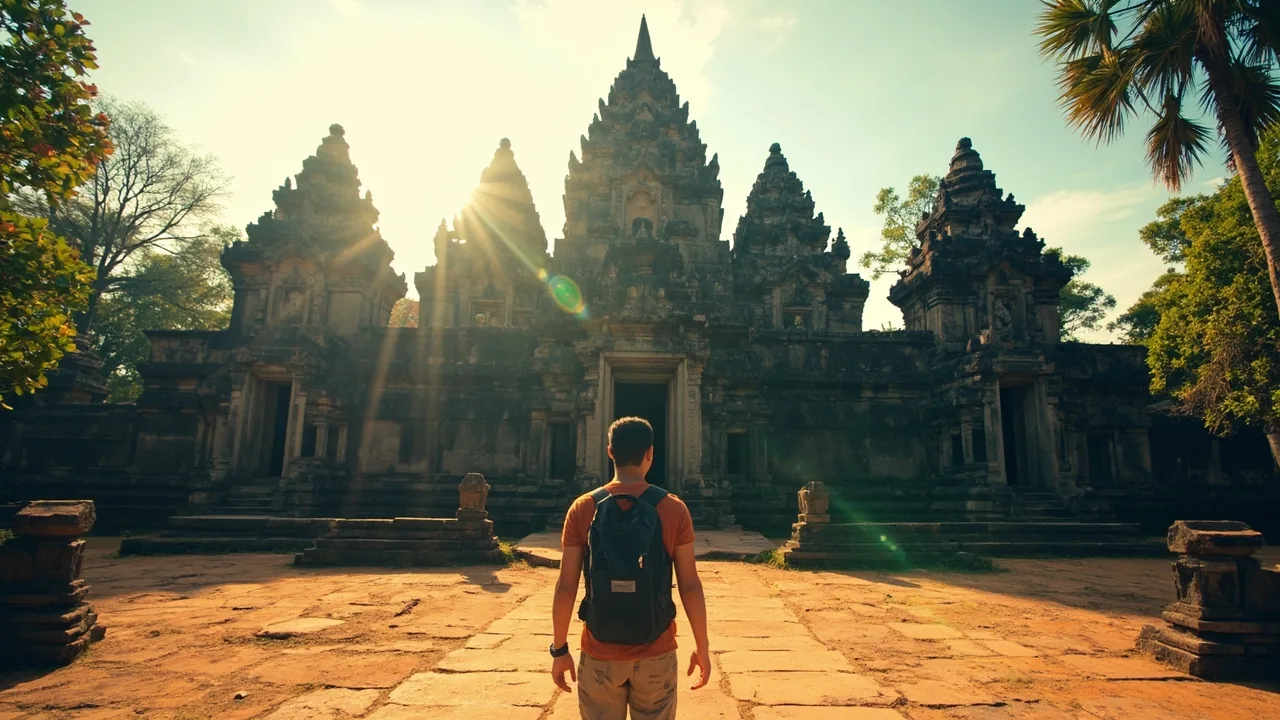
Southeast Asia’s Most Stunning Temples: A 2026 Backpacker Guide
✅ Last verified on-the-ground: Entry fees, hours, and visa rules checked against official tourism portals in July 2026; double-check closer to your trip.
This guide covers the best temples in Southeast Asia for Indian backpackers in 2026, with current entry fees, dress codes, transport links, and the route order that saves you the most time and money. Most of the sites on this list cost under ₹2,295 (~800 THB or ~$23.83) or ₹736 (~200,000 VND or ~$7.64) to enter.
Subodh’s Pro Tip: Don’t try to see every temple on every list. Pick one site per country, go at sunrise, and you’ll remember it longer than any rushed checklist.
Quick Answers: Best Temples in Southeast Asia at a Glance
| What | Answer | Price (INR) |
|---|---|---|
| Angkor Wat (Cambodia) | 5:00 AM opening, sunrise best | ₹3,564 (~37 USD) |
| Bagan (Myanmar) | Sunrise/Sunset, balloon season Oct–Mar | 25,000 MMK |
| Borobudur (Indonesia) | 6:00 AM–5:00 PM, sunrise extra ticket | ₹1,999 (~375,000 IDR or ~$20.75) |
| Prambanan (Indonesia) | 6:00 AM–5:00 PM, sunset best | ₹1,999 (~375,000 IDR or ~$20.75) |
| Bayon (Cambodia) | 7:30 AM–5:30 PM, late afternoon | Included in Angkor Pass |
| Wat Arun (Thailand) | 8:00 AM–6:00 PM, sunset | ₹287 (~100 THB or ~$2.98) |
| Wat Phra That Doi Suthep (Thailand) | 6:00 AM–6:00 PM, early morning | ₹86 (~30 THB or ~$0.89) |
| Hoi An Ancient Town (Vietnam) | 24h old town; ticket 7 AM–9 PM, lantern evening | ₹442 (~120,000 VND or ~$4.58) |
| My Son Sanctuary (Vietnam) | 6:30 AM–5:00 PM, morning | ₹552 (~150,000 VND or ~$5.73) |
| That Luang (Laos) | 6:00 AM–6:00 PM, late afternoon | Free |
| Haw Phra Kaew / Buddha Park (Laos) | 8:00 AM–4:30 PM, late afternoon | ₹129 (~30,000 LAK or ~$1.34) |
| Banteay Srei (Cambodia) | 7:30 AM–5:30 PM, morning | ₹735 (~$7.63) |
All fees verified against the official Apsara Authority (Cambodia), Borobudur Park management, and national tourism portals in July 2026. Prices are shown in Indian rupees with local currency equivalents.
How to Choose the Temples Worth Your Time
The list of must visit temples in Southeast Asia runs into the hundreds, but you realistically have two or three weeks and a backpack. Here’s the honest way to pick.
Prioritize by Historical Significance, Not Instagram Hype
Angkor Wat, Borobudur, Bagan, and Prambanan are the four heaviest-hitters in the region, and Indian backpackers rarely regret doing all four if their route lines up. These are the temples that genuinely changed how the world understands Khmer, Buddhist, Hindu, and Burmese civilizations. Every other temple on this list is a complement, not a substitute.
Match Temples to Your Route
Don’t fly back to a city you already left just for one temple. Build your temple list into your overland route:
- Thailand → Laos → Vietnam → Cambodia route: Wat Phra That Doi Suthep (Chiang Mai), That Luang (Vientiane), My Son (near Hoi An), Angkor Wat (Siem Reap). This is one common Bananarchy-style route.
- Thailand → Cambodia → Thailand route: Wat Arun (Bangkok), Angkor Wat + Bayon + Banteay Srei (Siem Reap). Add Wat Phra That Doi Suthep if you swing through Chiang Mai.
- Indonesia-focused route: Borobudur + Prambanan (a single day from Yogyakarta covers both).
- Myanmar-focused route: Bagan (need at least 2 nights, more if chasing the sunrise balloon photos).
Factor in the Dress Code Before You Fall in Love with a Temple
Every temple on this list enforces shoulder and knee coverage. Our temple etiquette guide covers the dress code rules country by country. Be aware that short shorts and sleeveless tops will get you turned away at Wat Phra That Doi Suthep and Bagan’s biggest pagodas. Carry a sarong or lightweight trousers you can roll up. Most major sites rent sarongs at the entrance for ₹287-₹574 (~100-200 THB or ~$2.98-$5.96) or ₹37-₹74 (~10,000-20,000 VND or ~$0.38-$0.76) if you forget.
The 11 Best Temples in Southeast Asia
1. Angkor Wat (Cambodia)
The single most famous temple in Southeast Asia and the one temple every Indian backpacker should anchor a trip around. Built by Suryavarman II in the early 12th century as a Hindu Vishnu temple, later converted to Buddhist use, and now the symbol on Cambodia’s flag. The complex covers over 400 acres and includes Angkor Wat, Bayon, Ta Prohm, and dozens of smaller sites under one ticket; Banteay Srei sits outside the main complex and requires a separate trip.
Entry: ₹3,564 (~37 USD) one-day pass, ₹5,972 (~62 USD) three-day pass, ₹6,936 (~72 USD) seven-day pass. Cross-checked with the official Apsara Authority site, July 2026. Children under 12 enter free with a parent.
Timing: Sunrise over the central towers is the move. Be at the western reflection pool by 5:00 AM. The temple opens at 5:00 AM and the crowds thin out after 9:00 AM.
Dress code: No shorts above the knee, no sleeveless tops. Sarongs available at the entrance for ₹96-₹193 (~1-2 USD).
How to get there: Fly into Siem Reap (REP) from Bangkok, Kuala Lumpur, or Singapore. From Phnom Penh, take a Book on 12go bus (6–7 hours, around ₹1,156-₹1,445 (~12-15 USD)).
2. Bayon (Cambodia)
The face-tower temple at the heart of Angkor Thom, built by Jayavarman VII in the late 12th century. 54 stone towers, 216 smiling faces of Avalokiteshvara. Same Angkor Pass covers it, no extra ticket.
3. Banteay Srei (Cambodia)
The “Citadel of Women” sits 25 km northeast of the main Angkor complex. Smaller, pink sandstone, with some of the most detailed carvings in Khmer art. Worth the half-day tuk-tuk detour. Same Angkor Pass covers it.
4. Wat Arun (Thailand)
The Temple of Dawn on the Bangkok riverfront, a Khmer-style prang decorated with porcelain and seashells. Climbable central tower (now partially restricted for safety, but the lower terraces still give good views).
Entry: ₹287 (~100 THB or ~$2.98) for foreigners, verified at the gate in July 2026.
Timing: Sunset is the move. The river-bus from Sathorn Pier takes 15 minutes and costs ₹14 (~5 THB or ~$0.15).
How to get there: BTS to Saphan Taksin, then the Chao Phraya Express boat to Wat Arun pier (stop 8).
5. Wat Phra That Doi Suthep (Thailand)
The hilltop temple above Chiang Mai, 1,073 metres up Doi Suthep. Golden chedi, naga staircase, and a view over the whole city on a clear day. This is widely considered the single most rewarding temple in northern Thailand.
Entry: ₹86 (~30 THB or ~$0.89) for foreigners, plus ₹143 (~50 THB or ~$1.49) for the songthaew (red truck) up the mountain.
Timing: Early morning or late afternoon. The midday heat is brutal on the climb.
Dress code: Strict. Shoulders and knees covered. Sarongs for rent at the entrance.
6. Bagan (Myanmar)
Over 2,200 surviving Buddhist temples and pagodas on a 26-square-mile plain, built between the 9th and 13th centuries. Sunrise balloon rides (October. March) are the classic experience. Note: Myanmar’s tourism situation is volatile, and the Indian MEA travel advisory page (mea.gov.in) is the right place to check before booking.
Entry: 25,000 MMK for the Bagan Archaeological Zone fee, paid at the checkpoint when entering the plain. Verified against Myanmar’s Ministry of Hotels & Tourism, July 2026.
Timing: Sunrise from a pagoda top (your hotel or guide will know which ones are accessible). Sunset from a different pagoda. Most tourists do two sunrises and one sunset.
Dress code: Knees and shoulders covered. Several major pagodas ban shoes on upper terraces.
How to get there: Fly intoNyaung U (NYU) from Yangon or Mandalay. Domestic flights run on Myanmar National Airlines and Air KBZ.
7. Borobudur (Indonesia)
The world’s largest Buddhist temple, built around 800 CE by the Sailendra dynasty. A massive stone mandala with 504 Buddha statues and 2,672 relief panels. Sunrise from the upper terraces is the move (extra ticket required).
Entry: ₹1,999 (~375,000 IDR or ~$20.75) for the standard ticket (6 AM, 5 PM), ₹2,425 (~455,000 IDR or ~$25.18) for the sunrise combo (4:30 AM entry). Verified against borobudurpark.com in July 2026.
Timing: Sunrise is worth the early wake-up. Crowds thin after 10 AM.
Dress code: Sarongs provided free at the entrance. Modest clothing still required.
How to get there: Fly into Yogyakarta (YIA or JOG), then a 1-hour car or Grab to the temple. From Yogyakarta’s main backpacker strip (Prawirotaman), a day-return car with driver runs ₹1,865-₹2,665 (~350,000-500,000 IDR or ~$19.37-$27.67).
8. Prambanan (Indonesia)
A 9th-century Hindu temple compound dedicated to Shiva, Vishnu, and Brahma, and a UNESCO World Heritage Site. Sharper vertical lines than Borobudur, more sandstone, and a smaller, easier-to-navigate site. Borobudur and Prambanan fit into one long day from Yogyakarta if you start at sunrise.
Entry: ₹1,999 (~375,000 IDR or ~$20.75) for foreigners (combo ticket with Borobudur is ₹3,598 (~675,000 IDR or ~$37.35)). Verified at the gate, July 2026.
Timing: Sunset is better than midday. The trimurti temples glow orange in the late light.
How to get there: Same as Borobudur. A full-day Borobudur + Prambanan tour runs ₹3,198-₹4,797 (~600,000-900,000 IDR or ~$33.20-$49.80) per person.
9. My Son Sanctuary (Vietnam)
Cham Hindu temples built between the 4th and 14th centuries in a valley 60 km southwest of Hoi An. Smaller than Angkor but architecturally related, and far less crowded. Many red-brick towers are still standing.
Entry: ₹552 (~150,000 VND or ~$5.73) for foreigners. Verified against the official My Son management, July 2026.
Timing: Morning, before the heat and the tour-bus crowds from Hoi An. The first boat of the day is the move.
Dress code: Knees and shoulders covered.
How to get there: From Hoi An, Book on 12go shuttle buses run at 6:30 AM, 7:30 AM, and 8:30 AM. Round-trip with entry runs ₹920-₹1,288 (~250,000-350,000 VND or ~$9.55-$13.37).
10. Hoi An Ancient Town (Vietnam)
Hoi An itself is a UNESCO site, and the entry ticket covers entry to several heritage temples within the old town: several heritage assembly halls and a handful of smaller temples. Night-time lantern viewing is the draw.
Entry: ₹442 (~120,000 VND or ~$4.58) for the standard combo ticket (5 heritage sites). Verified at the Hoi An ticket booth, July 2026.
Timing: Evening, after 6 PM. The lantern-lit riverfront is the reason you’re there.
How to get there: Fly into Da Nang (DAD), then a 45-minute Grab or taxi to Hoi An Old Town. From Hanoi, an overnight train to Da Nang is the classic route, and our Hanoi to Da Nang sleeper train guide covers the train logistics.
11. That Luang and Buddha Park (Laos)
For full Laos logistics, see our Laos travel guide for Indian backpackers.
That Luang in Vientiane is the national symbol of Laos: a gold-covered 16th-century stupa with original 3rd-century brickwork underneath. Free entry, central location, easy to combine with other Vientiane stops.
Xieng Khuan (Buddha Park) sits 25 km southeast of Vientiane, a sculpture garden built in 1958 by the mystic Bunleua Sulilat. Hundreds of concrete Hindu and Buddhist statues, including a giant reclining Buddha and a three-storey “pumpkin” tower you can climb. ₹129 (~30,000 LAK or ~$1.34) entry.
How to get there: That Luang is a 15-minute tuk-tuk from central Vientiane. Buddha Park needs a tuk-tuk or songthaew for ₹215-₹344 (~50,000-80,000 LAK or ~$2.24-$3.58) round-trip.
How to Build a Temple Route Without Wasting Time
The Bananarchy Loop (Recommended for 3–4 Weeks)
- Chiang Mai → Wat Phra That Doi Suthep (half-day, ₹230 (~80 THB or ~$2.38) total)
- Chiang Mai → Vientiane (slow boat or flight) → That Luang + Buddha Park (half-day)
- Vientiane → Hanoi (overnight bus or flight) → overland to Hoi An → My Son Sanctuary (half-day) + Hoi An Ancient Town (evening)
- Hoi An → Ho Chi Minh City → Siem Reap → Angkor Wat (3 days for the Angkor Pass to pay off)
This route hits six of the eleven temples on this list in one trip, with the option to add Bali’s Borobudur/Prambanan as a 4-day extension.
The Thailand + Cambodia Loop (10–12 Days)
- Bangkok → Wat Arun (sunset, ₹287 (~100 THB or ~$2.98) + ₹143 (~50 THB or ~$1.49) boat)
- Bangkok → Chiang Mai → Wat Phra That Doi Suthep (half-day, ₹230 (~80 THB or ~$2.38) total)
- Chiang Mai → Siem Reap (flight via Bangkok or Kuala Lumpur) → Angkor complex (3 days minimum)
- Siem Reap → Bangkok (flight)
Connectivity and SIM Cards
You’ll want data the second you land at Angkor or Borobudur, and physical SIMs are still the cheapest option in most SEA countries. Cambodia’s Smart and Metfone, Thailand’s AIS and dtac, Vietnam’s Viettel, Indonesia’s Telkomsel, and Laos’s Lao Telecom all sell tourist SIMs at the airport for ₹482-₹963 (~5-10 USD).
For multi-country trips, an eSIM is faster than swapping physical SIMs at every border. Nomad eSIM has regional SEA packages that cover Thailand, Vietnam, Cambodia, Laos, Indonesia, and Malaysia under one data plan, useful if you’re on the Bananarchy loop and hitting four countries in three weeks.
Common Mistakes Indians Make at SEA Temples
Mistake 1: Wearing Shorts or Sleeveless Tops
Every major temple enforces shoulder and knee coverage. Travellers report being turned away at Doi Suthep, Bagan, and Wat Arun for shorts above the knee. Carry a lightweight shawl or sarong in your daypack; it costs nothing and saves a ₹287-₹1,435 (~100-500 THB or ~$2.98-$14.89) sarong rental.
Mistake 2: Showing Up at Angkor at Noon
The midday sun at Angkor is brutal and the crowds are at their peak. Be at Angkor Wat by 5:00 AM for sunrise. You’ll have the reflection pool almost empty and the central towers largely to yourself until 8:30 AM.
Mistake 3: Paying More Than the Official Angkor Pass
The official Angkor Pass is ₹3,564 (~37 USD). Anything higher is a scam, including tuk-tuk drivers selling “tour packages” that include the pass. Buy the pass at the official Apsara counter, not from a middleman.
Mistake 4: Trying to See Angkor in One Day
A one-day pass forces you to rush. Three-day passes cost only ₹2,408 (~25 USD) more and let you do Angkor Wat sunrise on day 1, Bayon + Ta Prohm on day 2, and Banteay Srei + the outer temples on day 3.
Mistake 5: Skipping the Bagan Sunrise Balloon Season
Bagan’s sunrise balloon rides run only from October to March. Travellers who arrive in the off-season miss the classic Bagan experience, and no balloon operators run outside that window.
What Most Guides Don’t Tell You
Myanmar’s Tourism Status Can Change Quickly
Temple sites in Myanmar are open and Bagan is accessible as of July 2026, but political and security conditions in the country shift without notice. Before booking Bagan, check the official Indian MEA travel advisory (mea.gov.in) and the Myanmar Ministry of Hotels & Tourism site for current entry rules. Note that flights into Bagan are the easy part; getting a current visa and an active SIM card is where most delays happen.
Some “Free” Temples Are Donation-Supported
That Luang in Vientiane, the Buddhist temples in central Bangkok, and several Lao and Thai sites are technically free or have nominal fees for foreigners. Travellers report that a small donation (₹143-₹287 (~50-100 THB or ~$1.49-$2.98) or ₹86-₹215 (~20,000-50,000 LAK or ~$0.89-$2.24)) goes to maintenance and is appreciated.
Angkor Wat’s Main Tower Has a Restricted Climb
As of 2026, the Bakan tower (central upper sanctuary of Angkor Wat) is closed for restoration. You can climb to the first level and the gallery terraces, but the uppermost platform is fenced off. Don’t plan your sunrise around climbing the central tower.
Prambanan Has a Dress Code for Non-Muslims Too
Prambanan is Hindu, but the dress code applies to everyone: shoulders and knees covered, sarongs provided at the entrance for free. Many travellers assume “it’s not Muslim” means “dress code doesn’t apply,” and they get turned away at the gate.
Budget at a Glance
If your temple route covers all eleven sites on this list, here is what the entry fees add up to:
| Country | Sites Covered | Total Entry (Local) |
|---|---|---|
| Cambodia | Angkor, Bayon, Banteay Srei (3-day pass) | ₹5,972 (~62 USD) |
| Thailand | Wat Arun, Doi Suthep | ₹660 (~230 THB or ~$6.85) |
| Myanmar | Bagan zone fee | 25,000 MMK |
| Indonesia | Borobudur sunrise, Prambanan combo | ₹6,023 (~1,130,000 IDR or ~$62.52) |
| Vietnam | My Son, Hoi An combo | ₹994 (~270,000 VND or ~$10.31) |
| Laos | That Luang (free), Buddha Park | ₹129 (~30,000 LAK or ~$1.34) |
Total entry fees for the full list: roughly ₹8,862 (~92 USD) plus local currency equivalents. At current rates (1 USD ≈ ₹96.33, 1 THB ≈ ₹2.87, 1 VND ≈ ₹0.0037, 1 IDR ≈ ₹0.0053, 1 LAK ≈ ₹0.0043, 1 MMK ≈ ₹0.05), the whole set runs about ₹10,000. Transport, food, and accommodation are separate and covered in our Southeast Asia trip cost guide.
FAQ
Which temple should I visit if I only have time for one?
Angkor Wat. It is the most famous temple in Southeast Asia, it is well-connected from Bangkok, and a 3-day Angkor Pass (₹5,972 (~62 USD)) lets you cover Angkor Wat, Bayon, Ta Prohm, and Banteay Srei at a pace that doesn’t feel rushed.
Is Borobudur better at sunrise or sunset?
Sunrise. Borobudur faces east, so the sunrise lights up the upper terraces and the stupas glow. Sunset is at Borobudur’s back. Prambanan is the better sunset option; the two temples fit into one day from Yogyakarta if you start at 4:30 AM.
Do I need a guide at Angkor?
Not strictly. The complex is well-signed and most visitors manage without one. But a guide at Angkor Wat (not Bayon, where the faces speak for themselves) brings the bas-reliefs to life. Half-day guides at the main gate run ₹1,445-₹2,408 (~15-25 USD).
Can I wear jeans to temples in Southeast Asia?
Yes. Knees covered is the rule, and jeans work everywhere. The issue with jeans is the heat: in Thailand, Cambodia, and Vietnam, lightweight trousers are far more comfortable for the long walks at Angkor and Borobudur.
Are SEA temples safe for solo female travelers?
Yes. The major temples on this list are crowded, well-patrolled, and well-trodden by solo travelers. For more detail, see our solo female travel in Southeast Asia guide.
What’s the cheapest way to visit Borobudur and Prambanan together?
A day-return car with driver from Yogyakarta. Negotiate at Prawirotaman or Sosrowijayan for ₹1,865-₹2,665 (~350,000-500,000 IDR or ~$19.37-$27.67) per car (split 4 ways). This is cheaper than any tour and lets you control timing.
Do I need travel insurance for temple visits?
Standard travel insurance covers medical evacuation, trip cancellation, and theft. It does not cover any specific temple-related incidents, but the medical coverage is what matters at remote sites like Bagan or Borobudur, where the nearest good hospital can be 1–2 hours away.