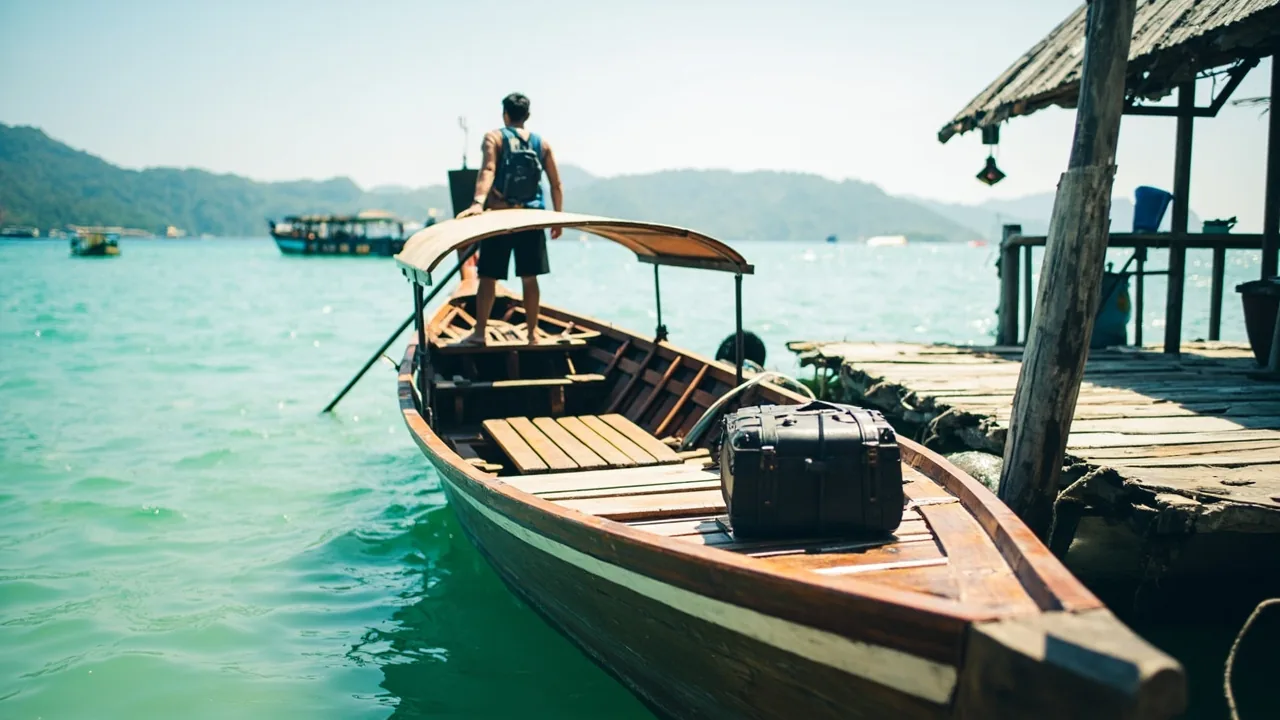
Southeast Asia Transport Guide: Getting Around by Sea (2026)
The short answer for Indian backpackers: Southeast Asia sea transport means island-hopping by ferry, speedboat, and longtail boat, mostly in Thailand, Indonesia, the Philippines, and Malaysia. Prices range from ₹574 (~200 THB or ~$5.96) for a short Thai island hop to ₹7,995 (~1,500,000 IDR or ~$83) for an Indonesian fast boat, and you book almost everything through 12go.asia or at the pier the morning of departure. This guide covers every crossing Indian backpackers do, the documents you need at each pier, how to read the timetable charts, and the mistakes that cost people their boat. Planning the wider region? Our Southeast Asia backpacking hub covers the full multi-country route.
Verified July 2026 against 12go.asia, Phuket Raja Ferry, Alesia Group (Phi Phi), and the official Bali fast-boat cooperative schedules.
What Is Sea Transport in Southeast Asia?
Southeast Asia sea transport is the network of ferries, fast boats, speedboats, and traditional longtail boats that connect islands, cross bays, and link coastal cities where no bridge or road exists. For backpackers it covers everything from the 11-hour overnight ferry between Lombok and Flores (Indonesia) to the 1.5-hour Phi Phi to Phuket hop, the Manila to Cebu liners in the Philippines, and the short Langkawi to Koh Lipe crossing that links Malaysia to southern Thailand.
Unlike European or Japanese ferry networks, SEA crossings are operated by dozens of small private companies on overlapping routes, with schedules that change seasonally and sometimes weekly. There is no single integrated timetable, which is why most travellers rely on aggregator sites like 12go.asia or book at the pier the morning they want to travel.
Quick Answers
| What | Answer | Price (INR) |
|---|---|---|
| Cheapest sea crossing | Ko Lanta to Ko Phi Phi (Thailand) | ₹1,291 (~450 THB or ~$13.40) |
| Most popular backpacker route | Bali to Gili Trawangan (Indonesia) | ₹1,546 (~290,000 IDR or ~$16.05) |
| Longest ferry Indian backpackers take | Lombok to Labuan Bajo (Indonesia, ~11 hrs) | ₹1,865 (~350,000 IDR or ~$19.37) |
| Booking platform | 12go.asia | , |
| Documents required | Passport (6+ months validity), ferry e-ticket, sometimes printed hotel booking | , |
| Average sea crossing cost per trip | ₹717-₹4,304 (~250-1,500 THB or ~$7.45-$44.68) in Thailand, ₹1,066-₹3,198 (~200,000-600,000 IDR or ~$11.07-$33.20) in Indonesia | , |
| Insurance covers cancellations | No, sea crossings are usually non-refundable | , |
FX rates as of July 2026: 1 THB = ₹2.87, 1 IDR = ₹0.0053, 1 VND = ₹0.0037, 1 MYR = ₹23.64, 1 SGD = ₹74.69.
Step-by-Step: How to Book and Take a Sea Crossing
1. Decide your route and timing
Not every island pair has a daily ferry. Phi Phi to Phuket runs 4 to 6 times a day in high season (November to April) and 1 to 2 times in low season. Lombok to Flores runs 3 times a week, every ferry operator on the same days. Always confirm frequency for your specific travel month before locking in flights or hotels around it.
Tides matter: in the Philippines and parts of Indonesia some boats only run at high tide. If the tide table says low tide at 2pm, your 3pm departure quietly moves to 5pm.
2. Book on 12go.asia (or at the pier)
For most routes, 12go.asia is the booking platform. You pick origin and destination, select date, and the system shows every operator, departure time, duration, and price. You pay with a Visa/Mastercard or PayPal. The e-ticket arrives by email within minutes. Print it or save the PDF, piers in Thailand and the Philippines regularly ask for the printed version.
If you’re flexible on time, booking the morning of at the pier is normal and often 10 to 20% cheaper. This works fine for Phi Phi, Koh Samui, Phuket, Koh Lanta, Bali to Gili, and most Malaysian crossings. It does not work for Lombok to Flores (Flores) or Manila to Cebu (2GO), those need 24 to 48 hours advance booking.
3. Check your documents
You need a passport valid for 6 more months (strictly enforced in Indonesia and the Philippines), the printed or digital ferry e-ticket, and your hotel name and address in the destination country (customs officials ask). If you’re crossing an international border by sea (Koh Lipe to Langkawi, for example), you also need:
- A valid visa or visa-on-arrival eligibility for the destination country.
- Proof of onward travel (return ticket or next-flight booking).
- The Thailand TDAC/TM7 arrival card if entering Thailand by sea.
For Thai island-to-island hops (no border crossing), only the passport is needed.
4. Arrive at the pier 45 to 60 minutes early
Thai piers assign seats on first-come-first-served for unreserved tickets. Indonesian fast boats often have weight limits on luggage (12 kg per person standard) and will charge extra for backpacks above that. The Manila North Harbour port requires terminal fees (around 200 PHP) paid in cash at a separate counter before boarding.
Eat something before you board. Most ferries sell drinks and snacks but the food is poor and expensive, and 4-hour crossings without food make people sick.
5. On board
Speedboats are bumpy, especially in the Andaman Sea from November to April and the Bali strait year-round. Take seasickness medicine (Avomine, available at any Indian pharmacy for around ₹40 (~$0.41)) 30 minutes before departure. Sit in the middle of the boat, not the front or back, motion is lowest there. A good packing list for Southeast Asia covers a dry bag, motion pills, and waterproof phone pouch so you don’t buy them at pier markup.
Phones in waterproof pouches. Salt water destroys electronics, and boats spray. A ₹300 (~$3.11) dry bag from Decathlon before your trip is the single best ₹300 (~$3.11) you’ll spend.
Common Mistakes Indians Make
Mistake 1: Booking a return ticket “just in case” and assuming it’s refundable
What people do: book the round trip on 12go for the 5% discount.
What happens: weather cancellations, illness, changed plans, and the operator refuses to refund, transfer, or reschedule. You eat the cost.
How to avoid it: book one-way, pay slightly more, and only book the return the day before if you know you’re staying. 12go.asia prices are the same for one-way and round-trip on most routes, the “discount” is a myth for SEA ferries.
Mistake 2: Not checking monsoon season for the specific route
What people do: assume “Southeast Asia low season” is universal.
What happens: the Andaman Sea (Phuket, Phi Phi, Koh Lipe) is rough from May to October, the Bali strait is rough from November to March. Sailing during the wrong monsoon means cancelled boats, choppy crossings, and sometimes overnight stays at the pier. The Lombok to Flores ferry gets cancelled for 2 to 3 days at a stretch during January-March.
How to avoid it: check the monsoon calendar for the specific sea you are crossing. Travellers report that operators rarely cancel more than 24 hours in advance, so build buffer days into your itinerary.
3. Trusting a tuk-tuk driver’s “ferry office”
What happens at the pier: someone meets you on the road before the official terminal and offers to sell you the same ticket for the same price (sometimes ₹143 (~50 THB or ~$1.49) more) and also arrange a “free” hotel pickup that turns out to be a timeshare presentation.
How to avoid it: walk into the official terminal, find the official operator counter (it has the company name in English and Thai/Indonesian), buy there. No exceptions, no matter how friendly the tout is.
Mistake 4: Bringing too much luggage
Speedboats in Bali and the Gili Islands have a 12 kg per person weight limit for checked luggage, with a hard 25 kg maximum. Phuket ferries to Phi Phi charge ₹287 (~100 THB or ~$2.98) per large backpack on top of the ticket. The Manila to Cebu overnight ferry has plenty of room, but you’ll haul it up four decks.
How to avoid it: pack light. If you’re carrying more than a 60-litre backpack plus a daypack, ship your main bag via Lalamove (Thailand) or JNE (Indonesia) to your next destination, they cost ₹1,435-₹4,304 (~500-1,500 THB or ~$14.89-$44.68) or ₹533-₹1,066 (~100,000-200,000 IDR or ~$5.53-$11.07) and save your back. Skim our tuk-tuk scam guide so the pier “helper” doesn’t walk off with your bag.
What Most Guides Don’t Tell You
The “sea transport chart” is a myth
There is no single authoritative Southeast Asia sea transport chart or timetable that covers all operators. Each company publishes its own schedule, and 12go.asia aggregates them. If you’ve Googled “sea transport chart,” the search results are mostly shipping-industry container freight charts (CMA CGM, Maersk), not passenger ferries. For monsoon timing across the routes below, the Vietnam peak season guide has a useful month-by-month pattern that overlaps with the Andaman and Bali seasons. For passengers, the de facto chart is the 12go.asia search results page. Screenshot your departure, you will not have Wi-Fi at the pier.
Lombok to Labuan Bajo is the route Indian backpackers regret
This 11-hour ferry (called the “Asiana” or “KLM” depending on operator) is sold as a great adventure. Travellers report it is rough, the boat is slow, food runs out by hour 5, and the cabin class is barely better than the deck. The alternative is a 1.5-hour flight on Lion Air or Citilink from Lombok Praya to Labuan Bajo for around ₹3,731 (~700,000 IDR or ~$38.73), same price as the ferry and you save 9 hours. Take the flight unless you specifically want the boat for the experience.
Sea crossings are not covered by travel insurance
Standard travel insurance, including SafetyWing, covers medical emergencies, trip cancellation for documented illness, and medical evacuation. Compare plans on our travel insurance for India to Southeast Asia breakdown before you sail. It does not cover the ferry ticket itself if you miss the boat, the operator cancels, or weather grounds the crossing. Read the fine print, assume your ferry ticket is a sunk cost the moment you book it.
Sea Transport by Country
Thailand
Thailand has the busiest and most backpacker-friendly ferry network. All major crossings (Phuket, Phi Phi, Koh Samui, Koh Phangan, Koh Tao, Koh Lanta, Koh Lipe) run multiple times daily in high season, fewer in low season. Booking on 12go.asia the night before is reliable. Prices: ₹574-₹2,295 (~200-800 THB or ~$5.96-$23.83) for short hops, ₹2,582-₹5,164 (~900-1,800 THB or ~$26.81-$53.61) for longer ones like Surat Thani to Koh Samui.
The Koh Lipe to Langkawi crossing is the only Thailand-Malaysia international sea route most backpackers take. It runs from November to mid-May only (closed in southwest monsoon). Check what the rainy season in Thailand looks like before you lock dates. ₹4,304 (~1,500 THB or ~$44.68) one way, takes 90 minutes, arrives at Kuah jetty in Langkawi.
Indonesia
The Indonesian ferry and fast-boat network is the most complex in the region. Routes Indian backpackers take:
- Bali (Sanur or Padang Bai) to Gili Islands (Trawangan, Meno, Air): ₹1,546-₹2,398 (~290,000-450,000 IDR or ~$16.05-$24.90), 1.5 to 2.5 hours, multiple operators daily.
- Bali (Padang Bai) to Lombok (Bangsal): ₹1,865 (~350,000 IDR or ~$19.37), 4 to 5 hours.
- Lombok (Bangsal) to Flores (Labuan Bajo): ₹1,865 (~350,000 IDR or ~$19.37), 11 hours, 3 times weekly.
- Java (Ketapang) to Bali (Gilimanuk): ₹107 (~20,000 IDR or ~$1.11) for foot passengers, 45 minutes, runs 24/7.
- Jakarta (Tanjung Priok) to Sumatra (Tanjung Pinang via Pelni): budget ferry for slow travellers, 1 to 3 days at sea.
Philippines
The Philippines uses 2GO Ferry for inter-island crossings (Manila to Cebu, Manila to Coron, Cebu to Siargao). Routes are long, 18 to 36 hours, with proper cabins, food, and deck space. Prices: 1,200 to 4,500 PHP for economy to tourist class. Book 2 to 5 days ahead in high season (December to May).
Short island-hopping in Palawan and the Visayas uses bangka (outrigger boats), booked at the pier the day before, prices negotiated in cash, 300 to 2,000 PHP per boat per person depending on distance.
Malaysia
Malaysia has a small but efficient ferry network, mostly connecting the mainland to islands. Langkawi to Penang, Langkawi to Koh Lipe (Thailand), and Penang to Medan (Indonesia, via Dumai) are the routes backpackers use. Prices: ₹1,182-₹4,255 (~50-180 MYR or ~$12.27-$44.17).
Vietnam, Cambodia, Laos, Singapore
Vietnam, Cambodia, and Laos have negligible passenger ferry networks for backpackers. The Mekong slow boat from Huay Xai (Laos) to Luang Prabang crosses the Mekong but it’s a slow boat, not a sea ferry, and is covered in our Mekong slow boat guide. Singapore to Batam and Singapore to Bintan are 60-minute ferries for around ₹3,734 (~50 SGD or ~$38.76) return, popular for weekend trips.
Sea Transport Documents Checklist
Before you board any international sea crossing, carry:
- Passport with 6+ months validity
- Printed ferry e-ticket (12go.asia confirmation or operator ticket)
- Visa for destination country (if required)
- Thailand arrival card (TDAC) if entering Thailand
- Proof of onward travel (flight out of the region)
- Hotel name and address in destination city (customs asks)
- Cash for terminal fees and port taxes (₹287-₹861 (~100-300 THB or ~$2.98-$8.94) or equivalent)
- Photocopies of passport and visa, kept separately from originals
For domestic island-hopping (no border crossing), only the passport is needed.
Reading Sea Transport Timetables (the Chart)
Most sea transport timetables follow the same format:
| Column | What it means |
|---|---|
| Departure | Time the boat leaves the pier (not when boarding starts) |
| Arrival | Time the boat docks at destination (crossing duration is added) |
| Operator | Company running the boat (Phuket Raja Ferry, Alesia Group, etc.) |
| Class | Economy / Tourist / VIP / Cabin, different seat and cabin levels |
| Notes | ”Bring passport,” “check-in 30 min before,” etc. |
The “sea transport chart” most search results link to is industry freight shipping. For passengers, the live chart is always the 12go.asia results page. Screenshot your booking the night before, signal is poor at the pier.
Connectivity at Sea and On Piers
Most piers have free Wi-Fi now. Boats rarely do. Buy a local SIM at the airport on arrival, AIS in Thailand, Telkomsel in Indonesia, Globe or Smart in the Philippines. For multi-country trips, a Nomad eSIM covers Thailand, Vietnam, Indonesia, and the Philippines on one data plan, cheaper than buying four SIMs.
If your trip has heavy sea-crossing days, download offline Google Maps for the destination island the night before.
FAQ
Do I need a visa to take a ferry between Thai islands?
No. Domestic ferries within Thailand only require your passport for identification. The Thailand arrival card (TDAC) is only filled out when entering Thailand at an international border, which includes the Koh Lipe to Langkawi crossing.
Can I take a sea crossing from Thailand to Malaysia on a tourist visa?
Yes. The Koh Lipe to Langkawi ferry is the standard route. Both Thailand and Malaysia offer visa-on-arrival or e-visa to Indian passport holders, and the ferry operator only asks for your passport and ticket. Have your Malaysia e-visa arranged before you board at Koh Lipe, the pier in Langkawi processes arrivals but the queue is long.
Are sea crossings safe?
Generally yes. The major routes (Phuket to Phi Phi, Bali to Gili, Koh Samui to Koh Phangan) have decades of operation and well-maintained boats. Speedboats in rough weather are the main risk. Sit in the middle of the boat, take seasickness medicine, and if conditions look bad at the pier, ask the operator honestly, most operators cancel rather than risk a serious crossing.
What happens if my ferry is cancelled due to weather?
You get a partial or full refund to your 12go.asia wallet, not your card. Most operators reschedule you on the next available departure, which might be the next day in low season. Travel insurance does not cover this, your only protection is buffer days in your itinerary and not pre-booking tight connections.
Can I book sea transport on the spot at the pier?
For most Thai and Malaysian crossings, yes. For Lombok to Flores, Manila to Cebu, and any Pelni route, no, book ahead. For Bali to Gili, you can book either way, pier price is usually ₹266 (~50,000 IDR or ~$2.77) cheaper than online, but you risk sold-out boats in July-August and December-January.
Do children need separate tickets on ferries?
Yes. Most operators charge full price for children above 90 cm height, half price for 60 to 90 cm, free below 60 cm. Carry proof of age for kids, piers occasionally ask.
Can I take a sea crossing during monsoon season?
Technically yes, but expect cancellations. The Andaman crossings (Phuket, Phi Phi) are rough June to October. The Bali crossings are rough December to February. Filipino typhoon season is June to November and some Palawan routes close entirely. Always check the operator’s Facebook page the morning of, they post cancellations there before 12go updates.
Subodh’s Take
Sea transport in Southeast Asia looks chaotic until you’ve done it once. After that you realise it’s pretty forgiving: piers are small, operators are at the pier, cash works, and 12go handles the rest. The mistakes that do cost money are almost always about pre-booking tight connections, ignoring monsoon seasons, and trusting tuk-tuk drivers at the pier. Skip those three and the rest is just a boat ride.
