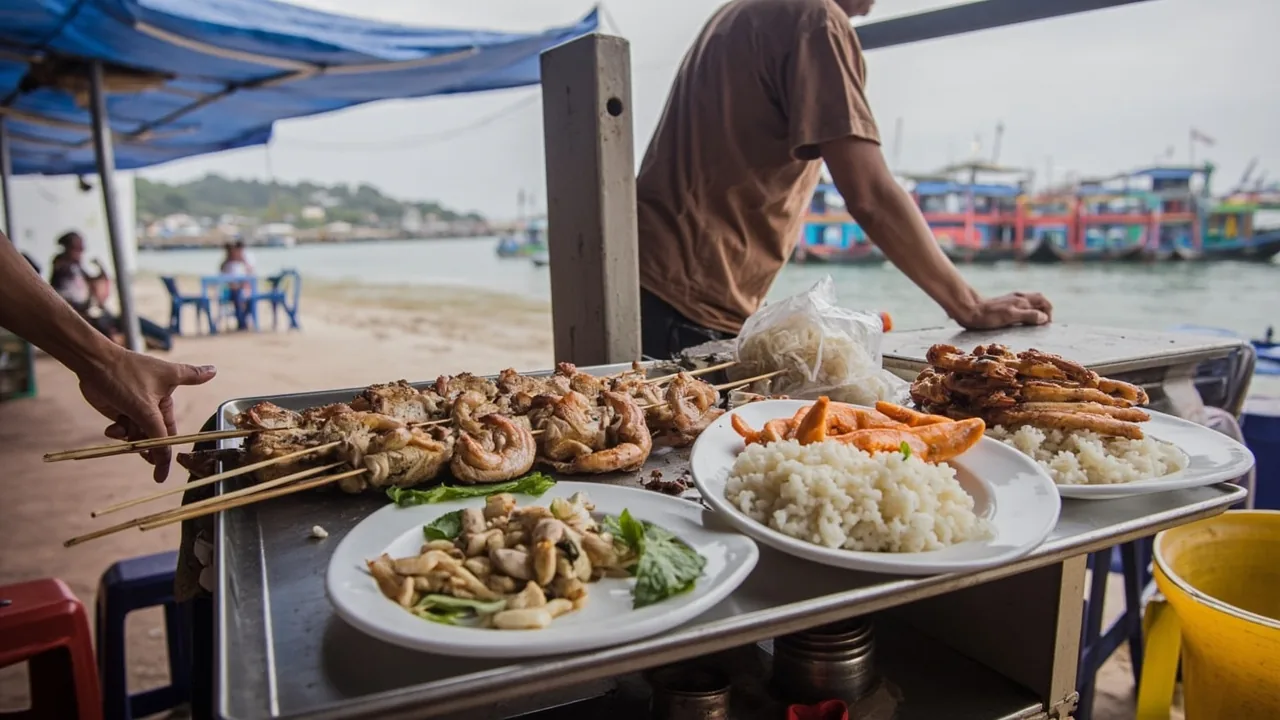
Street Food Safety at Sea: What to Eat, What to Skip
Coastal Southeast Asia serves some of the best food on earth, but the same stalls and beach grills that feed you a perfect grilled fish at sunset can wreck your gut by sunrise. This guide is the rulebook I cross-check every time I’m near a port, pier, or beachside barbecue from Koh Tao to El Nido. Verified against traveller reports from June 2026, cross-checked with WHO seafood-safety guidance, and aligned with the water safety rules every backpacker needs on this site. Planning the wider region? Our Southeast Asia backpacking hub covers the full multi-country route.
The short version: eat what’s cooked in front of you, skip anything that sits out, never trust seafood that’s been “fresh since morning,” and keep one or two backup meds in your daypack.
Quick Answers
| What | Answer | Price (INR) |
|---|---|---|
| Highest-risk coastal dish to skip | Raw oysters or shellfish from a roadside cart with no ice | ₣0 (~₹0, skip entirely) |
| Safest street seafood to eat | Whole grilled fish, scaled and gutted in front of you | ₣150 (~₹150) |
| Must-carry backup med | Oral rehydration salts (ORS) | ₣60 (~₹60 per sachet) |
| Cheapest safe lunch near any port | Pad kra pao or fried rice from a busy stall | ₣60 (~₹60) |
| Best cheap eSIM for coastal SIM-less maps | Nomad eSIM, 1 GB SEA plan | ₣400 (~₹400) |
Subodh’s Pro Tip: A stall with a queue of locals at lunch is safer than an empty beachfront “restaurant” with a laminated English menu and a man waving you in. Locals vote with their stomachs every day.
The Six Hygiene Red Flags at Coastal Stalls
The smell of grilled squid and lemongrass can drown out your common sense. Don’t let it. Walk past any stall showing any of these:
- No ice, warm fish on a tray. Fresh fish should sit on a thick bed of crushed ice at port stalls. A pile of shrimp sitting in a metal bowl at 32°C room temperature has been there for hours. Skip it.
- Reused cooking oil, dark and smoking. If the wok oil is black-brown and foaming, the vendor is cutting corners on turnover. The food will taste heavy and your stomach will pay.
- Raw and cooked seafood on the same board. Cross-contamination is the fastest way to spend two days in your hostel bathroom. If the vendor uses the same knife and cutting board for sashimi-grade fish and the grilled catch, leave.
- No running water or handwashing setup. A sink with a bottle of water and soap is the bare minimum. A wok, a cutting board, and a naked tap is not.
- Shellfish with no provenance. Oysters, cockles, mussels, and clams filter water, so they’re the most common carriers of vibrio bacteria and hepatitis A. A street oyster cart in Pattaya or Vung Tau is a coin flip with your gut.
- “Just caught this morning” with no ice or fridge. If the vendor can’t show you where the ice is, the fish is not fresh.
Safety Alert: Vibrio and hepatitis A peak in warm coastal waters between May and October. Travellers report spikes of stomach illness in Thailand’s east coast (Koh Samui, Koh Phangan) and Vietnam’s central coast (Hoi An, Nha Trang) during this window. Check your government’s travel advisory (for Indian travellers, the MEA travel advisory page) and the destination country’s health ministry page before departure.
What to Eat: The Safe Coastal Shortlist
These are the dishes that go from raw ingredient to cooked plate in front of you, on high heat, with no sitting-out time.
Whole grilled fish (pla pao / ikan bakar)
The fisherman or cook kills the fish, scales it, stuffs it with lemongrass and pandan, and grills it over coconut husk coals. You see the whole chain. Order by pointing at the freshest one on ice, not the one already plated.
Eat it at: beach grills in Koh Samui, Koh Lanta, Phu Quoc, Nha Trang, Sihanoukville, Ao Nang. Look for a stall with a charcoal pit, not a gas burner.
Grilled squid and prawns
Small whole squid and shell-on prawns cook in under three minutes on a hot grill. The shell protects the meat, the high heat kills surface bacteria, and you can see the char form in real time. Skip the pre-grilled tray.
Tom yum goong and tom kha gai (cooked seafood soups)
Boiling for 10+ minutes in a chilli-lime broth kills most pathogens. The shrimps should curl tight into a “C” shape when cooked. If they’re straight or limp, walk away.
Pad thai, pad see ew, and fried rice (cooked-to-order only)
Wok-fried dishes cooked at 200°C+ in front of you are safe. The risk only enters when the vendor pre-cooks a pile of noodles at noon and serves them lukewarm at 4 pm. Always watch them toss your portion.
Seafood omelette (hoy tod) at a busy stall
A Thai seafood omelette cooked on a screaming-hot cast iron pan is sterilised by the time it lands on your plate. Eat it within five minutes of cooking.
Banana leaf grilled fish (Vietnam, Cambodia)
Wrapped fish grilled in banana leaf traps steam and cooks the fish evenly. Vendors unwrap it tableside. You see the fish, the leaf, and the heat. Hard to fake.
Subodh’s Pro Tip: Order one seafood dish and one plain carb per meal. The fried rice, white rice, or plain noodles give your stomach a backup if the seafood is borderline. Don’t make seafood all three courses.
What to Skip: The Coastal Dishes That Hospitalise Travellers
These are the dishes I tell friends to avoid entirely at the beach.
Raw oysters, cockles, mussels, and clams
The single highest-risk coastal dish in Southeast Asia. Raw filter-feeders from warm tropical waters carry vibrio, norovirus, and hepatitis A. Travellers report multi-day hospitalisations from a “just one” oyster shooter at a Sihanoukville beach bar.
Skip rule: zero raw shellfish from a street cart, full stop. If you want oysters, eat them at a hotel buffet with a chef, an ice display, and a turnover of under two hours.
Ceviche and “lime-cured” fish
Ceviche is not cooked. The acid denatures the protein but does not kill vibrio or parasites. A beachfront “Thai-style ceviche” is a marketing trick, not a safety upgrade.
Pre-grilled fish displayed on platters
Fish that’s been sitting out under a glass dome for “display” is being kept warm by the ambient air and the lights above it. It’s a petri dish dressed up as a buffet.
Seafood larp / larb (raw minced)
Laotian and Isan larb can be served raw (lua) or cooked. The raw version mixes minced fish or pork with blood, herbs, and lime. Travellers love the photo, but raw minced fish is a top-three stomach-offender in this region.
Order the cooked version (suk) only, and even then, only from a busy lunch stall.
”Today catch” sushi at a beach shack
If the menu has both pad thai and sushi, the sushi is a tourist trap. Sushi-grade fish in Southeast Asia goes to Japanese restaurants in Bangkok, Singapore, and KL, not to a beach shack in Koh Chang.
Unrefrigerated coconut water
Once a green coconut is opened, the water is no longer sterile. Vendors with a stack of pre-cut coconuts on a hot counter are growing bacteria. Buy a coconut cut in front of you, drink it within 20 minutes, and toss the rest.
Safety Alert: Travellers have reported hepatitis A and typhoid outbreaks traced back to street coconut water in Thailand and Cambodia. Cut in front of you only. If you have any doubt, switch to bottled water or a fresh lime soda.
The “Two-Hour Rule” for Buffets and Beach BBQs
Beachside seafood buffets at sunset are the single most common food-safety trap in coastal SEA. The fish was caught at 6 am, cooked at 11 am, and is sitting under heat lamps at 7 pm. By 9 pm, the shellfish tray is a buffet for bacteria.
The rule: eat seafood within two hours of it being cooked, full stop. If you’re arriving at a beach BBQ at sunset, eat only what is being grilled in front of you in that moment. Skip the trays. If the grill is cold, skip the venue.
Drinks, Ice, and Water Around the Coast
Saltwater isn’t the only thing that ruins a trip. Drinks are an easy second route in.
- Ice: Only accept ice from a sealed bag with a hole punched by the vendor’s spoon, or from a bar where you’ve watched them scoop from a sealed bag. A pile of open ice by the side of the road is unsafe.
- Sealed water: Every country has a 0.5 L and 1.5 L bottle. Buy sealed, check the cap seal, drink from the bottle not a glass.
- Fresh juices: Fine if you watch them cut the fruit and squeeze it in front of you. Skip the pre-bottled “fresh mango juice” on a beach cart, it’s often watered-down concentrate.
- Beer and spirits: Safest drink on the menu. Alcohol sterilises itself. If you want to keep your stomach calm, drink beer or soda water with lime.
- Coffee and tea: Boiled water, so it’s safer than you think. Skip the iced versions at suspicious stalls.
For deeper rules on what to drink and what to filter, see the water safety guide.
Your Coastal Daypack: The Three-Medic Kit
If your gut goes wrong on a beach with no pharmacy for 30 km, you need three things in your daypack. Always.
- Oral rehydration salts (ORS). One sachet in clean water, sipped slowly. Replaces what you lose in six hours of vomiting. Costs about ₹60 (~$0.62) per sachet at any 7-Eleven or pharmacy.
- Loperamide (Imodium). Stops you running for the toilet on a bus or boat ride. Don’t use it if you have a fever; that’s when you need a doctor, not a plug.
- Activated charcoal or a probiotic. Helps with mild bloating from unfamiliar food. Skip if you’re already having acute symptoms.
Add a fourth if you have space: a thermometer. Anything above 38.5°C plus diarrhoea plus blood in the stool means you need antibiotics, not home remedies. Find a clinic.
Coastal Scams Tied to Seafood
Food and scams overlap at the beach. Watch for these three.
The “today catch” upcharge
The vendor names a price per 100g of fish, then weighs the whole fish plus the plate, plus the ice, plus the garnish. Travellers report being charged for 800g of fish on a 400g fish.
Avoid it: Ask for the price per fish (“one fish, how much?”), not per weight. Or agree the weight before cooking and watch them put it on the scale.
The “extra dish” add-on
You order a grilled fish for ₹717 (~250 THB or ~$7.45). The bill shows ₹717 (~250 THB or ~$7.45) fish, ₹230 (~80 THB or ~$2.38) “cooking fee,” ₹143 (~50 THB or ~$1.49) “rice,” ₹86 (~30 THB or ~$0.89) “sauce.” The total balloons to ₹1,176 (~410 THB or ~$12.21).
Avoid it: Ask for the all-in price before cooking. Walk away if they won’t commit.
The “fresh lobster” swap
You order a ₹1,721 (~600 THB or ~$17.87) lobster. The kitchen “substitutes” it with a smaller prawn because the lobster “just sold out” and now the bill is ₹1,721 (~600 THB or ~$17.87) for a prawn dish.
Avoid it: Confirm the price of the specific animal the vendor points at, then watch it go into the kitchen. If they swap it, refuse to pay the swap price.
For more port and pier scams (fake porters, jet-ski damage scams, fake tour desks), see the solo traveller safety at sea guide.
Connectivity: Maps, Translate, Reviews
You need data at the coast for three things: Google Maps (to find the next clinic), Google Translate (to read a Thai menu), and Google Reviews (to vet the next stall).
Physical SIM: Buy at any 7-Eleven in Bangkok, Phnom Penh, or Bali. AIS, dtac, and Smart are the usual options for Thailand. Ask for the tourist SIM with 15 GB, around ₹858 (~299 THB or ~$8.91) for 8 days.
eSIM alternative: Get Nomad eSIM, around ₹400 (~$4.15) for 1 GB covering Thailand, Vietnam, Cambodia, Indonesia, and the Philippines. No passport photocopy, no queue at the airport kiosk.
Airport SIMs: Marked up 30 to 50% versus city stores. Skip them.
Subodh’s Pro Tip: Set Google Maps to download the offline map of every coastal region you visit. It costs 0 MB, runs without data, and will save you when your eSIM drops out on a remote island.
Cross-Country Coastal Notes
A few specific calls by country, since rules vary by bay.
- Thailand: Koh Tao, Koh Samui, Koh Phangan, Krabi, Koh Lanta, Koh Chang, Phuket. Busiest stalls at night markets are usually safe. Avoid raw shellfish everywhere. Koh Tao diving sickness is a separate issue from food, see a hyperbaric chamber, not a pharmacy.
- Vietnam: Hoi An, Nha Trang, Da Nang, Vung Tau, Phu Quoc, Mui Ne. Grilled seafood on the street in Nha Trang is some of the best and safest in the country. Skip raw shellfish completely.
- Cambodia: Sihanoukville, Koh Rong, Koh Rong Samloem, Kampot. Koh Rong has had traveller reports of stomach bugs traced to undercooked seafood. Eat only what’s grilled to order. See the Cambodia scams and safety guide for the bigger picture.
- Indonesia: Bali, Lombok, Gili Islands, Labuan Bajo, Raja Ampat. Warungs with high turnover are safer than empty beach clubs. Fish here is excellent but the heat is brutal on leftovers.
- Philippines: Palawan, El Nido, Coron, Cebu, Bohol, Boracay. Filipino grilled fish (inihaw) is generally safe. Seafood buffets at sunset are the usual trap.
- Myanmar (Mandalay, Ngapali): Fewer beach options due to current travel advisory levels. Check the MEA travel advisory page and the Myanmar Ministry of Hotels and Tourism before booking. For context on cheap hotels in Mandalay, see the Mandalay budget guide.
Common Mistakes Indians Make at Coastal Stalls
Three patterns I see from Indian travellers specifically at beach stalls.
- Trusting the English menu over the queue. The English menu is for tourists, the local queue is for locals. Go where locals queue.
- Eating everything raw because “it looks fresh.” Sashimi-grade fish exists in SEA but not at a beach cart. If you want raw, go to a Japanese restaurant in Bangkok, Singapore, or KL.
- Drinking the welcome coconut water without checking the cut. Pre-cut coconuts on a hot counter are a common source of stomach bugs. Always ask the vendor to cut it in front of you.
FAQ
Is it safe to eat grilled squid at the beach? Yes, if it’s grilled to order on a charcoal or gas grill, the surface bacteria are killed by the high heat. Skip pre-grilled trays sitting under heat lamps.
Can I drink coconut water from a street cart? Only if the vendor cuts the coconut in front of you. Pre-cut coconuts sitting on a hot counter grow bacteria within 30 minutes of opening.
What is the highest-risk coastal dish? Raw oysters, cockles, mussels, and clams. They filter warm seawater and concentrate vibrio bacteria. Skip them at street level.
Is sushi safe at a beach shack? Almost never. Sushi-grade fish in SEA goes to Japanese restaurants in major cities, not to a beach shack. Skip.
How do I find a clinic on a remote island? Ask your hostel for the nearest clinic. Most Thai islands have one; smaller Indonesian and Philippine islands may need a boat transfer to the mainland. Carry ORS and Imodium for the gap.
Should I take a probiotic before a coastal trip? It won’t hurt. It won’t fully protect you either. The strongest prevention is what you eat, not what you supplement.
What about durian near the coast? Less risky than seafood. The bigger durian issue is the smell and the spike in blood pressure for some travellers. For a deeper primer, see the durian and cendol first-timer guide.
