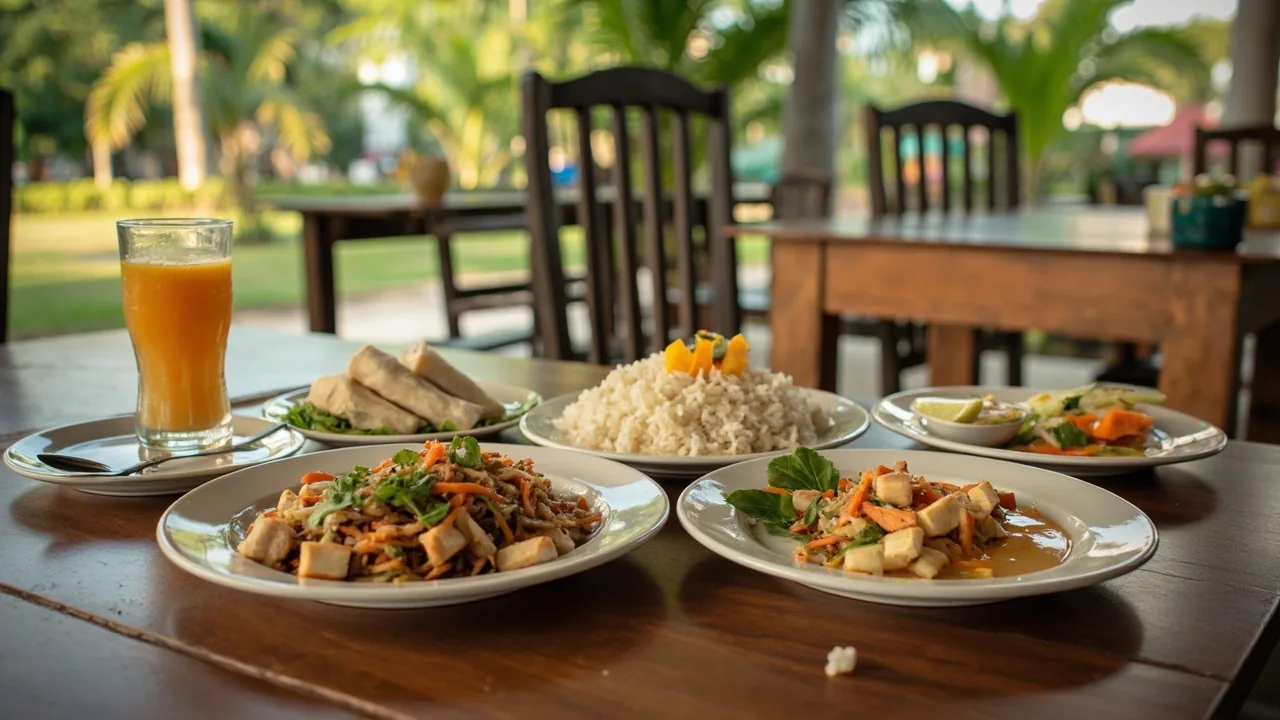
Koh Mak Vegetarian Food: Where to Eat Plant-Based
Koh Mak is small, sleepy, and mostly run by the families that built the bungalows you’ll sleep in. Eating well here as a vegetarian takes a little more planning than on Koh Chang or Koh Kood. There are not many options, but the ones that exist are good enough to stay fed for a week.
The single most important thing to know is that almost every kitchen on Koh Mak uses fish sauce and shrimp paste as a default seasoning, including in vegetable dishes. That’s normal Thai home cooking, not malice. If you are vegetarian (and especially if you are vegan or Jain), you have to ask, every time, in specific terms. The phrase cheat sheet below is worth more than any list of restaurants.
Quick Answers
| What | Answer | Price (INR) |
|---|---|---|
| Is there a dedicated vegetarian restaurant on Koh Mak? | Yes, one: Pure Vegan Heaven | ₹574-₹918 (~200-320 THB or ~$5.94-$9.51) |
| How many kitchens handle vegan requests reliably? | About 4 to 5 out of roughly 30 | , |
| Is fish sauce used in most Thai stir-fries here? | Yes, almost always by default | , |
| Average price for a veg main on the island | ₹516-₹1,004 (~180-350 THB or ~$5.35-$10.40) | ₹516-₹1,004 (~180-350 THB or ~$5.35-$10.40) |
| Cheapest safe veg meal (rice + curried veg) | ₹430 (~150 THB or ~$4.46) at family-run shacks | ₹430 (~150 THB or ~$4.46) |
| Is Koh Mak harder than Koh Chang for vegetarians? | Yes, materially fewer options | , |
| Best long-stay strategy | Lean on Pure Vegan Heaven + rotate family kitchens that handle Jay well | , |
The Local Culinary Landscape
Koh Mak sits in Thailand in Trat Province, the same stretch of coast that includes Koh Chang vegan food and Koh Kood vegan food. All three islands share the same menu DNA: grilled fish, papaya salad, massaman curry, pad thai, fried morning glory. The difference is volume. Koh Chang has roughly 200 kitchens, Koh Kood around 80, and Koh Mak maybe 30, of which only 8 or 9 stay open year-round. Off-season (May to October) hours collapse further.
The default flavour profile here, like everywhere in Thailand, is fish sauce (น้ำปลา nam pla) and shrimp paste (กะปิ krapi). They go into stir-fries, curries, fried rice, even some clear soups. Pad thai uses dried shrimp in the noodles. “Vegetable fried rice” almost always contains egg unless you stop them. Local attitude toward vegetarianism itself is friendly, just uninformed. Thai people often count seafood or egg as vegetarian, so if you say “gin Jay” (กินเจ), which means “I eat vegan / strict Buddhist vegetarian,” you get a more careful response than “gin pak” (กินผัก), which just means “eat vegetables.”
Subodh’s Pro Tip: On Koh Mak, “Jay” is a stronger word than “vegetarian.” Most kitchen aunties understand it. “Pak ruam” (ผักรวม) just means mixed veg, not necessarily veg-only.
Key Phrases in Local Script
Print this out or screenshot it on your phone. Koh Mak has fewer English speakers than Koh Chang, and the small kitchens rarely have English menus.
| English Phrase | What it Means | Local Script | Pronunciation |
|---|---|---|---|
| I am vegetarian (vegan) | No meat, fish, seafood, egg, dairy | กินเจ | gin Jay |
| No fish sauce | Skip nam pla | ไม่ใส่น้ำปลา | mai sai nam pla |
| No shrimp paste | Skip krapi | ไม่ใส่กะปิ | mai sai ka-pi |
| No egg | Skip egg | ไม่ใส่ไข่ | mai sai khai |
| No meat, no seafood | Animal products off | ไม่เอาเนื้อ ไม่เอาอาหารทะเล | mai ao nuea, mai ao ahan talay |
| No onion, no garlic | Jain-safe | ไม่ใส่หัวหอม ไม่ใส่กระเทียม | mai sai hua hom, mai sai kratiem |
| Just vegetables and rice | Simplest fallback | ผักกับข้าวอย่างเดียว | pak kap khao yang diao |
| Is there fish sauce in this? | Verify a specific dish | มีน้ำปลาไหม | mee nam pla mai |
For broader Thai veg vocabulary and the wider country picture, see Vegetarian Food in Thailand. Most of what works in Bangkok works here, just with fewer choices.
Safe Local Dishes and How to Order Them
Koh Mak does not have “street food” the way Bangkok does. There are no hawker stalls circling the port, no night market rows. Eating out means sitting down at a small open-air kitchen and pointing. The dishes below are reliably veg-friendly across the island once you order them carefully.
Pad Pak Ruam (ผักผักรวม): Mixed vegetables stir-fried with garlic. Order with “mai sai nam pla, sai kratiem thae” (no fish sauce, garlic is fine). Cabbage, morning glory, broccoli, carrots in oyster-style sauce. Most kitchens can do this. ₹344-₹516 (~120-180 THB or ~$3.57-$5.35).
Pad Krapow Jay (ผักกะเพราเจ): Holy basil stir-fry with tofu instead of pork. Specify “mai sai nam pla, sai taohu” and you’ll get a clean version. Comes with rice. Strong, peppery, satisfying. ₹430-₹574 (~150-200 THB or ~$4.46-$5.94).
Tom Yum Pak (ต้มยำผัก): Clear vegetable soup, hot and sour. Order without shrimp. Many kitchens will still default to fish sauce in the broth; ask for “tom yum pak, mai sai nam pla.” ₹344-₹459 (~120-160 THB or ~$3.57-$4.76).
Khao Pad Jay (ข้าวผัดเจ): Fried rice, vegetarian. Specify no egg, no fish sauce. The kitchen will probably default to both, so be explicit: “khao pad, mai sai khai, mai sai nam pla.” ₹344-₹430 (~120-150 THB or ~$3.57-$4.46).
Som Tam Jay (ส้มตำเจ): Green papaya salad, vegetarian. The classic version uses dried shrimp and fish sauce, so ask for “som tam Thai, mai sai boo, mai sai nam pla” (no shrimp, no fish sauce) and they’ll do a clean version with peanuts and tomato. ₹229-₹344 (~80-120 THB or ~$2.38-$3.57).
Mango Sticky Rice (ข้าวเหนียวมะม่วง): The dessert that keeps vegetarians sane across Thailand. If you want the full picture on this dish across the country, Mango Sticky Rice in Phuket covers the southern version in detail. On Koh Mak, available at most cafes during mango season (March to June). ₹229-₹344 (~80-120 THB or ~$2.38-$3.57).
Recommended Vegetarian and Veg-Friendly Restaurants
There is exactly one dedicated vegetarian kitchen on Koh Mak, plus a handful of family spots that handle vegan requests well. Below are the real places, in plain order of how often they show up in traveller reports.
Pure Vegan Heaven
The only fully vegan cafe on the island.
Food Lab
Listed in traveller shortlists of veg-friendly spots on Koh Mak.
Mama Ann
Family-run Thai kitchen mentioned in traveller shortlists.
Secret Oven
Bakery and breakfast spot mentioned in traveller shortlists.
At the Beach Kitchen
Beachside spot mentioned in traveller shortlists.
Mama Rocky’s Food and Cocktails
Evening spot mentioned in traveller shortlists.
For a more general island overview that includes the Indian-friendly spots (yes, they exist, and yes, paneer makes an appearance), see Indian food on Koh Mak.
Food Safety and Hygiene
Koh Mak’s food safety record is good. The island is small, kitchens are family-run, ingredients are fresh, and turnover is high enough that food rarely sits out. Most cases of traveller stomach trouble on Koh Mak come from tap water, ice in drinks at the cheapest shacks, and undercooked shellfish at seafood-focused spots (which you can sidestep entirely as a vegetarian).
A few practical rules:
- Drink bottled or filtered water only. The tap water on Koh Mak is not potable. Every bungalow provides a refillable bottle or a cooler.
- Avoid ice from unknown sources. Resort kitchens are fine; tiny roadside shacks are riskier during off-season.
- Peel-it-or-cook-it applies to fruit. The papaya and mango sold at Ao Soun Yai are usually fine, but wash before cutting.
- Eat where locals eat, but at peak hours. An empty kitchen at 7pm is a kitchen where the food has been sitting.
- Carry oral rehydration salts (ORS) from a pharmacy at home for traveller’s diarrhoea; consult your doctor before travel for any prescription medication.
Safety Alert: If you develop a fever above 38.5°C, blood in stool, or persistent vomiting beyond 24 hours, you need to leave the island. The clinic on Koh Mak handles cuts and scrapes, not systemic infections. The nearest proper hospital is in Trat town, a 1-hour boat + 30-minute drive away.
Getting Connected
You’ll want data on Koh Mak to look up Google Maps (the island is poorly signed), translation apps, and Grab or Bolt in case you need a ride to the port. Local SIMs from AIS, TrueMove, and DTAC are sold at the piers and at 7-Eleven on the mainland, but if you want to land with connectivity already working, an eSIM is the cleaner option. Get Nomad eSIM covers Thailand on most plans and activates the moment you land at Bangkok or Trat.
Common Food Mistakes Indians Make
These are the avoidable pitfalls that come up most often for vegetarians on Koh Mak.
Mistake 1: Trusting “vegetable” dishes on a Thai menu by default. Most Thai kitchens assume “vegetable stir-fry” still gets fish sauce and oyster sauce unless told otherwise. What happens: you order what reads as a clean veg meal and eat fish sauce unknowingly. How to avoid: use the phrase table above and confirm “mai sai nam pla” every time, even at restaurants that look veg-friendly.
Mistake 2: Ordering pad thai as a default veg option. Pad thai in Thailand contains dried shrimp in the noodles, fish sauce in the sauce, and egg unless you stop all three. What happens: you get a delicious meal with three non-veg ingredients. How to avoid: order pad thai Jay specifically, or skip it for pad pak or pad krapow.
Mistake 3: Assuming papaya salad is safe. Som tam’s defining flavour comes from fish sauce and dried shrimp. What happens: the salad looks pure veg, but it’s not. How to avoid: order “som tam Thai, mai sai boo, mai sai nam pla” or pick a different dish.
Mistake 4: Skipping protein and getting tired. Koh Mak’s veg options lean heavily toward carbs and vegetables. Travellers who stay two weeks without planning end up exhausted. How to avoid: ask for tofu (“sai taohu”) in stir-fries, keep peanuts and bananas stocked from the minimarts, and consider a week on Koh Chang or Bangkok partway through if you have flexibility.
Mistake 5: Not checking whether onion and garlic are in the dish. Relevant if you eat Jain. Most Thai kitchens, including Pure Vegan Heaven, use both as default aromatics. What happens: you accidentally eat a meal that’s not Jain. How to avoid: the “mai sai hua hom, mai sai kratiem” phrase in the table above is essential. Pure Vegan Heaven is the one place on the island where you can confirm with the staff directly.
FAQ
Is there a proper Indian restaurant on Koh Mak?
There are a couple of spots that serve a few Indian dishes, mostly curries and dals. The full rundown is on Indian food on Koh Mak. For richer Indian menus, Koh Chang is the better bet.
Can I get vegan food on Koh Mak?
Yes, but the options are narrow. Pure Vegan Heaven is fully vegan, and Food Lab and a couple of the family kitchens will do vegan with the right phrases. Don’t expect the variety of Koh Kood vegan food or Koh Chang.
Is Jain food possible on Koh Mak?
Pure Vegan Heaven is the only kitchen where you can reliably confirm onion-and-garlic-free cooking with the staff in person. Elsewhere you’ll need the phrase “mai sai hua hom, mai sai kratiem” and to verify each dish. It’s harder than in Bangkok or Chiang Mai.
How does Koh Mak compare to other Thai islands for vegetarians?
It’s the toughest of the main Trat Province islands. Koh Chang has more kitchens, more variety, and several dedicated veg options. Koh Kood is closer to Koh Mak in scale but a touch easier for vegans. For the broader country picture, the Thailand food cost per day breakdown and the Thailand vegan food tour are useful starting points.
Are there any cooking classes on Koh Mak?
A few hostels and resorts offer half-day Thai cooking sessions. These are the best place to learn how to make the veg versions of classic Thai dishes yourself. Book early in high season.
What if I’m on Koh Mak for two weeks? Will I get bored of the food?
Honestly, yes, some travellers do. For the long stay, lean on Indian food on Koh Mak and Pure Vegan Heaven as your anchors, and rotate the family kitchens that handle veg well for variety.
Subodh’s Take
Koh Mak is the kind of place you go to do nothing, and the food scene reflects that. As a vegetarian you won’t starve, but you also won’t find the variety of Koh Chang or the vegan scene of Chiang Mai. The honest play is to land knowing the phrases, eat at Pure Vegan Heaven within the first 24 hours, and build your week around a small set of family kitchens that get what “gin Jay” means. After three or four days you’ll have your regular spots, and after that the slow rhythm of the island starts to work in your favour.
Travel Insurance: Get SafetyWing travel insurance, which covers Indian travellers from around $62/month (about ₹5,900 (~$61.15)). It includes COVID, trip interruption, and medical evacuation across Southeast Asia.
— Subodh
