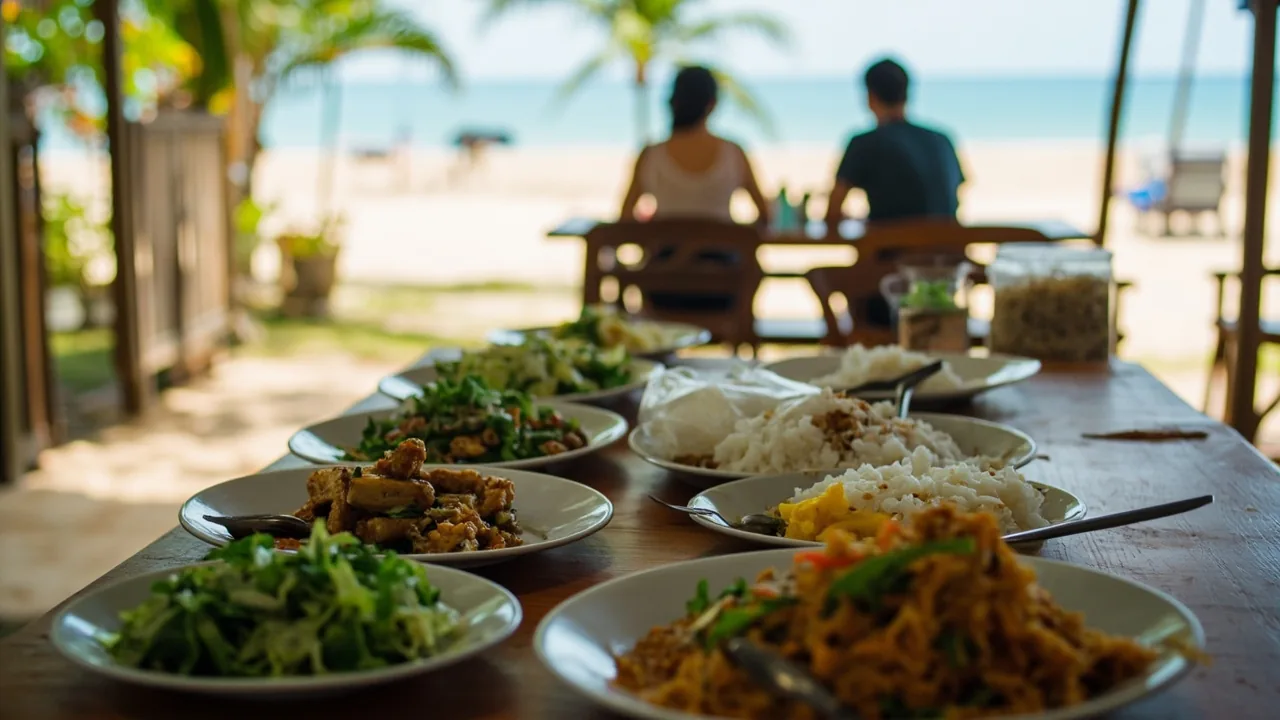
Where to Eat Vegetarian Food on Koh Kood: A Honest Guide
Koh Kood is one of Thailand’s quietest islands. Resort-heavy, scooter-only, no 7-Eleven on every corner. The food scene is roughly 80% seafood and grilled meat, with a thin but real layer of vegetarian-friendly places if you know where to look. Strict Indian veg (no onion, no garlic) is harder, not impossible, and you will need the right phrases. For related planning, see our guides on Sea Backpacking Hub and Mango Sticky Rice Phuket.
The good news: there’s Pure Vegan Heaven, a fully vegan cafe, plus a few Thai restaurants that handle Jay-style ordering well. The realistic news: you cannot wing every meal. One evening you’ll find an amazing massaman curry, the next night you’ll be eating pineapple fried rice and hoping the chef remembered to skip the fish sauce. You may also find Chiang Dao Vegetarian Food Guide Best Restaurants for Plant Based Travelers useful for this trip.
This guide lists exactly what is open, what to order, what to skip, and the phrases that save the day.
Quick Answers
| What | Answer | Price (INR) |
|---|---|---|
| Fully vegan cafe on Koh Kood? | Yes, Pure Vegan Heaven on the west coast | ₹115-₹575 (~$1.19-$5.97) |
| Cheapest veg meal on the island? | Pineapple fried rice, veggie pad thai at local spots | ₹143-₹287 (~$1.48-$2.98) |
| Best for an Indian-veg fix? | Resort kitchens with North Indian options, occasional pop-ups | ₹287-₹575 (~$2.98-$5.97) |
| Do Thai kitchens understand “no fish sauce”? | Yes, most do. Say “mai sai nam pla” (ไม่ใส่น้ำปลา) | Free |
| Highest rated dinner spot for vegetarians? | Mama Ann (home-style Thai, easy to customize) | ₹230-₹431 (~$2.39-$4.47) |
The Local Culinary Landscape
Koh Kood’s food scene is built on four pillars: fresh seafood off the boat, grilled meat on outdoor kitchens, Thai curries, and a small but growing plant-based set. There are no hawker stalls in the way Bangkok or Chiang Mai have hawker stalls. Most eating happens at your resort restaurant, the handful of independent spots scattered along the two main roads, and beach shacks that spring up at Klong Chao, Ao Yai, and Bang Bao.
Here’s what trips up vegetarian travellers. Fish sauce (น้ำปลา, nam pla) and shrimp paste (กะปิ, ka pi) go into almost everything savory. A “vegetable” stir-fry at most places is cooked in the same wok as a meat dish, with oyster sauce and fish sauce ladled in by default. Egg is in pad thai and most fried rice unless you ask. Chicken stock is the base for many soups, including the tom yum that looks safe on the menu.
Local attitudes toward vegetarianism are polite but loose. Thai people will often assume “vegetarian” means “no red meat, fish is fine” unless you specifically say “no seafood.” Waiters at fancier restaurants (Mama Ann, the larger resorts) are used to dietary requests. Smaller shacks may smile, nod, and deliver a dish with shrimp in it because the cook forgot. Always confirm your order twice.
A practical workaround that works all over Thailand: ask for “Jay” (เจ) food. Jay is a Thai-Buddhist vegan tradition that excludes meat, seafood, egg, dairy, onion, garlic, and often strong-smelling vegetables. A yellow flag with red Chinese characters (เจ) marks Jay restaurants during the annual Jay festival. Year-round, the same word gets you vegan preparations at any decent Thai kitchen. See vegetarian food in Thailand for the full Thai-wide breakdown.
Subodh’s Pro Tip: Print or screenshot the phrases below before you get on the ferry. Koh Kood has patchy signal in the south, and you cannot Google-translate your way out of a kitchen that just put shrimp paste in your curry.
Key Phrases in Local Script
| English Phrase | What it Means | Local Script | Pronunciation |
|---|---|---|---|
| I am vegetarian (vegan) | Asks for the Jay preparation, no meat or seafood | ขอเจค่ะ/ครับ | kor jay ka / krap |
| No fish sauce | The single most useful phrase on Koh Kood | ไม่ใส่น้ำปลา | mai sai nam pla |
| No shrimp paste | Critical for curries, stir-fries, fried rice | ไม่ใส่กะปิ | mai sai ka pi |
| No meat or seafood | General-purpose safeguard | ไม่ใส่เนื้อ ไม่ใส่กุ้ง | mai sai nuea, mai sai kung |
| No egg | For pad thai, fried rice, tofu scrambles | ไม่ใส่ไข่ | mai sai khai |
| No dairy | Vegan-friendly request | ไม่ใส่นม | mai sai nom |
| No onion, no garlic | Strict Indian veg, Jain-friendly | ไม่ใส่หัวหอม ไม่ใส่กระเทียม | mai sai hua hom, mai sai kratiem |
| Is there fish sauce in this? | Cross-check before eating | มีน้ำปลาไหม | mee nam pla mai |
| Spicy OK for me | Lets the chef skip the de-spicing if you want real heat | เผ็ดได้ | phet dai |
| Not spicy | The default safer choice if you’re unsure | ไม่เผ็ด | mai phet |
A useful mix-and-combine: “Kor jay, mai sai nam pla, mai sai ka pi, mai sai khai” gets you a credible vegan dish almost anywhere on the island. If you want strict Indian veg without onion and garlic, add “mai sai hua hom, mai sai kratiem.”
Safe Local Street Food Dishes
There’s no “street food” in the Bangkok sense on Koh Kood, but the beach shacks and small independent restaurants serve the same Thai classics. The following dishes are either vegetarian or easy to make vegan with the phrases above.
Pad Thai Jay (ผัดไทยเจ) The classic stir-fried rice noodles with tofu, bean sprouts, peanuts, lime. Order it with “mai sai nam pla, mai sai khai” and you get a vegan version. Most kitchens on Koh Kood will know this request. Expect ₹229-₹429 (~80-150 THB or ~$2.37-$4.45) at a shack, ₹429-₹629 (~150-220 THB or ~$4.45-$6.53) at a sit-down restaurant like Mama Ann.
Pineapple Fried Rice (ข้าวผัดสับปะรด) Fried rice with pineapple chunks, cashews, raisins, and veg. Egg-free at most island kitchens, but always confirm the fish sauce. Sweet, mild, great for travellers who want a break from chili heat. ₹286-₹515 (~100-180 THB or ~$2.97-$5.34).
Massaman Curry (มัสมั่น) A mild, peanutty, slow-cooked curry with potato and onion. Originally a meat dish, but most kitchens do a vegetarian version with tofu or just extra veg on request. Watch for shrimp paste in the curry base. ₹429-₹715 (~150-250 THB or ~$4.45-$7.42).
Morning Glory (ผัดผักบุ้ง) Stir-fried water spinach with garlic and chili. Order without the garlic if you’re strict Indian veg, and skip the oyster sauce (“mai sai nam man hoy”). Tastes clean and fresh. ₹229-₹343 (~80-120 THB or ~$2.37-$3.56).
Mango Sticky Rice (ข้าวเหนียวมะม่วง) The single best dessert in Thailand and totally plant-based. Coconut milk, sticky rice, fresh mango. Vegan. ₹229-₹343 (~80-120 THB or ~$2.37-$3.56) from April to August when mango is in season, ₹286-₹429 (~100-150 THB or ~$2.97-$4.45) off-season.
Tom Yum Hed (ต้มยำเห็ด) The mushroom version of tom yum. Order “Jay, mai sai nam pla.” Good kitchens deliver a sour, hot, lemongrassy broth that has nothing animal in it. ₹343-₹515 (~120-180 THB or ~$3.56-$5.34).
Subodh’s Pro Tip: When a restaurant has Pure Vegan Heaven on the same road, the owner usually knows Jay prep. When a restaurant is a beach shack with a one-page Thai menu, order the simple stir-fries only. Complex curries at smaller places are where shrimp paste sneaks in.
Recommended Vegetarian Restaurants
Koh Kood has fewer dedicated veg spots than Koh Chang or Koh Samui, but the ones that exist are genuinely good. Listed roughly from easiest to find to most tucked away.
Pure Vegan Heaven The only fully vegan cafe on the island, west coast near the Klong Chao area. Plant-based versions of Thai classics, fresh juices, smoothie bowls, proper vegan desserts. Run by a Thai-Japanese couple who understand the difference between “vegetarian” and “vegan.” Portions are generous and prices sit between ₹229-₹715 (~80-250 THB or ~$2.37-$7.42). If you want a guaranteed safe meal without speaking a phrase, this is your spot. Mention the staff call-out specifically: MAMA (Massaman, Asian, Mushroom, Avocado) curries are reliably good.
Mama Ann Family-run, home-style Thai place near Khlong Yai Ki. Cabbage stir-fry with tofu, vegetable curries, fresh spring rolls. The cooks here use the same wok as everyone else, but they consistently remember to skip the fish sauce when asked. Mama Ann’s tom yum hed (mushroom) and pineapple fried rice are reliable. ₹286-₹572 (~100-200 THB or ~$2.97-$5.94) per dish. Travellers report the massaman with tofu is one of the better versions of that curry on the island.
Mama Rocky’s Food and Cocktails A fusion spot with a bigger menu than most, including several vegetarian plates. The kitchen is used to non-meat-eaters and handles customizations cleanly. The Thai salads (yam) with tofu are standouts, as are the mocktails. Slightly higher prices, ₹429-₹858 (~150-300 THB or ~$4.45-$8.90) per dish, but a good date-night pick.
Secret Oven Comfort food specialist with strong veggie options. Roasted vegetable plates, salads, hearty soups, fresh-baked bread. Good for breakfast or a break from chili-heavy Thai food. Useful if you’re feeling digestive-stressed or just want something gentle. ₹343-₹629 (~120-220 THB or ~$3.56-$6.53).
Food Lab On the experimental end of the Koh Kood scene. Plant-based bowls, smoothie mixes, veg-heavy brunch items. Smaller place, often busy mid-morning. ₹286-₹572 (~100-200 THB or ~$2.97-$5.94).
Subodh’s Pro Tip: For the strict Indian-veg travellers who want a real dal, roti, and paneer fix, the options on Koh Kood are limited. Several resorts (Soneva Kiri side, high-end, Cape Beach, etc.) have Indian dishes on rotating menus. Bang Bao Beach Resort and a few places in Ao Yai village occasionally run small Indian pop-ups during high season. If this is non-negotiable for you, plan your trip around Koh Chang or Bangkok for the heavy Indian-food days, and use Koh Kood for the natural food and resort buffets.
What About Indian Restaurants Specifically?
Strictly Indian-restaurant options on Koh Kood are thin. The bigger resorts bring in North Indian chefs seasonally, and you’ll find a few hybrid Thai-Indian menus at places like the larger boutique hotels. Two patterns show up.
First, the resort kitchen. Most mid-range and high-end resorts have a “vegetarian Indian” section on their a la carte menu, even when they are not specifically Indian restaurants. Palms Beach, Koh Kood Resort, and a few others do this consistently. Mains ₹715-₹1,144 (~250-400 THB or ~$7.42-$11.87), sometimes inflated compared to local places. Quality varies. Travellers report mixed results, with the best being Thai cooks who’ve learned basic Indian techniques.
Second, the popup. During high season (November to March), small Indian-run shacks pop up near Ao Yai and Bang Bao. They are not on Google Maps consistently, so ask locally when you arrive. Curries ₹429-₹715 (~150-250 THB or ~$4.45-$7.42).
If you’re planning a longer veg-heavy trip, route through Koh Chang too. The Indian food scene there is meaningfully larger. See Indian food in Koh Mak for the neighbour island’s options.
Food Safety and Hygiene
Koh Kood’s food-safety story is different from mainland Thailand. The island has fewer stalls, longer supply chains, and more imported ingredients. Practically, this means you lean on resort kitchens and the established restaurants for most meals and treat random shacks with the same caution you’d treat any rural kitchen.
Wash your hands or carry sanitiser. Drink bottled water only. Ice at the bigger restaurants is fine, ice at the tiniest shacks can be risky; if in doubt, ask “น้ำแข็งสะอาดไหม” (nam khreng sa-at mai, “is the ice clean?”). Avoid raw seafood. Mango sticky rice and cut fruit are fine when freshly cut in front of you.
Food poisoning on Koh Kood is rarer than in Bangkok or Vientiane, but distance from a hospital makes it scarier. The island clinic in Khlong Yai Ki handles basics, but serious cases go to Trat on the mainland. For a trip to such a remote island, travel insurance with medical evacuation is genuinely worth the cost. Hospital bills in Trat or Bangkok private hospitals run ₹14,295-₹142,945 (~5,000-50,000 THB or ~$148.38-$1,483.77) for non-trivial cases, so don’t skip the cover.
Getting Connected
A working phone with translation apps is genuinely useful on Koh Kood. AIS and TrueMove both cover the populated west coast; signal gets patchy on east-coast beaches and Klong Chao waterfall road. Airalo and Nomad both sell eSIMs that activate on landing at Bangkok or Trat, then work on Koh Kood. Get Nomad eSIM is the easiest option if you’d rather not visit an AIS counter. Offline Google Maps downloaded for Koh Kood before you arrive saves real time.
For cooking classes and food experiences, Koh Kood has a few hands-on kitchens. Seafood-focused by default but most are happy to do a vegetarian version. See Koh Kood food experiences on GetYourGuide lists the current options.
Common Food Mistakes Indians Make
Mistake 1: Assuming “vegetable stir-fry” is safe. What happens: Most islands use oyster sauce and fish sauce as defaults. You get a dish that tastes fine, then a stomach ache four hours later. How to avoid: Always specify “mai sai nam pla, mai sai nam man hoy” (no fish sauce, no oyster sauce).
Mistake 2: Not specifying “no egg” in pad thai and fried rice. What happens: Egg sneaks into dishes where you wouldn’t expect it. Chicken stock is the next surprise, in soups marked “vegetable.” How to avoid: Order with “mai sai khai” (no egg) and confirm the soup base is vegetable, not chicken.
Mistake 3: Trusting “vegetarian” by itself. What happens: Some Thai staff hear vegetarian and assume pescatarian, since fish and seafood are culturally separate from “meat” in Thai food. The dish arrives with shrimp. How to avoid: Use “kor jay” instead of just “vegetarian” at smaller places.
Mistake 4: Eating only resort food the whole trip. What happens: Resorts are convenient but pricey. On Koh Kood, food at independent spots is genuinely cheaper and often better, but you need the phrases. Missing out on the local scene wastes the trip. How to avoid: Aim for a 50/50 split: half your meals at the resort kitchen, half at Pure Vegan Heaven, Mama Ann, Mama Rocky’s.
Mistake 5: Not carrying water and snack backups. What happens: Koh Kood has long stretches of road with no shops. If your scooter ride ends in a remote bay and the shack is closed, you have no fallback. How to avoid: Keep a bottle of water, peanut packets, and biscuits in your daypack. Mango sticky rice is dessert, not a substitute for a meal.
Eating By Day: A Realistic Sample Plan
Day 1, west coast, Klong Chao: Breakfast at the resort. Lunch at Pure Vegan Heaven (smoothie bowl + veg curry, ~₹572 (~200 THB or ~$5.94)). Dinner at Mama Ann (mushroom tom yum + massaman with tofu, ~₹858 (~300 THB or ~$8.90)). Snacks and water from a 7-Eleven or local mini-mart.
Day 2, north coast, Ao Yai: Breakfast at the resort. Lunch at a shack with “kor jay pad thai” (~100-150 THB). Afternoon beach time. Dinner at Mama Rocky’s (yam salad with tofu, mocktail, ~₹858 (~300 THB or ~$8.90)).
Day 3, east coast, Bang Bao: Breakfast at your accommodation. Lunch at Food Lab (vegan bowl, ~₹429-₹572 (~150-200 THB or ~$4.45-$5.94)). Afternoon hike to Klong Chao waterfall. Dinner at Secret Oven (roasted veg plate + soup, ~₹715-₹858 (~250-300 THB or ~$7.42-$8.90)).
This comes to around ₹3,431-₹4,288 (~1,200-1,500 THB or ~$35.61-$44.51) per day on food if you mix kitchens, which is a reasonable per-day food budget for a mid-range traveller. Tight budget travellers can run ₹1,715-₹2,573 (~600-900 THB or ~$17.81-$26.71) a day sticking to rice and noodle dishes at shacks. Resort-only dining jumps the bill to 2,000-3,000 THB daily.
The current rate is roughly 1 INR = 0.35 THB, so 1,500 THB a day is around 430 INR at the time of writing, and the per-day totals in THB translate cleanly back to rupee budgets when you do the math.
FAQ
Is the Koh Kood resort food safe for Indian vegetarians?
Yes, mostly. Mid-range and high-end resorts have vegetarian sections and handle Jay requests well. Ask at check-in if the chef can prepare a no-onion, no-garlic Indian veg meal. If the answer is yes, your biggest problem is solved for the trip. If the answer is no, shift your eating to independent restaurants.
Can I find completely plant-based (vegan) food on Koh Kood?
Yes. Pure Vegan Heaven is the anchor. Mama Rocky’s has clear vegan-labelled plates. Secret Oven has several explicitly vegan items. Outside these three, you’ll need the phrases.
How common is fish sauce in Thai cooking, really?
It’s in roughly 80% of savory Thai dishes that don’t already contain meat. This includes “vegetable” stir-fries, fried rice, soups, salads, and curries. Always specify.
Is seafood considered vegetarian in Thailand?
Frequently, yes. Thai food categories fish separately from “meat” in many traditional recipes. If you say “vegetarian” without further clarification, some kitchens will serve you fish. Always follow up with “mai sai kung” (no shrimp), “mai sai pla” (no fish), “mai sai hoo” (no shellfish).
Can I get Jain food on Koh Kood?
Strict Jain food (no onion, no garlic, no root vegetables in some interpretations) is unavailable at dedicated Indian restaurants on the island. You can manage a credible Jain-style vegan meal by ordering Jay food with “mai sai hua hom, mai sai kratiem” (no onion, no garlic). Carry dry snacks and backup food if your trip is longer than a few days.
What should I do if I’m sick after eating?
Most stomach issues on Koh Kood clear within 24 hours. Drink bottled water, eat plain rice, take activated charcoal or electrolyte sachets. If symptoms last more than 48 hours, see the island clinic in Khlong Yai Ki, or take the ferry back to Trat for proper medical care. Travel insurance with evacuation coverage is essential on this island.
How do I handle a strict veg traveller who also wants sunscreen, mosquito repellent, and toiletries without animal products?
Most Thai pharmacies carry basic vegan cosmetics. 7-Eleven stocks “natural” labelled options at the ferry port in Trat. Bring your own if it matters, the island has limited dedicated vegan retail.
Once you know the phrases and you’ve eaten at Pure Vegan Heaven, Koh Kood’s food scene settles down. Eat at the spots your body trusts, default to stir-fries and curries you can confirm are Jay-style, and use the independent restaurants as your main loop. You’ll eat well, the food is cheap by Thai standards, and the slow pace is part of the point.
