Overland Border Crossings in Southeast Asia: Routes, Timings & Tips for Indian Backpackers
📍 Region: Mainland Southeast Asia (Thailand, Laos, Cambodia, Vietnam, Malaysia)
⏱️ Fastest crossing: 30 minutes (Aranyaprathet, Poipet, visa-on-arrival queue aside)
💰 Cheapest crossing: Free land border, only visa fees apply
✅ Most backpacker-friendly crossing: Chiang Khong, Huay Xai (slow boat) and Aranyaprathet, Poipet
Every overland border crossing southeast asia accepts Indian passport holders at the land checkpoints, and most of them offer visa-on-arrival. The bad news: the rules, fees, accepted currencies, and scams differ at every single post, and the wrong turn at the wrong border has cost travellers a full day. This guide walks through every land option from Thailand to Cambodia, Laos, Vietnam, and Malaysia, with verified 2026 visa fees and timings for each corridor.
Visa fees and border procedures below reflect the latest verified data from Thai, Lao, Cambodian, Vietnamese, and Malaysian immigration authorities as of mid-2026. Operating hours and fees shift without notice, so always double-check 48 hours before you travel.
Quick Answers
| What | Answer | Price (INR) |
|---|---|---|
| Do Indian passport holders need a visa in advance? | Thailand: visa-free 60 days. Cambodia: carry $30 for arrival visa. Laos: carry $30 for arrival visa. Vietnam: e-Visa $25 online. Malaysia: free eNTRI (15 days) or $22 eVISA (30 days). | ₹0–₹2,500 |
| Typical visa-on-arrival fee at Thai land borders? | Indians use visa-free 60-day entry (no fee). VoA (15 days) costs ₹5,773 (~$58) but is less useful. | ₹0 (visa-free) |
| Typical border crossing time end-to-end? | 30 min (Aranyaprathet, Poipet, smooth day) to 4 hours (Chiang Khong, Huay Xai with slow boat). | ₹0 |
| Cheapest transport between Thailand and Cambodia? | Aranyaprathet, Poipet local bus via the border: ~₹717 (~250 THB or ~$7.45) total. | ₹717 (~$7.44) |
| Cheapest transport between Thailand and Laos? | Chiang Khong, Huay Xai Mekong slow boat (2 days, Pak Beng stop): ~₹4,160 (~1,450 THB or ~$43.19). | ₹4,160 (~$43.19) |
The Main Corridors at a Glance
Five corridors carry 90% of backpacker traffic on the mainland, ranked from most-used to least-used.
| Corridor | Main border post | VoA for Indians? | Cheapest | Fastest |
|---|---|---|---|---|
| Thailand to Cambodia (east) | Aranyaprathet, Poipet | Cambodia: carry $30 | Local bus | Minivan |
| Thailand to Laos (north) | Chiang Khong, Huay Xai | Laos: carry $30 | Slow boat | Direct bus |
| Thailand to Laos (northeast) | Nong Khong, Vientiane | Laos: carry $30 | Train to Nong Khai + tuk-tuk | Train + bus |
| Cambodia to Vietnam (south) | Bavet, Moc Bai | Vietnam: $25 e-Visa online | Local bus | Private car |
| Cambodia to Vietnam (north) | O Smach, Chau Doc / Prek Chak, Ha Tien | Cambodia: carry $30, Vietnam: $25 e-Visa | Shared taxi | Minivan |
| Malaysia to Thailand | Sadao, Bukit Kayu Hitam or Padang Besar | Thailand visa-free, Malaysia eNTRI free | Train to Butterworth + KTM | ETS train |
Pro Tip: Don’t try to “do it all” in one trip. The Bangkok, Chiang Mai, Huay Xai, Luang Prabang, Vientiane, Phnom Penh, Siem Reap loop takes a minimum of 3 weeks if you want to enjoy it. Two weeks is a sprint that leaves no time to recover from delays. Planning the wider region? Our Southeast Asia backpacking hub covers the full multi-country route.
Thailand → Cambodia: Aranyaprathet,Poipet
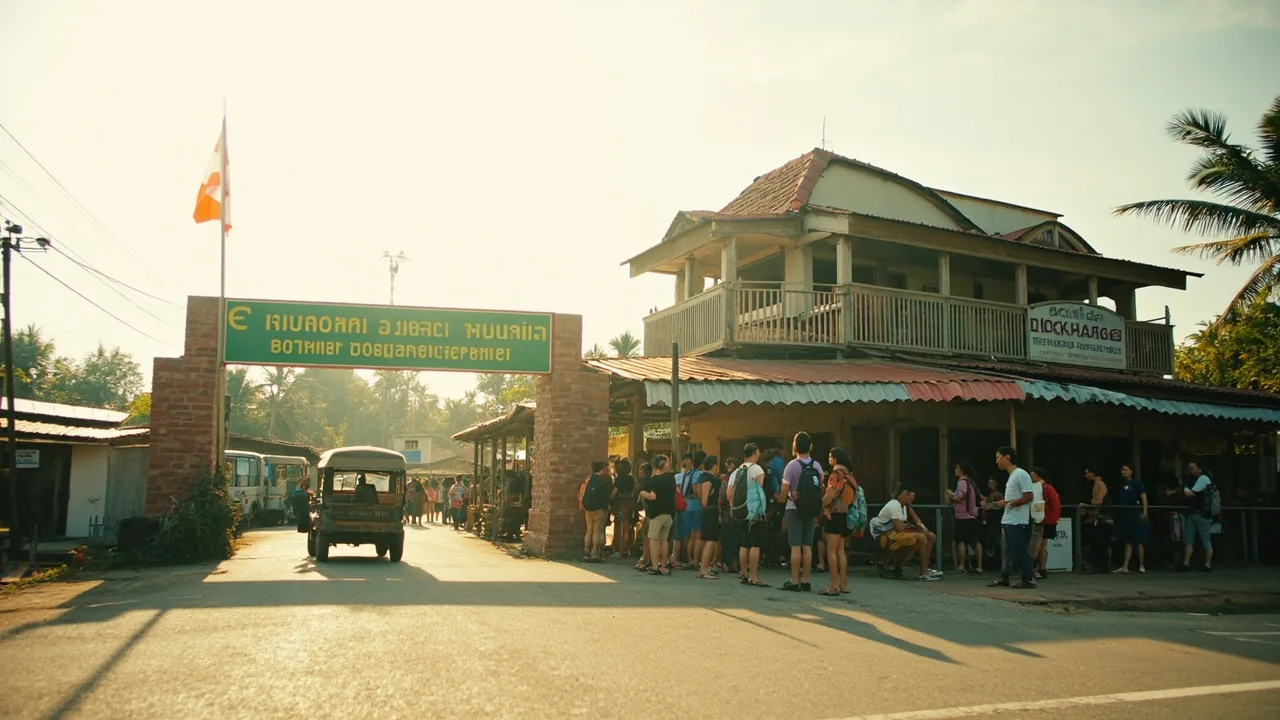
This is the workhorse border. Almost every first-time backpacker crosses here because it sits on the train line between Bangkok and the Cambodian beaches of Sihanoukville.
On the Thai side: Take a train from Bangkok’s Krung Thep Aphiwat (Bang Sue Grand) terminal to Aranyaprathet. The State Railway of Thailand runs 2–3 services daily, fares run ₹143-₹717 (~50-250 THB or ~$1.49-$7.45) depending on class. From Aranyaprathet station, a tuk-tuk or songthaew to the border post costs ₹172-₹287 (~60-100 THB or ~$1.79-$2.98). Don’t let anyone at the train station tell you the border is “closed today” or that you need a specific “tourist bus.” That’s the classic scam; local buses and shared songthaews run all day.
Border process for Indians: You exit Thailand (no fee), walk ~500 metres across no-man’s land, then arrive at the Cambodian immigration hall. Cambodia grants visa-on-arrival to Indians at this post: carry $30 cash (₹2,500) for a 30-day tourist visa. You’ll need: passport (6+ months validity), one passport photo, the fee in cash (Thai baht, US dollars, or Cambodian riel accepted), and the arrival form filled out in advance (available on the right side of the queue).
On the Cambodian side: Once stamped in, walk out to the bus terminal. Buses to Siem Reap run ₹191-₹214 (~8,000-9,000 KHR or ~$1.98-$2.23), taking 7–8 hours with one food stop. Buses to Phnom Penh cost ₹286 (~12,000 KHR or ~$2.97), about 6 hours. Direct minivans to both cities cost more, ₹357-₹476 (~15,000-20,000 KHR or ~$3.71-$4.95), and are worth it if you’re short on time.
Common scams: “Visa unavailable today” (lie, walk to the next counter), unofficial “helpers” who grab your passport, gem shop detours on buses to Phnom Penh, and inflated ATM charges. Use the official ATMs inside the immigration hall or the ABA/KHQR route via apps.
Pro Tip: Compare prices on 12go for the Bangkok to Siem Reap direct bus: it bypasses Aranyaprathet entirely, crosses the same border with a guide, and costs about ₹4,304 (~1,500 THB or ~$44.68) including the visa fee. Slightly more than DIY, hours less stress.
Thailand → Laos: Chiang Khong,Huay Xai (Slow Boat)
This is the famous Mekong slow boat, and it earns the reputation. Two days on the river, a night in the small town of Pak Beng, then arrival at Luang Prabang. It’s tourism, but it’s good tourism.
Getting to Chiang Khong from Chiang Mai: Buses run from Chiang Mai Arcade Bus Terminal, taking 6–7 hours, fares ₹1,004-₹1,435 (~350-500 THB or ~$10.42-$14.89). See our Bangkok to Chiang Mai guide for the full route options to Chiang Mai first. Alternatively, book a combined minivan + slow boat package from Chiang Mai; these run ₹4,304-₹7,173 (~1,500-2,500 THB or ~$44.68-$74.46) and handle the whole transfer.
Border process: At Chiang Khong, you walk across the Thai,Lao Friendship Bridge. Lao visa-on-arrival for Indians: carry $30 (₹2,500) payable in USD, Thai baht, or Lao kip. Some travellers report being quoted higher amounts at this post; the official rate is $30. Bring crisp USD bills for the smoothest process.
The slow boat: Two-day boats depart at 11:00, with a night in Pak Beng (boats moor for the night, you sleep in a guesthouse). Ticket costs ₹3,586-₹4,160 (~1,250-1,450 THB or ~$37.23-$43.19) including the Pak Beng guesthouse. The boat has padded bench seats, a small shop selling Beerlao and instant noodles, and a toilet that mostly works. Bring a cushion, sunscreen, and a download of podcasts because there is no WiFi and patchy signal.
Pro Tip: If you want the river experience but not the two-day commitment, the Mekong speedboat from Huay Xai to Luang Prabang runs in 6 hours, costs around ₹3,500 (~$35), and skips the Pak Beng overnight. It’s louder and rougher than the slow boat, but it gets the job done in one stretch.
Thailand → Laos: Nong Khong,Vientiane (Train + Tuk-Tuk)
The easiest border crossing in Southeast Asia, full stop. The Thai train literally drops you 3 km from the bridge, a tuk-tuk drops you at the bridge, you walk across, and you’re in Vientiane.
Getting to Nong Khai: From Bangkok, the sleeper train to Nong Khai runs nightly, taking 11 hours, fares ₹2,295-₹4,304 (~800-1,500 THB or ~$23.83-$44.68) depending on class. From Chiang Mai, the direct bus to Nong Khai takes 12 hours, or fly to Udon Thani and connect by bus.
Border process: Walk across the First Thai,Lao Friendship Bridge. The Lao visa-on-arrival fee for Indians: carry $30 (₹2,500) at this post too. Office hours are 06:00–22:00, among the longest of any border in the region. The walk from the bridge to the central bus station in Vientiane is 30 minutes; tuk-tuks cost ₹215-₹344 (~50,000-80,000 LAK or ~$2.24-$3.58).
Why this crossing is underrated: Almost no scams, English widely spoken, the Vientiane side is calm and well-organized, and you’re already in the capital. Most travellers use it as the gateway from northern Thailand to Vientiane and then onward to Vang Vieng.
Cambodia → Vietnam: Bavet,Moc Bai (Ho Chi Minh City Route)
The only direct land crossing between Ho Chi Minh City and Phnom Penh, and the busiest Cambodia, Vietnam border.
Border process for Indians: Vietnam requires Indian passport holders to have an e-Visa before arrival. Apply at the official government portal (https://evisa.xuatnhapcanh.gov.vn), $25 (₹2,085), 3 working days processing. Cambodia grants visa-on-arrival on arrival, carry $30 (₹2,500), payable in USD or Thai baht.
Transport: Buses between HCMC and Phnom Penh via this border run 12–15 times a day, ₹963-₹2,408 (~10-25 USD), 6–7 hours including border formalities. Well-known operators on this route include Giant Ibis and Mekong Express; they handle the visa run for you. The local bus option is the cheapest at the border, but you’ll queue separately and handle your own forms.
Pro Tip: Don’t try to do a “visa run” from HCMC into Moc Bai for a same-day Vietnam e-Visa renewal. The day trip is doable but exhausting, and you’ll spend 3 hours at each immigration post. Plan at least one night on the Cambodian side if you have an onward flight.
Cambodia → Vietnam: Prek Chak,Ha Tien or O Smach,Chau Doc (Backpacker Routes)
If you’re heading from Koh Rong or Sihanoukville to the Mekong Delta, or from Siem Reap to Ha Tien / Chau Doc, these are your crossings. Smaller, less crowded, and faster than the Bavet,Moc Bai option.
Prek Chak,Ha Tien: Buses from Sihanoukville via this border run 6–8 hours including the border, costs around ₹2,500 (~30 USD). Vietnam side drops you in Ha Tien, from where buses continue to Rach Gia, Can Tho, or HCMC.
O Smach,Chau Doc: Mainly used by overlanders heading to Angkor Wat from Bangkok via the Aranyaprathet,Poipet corridor, then south through Cambodia and across to Vietnam. This crossing is quieter than Bavet and the officials are friendlier.
For a deep dive on the specific scams at these crossings, the Prek Chak,Ha Tien guide covers it in detail.
Malaysia → Thailand: Padang Besar or Sadao,Bukit Kayu Hitam
The land crossing between Peninsular Malaysia and southern Thailand. Two posts, both easy.
Padang Besar: Sits on the KTM ETS railway line between KL and Butterworth, and connects directly to Hat Yai via train. This is the crossing most travellers use if they’re heading from Kuala Lumpur or Penang to Ko Lipe, Ko Lanta, or Bangkok. Border runs 05:00–22:00 daily.
Sadao,Bukit Kayu Hitam: The road crossing, used by buses running between Kuala Lumpur, Penang, and Hat Yai or Bangkok. Bus tickets run ₹1,891-₹3,310 (~80-140 MYR or ~$19.63-$34.36) for the full KL. Hat Yai run.
Visa situation: Thailand: Indian passport holders are currently visa-free at land borders for 60 days; if that changes, VoA availability at these specific posts has been inconsistent, so carry an onward ticket proof. Malaysia offers eNTRI (free, 15 days) or eVISA (₹1,800 / ~$22, 30 days) to Indians at both posts. Apply online before travel; no VoA is available for Indians at Malaysian land borders.
Documents You Need at Every Land Border
Indian travellers regularly get turned back at land borders for missing one of these. Carry all six, every time.
| Document | Why |
|---|---|
| Passport (6+ months validity, 2 blank pages) | Immigration stamps need both |
| Printed e-Visa confirmation (Vietnam) | Required at the Cambodian-Vietnamese borders, even with VoA on the other side |
| USD cash, crisp bills | Accepted everywhere; the universal fallback when local currency kiosks are closed |
| Passport photos (2) | Cambodia requires one; Laos sometimes asks; backup is always useful |
| Proof of onward travel | Border agents occasionally ask for a bus or flight ticket out |
| Travel insurance proof | Not required at land borders, but a smart carry; the SafetyWing travel insurance for Indian travellers covers the entire region |
If you’re carrying more than USD 3,000 equivalent in cash, declare it on both sides. The Thai customs form on exit asks, and lying triggers a fine.
Indian Passport Quirks by Country
- Thailand: 60-day visa-free entry for Indians was introduced in 2024 and runs through at least 2026. Verify current status on the Royal Thai Embassy site before you travel. VoA at land borders costs ₹5,773 (~2,000 THB or ~$58) for 15 days but is less useful than the visa-free option.
- Laos: Carry $30 (₹2,500) for visa-on-arrival at every land border. Some posts accept baht, some don’t. Bring USD.
- Cambodia: Carry $30 (₹2,500) for visa-on-arrival at every land border for Indians. E-Visa also accepted, $36 (₹3,000), apply at evisa.gov.kh.
- Vietnam: e-Visa mandatory for Indians since 2022; VoA was discontinued. Apply at the official government portal only; the dozens of “vietnam-visa.com” sites charge 3x the official fee.
- Malaysia: No VoA for Indians. eNTRI (free, 15 days) or eVISA (₹1,800 / ~$22, 30 days) available online before travel.
Safety Alert: Scams at Southeast Asian land borders cluster around three patterns: unofficial “helpers” who grab your passport (drop it on the counter, walk away), inflated visa fees quoted in Thai baht or Lao kip (always ask for the USD rate), and transport drivers who detour to gem shops or fake “tourism centres.” Walk past anyone offering unsolicited help at the border gate. For a full rundown, the scams-to-avoid-Laos-Vietnam-border guide is worth a read.
When NOT to Cross Overland
- Monsoon (June to October): The Chiang Khong,Huay Xai slow boat runs year-round but Pak Beng guesthouses flood occasionally in August. The Mekong Delta ferries from Chau Doc and Ha Tien get cancelled in heavy rain.
- Cambodian New Year (mid-April) and Thai New Year (Songkran, also mid-April): Borders stay open but staff are slow, and transport on both sides is fully booked 2–3 days out.
- Buddhist holidays in Laos (Boun That Luang, late October/early November): Nong Khai and Huay Xai crossings see small surges.
- Any announced border closure: Check the official MEA travel advisory page (mea.gov.in) and the destination country’s own government site within 48 hours of travel.
Getting Connected
SIM coverage is patchy on the slow boat between Huay Xai and Luang Prabang, and on the Aranyaprathet,Poipet bus once you leave Thai territory. Buy a local SIM on arrival in each country; AIS and DTAC work in Thailand, Unitel and Lao Telecom in Laos, Smart and Cellcard in Cambodia, Viettel and Mobifone in Vietnam. If you’d rather skip the airport SIM queue, the Get Nomad eSIM covers all five countries on regional plans and activates before you land.
FAQ
How much cash should I carry for a land border crossing? Bring ₹19,266-₹28,899 (~200-300 USD) in mixed denominations. Small bills (₹96 (~1 USD), 5, 10, 20) for visa fees and tuk-tuks, one or two ₹4,816 (~50 USD) or 100 notes as backup. ATMs at major borders work but charge ₹574-₹1,148 (~200-400 THB or ~$5.96-$11.91) per withdrawal.
Can I cross multiple land borders on one visa? Most ASEAN tourist visas are single-entry. Vietnam’s e-Visa is the only one that allows multiple entries (since 2023). If you plan a multi-country loop, plan a fresh visa for each country except Vietnam.
What happens if I overstay by one day?
Thailand charges a flat fine of ₹57,382 (20,000 THB or $10) per day for the first 30 days. Vietnam overstays can result in detention and fines of ₹4,816 (~$50) or more per day. Don’t risk it.$595) for overstays up to 90 days. Cambodia charges around ₹2,890 ($30) per day. Laos charges around ₹963 (
Is it safe for solo female Indian travellers? Yes, with the usual precautions. Stick to daytime crossings, arrive before 16:00, and pre-book transport to the next city rather than sorting it at the border. The Aranyaprathet,Poipet and Nong Khong,Vientiane posts are the safest.
Do I need a yellow fever certificate? Only if you’re arriving from a country with risk of yellow fever transmission (mostly parts of Africa and South America). If you fly direct from India, you don’t need one.
Subodh’s Take
The land borders in Southeast Asia are far easier than the forums make them sound, once you’ve done one. The trick is to start with Nong Khai, Vientiane or Chiang Khong, Huay Xai, not Aranyaprathet, Poipet, because the first two are calmer and the staff are less likely to wave you through with the wrong form filled out. Once you’ve crossed your first bridge over the Mekong, every other border feels routine.
