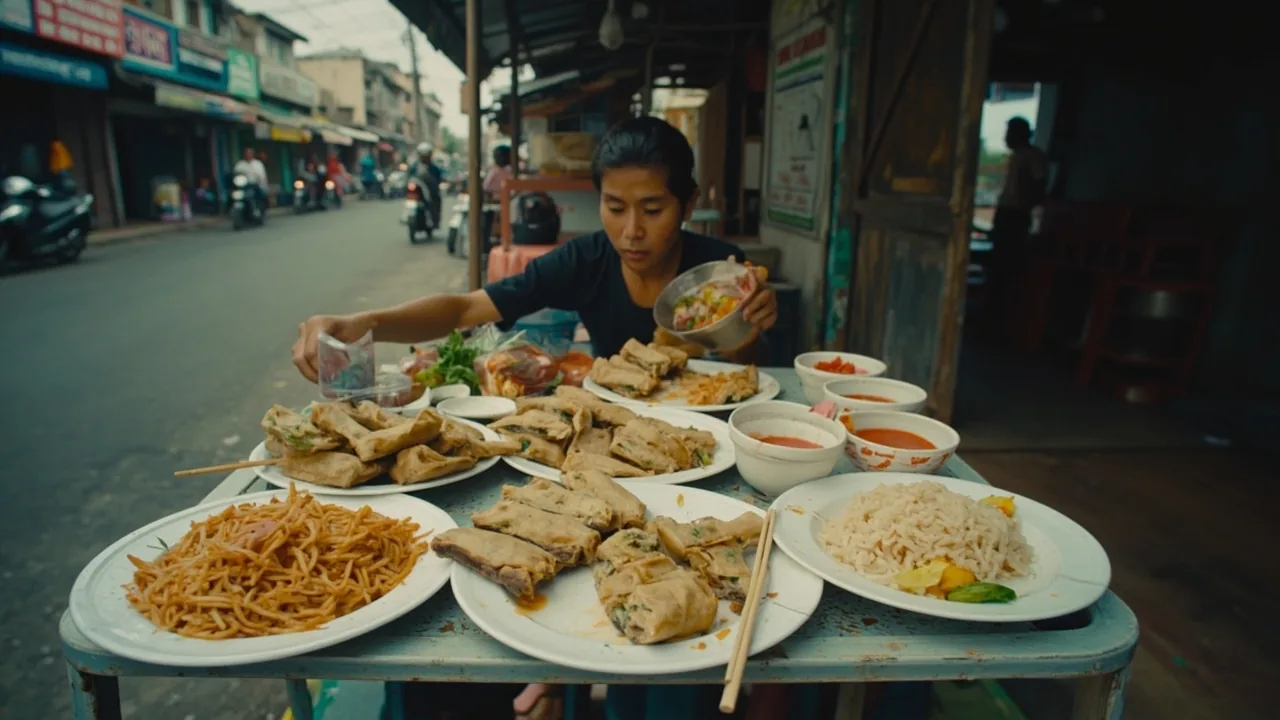
Vegetarian Food Tour of Southeast Asia: A 2-Week Itinerary for Indian Backpackers
A vegetarian food tour of Southeast Asia sounds like a contradiction until you’ve watched a Bangkok Chinatown vendor ladle soy-milk broth into her pot. SEA eats vegetarians well, but only if you know where to look. “Vegetarian AND cheap AND tasty” is the puzzle this itinerary solves. For the full corridor, see the SEA Backpacking Hub.
Two weeks, four countries, every meal planned for someone who avoids meat, fish, egg, and dairy.
📍 Distance: \~2,400 km end-to-end
⏱️ Fastest run-through: 12 days (tight)
💰 Daily veg food budget: ₹1,721 (\~600 THB or \~$17.87)
✅ Best route: Bangkok → Chiang Mai → Luang Prabang → Hanoi → Hoi An → Ho Chi Minh City → Phnom Penh
Subodh’s Pro Tip: “Vegetarian” in SEA often means “vegetarian-ish” (fish sauce in everything, eggs in fried rice, oyster sauce in greens). Learn three phrases before you go: tao hai (Thai, no eggs), chay (Vietnamese, fully vegan Buddhist), and jay (the Indian-origin term that most Thai-Chinese restaurants understand). Saying “no fish sauce” in Thai gets you a confused smile. Saying chay in Vietnam gets you a clean plate.
Quick Answers
| What | Answer | Price (INR) |
|---|---|---|
| Cheapest veg meal on this route | Khao soy at a Chiang Mai market stall | ₹100 (~35 THB or ~$1.04) |
| Best veg street food city | Hoi An, Vietnam (the chay capital) | ₹92 (~25,000 VND or ~$0.96) |
| Indian veg restaurant you’ll fall back on at least 4 times | Indian-veg thali spot, Bangkok | ₹230 (~80 THB or ~$2.38) |
| Veg-friendly night market | Sunday Walking Street, Chiang Mai | Free entry |
| Average daily food spend across the whole route | Mix of veg + Indian fallback | ~₹2,295 (~800 THB or ~$23.83) equivalent |
Prices in this article are written in triple format: local currency, INR, and USD, so you can compare across borders without pulling out a calculator.
The Itinerary at a Glance
| Days | Where | Veg Highlight |
|---|---|---|
| 1–3 | Bangkok, Thailand | Jay Thai buffets, Indian-veg fallback |
| 4–6 | Chiang Mai, Thailand | Khao soy, Sunday Walking Street |
| 7–8 | Luang Prabang, Laos | Morning alms, sticky rice |
| 9–10 | Hanoi, Vietnam | Pho chay, bun cha chay |
| 11–12 | Hoi An, Vietnam | Hoi An’s full chay corridor |
| 13–14 | Ho Chi Minh City / Phnom Penh | Banh mi chay, Cambodian jay |
This isn’t a “vegetarian tour package” with a fixed bus and a guide with a flag. This is a self-paced backpacking route built around where the vegetarian food is best. If you want a guided package, I cover those at the end.
Days 1–3: Bangkok, Thailand
Start here because Bangkok has the most vegetarian infrastructure of any city on the route. Chinatown (Yaowarat) is one of the strongest street-food neighbourhoods for vegetarians in the region. Look for the yellow “เจ” (jay) sign or a bowl with a Buddhist swastika (the traditional symbol, not the modern misappropriation) on it. These stalls serve a full Thai meal, no meat, no fish sauce, no egg, often for under ₹172 (~60 THB or ~$1.79).
An Indian-veg thali spot in the Khao San area is the safety net. Thali is ₹230 (~80 THB or ~$2.38), paneer masala ₹201 (~70 THB or ~$2.08), dal tadka ₹143 (~50 THB or ~$1.49). It’s not the best Indian food you’ve had in your life, but after a week of vegetable-heavy Thai plates, your body will ask for it. Travellers report the paneer here is consistent even when other items on the menu rotate.
For hostels, stay near Khao San or Banglamphu. The Mad Monkey and Lub d Bangkok both run hostel kitchens, but I’d skip the kitchen route: the veg food outside is too cheap and too good to justify cooking. Spend your hostel time on the rooftop and let the city feed you.
Safety Alert: Bangkok tuk-tuks will quote you ₹574 (~200 THB or ~$5.96) for a ₹115 (~40 THB or ~$1.19) ride and tell you “today is closed for ceremony” at the destination. It is not. Use Bolt or Grab, full stop.
Days 4–6: Chiang Mai, Thailand
Take the night train from Bangkok (12 hours, sleeper berth ~₹2,295 (~800 THB or ~$23.83)) or fly for ~₹4,304 (~1,500 THB or ~$44.68) if you’ve got the budget. Chiang Mai’s old city is ringed by vegetarian Thai restaurants that don’t even advertise as vegetarian because the entire menu is.
The single dish you have to eat: khao soy, the coconut-curry noodle soup that’s the regional signature. The standard version has chicken, but every Chiang Mai khao soy shop makes a vegetarian version on request. The best veg khao soy is at the dedicated khao soy shops near the old city moat, both around ₹143 (~50 THB or ~$1.49). The broth is the same, the noodles are the same, they swap the meat for tofu and mushrooms.
Sunday Walking Street (Tha Phae Gate, 4pm onwards) is the best night market for veg food on the entire route. Half the stalls are jay. Look for the bright yellow jay flag. Mango sticky rice (₹115 (~40 THB or ~$1.19)), pad thai jay (₹143 (~50 THB or ~$1.49)), fresh fruit shakes (₹86 (~30 THB or ~$0.89)), and grilled bananas with coconut cream (₹57 (~20 THB or ~$0.60)). You can eat dinner here for under ₹287 (~100 THB or ~$2.98).
For the Chiang Mai vegetarian tour-package option, several local operators run a 3-day “Buddhist Vegetarian Experience” including cooking class, temple stay, and farm visit. Expect to pay around ₹34,429 (~12,000 THB or ~$357.41) all-in. Search GetYourGuide or Viator for “Chiang Mai vegetarian tour” to compare dates and reviews.
Subodh’s Pro Tip: If your trip falls in late September or October, time it for the Chiang Mai Vegetarian Festival (Tesagan Gin Jay). The whole city goes jay for nine days. Free meals from community stalls, lantern processions, and the food quality spikes because everyone is competing. This is the single best week for a vegetarian food tour of SEA, period.
If you’ve only got a week, our first-timer 2-week starter route covers a similar corridor with more breathing room. For the full budget breakdown by city, see the SEA budget guide.
Days 7–8: Luang Prabang, Laos
Chiang Mai to Luang Prabang is the long travel day of the trip. First, bus from Chiang Mai to Chiang Khong (4–5 hours, ~₹715 / 250 THB), cross the border to Huay Xai in Laos, then board the slow boat down the Mekong for 2 days (₹5,164 (~1,800 THB or ~$53.61) per person for the boat package including a night in Pakbeng). The flight is 1 hour, around ₹11,476 (~4,000 THB or ~$119.14) on Lao Airlines. Take the slow boat if you have the time, the river is half the experience.
Book on 12go.
Luang Prabang’s veg situation is different. It’s not a vegetarian city the way Chiang Mai is. The cuisine is meat-heavy (larb, sausages, river fish). What saves it is the Buddhist temple tradition: most wats serve a daily jay lunch to anyone who shows up, and several restaurants in the old town lean vegetarian by default.
Two mid-range spots in the old town have full veg menus. For backpacker budget, head to the Phousi night market and look for the jay stalls (yellow flags again). Stick rice and grilled vegetables for ₹65 (~15,000 LAK or ~$0.67), papaya salad without fish sauce for ₹43 (~10,000 LAK or ~$0.45). The alms-giving ceremony at sunrise is cultural, not food, but it sets the tone for why vegetarianism matters here.
For SIM cards and data, buy a local SIM at Luang Prabang airport (₹215 (~50,000 LAK or ~$2.24) for 8 GB / 30 days) or skip the airport and use Get Nomad eSIM before you fly. Laos has spotty 4G outside Luang Prabang proper, so download offline maps before the slow boat.
Days 9–10: Hanoi, Vietnam
Vietnam is where the route flips from “vegetarian-friendly” to “actively set up for vegetarians.” The chay tradition here is deep: Buddhist vegetarian restaurants in Hanoi number in the hundreds, and many have been operating for decades.
Pho Chay is the dish. Same broth as regular pho, made without beef bone. Bun Cha Chay is grilled “pork” that’s mushroom and tofu, with the same rice noodles and dipping sauce. Both are around ₹129 (~35,000 VND or ~$1.34) at a streetside stall, ₹221 (~60,000 VND or ~$2.29) in a sit-down chay restaurant.
A dedicated chay spot in the Old Quarter is the go-to, full menu of Vietnamese classics rendered vegan, ₹184-₹294 (~50,000-80,000 VND or ~$1.91-$3.06) a dish. A fancier option goes more like ₹368-₹552 (~100,000-150,000 VND or ~$3.82-$5.73), worth it for the mock meat done well.
Hanoi’s veg-friendly street food goes deeper than chay. Egg coffee (around ₹129 (~35,000 VND or ~$1.34) at dedicated Hanoi egg-coffee cafes) is technically not vegetarian if you’re strict (egg yolk), but every cafe makes a coconut-coffee or condensed-milk-coffee version that is. Banh mi stands will make a chay banh mi if you ask, no egg, no pâté, all the pickled veg and tofu for ₹74 (~20,000 VND or ~$0.76).
Hanoi also has a serious Indian restaurant scene because of the embassy and student population. A West Lake Indian restaurant has a full North Indian thali for ₹552 (~150,000 VND or ~$5.73), paneer dishes around ₹294 (~80,000 VND or ~$3.06). Another Old Quarter Indian spot is the other main fallback.
Subodh’s Pro Tip: Vietnamese “vegetarian” sometimes hides fish sauce in the dressing or shrimp in the rice. The word chay on the sign is the cleanest guarantee. If the menu isn’t flagged chay, ask “có chay không?” (is this vegetarian?) before ordering.
Days 11–12: Hoi An, Vietnam
If Hoi An had a slogan it would be “the vegetarian capital of Vietnam.” If you want to extend this leg into a full street-food deep dive, our 3-week street-food tour spends extra days here. The Old Town is small, walkable, and stacked with chay restaurants, many of which are also cooking schools. You can take a veg cooking class in the morning and eat chay for the rest of the day within a 500-metre radius.
The two standouts sit within a block of the night market. Banh xeo chay (turmeric crepe with mung bean, no shrimp) is the regional dish done vegetarian, around ₹147 (~40,000 VND or ~$1.53). Cao lau (Hoi An’s signature noodle) is harder to find chay because the broth usually has pork, but a dedicated chay cao lau shop does it well.
Hoi An also runs the famous lantern-making and tailoring shops, both veg-friendly by definition, and the night market along the river is full of chay stalls selling banh mi chay for ₹55 (~15,000 VND or ~$0.57).
The Hoi An cooking class route is the closest thing to a “vegetarian tour package” on this leg. A local cooking school runs a vegetarian-only class for around ₹2,208 (~600,000 VND or ~$22.92) including market tour. Search GetYourGuide or Viator for “Hoi An vegetarian cooking class” to compare options and book.
Days 13–14: Ho Chi Minh City / Phnom Penh
Two options here. You can fly HCMC → Phnom Penh (1 hour, around ₹4,416 (~1,200,000 VND or ~$45.84) on Vietnam Airlines or VietJet, cheaper if booked early) or take the overland bus via the Moc Bai / Bavet border crossing (7–8 hours including border, around ₹1,288 (~350,000 VND or ~$13.37)). Take the flight if you’re on a strict 2-week budget. Take the bus if you’ve got buffer time and want the overland experience.
Ho Chi Minh City has the best chay street food in Vietnam, full stop. A District 3 chay restaurant is the headline spot, modern Vietnamese vegan, ₹294-₹552 (~80,000-150,000 VND or ~$3.06-$5.73) per dish. For cheap eats, the District 1 night market has chay vendors with banh mi, bun bo Hue chay (Hue-style beef noodle soup, mushroom version), and com tam chay (broken rice with veg) all under ₹147 (~40,000 VND or ~$1.53).
Phnom Penh is the weakest vegetarian city on the whole route. Cambodia doesn’t have the Buddhist chay tradition that Thailand and Vietnam do. What it has is Indian restaurants, because of the small but tight Indian expat community. An Indian restaurant near BKK1 has a full Gujarati and North Indian veg menu, thali around ₹771 (~8 USD). A Khmer restaurant does a Khmer vegetarian set if you ask. The night market along the river has fruit shakes (1 USD) and grilled corn (0.50 USD) as veg fallback.
Cross the border to Phnom Penh by booking the through-ticket on 12go. Indian passport holders get Cambodian visa on arrival at the land border, ₹2,890 (~30 USD) + ₹578 (~6 USD) processing, bring a passport photo. The border runs 6am–10pm. Total crossing time including visa: 1.5–2 hours.
Indian Passport Specifics
| Border | Visa Type | Fee | Notes |
|---|---|---|---|
| Thailand entry | Visa-free for Indians (60 days) | Free | As of 2026, Thailand grants 60-day visa-free entry to Indian passport holders. Confirm on the Thai MFA site before you fly. |
| Laos entry | Visa on arrival | ~₹3,853 (~40 USD) + ₹193 (~2 USD) processing | Bring 2 passport photos. Available at Luang Prabang airport and the Mekong border crossings. |
| Vietnam entry | E-visa | ₹2,408 (~25 USD) | Apply at the official gov.vn portal at least 3 days before travel. Multiple-entry option is worth it for this loop. |
| Cambodia entry | Visa on arrival | ₹2,890 (~30 USD) + ₹578 (~6 USD) processing | Bring a passport photo. Available at Phnom Penh airport and Bavet land border. |
For emergencies, the Indian embassy in Bangkok is at 44 Soi Phiphat, Silom. The Indian consulate in Ho Chi Minh City handles Vietnam issues. Save both contacts in your phone before you leave.
Getting Connected
The single best move is to buy a Nomad eSIM before you fly from India. It covers Thailand, Laos, Vietnam, and Cambodia on one plan, no SIM-swapping at every border. Activate it at Delhi airport and you’re online from the moment you land in Bangkok.
If you’d rather do physical SIMs, the tourist SIM at Bangkok airport (₹858 (~299 THB or ~$8.91) for 15 GB / 8 days) is the best deal on arrival. Then local SIMs in Luang Prabang, Vietnam (under ₹736 (~200,000 VND or ~$7.64) each for 30-day plans), and Phnom Penh (₹482 (~5 USD) for 10 GB). Expect to lose signal on the slow boat between Chiang Mai and Luang Prabang, and on parts of the HCMC. Phnom Penh bus route.
eSIM option: Get Nomad eSIM, covers all four countries on one plan, no SIM swap, instant activation.
When NOT to Take This Route
Monsoon (June–October): Northern Vietnam and Laos get heavy rain. The slow boat from Huay Xai to Luang Prabang gets cancelled or delayed. Hue floods badly in October. Skip this loop from July through September. Push it to November or March.
Tet (Vietnamese New Year, late Jan / early Feb): Many Vietnamese chay restaurants close for 3–5 days around Tet. Vietnam travel costs also spike. Skip Vietnam for those 2 weeks specifically.
Cambodian New Year (mid-April): Phnom Penh empties out, restaurants close, transport gets weird. Don’t end your trip in Cambodia during Chol Chnam Thmey.
The best windows for this exact loop: November, February, or March. Cool, dry, post-festival, every restaurant open.
FAQ
Do I need to know Thai, Lao, Vietnamese, and Khmer? No. Google Translate’s camera function covers menus. Learn the word for “vegetarian” in each language: jay (Thai), chay (Vietnamese), sok in some Lao contexts, and just point and say “no meat” everywhere else. English works at most mid-range restaurants in Bangkok, Hanoi, HCMC, and Phnom Penh.
Is the food good, or is it just “good for vegetarian”? Genuinely good. Thailand’s jay tradition uses soy-based mock meats that are better than the actual meat versions. Vietnam’s chay tradition is mushroom-and-tofu-driven, lighter and cleaner. Cambodia is the weak link because the jay tradition is newer.
Can I do this in under 2 weeks? Yes, but it’s tight. Drop Luang Prabang and fly Chiang Mai to Hanoi directly (1 stop via Bangkok, ~3,500 THB). That gets you to 11 days. Alternatively, the 3-week SEA loop gives you the time to add Laos properly.
Are guided vegetarian tour packages worth the money? For Chiang Mai only. The rest of the route is better done independently because the chay and jay restaurant scenes are easy to navigate on foot. Look at guided vegetarian operators in Chiang Mai, cooking schools in Hoi An, and skip everything else.
How much cash should I carry between borders? Carry ₹14,346 (~5,000 THB or ~$148.92) or ₹14,449 (~150 USD) equivalent when crossing into Laos. Carry ₹4,816 (~50 USD) when crossing into Cambodia. Most major cities have ATMs (with a ₹631 (~220 THB or ~$6.55) foreign card fee per withdrawal), so cash buffers are just for emergencies.
What if I get sick from the veg food? The risk is low (no meat, no fish). The bigger risk is water. Stick to bottled water across the route. Most travellers report mild stomach adjustment in the first 3–4 days and nothing after that.
Subodh’s Take
The honest summary after putting this route together: Thailand and Vietnam will spoil you. Cambodia is where you miss Indian food. Plan at least two Indian-veg fallback meals a week in Bangkok, HCMC, and Phnom Penh, and you’ll be fine. Don’t try to be a vegetarian hero for 14 straight days. Mix chay and jay with the occasional paneer thali and your body and your taste buds will both thank you.
- Subodh
