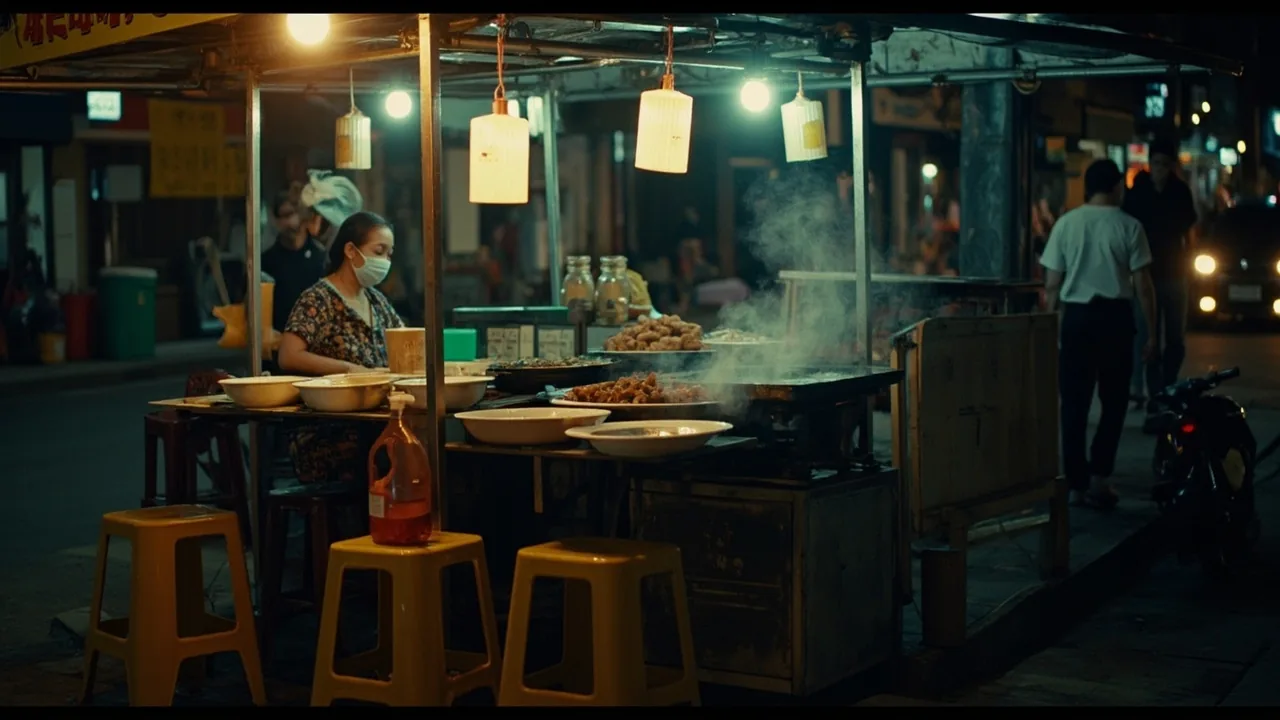
Street Food Tour of Southeast Asia: A 3-Week Itinerary for Backpackers
📍 Distance: \~3,500 km overland (Bangkok → Chiang Mai → Luang Prabang → Hanoi → Hoi An → HCMC)
⏱️ Fastest option: 3 weeks at a comfortable pace (can be compressed to 18 days)
💰 Cheapest realistic budget: \~₹20,000-₹25,000 (\~$207.60-$259.50) for food, plus local transport, for 21 days
✅ Best option: Slow overland route with day stops in Chiang Mai, Luang Prabang, Hoi An
Quick Answers
| What | Answer | Price (INR) |
|---|---|---|
| Total food budget for 21 days | ~₹20,000-₹25,000 (~$207.60-$259.50) if you stick to street + markets | ~₹20,000-₹25,000 (~$207.60-$259.50) |
| Cheapest meal of the trip | Khao niao (sticky rice) at a Lao morning market | ₹21 (~5,000 LAK or ~$0.22) |
| Most expensive single meal | A proper Vietnamese com suon nuong at Hoi An’s night market | ₹294 (~80,000 VND or ~$3.05) |
| Daily food average | Around ₹1,000/day across the three countries | ~₹1,000 (~$10.38) |
| Veg-friendly country | Vietnam (pho chay, banh mi chay, com suon chay everywhere) | — |
Subodh’s Pro Tip: The street food is the reason to do this trip. Don’t eat at your hostel, don’t cook your own meals, and don’t default to tourist restaurants with English menus and inflated prices. The plastic-stool places with no English signage are where the food is. You may also find Best Places to Visit During Monsoon Season in Southeast Asia Backpacker Edition useful for this trip.
Why This Route Orders the Way It Does
A street food loop through Southeast Asia only works if you sequence countries by land border, not by Insta-grid. Start in Bangkok, angle north to Chiang Mai, cross the Mekong into Laos, then drop into Hanoi and follow the coast down to HCMC. That order keeps every major stop on a single overland line, lets you save Vietnam for last (the longest food list), and finishes you in a city with direct flights back to India. For the full picture of overland options across the region, see our Southeast Asia Backpacking Hub. See also: Festival Based Itineraries How to Plan Trips Around Southeast Asia S Biggest Events.
The other reason this ordering works: each country has a different street food personality. Thailand is grilled, sweet, and coconut-heavy. Laos is sticky rice, herb-loaded, and almost entirely seated on the floor. Vietnam is the deepest catalogue: soups in the morning, banh mi at lunch, grilled meats and seafood at night. Eating that sequence in that order feels like a three-course progression, not a repeat. For related planning, see our guide on Solo Traveler Itineraries for Backpackers How to Use Social Hostels Group Activities to Never Eat Alone.
Subodh’s Pro Tip: Fly into Bangkok, fly out of Ho Chi Minh City. Doing the loop in reverse (HCMC first) is fine logistically but starts you on the strongest food country, which sets a bar the others can’t match day-to-day. Bangkok → Chiang Mai first gives you a gentler ramp.
Week 1: Bangkok and Chiang Mai
Days 1-3: Bangkok
Bangkok is the wettest match you’ll ever strike for street food. The city’s official count of registered street vendors crossed 20,000 a few years back and has only grown since. You don’t need an itinerary, you need a stool and a few pointers.
Hit Chinatown (Yaowarat Road) twice: once around 6 PM as the stalls light up, once at 11 PM when the late-night seafood grills are firing. The famous oyster omelet stalls there are tourist magnets for a reason, but the better move is to walk two streets over, find the busiest stall with no English menu, and point at what the table next to you is eating. Most plates run ₹114-₹229 (~40-80 THB or ~$1.19-$2.37).
For breakfast, skip the hotel buffet and walk to the nearest 7-Eleven for a ₹100 (~35 THB or ~$1.04) pork bun, then find a street vendor with a row of bamboo baskets for a proper guay tiew kua gai (chicken pan-fried noodles) at ₹143-₹172 (~50-60 THB or ~$1.48-$1.78). The vendor will look at you like you’re odd for being there at 8 AM. That’s the tell.
Strict vegetarians: Bangkok is harder than Ho Chi Minh City. Look for the Jay (เจ) symbol, a Thai word for Buddhist vegetarian food, on yellow signs. Jay restaurants cluster around Chinatown and around the Pratunam area. Most Jay buffets are ₹172-₹286 (~60-100 THB or ~$1.78-$2.97) per head and refill from trays of mock meat, tofu, and Thai veg curries.
Subodh’s Pro Tip: Bangkok’s street food vendors rotate. A few famous stalls (like the Michelin-recognized ones) only operate 5 PM-1 AM and the guy cooking them charges the same as the stall half a block over. The Bib Gourmand list is useful but don’t treat it as gospel; reporters consistently find that an unrecognised 40-THB kuay teow reua (boat noodles) stall can match the Michelin one at a third of the price.
Days 4-5: Travel to Chiang Mai
Overnight train from Bangkok to Chiang Mai is the right move. Second-class sleeper runs ₹3,431-₹5,146 (~1,200-1,800 THB or ~$35.61-$53.42) depending on berth type, takes 12-13 hours, and you wake up in the mountains. Book at Hua Lamphong station or via 12go. Daytime buses are cheaper (around ₹2,001 (~700 THB or ~$20.77), 9-10 hours) but the night bus saves you a hotel night.
**Compare prices on 12go](https://12go.asia/en/travel/street+food+tour?z=16187692)
Days 5-7: Chiang Mai
Chiang Mai is half the size of Bangkok and probably twice as good for daily street food wandering. The Old City moat has hawker stalls from 5 AM (khao tom - rice soup - at ₹71 (~25 THB or ~$0.74)) through midnight (sai ua sausage and grilled chicken at ₹86-₹172 (~30-60 THB or ~$0.89-$1.78)).
The Sunday Walking Street market is a food crawl in itself. Same goes for the Saturday Walking Street on Wualai Road. Skip the branded merchandise and walk the food section. Try khao soi (curry noodle soup) at a stall where the queue is 80% Thai speakers. The famous one on the main road charges ₹172 (~60 THB or ~$1.78) and is worth it; the one next door at ₹114 (~40 THB or ~$1.19) with the same broth is also worth it.
Vegetarian alert: Chiang Mai has an entire district of Muslim-Thai and Burmese-Chinese vendors in the Chang Phueak Gate area. Halal food means no pork, not strictly vegetarian, but the variety of grilled chicken and vegetable curries is huge. For pure veg, the night bazaar near Tha Phae Gate has a few stalls with stir-fried morning glory and tofu at ₹114 (~40 THB or ~$1.19).
Week 2: Across the Mekong to Laos
Days 7-8: Chiang Mai to Luang Prabang
The Chiang Mai to Luang Prabang run is the most beautiful border crossing on the Banana Pancake Trail. Two days is the right window.
Day 1: Chiang Mai to Chiang Khong on the Thai side (green bus, around ₹1,429 (~500 THB or ~$14.84), 7 hours, leaves early morning). Sleeper in Chiang Khong.
Day 2: Chiang Khong to Huay Xai, slow boat 2 hours downriver, then the Luang Prabang slow boat for 2 days on the Mekong. Around ₹5,146-₹7,147 (~1,800-2,500 THB or ~$53.42-$74.19) depending on boat class. The boat pulls into Luang Prabang late afternoon on day 3 of the route (day 8 of the trip).
The slow boat is the only option worth taking. The alternative is a speedboat that does the same stretch in 6 hours and has killed travellers in past accidents. The slow boat is also the only one where you can buy food from village children who paddle alongside the boat at every stop. Pack a sleeping bag and a flashlight.
Subodh’s Pro Tip: Buy your slow boat ticket directly at the Chiang Khong dock the morning of departure. The online tour operators and hostels in Chiang Mai add ₹1,429-₹2,859 (~500-1,000 THB or ~$14.84-$29.68) markup. Walk-ins get the same boat, same seat, same lunch.
Days 8-11: Luang Prabang
Luang Prabang is small, walkable, and has a street food scene that runs entirely on the night market on the main street. The night market (5 PM-10 PM) has around 300 stalls, mostly serving the same Laotian staples.
Eat these, in order:
- Khao niao (sticky rice) served in a bamboo basket with every meal. ₹21-₹43 (~5,000-10,000 LAK or ~$0.22-$0.45).
- Larb (minced meat or mushroom salad with herbs, lime, and toasted rice powder). ₹64-₹107 (~15,000-25,000 LAK or ~$0.67-$1.11).
- Sai oua (local lemongrass sausage). ₹64-₹86 (~15,000-20,000 LAK or ~$0.67-$0.89).
- Or lam (stew with eggplant and sakhan vine). ₹86-₹129 (~20,000-30,000 LAK or ~$0.89-$1.34).
Breakfast is the morning market near the old royal palace, where vendors set up by 5 AM with rice porridge, grilled river fish, and Lao coffee (strong, sweet, usually ₹43 (~10,000 LAK or ~$0.45)). The Phousi morning alms-giving ceremony is a tourist draw and worth seeing once, but don’t take photos of the monks (highly sensitive in Laos).
Vegetarians: Luang Prabang has the strongest vegan/vegetarian scene of the entire route. A few restaurants in the old town run under the “veggie” banner and serve mushroom larb, tofu laab, and sticky rice variations. Most meals are ₹86-₹172 (~20,000-40,000 LAK or ~$0.89-$1.78). The night market also has a small veg stall section behind the main meat aisle.
Week 3: Vietnam
Days 11-12: Luang Prabang to Hanoi
Overland from Luang Prabang to Hanoi is two days. Fly if you can: Hanoi Airways and Lao Airlines run direct flights for ₹10,006-₹14,295 (~3,500-5,000 THB or ~$103.86-$148.38) equivalent, 1 hour 20 minutes. Cross-border buses go via the Nam Phao-Cau Treo border, take 24 hours, and are exhausting. For a 3-week food trip, the flight is the right call.
Day 11 is a travel day. Land in Hanoi in the evening, check into a hostel near the Old Quarter, and walk straight to the nearest pho stall. The Old Quarter is dense enough that you’ll find one within 200 metres without trying.
Subodh’s Pro Tip: At Noi Bai airport, the scam rate is high. Don’t take a metered taxi from the official taxi rank; use Grab (the Southeast Asian Uber, works in Vietnam) at the pickup zone outside Arrivals. A Grab to the Old Quarter runs ₹918-₹1,102 (~250,000-300,000 VND or ~$9.53-$11.43). The taxi will quote ₹1,836 (~500,000 VND or ~$19.06) and the meter will somehow get “stuck.”
Days 12-14: Hanoi
Hanoi is the deep end of Vietnamese street food. The city has over 22,000 street food vendors, more than any other city in the country. You cannot eat badly in Hanoi. You can, however, eat without trying.
Breakfast: Pho bo (beef noodle soup) at any of the thousand stalls. ₹110-₹184 (~30,000-50,000 VND or ~$1.14-$1.91). Add a sliced baguette with pâté for ₹55 (~15,000 VND or ~$0.57). Street coffee (ca phe den, black with condensed milk) at ₹44-₹73 (~12,000-20,000 VND or ~$0.46-$0.76).
Lunch: Banh mi from a cart on the sidewalk. Stuffed with pork, pâté, pickled carrot, cilantro, and chili. ₹92-₹147 (~25,000-40,000 VND or ~$0.95-$1.52). Look for a busy cart with a short local queue, quality varies block to block, so compare two adjacent vendors before committing.
Dinner: Bun cha (grilled pork with cold rice noodles and dipping sauce). ₹184-₹257 (~50,000-70,000 VND or ~$1.91-$2.67). Any busy grill-smoke spot in the Old Quarter will do. Obama’s 2016 visit put bun cha on the map, so queues at the better-known spots are permanent, but turnover is fast.
Late night: Bia hoi corner at the Ta Hien Street intersection. Fresh draft beer for ₹18-₹29 (~5,000-8,000 VND or ~$0.19-$0.30) a glass, served on a plastic stool from 6 PM to midnight. Order by pointing at the next table’s order.
Vegetarians: Hanoi is challenging for strict veg because the broth culture uses pork bones heavily. The phrase is “chay” (vegetarian). Find vegetarian-only restaurants in the Old Quarter. A bowl of pho chay (veg pho) runs ₹110-₹147 (~30,000-40,000 VND or ~$1.14-$1.52). Bun cha chay is harder to find but exists. Most Buddhist temples have a small vegetarian restaurant nearby.
Days 14-16: Travel to Hoi An
Hanoi to Hoi An as a direct route is impractical. The standard route is Hanoi to Hue (overnight sleeper bus, 12-14 hours, ₹1,102-₹1,652 (~300,000-450,000 VND or ~$11.43-$17.15)) then Hue to Hoi An (3-4 hours by train or bus, ₹367-₹661 (~100,000-180,000 VND or ~$3.81-$6.86)).
A nicer option: Train from Hanoi to Da Nang (sleeper, 14-16 hours, ₹1,469-₹2,570 (~400,000-700,000 VND or ~$15.25-$26.68)), then 30-minute taxi or local bus to Hoi An. The sleeper train is the same price as the bus and you sleep.
Subodh’s Pro Tip: The Hai Van Pass coastal route between Hue and Da Nang is one of the most scenic road stretches in Southeast Asia. If you have a day, rent a motorbike (around 150,000 VND/day) and ride it. The pass has a few war-era tunnels you can stop at.
Days 16-18: Hoi An
Hoi An’s street food is the most underrated on the trip. The Old Town is a UNESCO site, and the surrounding food scene is the draw nobody talks about.
The night market on Nguyen Hoang Street lights up with cao lau (regional noodle dish with pork, greens, and croutons), white rose dumplings (banh bao vac, made only in Hoi An), and banh xeo (savoury crepe). Plates run ₹110-₹220 (~30,000-60,000 VND or ~$1.14-$2.29).
The morning market (around 5 AM-9 AM) is where the locals eat. Walk there at sunrise, order mi quang (turmeric noodle bowl) at ₹92 (~25,000 VND or ~$0.95), and sit on the small plastic stools by the river.
Vegetarians: Hoi An has the easiest veg street food on the route. Most vendors have a “chay” version of every dish. The cao lau chay is widely available and the white rose dumpling shops usually make a separate veg order.
Days 18-19: Hoi An to HCMC
Sleeper bus from Hoi An (Da Nang) to Ho Chi Minh City is 18-20 hours, ₹1,469-₹2,203 (~400,000-600,000 VND or ~$15.25-$22.87). Flight is 1 hour 20 minutes, ₹2,938-₹9,180 (~800,000-2,500,000 VND or ~$30.49-$95.29) on VietJet or Vietnam Airlines. For a 3-week tight itinerary, the flight saves you a full day.
Days 19-21: Ho Chi Minh City
HCMC is the most modern and the most international of the route’s cities. The street food is excellent but slightly more diluted by chains and tourist restaurants than Hanoi.
Must-eats:
- Com tam (broken rice with grilled pork, egg, and pickled veg). ₹147-₹220 (~40,000-60,000 VND or ~$1.52-$2.29). Found at any street vendor.
- Bo la lot (beef in betel leaves, grilled). ₹184-₹294 (~50,000-80,000 VND or ~$1.91-$3.05).
- Bun bo Hue (beef noodle soup, spicier than Hanoi pho). ₹147-₹202 (~40,000-55,000 VND or ~$1.52-$2.10).
- Banh xeo (savoury crepe, HCMC version is larger than Hoi An). ₹184-₹257 (~50,000-70,000 VND or ~$1.91-$2.67).
The central market’s food court is a tourist trap during the day but the surrounding alleys fill up with legit vendors at night. District 4 (Quan 4) has the strongest local food scene at 30-50% lower prices than District 1.
Vegetarians: HCMC is the most veg-friendly after Hoi An. The phrase “chay” works everywhere. District 1 has a row of vegetarian restaurants on Nguyen Van Trang Street near the Buddhist temple. Most meals are ₹110-₹184 (~30,000-50,000 VND or ~$1.14-$1.91).
Daily Budget Reality
Food-only budget for 21 days, sticking to street food and market stalls:
| Country | Days | Daily food avg | Total |
|---|---|---|---|
| Thailand | 7 | ₹1,429 (~500 THB or ~$14.84) | ₹10,006 (~3,500 THB or ~$103.86) |
| Laos | 4 | ₹258 (~60,000 LAK or ~$2.67) | ₹1,031 (~240,000 LAK or ~$10.70) |
| Vietnam | 10 | ₹918 (~250,000 VND or ~$9.53) | 2,500,000 VND |
In rupee terms at current rates (1 THB = ₹2.87, 1 LAK = ₹0.0043, 1 VND = ₹0.0037): the Thailand segment runs about ₹10,045, Laos runs about ₹1,032 (~$10.71), and Vietnam runs about ₹9,250 (~$96.02). Total food-only cost is around ₹20,000-₹25,000 (~$207.60-$259.50), depending on how many sit-down meals you take.
Add local transport (buses, slow boat, taxis), accommodation in budget hostels, and daily incidentals, and the realistic 21-day budget for an Indian backpacker on this route is ₹60,000-₹75,000 (~$622.80-$778.50) all-in on food, ground transport, and beds. Airfares from India run ₹18,000-₹28,000 (~$186.84-$290.64) round trip depending on season and how early you book.
Border Crossing: Thailand to Laos
The Chiang Khong to Huay Xai border is the standard crossing. For the Laos-to-Vietnam leg later in the route, see our Laos to Vietnam Border Crossings Guide. Process for Indian passport holders:
- Get to Chiang Khong the day before. The border opens at 6 AM and closes at 6 PM.
- Take the local ferry from Chiang Khong to Huay Xai (around ₹86 (~30 THB or ~$0.89)).
- On the Laos side, walk to the immigration office. Visa on arrival for Indian passport holders costs ₹2,890-₹4,046 (~30-42 USD) depending on nationality (India is on the lower tier; confirm at the desk). Bring two passport photos, USD cash, and your passport with 6+ months validity.
- After the visa, get the exit stamp from Laos at the same office.
- Walk to the slow boat pier. Buy your slow boat ticket at the official counter (around ₹5,146-₹7,147 (~1,800-2,500 THB or ~$53.42-$74.19) or ₹1,074-₹1,331 (~250,000-310,000 LAK or ~$11.15-$13.82)).
Total crossing time: 2-4 hours depending on queue. Avoid the 11 AM-2 PM window when tour buses arrive.
Scams to watch: Touts at the Chiang Khong side trying to sell you “faster” boat services to Luang Prabang (these are the speedboats, dangerous). Money changers at the border with rates 5-10% worse than the official bank rate. Stick to the bank counter at the immigration office.
Indian Passport Specifics
- Visa on arrival for Laos: ₹2,890-₹4,046 (~30-42 USD), two passport photos, USD cash only (the desk doesn’t take Lao kip for the visa).
- Vietnam: e-visa required in advance for Indian passport holders. Apply at the official government site, costs ₹2,408 (~25 USD), processing 3-5 working days. Can also do visa on arrival with pre-approved letter but e-visa is cleaner.
- Thailand: Entry rules for Indian passport holders change frequently, check the current Thai visa-exemption length, return ticket, and proof-of-funds requirements at the airline counter before flying.
- Cambodia: not on this specific route but for the extended trip, visa on arrival is ₹2,890 (~30 USD) or e-visa ₹2,890 (~30 USD) with a small processing fee.
Carry photocopies of your passport, visa, and e-visa printout. Keep the originals in the hostel’s safe if they have one.
The Indian embassy in Laos is in Vientiane, contact details change yearly; check the MEA portal at mea.gov.in for the current number. The Indian embassy in Vietnam is in Hanoi, with a consulate in HCMC. The Indian embassy in Thailand is in Bangkok with a 24-hour helpline at +66-2-225-3666.
When NOT to Take This Route
Monsoon (June to October in most of the route): Laos and northern Vietnam get heavy rain. The slow boat from Huay Xai to Luang Prabang gets cancelled or runs infrequently in August and September. Chiang Mai floods in September. Skip the trip or reroute to southern Vietnam and the Thai islands if you’re only free in those months.
Tet (Vietnamese New Year, late January / early February): Vietnam shuts down for a week. Most street vendors close. Hanoi and HCMC become ghost towns. You can still travel, but the food scene collapses. Avoid this week.
Mekong river low water (March-May): The slow boat can run aground on sandbars if the river drops too low. Usually still runs but takes longer.
Lao New Year (Pi Mai, mid-April): Luang Prabang is one big street party. Fun to visit, terrible for the food-focused route because vendors close for the festival.
Getting Connected
Coverage is solid in cities and towns along the route. AIS and dtac in Thailand, Lao Telecom in Laos, Viettel and MobiFone in Vietnam. Buy a SIM at the airport on arrival for each country. In Thailand, a tourist SIM runs around ₹855 (~299 THB or ~$8.87) for 8 days (cheaper short-duration packs are available at convenience stores for less). In Laos, a 7-day tourist SIM costs ₹215 (~50,000 LAK or ~$2.23). In Vietnam, a 30-day SIM runs ₹734 (~200,000 VND or ~$7.62). Dead zones exist on the Mekong slow boat stretch (2-3 hours of no signal at a time) and on the mountain segments of the Hanoi-Laos border.
ESIM option: skip the airport counter and set up before you fly. Get Nomad eSIM works across Thailand, Laos, and Vietnam with one purchase. For country-specific SIM registration rules, see our SIM Card Registration Guide.
FAQ
Can I do this whole route as a strict vegetarian? Yes, but plan your meals. Vietnam is the easiest. Laos is medium (most dishes can be made chay). Thailand is the hardest outside Bangkok and Chiang Mai’s Jay restaurants. Carry snack bars for the slow boat and overnight bus days.
Is the Lao slow boat safe? Yes, the slow boat. Avoid the speedboat. The speedboat has had fatal accidents in past years and is widely considered unsafe. The slow boat is also infinitely more scenic.
How much USD cash should I carry for the Laos border? ₹4,817-₹9,634 (~50-100 USD) in small bills, plus two passport photos. The rest of the route runs on local currency from ATMs. SBI debit cards work at most Thai and Vietnamese ATMs; check the foreign transaction fee before you fly.
Should I book the slow boat in advance? No. Walk-ins at the Chiang Khong dock get the same boat for the same price as the Chiang Mai hostel tour operators. The markup is ₹1,429-₹2,859 (~500-1,000 THB or ~$14.84-$29.68).
Is the street food safe for Indian travellers? Yes. The main exception is in parts of Thailand, where travellers are advised to eat only cooked food and avoid raw vegetables rinsed in tap water. Outside of that, the cooking temperatures are high enough to kill most things. Travelers report that the bigger issue is overeating on day one of the trip.
Can I skip Bangkok and start in Chiang Mai? Yes. Fly direct into Chiang Mai from Delhi or Mumbai (sometimes via Bangkok) and start the route from there. Saves you 2 days and most of Bangkok’s food is similar to what you find in Chiang Mai.
Subodh’s Take
The honest takeaway from researching this route is that the “best” street food on this trip is rarely the most famous. The Instagram-famous stalls in Bangkok and Hoi An are worth one visit, but the daily meals you’ll eat will come from the unrecognised plastic-stool place around the corner. Spend the first day of each city walking the streets near your hostel without a plan, follow the busiest queue, and you’ll eat better than any guidebook can recommend.
