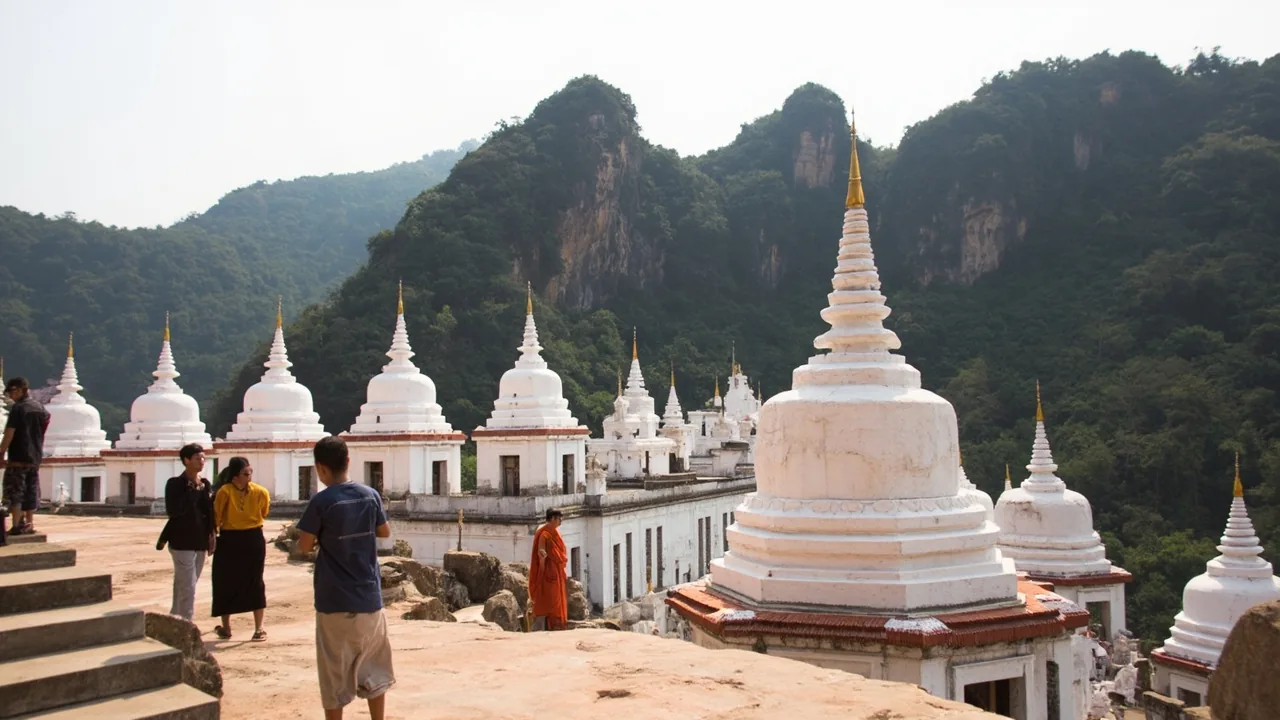
Chiang Dao Temple Etiquette Guide for Indian Travellers (2026)
Chiang Dao cultural etiquette follows standard Thai Buddhist practice across the valley’s three main meditation temples. This guide covers exactly how to dress, behave, and interact as an Indian traveller visiting in 2026.
What Counts as “Temple Etiquette” in Chiang Dao?
Chiang Dao sits at the foot of one of Thailand’s highest mountains, and the valley has been a meditation centre for over a century. Most visitors come for three sites: Wat Tham Pha Plong, a hillside meditation temple reached by 500+ steps, Wat Tham Pakpiang, a forest temple with a large seated Buddha, and Wat Tham Chiang Dao, a cave-temple complex that’s been an active monastery since the 14th century. All three operate as living monasteries, not tourist attractions. That distinction is what the etiquette rules are protecting. Dress code, monk interaction, photography restrictions, and even which direction you walk through a hall exist because the space is in active religious use.
If you’ve never been to a Thai wat before, treat this as a quick primer, then check the step-by-step rules below for the specific things Indian travellers get wrong. If this is your first time abroad, our first-trip guide for Indians covers the basics before you get to temple etiquette.
Quick Answers
| What | Answer | Price (INR) |
|---|---|---|
| Do I need to cover my shoulders? | Yes, at all three Chiang Dao temples | - |
| Can I wear shorts above the knee? | No, knee-length or longer required | - |
| Are shoes worn inside the hall? | No, remove before entering any prayer hall or monk area | - |
| Can women speak directly to monks? | Yes, but never touch them or hand them objects | - |
| Is photography allowed? | Outside yes, inside the main hall often no | - |
| Donation expected? | Optional, ₹57-₹287 (~20-100 THB or ~$0.60-$2.98) is fine | ₹57-₹287 |
| Best time to visit respectfully? | Morning, 6 to 9 AM, before tourist groups arrive | - |
| Are the meditation programs open to visitors? | Wat Tham Pha Plong runs a formal English-speaking program; check in advance | ₹4,307/week |
Step-by-Step: How to Behave at Chiang Dao’s Temples
1. Dress before you leave the hostel
This is the single thing Indian travellers get turned away for. The stair entrance to Wat Tham Pha Plong has a sign that says, in Thai and English: “No shorts, no sleeveless tops, no torn clothing.” Travellers report being asked to wrap a sarong (provided free at the entrance) over shorts that hit mid-thigh, but if your shoulders are bare, you will not get a sarong, you will be told to come back changed.
Pack one set of temple clothes: long trousers or ankle-length skirt, t-shirt with sleeves that cover the shoulder seam, and slip-on shoes. The broader Southeast Asia temple dress code rules apply across the region, so what works at Chiang Dao works everywhere. The stairs at Pha Plong are uneven and the hall floors are polished wood, so flip-flops or sandals that come off easily are practical. Travellers who hiked up in trainers regularly had to unlace them at the door, slowing everyone behind them down.
Subodh’s Pro Tip: Buy a ₹287 (~100 THB or ~$2.98) sarong from the morning market in Chiang Dao town before you walk up. Most Indian travellers don’t own a sarong, but having one in your daypack solves every “you’re a bit underdressed” moment at any Thai temple for the rest of the trip.
2. Remove shoes at the threshold
Every building with a Buddha image inside has a shoe rack or a clear floor marker just outside the door. Step out, place shoes together pointing back toward the exit (a small Thai custom), and walk in barefoot or in socks. Travellers report that the floor of Wat Tham Pakpiang’s main hall gets hot by 11 AM, so thin socks are not optional luxury, they are survival. Wat Tham Pakpiang also has a separate shoe area for the meditation caves past the main hall.
3. Don’t point your feet at Buddha images
When you sit on the floor inside a prayer hall, the standard position is knees tucked under you, feet pointed away from the Buddha image and away from any monks present. If you can’t sit cross-legged comfortably, kneel. The rule is older than the monastery: feet are the lowest and dirtiest part of the body in Thai culture, and pointing them at anything sacred is a serious breach. Travellers who stretched out flat on the floor for a photo have been asked to leave.
4. Women: how to interact with monks
Thai Buddhist tradition holds that women and monks should not have physical contact. This applies when handing over alms, when monks bless an object, and when a monk passes through a crowd. The common practice is to place the item on a cloth or on the floor and let the monk pick it up. Verbal interaction is fine, smiling, asking about their practice, even brief English conversation happens regularly at Wat Tham Pha Plong’s international meditation programs. The restriction is physical, not social.
For Indian women used to offering food directly at a Hindu temple, this is the rule that feels most unfamiliar. Travellers report that placing a small envelope of dried food on a tray covered by a cloth works at every monastery in the Chiang Dao valley.
5. Photography: outside yes, inside often no
The grounds, stairways, and exterior shrines at all three temples are fair game. Inside the main prayer hall at Wat Tham Chiang Dao and inside the meditation cave at Wat Tham Pakpiang, signs prohibit photography. Travellers report this is enforced gently, a monk will wave a hand and say “no photo” rather than confiscate a phone. The exception is when monks explicitly invite you to photograph a ceremony or a blessing, which happens during the twice-monthly lunar observance days. Check the temple’s Facebook page (search “Wat Tham Pha Plong English program”) the week before you go.
6. Donations: how much, and how to give
There is no entry fee at any Chiang Dao temple. Donation boxes sit at the main hall entrance and at the top of the Pha Plong stair climb. Travellers report that ₹57-₹287 (~20-100 THB or ~$0.60-$2.98) is appropriate for a day visit, more if you attended a meditation session or received a blessing. Put the bills in the box yourself, don’t hand them to a monk. If you want a blessing string (sai sin) tied around your wrist, a small donation of ₹57 (~20 THB or ~$0.60) covers it.
7. Meditation programs at Wat Tham Pha Plong
This is the one Chiang Dao temple with a formal international program. Wat Tham Pha Plong runs meditation retreats in English, typically 3 to 10 days, with simple accommodation and two meals a day. Travellers who attended in 2025 and early 2026 report the cost is around ₹4,307 (~1,500 THB or ~$44.68) per week including food. Apply in advance by emailing the monastery (the address is on their website and Facebook page). Dress code is stricter than for day visits: long trousers, neutral colours, no jewellery, no phones in the meditation hall.
Safety Alert: Travellers report occasional border-area tension in northern Chiang Mai province, though Chiang Dao itself has had no incidents in 2026. Check the Indian Ministry of External Affairs travel advisory at mea.gov.in before you travel for any general guidance applicable to your trip. This is a normal precaution, not a warning specific to Chiang Dao.
Common Mistakes Indians Make
Wearing shorts above the knee. This is the only mistake that will physically stop you at the entrance. “Knee-length” means the hem must reach the kneecap when you’re standing. Cargo shorts, running shorts, and most jeans that end above the knee will get you turned around at Pha Plong.
Touching a monk while passing items. Indian temple culture involves offering prasad and flowers directly to a priest’s hand. In a Thai wat, that hand-to-hand contact is forbidden if you’re a woman. Put the offering on a tray or pass it through a male companion.
Sitting with feet toward the Buddha. Travellers used to sitting cross-legged or stretching out flat on the floor of a shrine room will get a quiet correction. Sit on your knees, or sit on a chair if the hall provides them (Pha Plong has wooden benches around the walls).
Talking loudly near the meditation cave. The cave at Wat Tham Chiang Dao is an active meditation space, and the rule is total silence within 20 metres of the entrance. Travellers who took phone calls at the cave mouth were asked to move down the path.
Wearing shoes inside the monk’s quarters. If you’re invited into a monk’s living area (rare, but it happens during meditation programs), the shoe rule applies again, and it applies to the bathroom too. Leave shoes at the door of every indoor space.
What Most Guides Don’t Tell You
The forest monks at Pakpiang are stricter than the town monks. Wat Tham Pakpiang follows the Thai Forest Tradition (Kammaṭṭhāna), which is more austere than city monasteries. Photography inside the meditation caves is genuinely forbidden, and the silence rule extends to the walking path between buildings. Travellers report that the town-side Wat Tham Chiang Dao is more relaxed, partly because it sees more tour groups, while Pakpiang is the place to behave as if you’re a guest in someone’s home.
You can attend a tak bat (alms round) at dawn without donating. Most Thai temples start the morning alms round at 6 AM. As a visitor, you’re allowed to kneel at the side of the path and watch, but you cannot place food in a monk’s bowl unless you’ve arranged it with the monastery in advance. Travellers report the 6 AM tak bat at Wat Tham Pha Plong is one of the most photogenic moments in Chiang Dao, and monks are used to respectful observers.
Menstruating women can visit, with caveats. Traditional Thai Buddhist belief holds that menstruating women should not enter the ordination hall (the ubosot). Travellers report that enforcement varies across Chiang Dao’s temples, and the tradition is observed differently even within Thai Buddhism. If you’re a woman on your period, you can still visit the grounds and the cave, just skip the ubosot for the duration.
Incense and candles are not the main offering. Indian temple culture centres on lamps and incense. Thai wat culture centres on flowers, food, and small envelopes with cash inside the donation box. Travellers who brought agarbatti from India and lit it at a Thai altar were politely asked to put it out, as the smoke interferes with the temple’s ventilation and the monastery’s fire-safety setup. Use the incense the temple provides at the entrance, or skip it.
Where to Stay (If You’re Doing a Temple Day)
Most travellers doing a temple day in Chiang Dao stay in town rather than at the monasteries themselves. The town has a small backpacker cluster with hostels and guesthouses within walking distance of the morning market and the road to Pha Plong. For longer meditation stays, the monastery itself is the accommodation.
For backpackers doing this on a wider Thailand loop, the Chiang Dao leg usually comes between Chiang Mai and Pai.
If you’re taking the public minivan up from Chiang Mai, the sleeper train to Chiang Mai (booked separately, well in advance) is one option to reach the region from Bangkok. For the full regional picture, our Southeast Asia backpacking hub covers route planning across Thailand, Vietnam, Laos, and Cambodia.
Subodh’s Pro Tip: Wake up at 5:30 AM, walk to Pha Plong’s base for the dawn alms round (6 AM), climb the stairs while it’s still cool (you’ll be at the top before 7:30), then walk down and have breakfast at the morning market. This order means you see the monks at their most natural, you climb in shade, and you’re back at your hostel by 9 AM with the whole day ahead.
What to Eat Nearby (Veg-Friendly Options)
After the temple visit, the Chiang Dao town has a handful of solid local restaurants. Kao Man Kai Jay Vegan Food serves authentic vegan Thai food, including the Hainanese-style chicken rice made with soy protein, at around ₹172 (~60 THB or ~$1.79) per plate. It’s the most reliable vegetarian stop for Indian travellers who want a break from hostel food.
Star Café Restaurant runs a Thai-Western menu with a Jungle Curry that’s popular with spice-tolerant travellers, around ₹345 (~120 THB or ~$3.57). For a calmer sit-down meal with fresh farm produce, TATA Chiang Dao Cafe and Farm does breakfast and lunch from around ₹287 (~100 THB or ~$2.98). Travellers report that none of these spots specifically label vegetarian Thai options in English, but pointing at the picture menu or saying “mai sai nuea, mai sai pu” (no meat, no fish sauce) works at every kitchen in town. For a deeper dive, our Southeast Asia vegetarian food guide covers restaurant-finding tactics across the region.
For the hostel etiquette rules that apply when you’re sharing a dorm with monks-in-training who sometimes stay at the same Chiang Dao guesthouses, that’s a separate read.
FAQ
Can I visit Chiang Dao temples if I’m not Buddhist? Yes. All three temples welcome visitors of any background for day visits and tours. Meditation programs are open to non-Buddhists as well, though you’ll be expected to follow the monastery’s daily schedule.
Do I need to speak Thai? No for day visits, signs are in English at the entrances. For meditation programs at Wat Tham Pha Plong, basic English is sufficient, the program is structured for international participants.
Is there an entry fee? No for any of the three main temples. Donations are optional, ₹57-₹287 (~20-100 THB or ~$0.60-$2.98) is appropriate.
Can I take photos of monks? Yes of monks walking or eating outside. No photos of monks in meditation or inside private quarters without explicit permission. The same rule that applies to photography in any religious space.
What if I make a mistake and offend someone? Thai monks and temple staff are accustomed to foreign visitors not knowing every rule. A brief apology in Thai (“khor thot”) is enough. The etiquette is observed for the monastery’s sake, not as a test of the visitor, no one will make a scene over a small breach.
Are Chiang Dao’s temples safe for solo female travellers? Yes. Travellers report that the temples in Chiang Dao are safer than tourist sites in Bangkok or Chiang Mai city, partly because the crowd is mostly meditation practitioners and quiet day-visitors. Standard night-safety rules still apply if you’re walking back to a town guesthouse after dark.
Subodh’s Take
Temple etiquette in Chiang Dao is simpler than it looks: cover up, take shoes off, keep quiet near the meditation spaces, and don’t put your feet toward a Buddha image. Get those five things right and you’re past 90% of what the monasteries care about. The rest is courtesy, not rule. Most Indian travellers will pick it up in the first ten minutes because the underlying logic is the same as entering a Hindu temple, the gestures just have a different shape.
