Con Dao Temple Etiquette Guide for Indian Backpackers (2026)
Con Dao’s temples are small, working Buddhist shrines used daily by locals, not tourist attractions. The etiquette boils down to three things: cover your shoulders and knees, take your shoes off at the threshold, and never point your feet toward a Buddha statue. Get those right and you will be welcome everywhere on the islands, from the rebuilt Van Son Pagoda near the harbour to the cliffside Phi Yen shrine used by fishermen for centuries. Planning the wider region? Our Southeast Asia backpacking hub covers the full multi-country route.
For readers heading to other parts of Southeast Asia after Con Dao, our Ninh Binh temple etiquette guide covers the dress code and do’s and don’ts at mainland pagodas.
Verified against the official Con Dao National Park visitor guidance (July 2026) and traveller reports from the island’s small hostel network. Con Dao’s Vietnamese Buddhist sites are smaller and quieter than Hue or Hoi An, which means locals notice every visitor. The rules below are written for that setting.
Quick Answers
| What | Answer | Price (INR) |
|---|---|---|
| Entry fee | Free at all public pagodas | ₹0 |
| Dress code | Shoulders and knees covered | , |
| Shoes | Off at the threshold, every time | , |
| Photography | Outside yes, inside the main hall ask first | , |
| Best time to visit | Early morning or late afternoon (avoid 12:00 to 14:00 siesta) | , |
| Offerings | Incense and small fruit only. Never packaged snacks | ₹18-₹74 (~5,000-20,000 VND or ~$0.19-$0.76) |
What Is a Vietnamese Pagoda (Chùa)?
A Vietnamese pagoda (chùa) is a Buddhist temple complex, usually centred on one main prayer hall with a statue of Buddha, surrounded by smaller shrines, a courtyard, and sometimes a tower. Con Dao has a handful of working chùa serving the local fishing and prison-guard communities, plus a few ancestral shrines (đình) tied to specific clans. None are built for tourists. Locals come to light incense, leave fruit for the ancestors, and pray for the safety of family members at sea.
This matters because most Indian visitors arrive expecting the show-temple experience of Angkor or Borobudur, where there is a clear visitor path, ticket gate, and a sense of being inside a museum. A Con Dao pagoda is the opposite: someone’s aunt is praying in the corner, a monk may be doing a quiet chant at the back, and the only “ticket” is removing your shoes and lowering your voice. The etiquette that follows is shaped by this reality. Travellers who later cross the border into Cambodia can compare notes with our Siem Reap to Phnom Penh travel guide.
How to Dress at a Con Dao Pagoda
This is the part travellers get wrong most often, because Con Dao is hot, the pagodas do not lend sarongs, and the shorts you packed for the boat trips will not pass.
What to wear:
- Long trousers, jeans, or ankle-length skirt. Light cotton is your friend.
- T-shirt or blouse with sleeves. A loose linen overshirt works in 32°C heat.
- Closed shoes you can slip off quickly. The thresholds are stepped and reused.
What to leave at the hostel:
- Shorts above the knee (including “just above the knee” cargo shorts).
- Tank tops, sleeveless tops, anything showing shoulders or undergarment straps.
- Flip-flops as your only footwear. The stone floors and steps are rough.
Subodh’s Pro Tip: Pack one lightweight pair of long trousers and one collared shirt specifically for pagoda visits. The combo weighs under 300g and lets you walk into any chùa on the islands without thinking twice. Travellers report that wearing a sarong tied at the waist over shorts is acceptable at most smaller shrines, but not at Van Son Pagoda or during festival days, where the dress code is stricter.
Step-by-Step: Entering a Con Dao Pagoda
The sequence below works for every chùa on the islands. Once you have done it three or four times, it becomes muscle memory.
- Approach from the front, never the side. Vietnamese pagodas have a clear main axis. Side entrances are for monks and staff. Walk up the central path.
- Stop at the outer gate (tam quan). The three-arched gate marks the boundary between ordinary and sacred space. Pause, take a breath, lower your voice. This is also where you finish putting your phone away and finish any conversation.
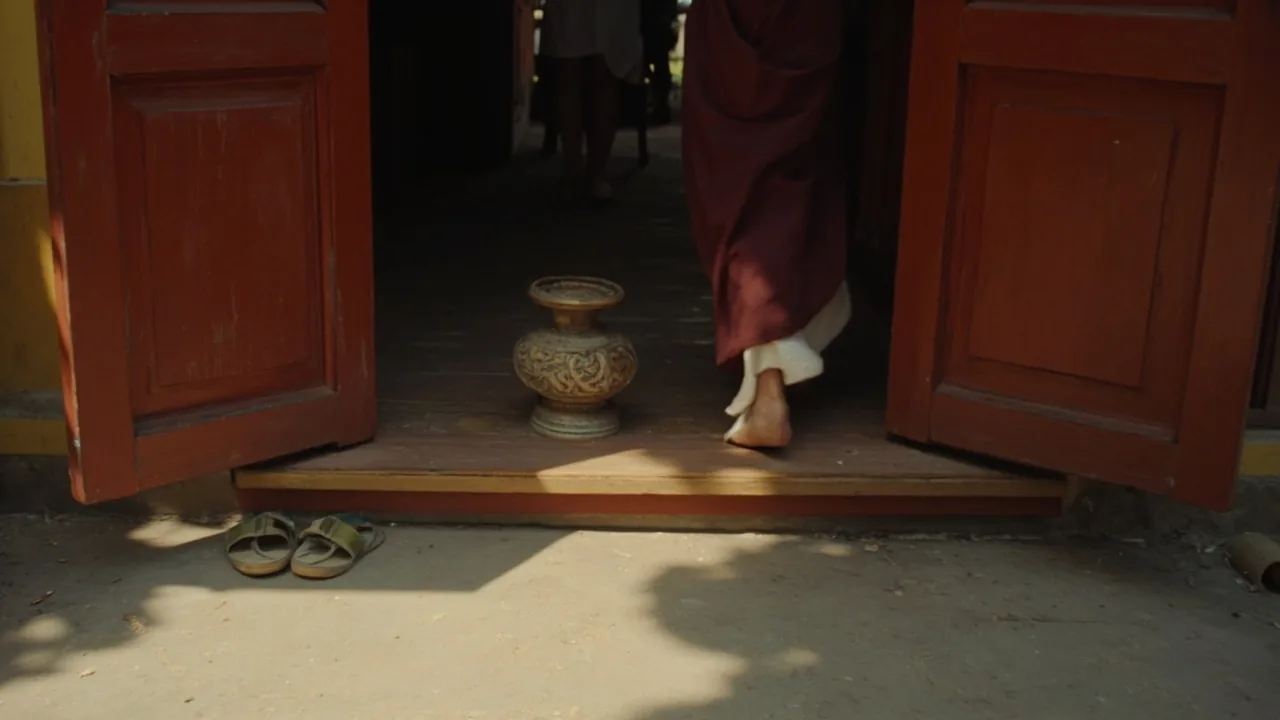
- Take your shoes off. Step out of them at the raised wooden threshold of the main hall, soles pointing outward (away from the Buddha). Do not step on the threshold itself; it carries symbolic weight. Carry your shoes with you or leave them in the shoe pile, never on a prayer mat.
- Step over the wooden plank (ô cửa) at the door. Inside the hall there is usually a raised wooden bar on the floor. Step over it, do not step on it. The plank is meant to be touched by the feet as a sign of humility, but in practice visitors walk around it.
- Walk quietly to the main altar. Move to the side, not down the centre aisle, unless the hall is empty. The centre is reserved for monks during ceremonies.
- Hands together at chest height. A light bow or a head nod toward the main Buddha is enough. You do not need to kneel or prostrate. Standing respectfully is fine.
- Light incense if you wish. Three sticks is the standard. Light from an existing stick or candle, never with a fresh lighter if a flame is already going. Hold them upright until the tip catches, then place them in the urn in front of the altar. Bow once.
- Step backwards out of the hall. Do not turn your back to the Buddha. Walk a few steps back, bow again, then turn and exit normally.
Common Mistakes Indians Make at Vietnamese Shrines
These come up again and again in traveller reports from Con Dao and similar Vietnamese islands.
Mistake 1: Touching a Buddha statue for a photo. Even a quick “let me take a selfie” lean-in. The statues are consecrated, not props. Stay at arm’s length. Same rule applies to monks, prayer books, and the small offering bowls.
Mistake 2: Sitting on a prayer mat or altar step. The mats are for monks and senior devotees during ceremonies. If you need to sit, ask first, or sit on the bare stone floor near the side wall, legs tucked under you, never extended toward the altar.
Mistake 3: Pointing feet at the Buddha. This is the one rule Southeast Asian Buddhists across Vietnam, Thailand, Laos, and Cambodia all agree on. If you sit on the floor, sit cross-legged or kneel. Feet stay behind you. If you want a deeper rundown for the Mekong side, our 4000 Islands temple etiquette guide covers Don Det and Don Khon shrines.
Mistake 4: Loud conversation, ringtones, and music. Vietnamese pagodas are quiet by design. Travellers report that the single most disrespectful thing they have seen is a phone call taken inside the prayer hall. Step outside, take the call, come back.
Mistake 5: Bringing packaged Western snacks as offerings. Fruit (mangoes, bananas, oranges), small rice cakes, or plain tea biscuits are fine. A Snickers bar, a can of Coke, or a bag of Lay’s is not. The offering is for ancestors and monks; it is meant to be whole and traditional.
Photography Rules at Con Dao Pagodas
The Vietnamese tourism guidance is consistent: outside the prayer hall, photograph freely. Inside, ask.
The unwritten rule, from traveller reports across the islands, breaks down like this:
- Outside courtyard, gate, and bell tower: Photographs fine. No flash during ceremonies. For more on shoot-the-architecture-not-the-worshippers rules, see our Angkor Wat temple dress code and sunrise guide.
- Inside the main hall, no ceremony in progress: A quiet word with whoever is in the hall, or a smile and a gestured question, gets you a yes. People-photography stays off; monument shots are usually okay.
- Inside the main hall during a ceremony or chanting: Do not photograph. Step out and come back later. Con Dao has few monks and even fewer ceremonies, so this is rare, but it does happen around the Lunar New Year (Tết) and the Vu Lan festival in the seventh lunar month.
- Monks, nuns, and worshippers: Always ask. A hand-on-chest bow with a smile works without language.
Safety Alert: Outside major Vietnamese cities, monks and nuns are sometimes camera-shy for political reasons related to religious freedom reporting. If anyone waves you off, comply and do not push. This is a general note, not a Con Dao-specific incident.
Offerings, Incense, and Small Donations
You do not need to bring anything to a Vietnamese pagoda. Walk in empty-handed and you are fine. If you do want to leave an offering, here is what works and what does not.
Good offerings:
- One bunch of small bananas, two mangoes, or three oranges. Fruit sold at the Con Dao town market for ₹37-₹74 (~10,000-20,000 VND or ~$0.38-$0.76) is appropriate.
- A small bundle of joss paper or ghost money, available at the same market stalls. Burn it in the dedicated urn, not in any open bin.
- A stick of incense. Most chùa have a free supply at the entrance. Use it; do not bring your own aromatherapy.
- A small cash donation, ₹18-₹74 (~5,000-20,000 VND or ~$0.19-$0.76), slipped into the donation box near the altar. No need for an envelope. Travellers report ₹37 (~10,000 VND or ~$0.38) is a polite middle amount.
What to skip:
- Bottled water in plastic.
- Imported snacks or chocolate.
- Lit candles unless you are sure the urn is set up for them (most are not).
- Anything wrapped in red paper. Red is for luck at home, not for offerings.
Where to Apply This on Con Dao
The islands have a small number of working pagodas and shrines. The two most visited by travellers are below. Both are free, both follow the etiquette in this guide exactly.
- Van Son Pagoda (Chùa Vạn Sơn) in town: The largest chùa on Con Dao, rebuilt in 2011 with donations from the local Vietnamese community and overseas monks. Active prayer hall, large courtyard, a few resident monks. Tourists are welcome; the dress code is enforced at festival times.
- Phi Yen Shrine (Đền Phi Yến): A small cliffside shrine above the sea, dedicated to the sea goddess and used by fishing families for safe voyages. Not technically a pagoda, but the etiquette rules (shoes off, no feet toward the altar, small offerings) apply the same way. The setting is the reason to come here. Wear grippy footwear for the path up.
A few smaller family đình (commune houses) sit along the backstreets of town. Travellers report being waved in by caretakers at some of them, but treat these as private space. Knock, smile, ask permission, accept a “no” without argument.
Frequently Asked Questions
Indian backpackers planning their full route through Southeast Asia should also skim our packing list for SE Asia before they fly.
Do I need to remove my hat inside a Vietnamese pagoda? Yes. Hats, caps, and sunglasses come off at the door. The same rule applies to backpacks at busy temples; smaller chùa do not usually enforce this.
Can I take photos of the altar at Con Dao pagodas? Outside, yes. Inside the main hall, ask whoever is in the room, including worshippers. A smile and a gestured question is enough.
What if I am menstruating? Can I enter a Buddhist temple? Vietnamese Buddhism is more relaxed on this than Thai or Burmese traditions. Travellers report no issues at any Con Dao pagoda, though strict monks in mainland monasteries occasionally ask women to skip a ceremony. If you are visibly uncomfortable, sit near the entrance and observe.
Is there a fixed “prayer time” I should avoid? Most Con Dao chùa hold their main morning service between 5:30 and 7:00 and an evening chant around 17:30. Visiting during these windows is fine, but stay at the back and do not photograph. Midday (12:00 to 14:00) is a quiet siesta window and the halls may be locked or unattended.
Can I make merit by donating money? Yes. The donation boxes near the altar are for temple upkeep, monk meals, and funeral funds for the local community. ₹37 (~10,000 VND or ~$0.38) is polite, ₹184 (~50,000 VND or ~$1.91) and above is generous and remembered.
Are there any taboos specific to Con Dao? The islands were the site of the French colonial Côn Đảo Prison, and some shrines double as memorials to political prisoners and revolutionaries. Speak softly near any memorial plaque, do not pose for photos with names on them, and do not argue Vietnamese history with locals. This is a working site of grief, not a debate topic.
Subodh’s Take
Con Dao is the kind of place where the temples stay quiet because everyone respects them, not because there are guards. Show up covered, shoes-off, voice low, and you will get a smile from the auntie sweeping the courtyard and sometimes a cup of tea you did not ask for. The etiquette is not a checklist; it is just being a polite guest in someone’s house. Once you have done it twice, you will not think about it again.
