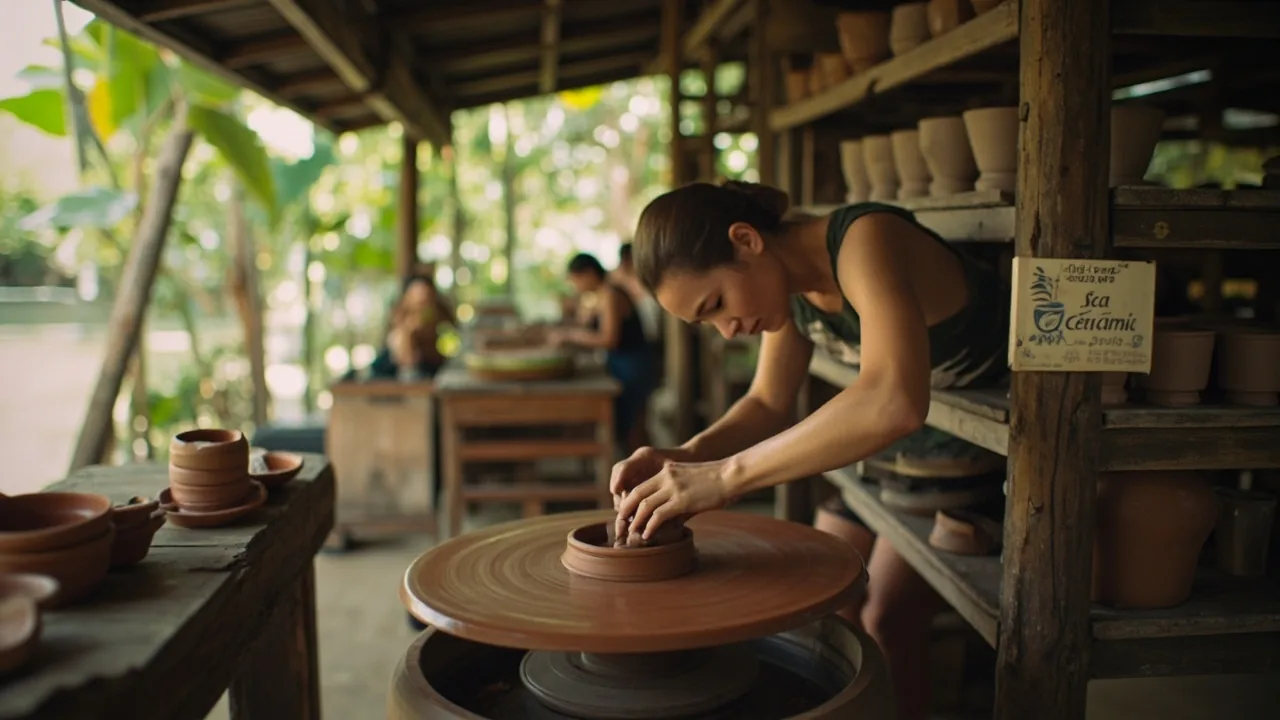
Pottery Classes in Luang Prabang: What to Expect, Where to Go, and What It Costs (2026)
Pottery classes Luang Prabang offers are drop-in sessions at small family-run ceramic studios along the Mekong, where you sit at a wheel, throw a piece, and pick it up after firing. Sessions cost ₹345-₹863 (~80,000-200,000 LAK or ~$3.58-$8.95) and last one to three hours.
This guide covers how to find a studio and what to budget, useful context if you are also planning a broader Southeast Asia trip on a backpacker budget. Planning the wider region? Our Southeast Asia backpacking hub covers the full multi-country route.
What Is a Pottery Class in Luang Prabang?
Most pottery classes in Luang Prabang are drop-in sessions at small family-run ceramic studios on the south side of the Mekong, where you sit at a wheel, throw a piece, and have it bisque-fired (low-temperature fired once, before glazing and the second, higher-temperature firing) to take home a few days later. Sessions run between one and three hours and cost between ₹345 (~80,000 LAK or ~$3.58) and ₹863 (~200,000 LAK or ~$8.95) depending on the studio, the length, and whether glazing and firing are included. If you are also weighing other craft workshops on this trip, pottery by the sea in Hanoi is a useful comparison point for what studios outside Laos charge.
The craft itself has deep roots here. Lao pottery villages like Ban Chan Nhien and Ban Hat Nua have produced earthenware for centuries, using local red clay (a high iron-content clay that fires a rust-red colour) and wood-fired kilns. Hands-on classes for travellers are a 2010s development, built on that older craft tradition.
Quick Answers
| What | Answer | Price (INR) |
|---|---|---|
| Average session cost | ₹345-₹863 (~80,000-200,000 LAK or ~$3.58-$8.95) | , |
| Session length | 1 to 3 hours | , |
| Where | Mekong south bank, near Phousi peninsula | , |
| Pickup | 3 to 7 days later (bisque-fired, ready to ship) | , |
| Wheel work or hand-build | Most studios offer both | , |
| Language | Lao, basic English | , |
Step-by-Step: How to Book and Take a Pottery Class in Luang Prabang
Step 1. Decide what kind of class you want. Wheel-throwing (shaping clay on a spinning wheel) is the classic; hand-building (pinching, coiling, or slab-rolling clay without a wheel) is easier for first-timers. Some studios combine both. Tell your guesthouse what you want and they’ll point you to the right place.
Step 2. Walk along the Mekong’s south bank. The pottery studios cluster on the river side opposite the old town peninsula, a 10 to 15 minute walk from the night market. You will not see a strip of signs. Walk south past the bridge area, look for small wooden buildings with clay-dusted entrances, and ask. Local tuk-tuk drivers also know the studios by description.
Step 3. Confirm what’s included. A session should include the instruction, the clay, use of tools, and either bisque-fired pickup or full glazing and firing. Ask in writing (a message on WhatsApp or a note on a booking slip): “Do I take the finished piece home, and on what day?” Studios that do not include firing often charge ₹129-₹259 (~30,000-60,000 LAK or ~$1.34-$2.69) extra for it.
Step 4. Show up in clothes you do not mind getting muddy. Clay ends up on you, not just the wheel. Wear closed-toe shoes if you have them. Studios provide aprons but the splatter still gets your legs.
Step 5. Make something. A small bowl, a cup, or a textured tile is realistic for a first session. The instructor will help you centre the clay (press the clay into a stable dome on the wheel before opening it up), open it up, and pull the walls. If your first three bowls collapse, that is normal.
Step 6. Pay, leave your contact info, and arrange pickup. Most studios fire pieces once a week. Pickup is usually 3 to 7 days after the class. If you are moving on (towards Vang Vieng, Vientiane, or the slow boat), ask if the studio can ship internationally or to your next Lao city. Travellers figuring out cross-border cash logistics can also check the carry money India abroad guide before you fly.
What Most Guides Don’t Tell You
Wood-firing vs electric kilns. Traditional Lao pottery uses wood-fired kilns, which give the clay its characteristic rust-red colour and slight black-flecked “fire clouds.” Most studios for tourists use electric kilns because they are predictable, faster, and avoid mass-cracking. If you specifically want wood-fired (the more traditional look), ask before booking. Several studios keep one wood kiln but only fire it during the cool season.
Sabbath days and kiln cycles. Pottery studios in Luang Prabang close on Buddhist Sabbath days: Uposatha (the four days a lunar month observed as Buddhist sabbath, falling on the new moon, full moon, and the two quarter-moons), plus occasional unscheduled kiln-firing closures. Check your trip dates against the Lao lunar calendar if you only have two or three days in town, because missing the window by 24 hours means your fired piece stays behind.
The picking-up window matters. If your backpacking route does not bring you back through Luang Prabang, you can ship pieces internationally. Most studios ship via small parcel services to Bangkok or Hanoi. Shipping costs depend on weight; ask the studio for a current quote.
Common Mistakes Indians Make
Showing up unannounced without a translator on your phone. A few studios have only basic English. Have Google Translate (download the Lao offline pack before you leave India) loaded so you can confirm cost and pickup details in writing. Screenshot the message. First-time India-to-SEA travellers should also skim the first trip abroad from India checklist before flying.
Paying in USD when LAK gives you better value. Studios quote in LAK or sometimes USD. Pay in LAK; you get 3 to 5% more value. Carry small-denomination notes (₹216 (~50,000 LAK or ~$2.24) is the largest you will usually need) and pay exact when you can. Walk-in day rates for a 1-hour session rarely hit USD at all.
Booking the longest session on day one. A 3-hour “master class” sounds appealing but a 1.5-hour taster is enough to know if you love the craft. Save the long session for day two if you are in town long enough.
Forgetting to factor shipping or carry-on weight. A fired piece weighs 300 to 800 grams. That is fine for checked baggage, not fine as a fragile carry-on. Pack a small soft cloth and a plastic bag.
Budgeting Your Pottery Day in Luang Prabang
| Item | Cost | Notes |
|---|---|---|
| 1-hour class | ₹345-₹518 (~80,000-120,000 LAK or ~$3.58-$5.37) | Wheel or hand-build |
| 3-hour class | ₹647-₹863 (~150,000-200,000 LAK or ~$6.71-$8.95) | Often includes glazing |
| Glaze + second firing | ₹129-₹259 (~30,000-60,000 LAK or ~$1.34-$2.69) extra | If not in the base price |
| Bisque pickup (3 to 7 days later) | Usually free | Confirm in advance |
| International shipping | ₹216-₹647 (~50,000-150,000 LAK or ~$2.24-$6.71) | To Bangkok or Hanoi |
| Tuk-tuk to and from your guesthouse | ₹86-₹172 (~20,000-40,000 LAK or ~$0.89-$1.79) each way | , |
What to Eat While You Wait for Your Piece
If you are hanging around for pickup or need lunch after class, the south bank is thin on food; cross back into the old town for proper meals.
Local and Lao spots:
- Manda de Laos for a slow Lao tasting menu.
- Two Little Birds Cafe on the riverside for coconut pancakes and coffee.
- Le Petit Prince Cafe for a quiet afternoon stop.
Indian and vegetarian-friendly spots:
- M&M RESTAURANT INDIAN HALAL FOOD for Punjabi thalis.
- Chennai Restaurant indian, lao & Malaysian halal food for South Indian and halal Lao dishes.
- Fathima Indian & Malaysian Halal Restaurant for vegetarian curries and paratha.
Getting to Luang Prabang
Luang Prabang connects directly by air from Bangkok, Chiang Mai, Hanoi, and Siem Reap. Bangkok Airways, Lao Airlines, Vietnam Airlines, and AirAsia fly the main routes. From India, the standard path is Bangkok, then Bangkok Airways or AirAsia into Luang Prabang. Sleeper trains run Bangkok to Chiang Mai, then a flight from Chiang Mai: Book the Bangkok to Chiang Mai sleeper train ticket covers the rail leg. For the slow boat option into Laos from northern Thailand, the Mekong slow boat route guide covers timing, cost, and stops.
Connectivity and SIM Cards
You will want data for Google Translate and studio confirmations. Two options:
- Local SIM at Luang Prabang airport. Lao Telecom and TPlus both sell SIMs at counters in arrivals. 5-day tourist SIMs run around ₹129-₹216 (~30,000-50,000 LAK or ~$1.34-$2.24) with 5 to 10 GB. Bring your passport.
- eSIM before you fly. If you would rather land with data already on, an eSIM from Nomad skips the airport counter. Get the regional Asia pack and it works across Thailand, Laos, Vietnam, and Cambodia. (Check current pricing and device compatibility directly with the provider before purchasing.)
Other Things to Do in Luang Prabang
Most backpackers do pottery as a half-day. The rest of your day has good options:
Safety in Luang Prabang
Luang Prabang is one of the safer towns in Southeast Asia for first-time backpackers from India. Petty theft is low, traffic is calmer than Bangkok or Hanoi, and the old town peninsula is walkable after dark. Standard backpacker precautions still apply: keep your phone zipped, use a cross-body bag in the night market, and avoid unmarked minivans at the bus station. For a broader rundown, the solo female travel Southeast Asia piece covers night-market and tuk-tuk safety in more detail.
Laos in general has had regional advisories from time to time. Check the Indian Ministry of External Affairs travel page (mea.gov.in) and the Lao government’s official channels before you fly. Bring a printed copy of your passport, visa, and travel insurance and store a digital copy separately.
Subodh’s Pro Tip: Carry exact LAK in 10,000 and 20,000 notes for pottery studio payments. The studios on the south bank of the Mekong are small operations and change for a 100,000 note is often not available.
FAQ
Do I need to speak Lao to take a pottery class? No. Most studios teaching travellers have a Lao-English bilingual instructor. Have Google Translate ready for studio policies and pickup dates, but the instruction itself will be in plain English.
Can I take my pottery piece home on the plane? Yes. A bisque-fired cup or small bowl fits in checked luggage. Wrap it in two plastic bags and your dirty laundry; studios sometimes sell or give a small cardboard box for the trip.
What happens if I leave Luang Prabang before my piece is fired? Two options: ship it internationally from the studio (cost and timing vary) or pick it up later if you return. Some studios hold pieces for up to 60 days. Confirm pickup window before paying.
Is pottery safe for someone who has never done it before? Yes. A 1-hour taster is entry-level. Wheel-throwing takes practice but a small bowl is realistic. Hand-building is easier than wheel work for absolute beginners.
Are kids allowed in classes? Most studios accept older children (above 8 or 10) on the wheel with close supervision. Younger children do better in hand-building sessions. Ask the studio in advance.
Can I do a class even if I am vegetarian and do not drink? Yes. Pottery studios are craft spaces; food or drink does not enter into it at all. Food and alcohol are not the point.
Are pottery classes open on the Lao New Year? Most studios close for Pi Mai (Lao New Year, mid-April) for several days. Plan around this if you are visiting in April.
Subodh’s Take
A pottery class in Luang Prabang is one of the best-value half-day activities in Southeast Asia. The clay is forgiving, the studios are family-run, and 100,000-200,000 LAK buys you a proper craft experience with a takeaway piece. Pair it with a walking afternoon in the old town and dinner on the riverside; you will leave Luang Prabang with photos of temples and an actual piece of the city in your suitcase.
