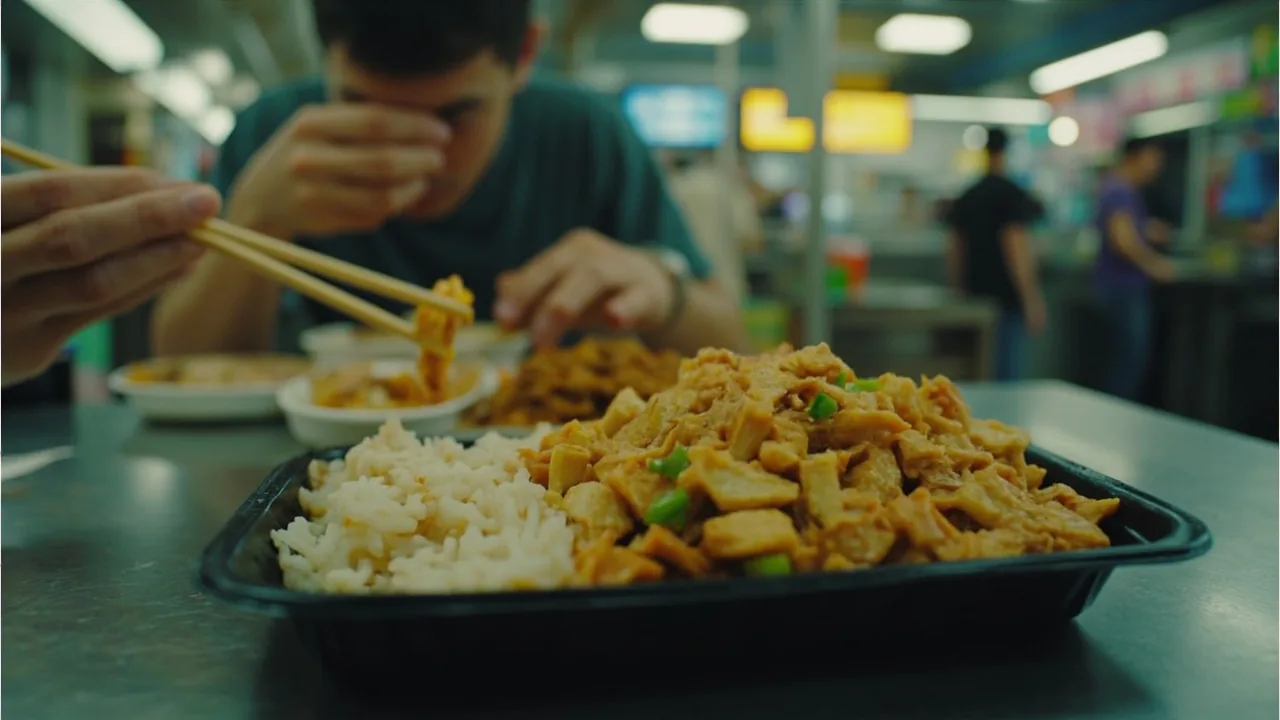
Singapore Vegan Food Tour: The Best Plant-Only Hawker Stalls and Cafes for Indian Travelers
Singapore is one of the easier Southeast Asian cities to eat vegan in, but it is also one of the easiest cities to accidentally eat hidden animal products in. Hawker culture here runs on lard, shrimp paste (hae ko), fish sauce, and egg, ingredients that hide in sauces and cooking oil, not just on the plate.
This guide covers the hawker stalls that are safe by default, the cafes that go fully plant-based, and the specific dishes you can order with confidence without sounding like a difficult customer.
Subodh’s Pro Tip: Singapore’s per-rupee rate right now is 1 INR ≈ 0.0134 SGD, so a 6 SGD hawker meal runs around ₹450 (~$4.67). Singapore is the most expensive hawker city in Southeast Asia, but a vegan can eat well for under ₹1,865 (~25 SGD or ~$19.36) a day if you know which stalls to skip.
Quick Answers
| What | Answer | Price (INR) |
|---|---|---|
| Cheapest safe vegan hawker meal | Char kway teow or carrot cake at vegetarian-dedicated stalls | ₹298 (~4 SGD or ~$3.10) |
| Average vegan hawker meal across the city | Stir-fried veg + rice at mixed stalls (verify ingredients) | ₹448 (~6 SGD or ~$4.65) |
| Fully plant-based cafe main dish | Buddha bowls, pasta, or plant-based burgers | ₹1,343 (~18 SGD or ~$13.94) |
| MRT single trip from one food district to another | Anywhere on the network | ₹119 (~1.60 SGD or ~$1.24) |
| Is lard common in hawker cooking? | Yes, common in stir-fries and fried rice. Ask before ordering | — |
The Local Culinary Landscape
Singapore’s hawker scene is one of the most diverse in the world, with Chinese, Malay, Indian, and Peranakan stalls sitting next to each other in the same food centre. For an Indian vegan traveler, this sounds like paradise, and at the dedicated vegetarian stalls it is. The catch is that almost every non-vegetarian stall uses animal-derived ingredients as seasoning, not as the main feature.
The ingredients to watch for, and they are everywhere, are:
- Lard (pig fat) in fried rice, char kway teow, and most wok-fried vegetables. It is the default cooking medium at Chinese-run stalls.
- Shrimp paste (hae ko) in sambal, laksa paste, and stir-fried beansprouts. Even “vegetarian” sambal at a non-veg stall often has dried shrimp.
- Fish sauce in cai fan (economy rice) vegetable dishes. It goes into nearly every “veg” dish at mixed stalls.
- Egg in tofu preparations. Mapo tofu at most stalls is egg-thickened. Dried shrimp is the secondary trap.
- Chicken stock or pork bones simmering in the background of any clear-looking soup, including “vegetable soup.”
Local attitudes toward vegetarianism are generally polite but loose. Many stallholders will call a dish “vegetarian” if it has no visible meat on top, even if the sauce was made with shrimp paste. You have to specifically say “no egg, no milk, no fish sauce, no oyster sauce, no lard” (see the phrase section below) and watch them nod at each item. The good news: Singapore has a strong Buddhist vegetarian tradition, so at the bigger hawker centres there is almost always at least one stall with a yellow sign that means “vegetarian-friendly, mostly vegan.” Those are the stalls to default to.
For broader context on what is in season and what local dishes look like across Singapore, see my Singapore food guide for Indian travelers.
Key Phrases in Local Script
These four phrases, written down on your phone, will solve 90% of vegan dining problems in Singapore. Most hawker stallholders understand basic English, but showing the Chinese characters gets faster nods.
| English Phrase | What it Means | Local Script | Pronunciation |
|---|---|---|---|
| I am vegan | No meat, fish, egg, dairy | 我吃素 (sú chī sù) | “wor chi su” |
| No fish sauce | No kecap ikan / hae ko | 不用鱼露 | ”bu yòng yú lù” |
| No egg | No egg in any form | 不要蛋 | ”bú yào dàn” |
| No lard, no shrimp paste | Cook only in vegetable oil | 不要猪油,不要虾酱 | ”bú yào zhū yóu, bú yào xiā jiàng” |
For Indian-script translations, say “Main shakahari hoon, non-veg mat dena” at any Little India-area stall, and at a Peranakan or Malay stall use “Saya vegetarian, tolong guna minyak masak” (please use vegetable oil).
If you want a fuller rundown of phrases and ordering customs, the where to find vegetarian food in Singapore article has the longer list.
Safe Local Street Food Dishes (Vegan-Friendly or Vegan-By-Default)
These are the dishes to order at hawker centres in Singapore where you can eat them without negotiating ingredient lists.
1. Vegetarian Char Kway Teow at People’s Park Food Centre
People’s Park Food Centre in Chinatown is one of the easiest hawker centres to eat vegan at because the vegetarian stall here runs an entirely plant-based menu. The vegetarian char kway teow (₹298 (~4 SGD or ~$3.10)) is wok-fried flat rice noodles with mock fish and bean sprouts, cooked in vegetable oil with sweet soy sauce and chili. It tastes like the real thing without the lard. This is the one stall where you can order confidently without using any phrases.
2. Vegetarian Carrot Cake (Chai Tow Kway)
Carrot cake here means radish cake, not the sweet Western dessert. The vegetarian stall version at People’s Park (₹298 (~4 SGD or ~$3.10)) uses no egg and no lard, fried with garlic, sweet soy, and preserved radish. Order it “white” (without sweet sauce) if you want to confirm no egg has been folded in.
3. Veg Nasi Lemak (Vegan Version)
Several hawker stalls in Singapore now do a vegan nasi lemak where the sambal is plant-only and the rice is coconut-cooked. Ask for the “vegetarian nasi lemak” at any stall you see with a yellow vegetarian sign. Price runs ₹298-₹448 (~4-6 SGD or ~$3.10-$4.65).
4. Plain Prata with No Egg
At Indian-Muslim stalls across the city, “prata kosong” (plain prata, ₹112-₹149 (~1.50-2 SGD or ~$1.16-$1.55)) is accidentally vegan at many stalls because the dough is just flour, water, oil, and salt. Specify “no egg, no milk” to be safe. This is your cheapest, fastest plant-based bite in the city.
5. Vegan Popiah (Fresh Spring Rolls)
Popiah is a Teochew-style fresh spring roll stuffed with shredded turnip, carrot, bean sprouts, and crushed peanuts. The vegetarian version at People’s Park and Tekka Centre (₹149-₹224 (~2-3 SGD or ~$1.55-$2.32)) is fully plant-based. It is one of the cleanest vegan street foods in Singapore.
For the broader question of whether local dishes across the region are vegan-safe, see the street food safety guide for Southeast Asia.
Where to Eat Vegan by Neighborhood (And What to Order)
For travelers who want a structured hawker food tour led by a local instead of piecing it together alone, see Singapore food tour options on GetYourGuide. Several tours now offer a plant-based or vegetarian-only version that covers hawker centres and Tiong Bahru cafes in one morning.
Singapore is small enough that you can hit three different vegan-friendly food districts in one day. Here is the loop that works.
Chinatown (People’s Park Complex)
This is your first stop. People’s Park Food Centre on Eu Tong Sen Street has a dedicated vegetarian stall section on the second floor. Start with the vegetarian char kway teow (₹298 (~4 SGD or ~$3.10)) or carrot cake, then add a popiah (₹149 (~2 SGD or ~$1.55)). Total for a full meal: under ₹746 (~10 SGD or ~$7.74). The same building has a few vegan-friendly dessert stalls selling tau sar pneah (mung bean pastry, ₹112 (~1.50 SGD or ~$1.16) per piece).
Safety Alert: At Chinatown Complex (the bigger hawker centre across the street, not People’s Park), most of the stalls are non-vegetarian. Stick to the yellow-sign stalls or the dedicated vegetarian section. Do not assume a vegetable dish is safe.
Little India (Tekka Centre)
Tekka Centre is where you go when you want Indian vegan food that is not restaurant-formal. The vegetarian stalls here serve South Indian thali (₹373-₹597 (~5-8 SGD or ~$3.87-$6.19)) where the sambar, rasam, and poriyal are plant-based. Specify “no ghee on the rice” if you want to keep it vegan. The dosas are clean (₹224-₹373 (~3-5 SGD or ~$2.32-$3.87)). Look for stalls with a Tamil “சைவ” (saiva) sign, which means vegetarian. Just outside Tekka, Ming’s Cafe & Pub on Race Course Road is a casual spot for local bites if you want a sit-down meal with a drink.
For more on Little India specifically, including how to spot authentic Indian-run stalls versus tourist-trap ones, see my Little India Singapore food guide.
Tiong Bahru
Tiong Bahru is the cafe-and-bakery neighborhood with several fully plant-based cafes. It is also where you go for the Western-vegan-fusion breakfast: avocado toast, smoothie bowls, plant-based lattes with oat or soy milk. A full breakfast here runs ₹1,119-₹1,641 (~15-22 SGD or ~$11.61-$17.03).
Bugis and Bras Basah
This is the cheapest vegetarian-eating stretch in central Singapore. Several older hawker centres along Victoria Street and Queen Street have vegetarian stalls feeding the Indian-Muslim and Buddhist communities. Popiah, vegetarian mee goreng (₹373 (~5 SGD or ~$3.87)), and prata are all safe here at the right stalls. Sanook Kitchen - Square 2 is a nearby Thai eatery that does vegetable curries and rice plates, worth a stop if you want a break from hawker centre food.
Fully Plant-Based Cafes (Worth the Price)
Singapore’s cafe scene has gone plant-positive hard, and the fully vegan cafes are good, not just acceptable. A few worth the detour.
Tiong Bahru is the main hub for plant-based cafes. The neighborhood has several fully vegan spots serving Buddha bowls, plant-based burgers, smoothie bowls, and specialty coffee with oat or soy milk. Expect to pay ₹1,119-₹1,641 (~15-22 SGD or ~$11.61-$17.03) for a full meal. Most cafes here open by 8 AM, making this a solid breakfast stop before hitting the hawker centres.
Dempsey Hill is a cluster of cafes and restaurants in a converted military barracks, about a 15-minute Grab ride from the nearest MRT (budget ₹500-₹950 or ~8-15 SGD for the ride). A few plant-based-friendly spots here do weekend brunch with vegan pancakes, grain bowls, and kombucha. It is more of a lifestyle destination than a budget pick, but the setting is worth it if you want a sit-down cafe morning.
For more on Singapore’s coffee and coworking cafe scene in general, see the best cafes for specialty coffee and coworking in Southeast Asia.
Indian and Vegan-Safe Restaurants (The Strict-Veg Fallback)
Sometimes you want dal-chawal, paneer, or biryani without negotiating ingredient lists. These spots are either fully vegetarian or have a clear vegan-marked section.
Chola Cafe - Biryani House (rated 4.9 on Google). This is your Hyderabadi biryani fix. They do a separate vegetarian section on the menu, and the paneer biryani is fully plant-based. Located in the Little India area.
KOTHI Restaurant & Bar (rated 4.9 on Google). Punjabi food from Amritsar. The dal makhani is cooked without butter if you specify, and the aloo paratha is safe by default. Casual, family-friendly, clean kitchen.
Zaffron Tandoori Restaurant @ Boat Quay (rated 4.8 on Google). Punjabi tandoori on the Singapore River. Most veg dishes here are butter-based, but they will do an oil-based version on request. The dal tadka is plant-based by default.
Black Pepper Multicuisine Restaurant (rated 4.8 on Google). North and South Indian with a clear vegetarian section. Their masala dosa is clean and one of the better ones in central Singapore.
We Desi - Indian Bistro (rated 4.6 on Google). Near Little India MRT, this is your casual option for tandoori momos and quick street-food-style plates. Easy access, no fuss.
Sahebs - The Indian Restaurant (rated 4.7 on Google) on Orchard Road. Fine dining North Indian. Strict-veg menus are labeled, and they will do Jain modifications on request (no onion, no garlic).
For a broader list of Indian restaurants across different neighborhoods, see the Indian restaurants in Singapore by area and the Singapore Indian food 2026 roundup.
Food Safety & Hygiene
Singapore’s food safety standards are tight by Southeast Asian standards. Tap water is potable, hawker centres are inspected, and food poisoning is rare compared to Bangkok or Hanoi. That said, a few rules worth keeping.
Eat at stalls with high turnover. The longer a dish sits under a heat lamp, the more likely the sambal has been sitting on top of it. Look for queues.
Drink bottled or filtered water at hawker centres. A ₹112 (~1.50 SGD or ~$1.16) bottled water is a ₹95 (~$0.99) safety net. Most hawker centres have refill stations now, but on a tight budget a bottle is cheap insurance.
Skip raw vegetables you cannot wash yourself. This means no unpeeled salad at random stalls. If a cafe has it, it is fine. At a hawker stall, stick to cooked dishes.
Avoid ice from street carts at night. MRT-station convenience stores and hawker centres are fine. Late-night pasar malam (night market) ice is the one to skip.
Carry electrolyte sachets. Travelan or Electral tablets are useful if you have a sensitive stomach. Pharmacies at Watsons and Guardian stock them.
For broader safety hygiene across the region, see the street food safety guide for Southeast Asia.
Getting Connected
You will need data to Google hawker stall names, check if a dish is plant-based, and use Grab to get between districts. A Singapore tourist SIM (StarHub, M1, or Singtel) at the airport counters runs about ₹746-₹1,119 (~10-15 SGD or ~$7.74-$11.61) for 7 days of unlimited data, and Singtel’s prepaid SIM is the easiest to activate with an Indian passport. For travelers who want zero airport-queue time, Get Nomad eSIM covers Singapore on its regional plan and activates before you fly.
Common Food Mistakes Indians Make in Singapore
Mistake 1: Ordering “vegetarian fried rice” at a Chinese-run hawker stall without asking about lard. Most “veg fried rice” in Singapore is cooked in pork fat. You get a plate of egg, scallion, and pork oil. Specify “no lard, vegetable oil only” or skip it entirely.
Mistake 2: Assuming “vegetable soup” is just vegetables. Clear-looking soups at hawker stalls are almost always stock-based, and “veg stock” at non-vegetarian stalls usually means chicken. Order teh tarik (tea) instead, or stick to dishes where you can see the ingredients.
Mistake 3: Eating sambal without checking. Most sambal has dried shrimp. The sambal at a vegetarian stall is plant-based; the sambal at a mixed-economy-rice stall is not. The visual difference is zero.
Mistake 4: Forgetting that “vegetarian” sometimes means “vegetarian-style, contains egg.” Cantonese-style vegetarian stalls often use egg in fried rice and noodles. The yellow-sign stalls with full English “vegan” menus are safer.
Mistake 5: Skipping the prata because you think it’s just Indian-Muslim food. Prata is accidentally vegan at many stalls and is one of the cheapest safe bites in the city.
For more on what Indian travelers miss at hawker stalls, see the where to find vegetarian food in Singapore guide.
FAQ
Is McDonald’s or Burger King safe for vegans in Singapore?
Most McDonald’s Singapore menu items are shared fryers and dairy buns, with limited plant-based options. Burger King has even fewer vegan options. Not worth the calories compared to a hawker meal.
Can I get Jain food (no onion, no garlic) in Singapore?
Yes, but mostly at Indian restaurants, not hawker stalls. Sahebs, Chola Cafe, and KOTHI will all do Jain modifications on request. At hawker centres, look for stalls with a “no onion no garlic” sign, which are usually South Indian vegetarian stalls.
Is fish sauce used in everything?
Almost. It is in most stir-fried vegetables, most noodle dishes at Chinese hawker stalls, and many “vegetable” rice plates. The phrase “no fish sauce” in Mandarin (不用鱼露) gets you out of this trap at almost any stall.
How much should I budget per day for vegan food in Singapore?
A realistic vegan-on-a-budget day: ₹597 (~8 SGD or ~$6.19) hawker breakfast, ₹597 (~8 SGD or ~$6.19) hawker lunch, ₹746 (~10 SGD or ~$7.74) hawker dinner, plus snacks. That comes to ₹1,940 (~26 SGD or ~$20.14) per day. Add a cafe breakfast and you are at ₹2,984 (~40 SGD or ~$30.97) per day.
Are the hawker centres clean?
Yes. Singapore hawker centres are cleaned daily, stalls are graded, and food poisoning rates are lower than most Western cities. They are also air-conditioned in most newer centres.
Do I need to tip?
No. Singapore does not have a tipping culture at hawker stalls or restaurants. Service charge of 10 percent is added at mid-range and fine-dining restaurants automatically.
Subodh’s Take
Singapore is the easiest city in Southeast Asia to eat vegan without compromising on flavor or variety, as long as you know the yellow-sign stalls and the four phrases above. The mistake most Indian travelers make is treating Singapore like Bangkok or Hanoi and assuming a “veg” order means plant-only. It does not. Spend your first day at People’s Park and Tekka Centre, get the phrases on your phone, and the rest of the week is smooth. Budget around ₹1,865-₹2,984 (~25-40 SGD or ~$19.36-$30.97) per day depending on how many cafe meals you add.
